


Abstract art definition explained: A guide for art enthusiasts
TL;DR:
- Abstract art uses formal visual elements like line, form, tone, and color to carry meaning independently of recognizable subjects. It exists on a spectrum from near-abstract forms to fully non-representational works, emphasizing structure over depiction. For collectors, understanding these distinctions enhances appreciation, evaluation, and investment in this dynamic art form.
Most people assume abstract art is simply random shapes and colors thrown together without purpose. That assumption is one of the most persistent misconceptions in the art world. The abstract art definition is precise: it refers to artworks where visual elements like line, form, tone, and color carry meaning independently, without depicting recognizable subjects from the real world. Understanding this distinction changes how you look at, evaluate, and collect abstract works. Whether you are building a collection or developing your eye, this guide provides the clarity you need.
Table of Contents
- What is abstract art? Core concepts and definitions
- Understanding abstraction: Spectrum and formal relationships in practice
- How to interpret and appreciate abstract art: Practical tips for collectors
- Comparing abstract art styles: Geometric, lyrical, and near-abstract distinctions
- Why abstract art matters: Cultural significance and collector value
- Reconsidering abstract art: A collector’s deeper view
- Explore original abstract art collections at Eman’s Gallery
- Frequently asked questions
Key Takeaways
| Point | Details |
|---|---|
| Abstract art’s core | Abstract art focuses on formal visual relationships rather than realistic representation. |
| Abstraction spectrum | Abstract art exists on a spectrum from partial depiction to total nonrepresentation. |
| Reading abstract works | Collectors should evaluate shapes, lines, and colors as independent relationships, not for literal subjects. |
| Styles vary | Geometric, lyrical, and near-abstract styles offer different visual and conceptual experiences. |
| Collector value | Abstract art combines aesthetic pleasure with subjective meaning and investment potential. |
What is abstract art? Core concepts and definitions
Abstract art is not the absence of skill or intention. It is the presence of a different kind of visual language. Where representational art communicates through recognizable subjects, abstract art communicates through formal qualities in art: the weight of a line, the tension between two colors, the rhythm of repeated shapes.
The National Gallery defines this clearly: abstract qualities are independent of a work’s resemblance to external reality, focusing instead on non-representational relationships of lines, forms, tone, and color. That single principle reframes everything. You are not supposed to find a tree or a face. You are meant to read the structure itself.
Key characteristics that define abstract art:
- Non-representational focus: The artwork does not attempt to depict objects, figures, or scenes from observable reality.
- Formal relationships as content: Lines, shapes, tones, and colors are the subject matter, not vehicles for depicting something else.
- Internal visual logic: The composition follows its own rules of harmony, tension, balance, and contrast.
- Intentional structure: Abstract art is deliberate. Each formal decision serves the artwork’s visual language.
- Subjective interpretation: Because no literal subject is depicted, the viewer brings their own reading to the work.
Key historical figures shaped what we now call abstract art. Wassily Kandinsky is widely credited as one of the first artists to produce fully non-representational work, believing color and form could express emotion directly. Movements including Cubism, Suprematism, and De Stijl each advanced a distinct interpretation of abstraction, progressively reducing or eliminating representation in favor of pure formal relationships.
Understanding abstraction: Spectrum and formal relationships in practice
Abstraction is not a single fixed point. It exists on a continuum, and understanding that range is one of the most practical skills a collector can develop.

On one end of the spectrum sits near-abstract art, where recognizable forms are simplified, distorted, or fragmented but still partially visible. On the other end sits total non-representation, where shapes refer only to themselves with no residual connection to observable subjects. The geometric abstraction overview at MoMA makes this clear: the abstraction-vs-representation question is a spectrum; insiders assess whether shapes refer only to themselves or preserve depiction.
| Degree of abstraction | Visual characteristics | Example movements |
|---|---|---|
| Near-abstract | Simplified or distorted forms; subject still partly recognizable | Late Cézanne, early Cubism |
| Partial abstraction | Forms reduced to essentials; subject implied but not literal | Synthetic Cubism, Fauvism |
| Lyrical abstraction | Gestural, expressive mark-making; no recognizable subject | Abstract Expressionism |
| Geometric abstraction | Hard-edge shapes and precise lines; purely non-representational | Suprematism, De Stijl, Op Art |
What this means practically is that abstract is primarily a visual-structural condition involving non-representational or reduced resemblance rather than total elimination of references. A painting with a vague horizon line still qualifies as abstract if the dominant function of that line is formal rather than depictive.
For collectors, reading this spectrum matters for both appreciation and evaluation. A work sitting at the near-abstract end of the continuum carries different investment considerations than a fully non-representational canvas. Understanding where a work sits on that continuum is part of assessing its art historical context and market positioning. For a practical overview of modern abstract art trends in the current market, that context becomes directly relevant to purchasing decisions.
Pro Tip: When evaluating an abstract work, ask yourself one question: are these shapes and colors doing something on their own terms, or are they pointing toward something outside the picture? If the answer is the former, you are looking at abstraction. That single question cuts through most of the confusion collectors face.
Key factors to assess when reading abstraction:
- Whether color functions expressively or descriptively
- Whether lines define forms or create movement and rhythm independently
- Whether composition produces internal tension or resolution without narrative
- How the art collector tips framework applies to formal evaluation before purchase
How to interpret and appreciate abstract art: Practical tips for collectors
Interpreting abstract art is a skill. It is also a learnable one. The biggest mistake most beginners make is spending the first ten minutes of looking at an abstract work trying to find something in it. That search, while understandable, is working against the work’s actual logic.
The National Gallery’s framework is direct: collectors should focus on how an artwork’s internal formal relationships function rather than searching for literal subjects. Here is how to put that into practice:
- Start with overall composition. Before looking at any single element, step back and observe the full arrangement. Where does the eye travel? What areas create weight or lightness?
- Identify the dominant formal element. Is this primarily a work about color relationships? Line and edge? Texture and surface? Identify what is driving the visual experience.
- Trace the tension or harmony. Does the composition feel resolved or unresolved? That quality is intentional. An unresolved composition is not a failure; it may be the entire point.
- Consider the artist’s process. Was the surface built up in layers? Scraped back? Applied quickly or slowly? The physical process of making an abstract work is often encoded in its surface.
- Evaluate authenticity. For collectors, understanding how to spot authentic abstract art is essential before any acquisition, particularly in the contemporary market.
- Sit with it. Abstract art often reveals itself over time. A work that seems opaque in the first minute may become visually articulate after five.
Pro Tip: Keep a short written note after viewing each abstract work. Record what you noticed, what felt resolved or unresolved, and how your reading changed over time. Collectors who develop this habit build a sharper eye faster than those who rely on instinct alone.
For a structured overview of evaluation methods, the collector insights guide covers practical frameworks relevant to both new and experienced collectors.
Comparing abstract art styles: Geometric, lyrical, and near-abstract distinctions
Not all abstract art is the same. The category is broad, and within it sit several distinct visual approaches with different histories, aesthetics, and collector markets. Knowing how to differentiate them sharpens both appreciation and purchasing decisions.
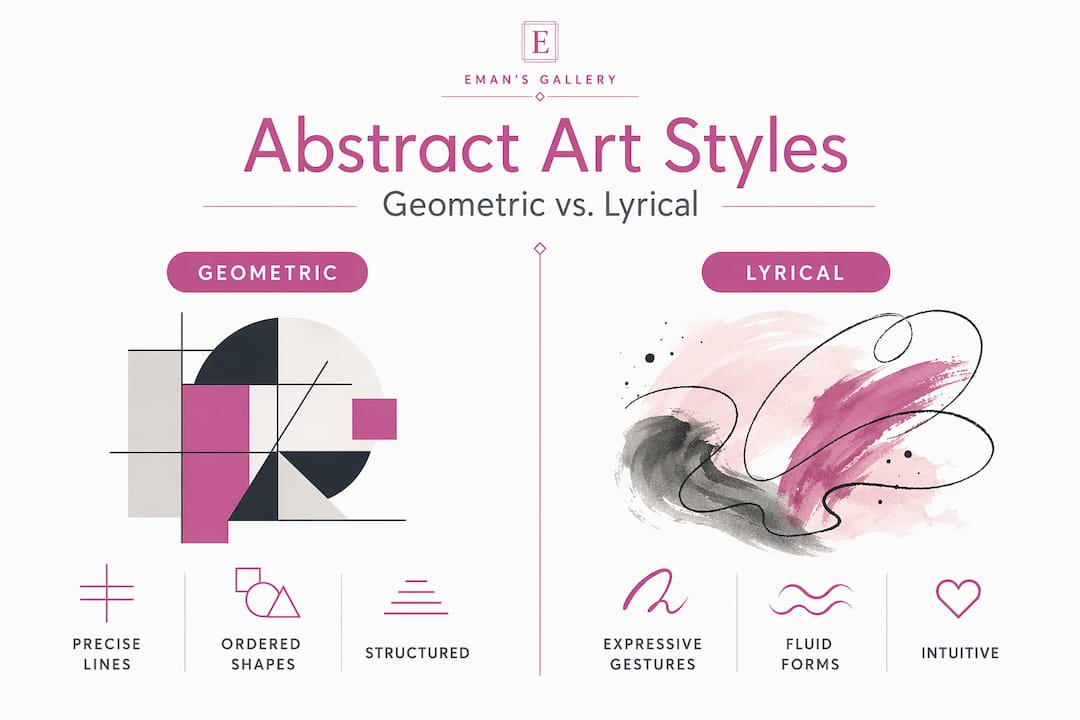
Geometric abstraction uses precise, hard-edged shapes arranged in non-representational compositions. As MoMA documents, geometric abstraction features hard-edge, linear forms arranged nonrepresentationally to refer only to themselves. Think Piet Mondrian’s grids, Kazimir Malevich’s black square, or Josef Albers’ color studies. The emphasis is on order, precision, and the relationship between form and color without any expressive gesture.
Lyrical abstraction is its counterpart. Where geometric abstraction is controlled, lyrical abstraction is expressive and gestural. Artists like Helen Frankenthaler and Joan Mitchell worked in this mode, where brushstroke, drip, and physical mark carry emotional weight. The composition feels discovered rather than planned.
Near-abstract art sits at the boundary between representation and abstraction. Some recognizable reference remains, but formal relationships dominate the reading. Late landscapes by J.M.W. Turner or Paul Cézanne’s late work are frequently discussed in this context.
| Style | Key qualities | Collector appeal |
|---|---|---|
| Geometric abstraction | Precise, ordered, non-representational | Strong secondary market; historically significant |
| Lyrical abstraction | Gestural, expressive, process-driven | Emotional resonance; strong in contemporary market |
| Near-abstract | Partial recognition; form-dominant | Accessible entry point for new collectors |
For concrete examples across these categories, the collectible abstract art examples resource provides a practical visual reference.
Key distinctions worth remembering:
- Geometric abstraction prioritizes structure; lyrical abstraction prioritizes process
- Near-abstract works may be more accessible to newer collectors unfamiliar with purely non-representational art
- Each style has its own art historical lineage and current market dynamics
Why abstract art matters: Cultural significance and collector value
Abstract art is not a passing experiment. It is a foundational development in modern visual culture, and its influence continues directly into contemporary practice. As Oxford Reference records, abstract art has been a major preoccupation of modern art, emphasizing subjective reality rather than concrete representation.
“Abstract art does not reproduce the visible; rather, it makes visible.” This framing, attributed to Paul Klee, captures precisely why the form endures. It is not about what exists in the world. It is about what can exist on a surface.
Cultural significance:
- Abstract art broke the centuries-old convention that painting must depict recognizable reality
- It enabled movements including Abstract Expressionism, Minimalism, Color Field painting, and Conceptualism
- It continues to shape contemporary practice globally, from large-scale installation to intimate works on paper
- Its influence extends into design, architecture, and digital visual culture
For collectors, the value proposition is both aesthetic and financial. The benefits of collecting contemporary art include the subjective and personal dimension that abstract work uniquely provides. Because no single interpretation is correct, each collector’s relationship with a given work is genuinely individual. That ownership experience is distinct from owning a work that depicts a fixed subject.
Investment potential varies by artist, period, and style. Geometric and lyrical abstraction both have active primary and secondary markets. Provenance, condition, and the artist’s exhibition history all factor into long-term value.
Reconsidering abstract art: A collector’s deeper view
Here is an observation that rarely appears in standard art guides: most collectors who say they “don’t get” abstract art are actually looking at it correctly. They are looking for a subject. They notice there is none. They conclude the work is inaccessible or arbitrary. That is not a failure of intelligence. It is a failure of framing.
The conventional approach to abstract art assumes that with enough context, a hidden subject will eventually reveal itself. That assumption is wrong, and it sends collectors in the wrong direction. The real task is not decoding an image. It is experiencing a set of formal relationships on their own terms. Color against color. Edge against field. Tension between forms.
What shifts when you accept that framing? The work becomes legible in a different register entirely. A large color field painting stops being “just paint” and starts communicating scale, atmosphere, and duration. A geometric composition stops looking cold and starts revealing the logic of visual decision-making at a high level.
Many collectors who develop this shift in approach find that abstract works become among the most consistently engaging pieces they own. Representational works communicate their content relatively quickly. Abstract works continue to offer new readings over time because the relationships between formal elements can be experienced differently depending on light, viewing distance, and the viewer’s own state.
The collector insights guide addresses this shift in practical terms. The collectors who benefit most from abstract art are those who approach it as a visual experience rather than a decoding exercise.
Explore original abstract art collections at Eman’s Gallery
Applying what you now understand about abstraction starts with looking at actual works. Eman’s Gallery offers original handmade abstract paintings and museum-quality prints by artist Eman Khalifa, spanning both lyrical and geometric abstract styles in formats suited for serious collectors and first-time buyers alike.
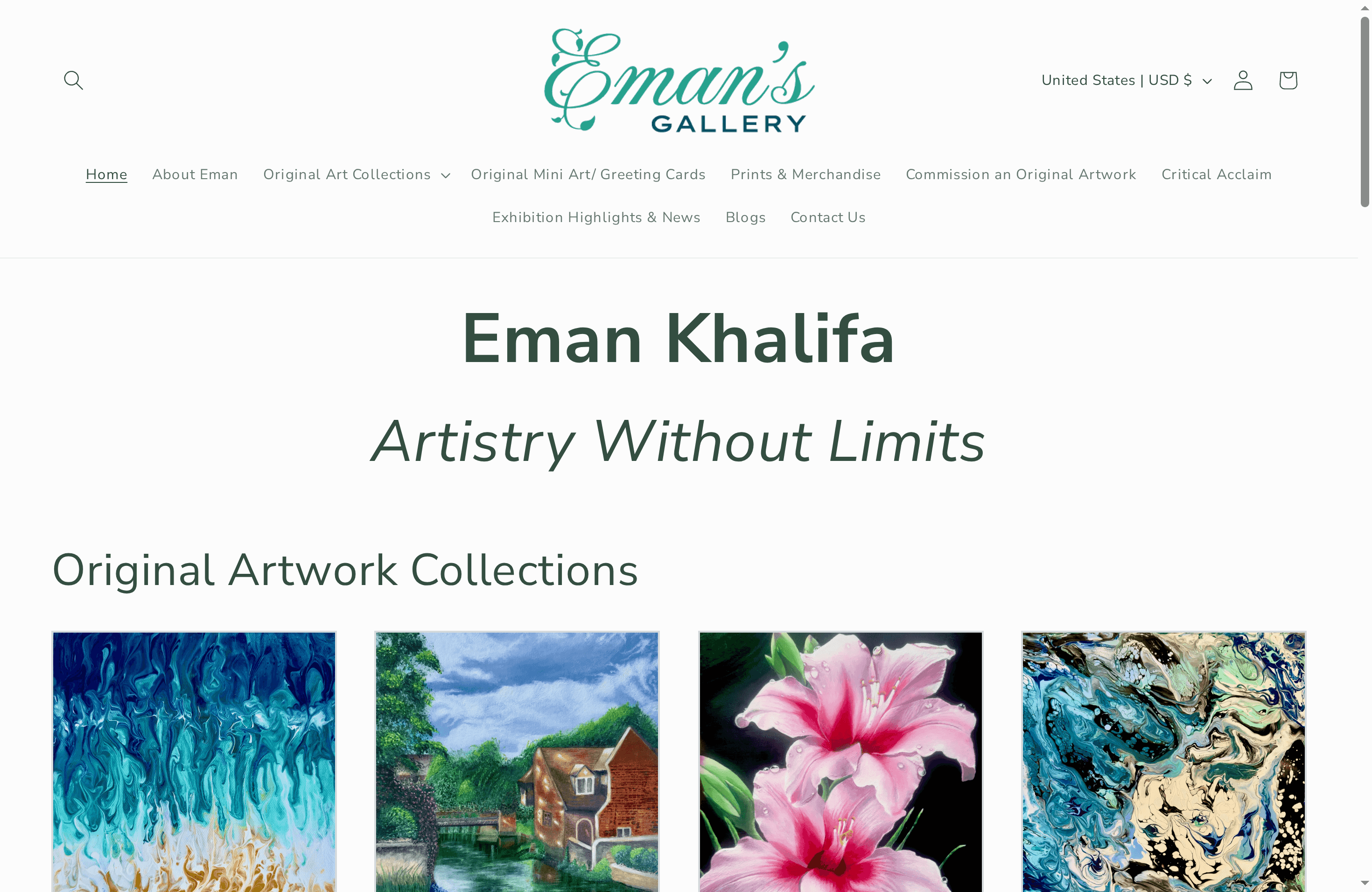
Original works like the Good Tidings original painting and the Mystic Sea original artwork demonstrate the formal relationships discussed throughout this guide: color interaction, compositional tension, and surface-driven visual logic. For those exploring prints, the wall art prints collection includes large-scale options suitable for residential and commercial spaces. Shipping is available worldwide from the UK, USA, Canada, Australia, Germany, France, Italy, Spain, and beyond.
Frequently asked questions
What does abstract art mean?
Abstract art means artwork in which visual elements such as shapes, lines, and colors function independently of realistic depiction, emphasizing non-representational relationships. As the National Gallery notes, abstract qualities are independent of a work’s resemblance to external reality.
How can I tell if an artwork is abstract or not?
An artwork is abstract if its shapes, lines, and colors operate as self-contained formal elements rather than pointing toward recognizable subjects. The question is a spectrum: works are assessed by whether their shapes refer only to themselves or preserve some degree of depiction.
Why is abstract art important to collectors?
Abstract art engages collectors with subjective visual languages that offer ongoing interpretive experience, along with potential investment value in an active contemporary market. Oxford Reference confirms that abstract art has been a major preoccupation of modern art emphasizing subjective reality.
How do I appreciate abstract art as a beginner?
Focus on how colors, lines, shapes, and tones relate to one another within the composition rather than searching for a narrative or subject. The National Gallery advises that collectors should focus on an artwork’s internal formal relationships rather than literal subjects.
What are the main styles of abstract art?
The main styles are geometric abstraction, which uses precise and ordered non-representational forms, lyrical abstraction, which is gestural and expressive, and near-abstract art, which retains partial recognizable references. MoMA’s documentation confirms that geometric abstraction features hard-edge linear forms, while lyrical abstraction is freer and more expressive.
Recommended
- What is urban art? Complete guide for collectors
- What Is Contemporary Art? Complete Guide Explained - Eman’s Gallery
- What is illustration art: A 2026 guide for enthusiasts
- Art Collecting Terminology: Complete Guide - Eman’s Gallery
Stay Connected
- ✨ Explore Eman Khalifa’s original art
- 📸 Follow Eman Khalifa’s art journey on: Instagram @emans_gallery and Facebook Eman’s Gallery
- 📹 Watch Eman Khalifa creating live art on: YouTube @emans_gallery
