


What is urban art? Complete guide for collectors
Urban art is often dismissed as simple graffiti or vandalism, but this oversimplification ignores a rich artistic movement that has transformed cities worldwide. From massive murals that revitalize neighborhoods to intricate stencil work that sparks social dialogue, urban art encompasses diverse techniques and profound cultural significance. This guide explores the definitions, styles, techniques, and cultural impact of urban art, equipping collectors and enthusiasts with the knowledge to appreciate and engage with this dynamic art form. You’ll discover how to distinguish authentic expressions from commercial reproductions and understand what makes urban art a compelling addition to contemporary collections.
Table of Contents
- Key takeaways
- Understanding urban art: definitions and types
- Techniques and materials used in urban art
- Cultural impact and public perception of urban art
- Debates on authenticity, commercialization, and conservation challenges
- Explore urban art with Eman’s Gallery
- Frequently asked questions
Key Takeaways
| Point | Details |
|---|---|
| Urban art types | Urban art includes graffiti, street art, and urban interventions as distinct but related public expressions. |
| Differences in focus | Graffiti emphasizes lettering and subcultural identity, street art targets broad public impact, and urban interventions explore space and conceptual experimentation. |
| Techniques and tools | Artists use spray paint with fat caps for fills and skinny caps for outlines, plus stencils and other methods. |
| Collector guidance | Collectors should distinguish authentic expressions from commercial reproductions to guide collecting decisions. |
Understanding urban art: definitions and types
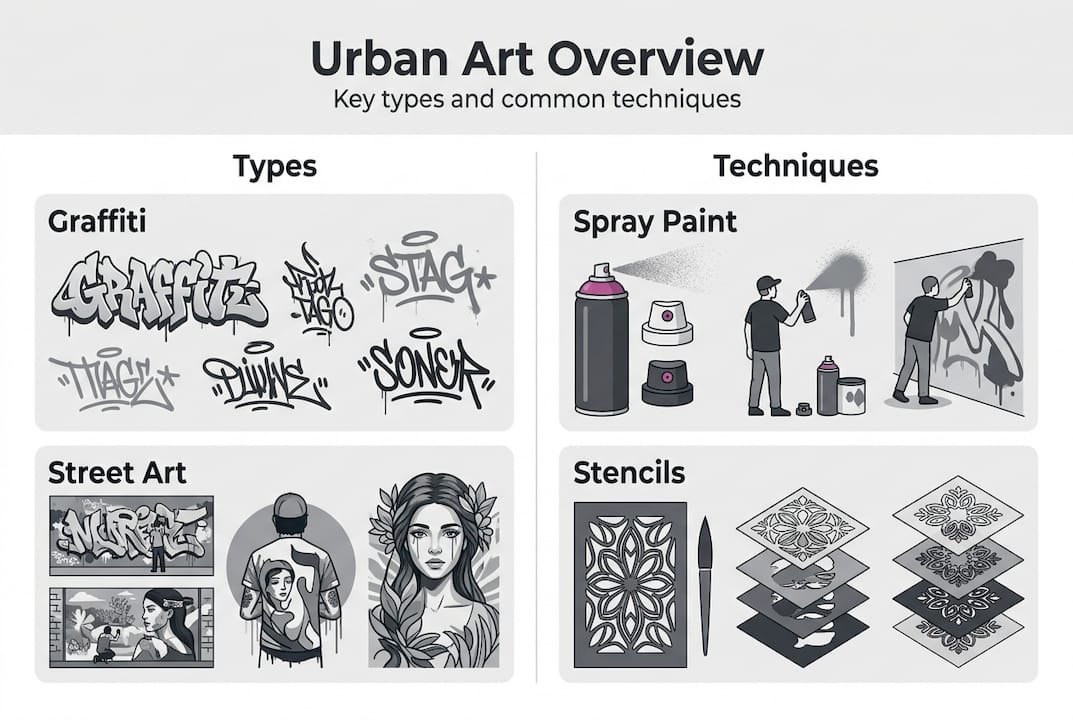
Urban art serves as an umbrella term for visual expressions created in public urban spaces that challenge conventional norms and engage communities directly. Unlike gallery-bound works, urban art encompasses street art, graffiti, and urban interventions that transform everyday environments into canvases for cultural commentary. These forms share public accessibility but differ significantly in intent, technique, and audience.
Graffiti focuses primarily on stylized lettering, tags, and elaborate letter-based compositions. Writers develop unique signatures and styles to gain recognition within subcultures, emphasizing technical skill in letter manipulation and color blending. The practice originated in 1960s Philadelphia and New York, where writers competed for visibility and respect through increasingly complex pieces. Graffiti prioritizes insider recognition over public comprehension, creating a coded visual language.
Street art emphasizes image-based works designed for broader public engagement. Murals, stencils, installations, and paste-ups communicate messages accessible to general audiences without requiring subcultural knowledge. Artists like Banksy and Shepard Fairey popularized street art by combining striking visuals with social commentary, making political and cultural statements legible to passersby. This approach values immediate visual impact and conceptual clarity.
Urban interventions represent experimental public expressions that alter spaces temporarily or permanently. These works might include yarn bombing, reverse graffiti (cleaning dirt to create images), or architectural additions that transform how people experience urban environments. Interventions often prioritize conceptual innovation over aesthetic polish, challenging viewers to reconsider familiar spaces.
Collectors should recognize these distinctions when evaluating works:
- Graffiti pieces emphasize letter-based complexity and subcultural authenticity
- Street art prioritizes visual accessibility and broader cultural commentary
- Urban interventions focus on spatial transformation and conceptual experimentation
- Hybrid works blend elements from multiple categories
Understanding these categories helps you appreciate how artists position their work within urban art’s diverse landscape. Many contemporary artists blur these boundaries deliberately, creating pieces that resist simple classification. Exploring contemporary wall art can help you develop an eye for these stylistic nuances and recognize quality across different approaches.
Techniques and materials used in urban art
Urban artists employ specialized techniques that distinguish their work from traditional painting. Spray paint techniques include fat caps for fills and skinny caps for outlines, allowing precise control over line width and paint application. Artists layer colors strategically, working from background to foreground to build depth and dimension. Advanced practitioners manipulate can pressure and distance to achieve effects ranging from tight lines to soft gradients.
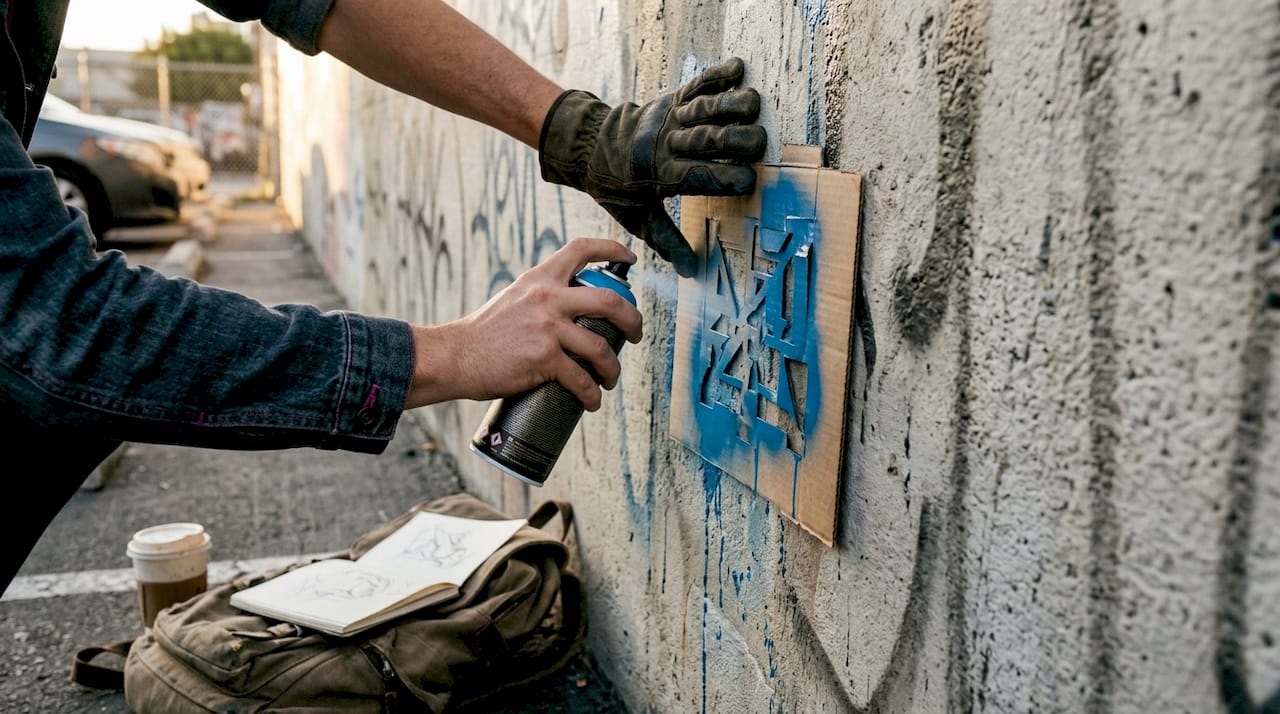
Stencils enable artists to reproduce detailed designs consistently across multiple locations. By cutting templates from cardboard, acetate, or metal, artists apply complex images quickly while maintaining precision. Multi-layer stencils use separate templates for each color, requiring careful registration to align elements properly. This technique gained prominence through political street art, where rapid deployment and reproducibility proved essential for message dissemination.
Wheatpasting involves adhering paper-based artworks to surfaces using wheat flour paste or commercial adhesives. Artists create designs digitally or by hand, print them at large scale, then install them overnight. This method allows intricate imagery impossible with spray paint alone, though the works prove more vulnerable to weather and removal. Wheatpasted pieces often incorporate photography, illustration, and typography in sophisticated compositions.
Three-dimensional effects emerge through strategic shadow and highlight placement. Artists study light sources in specific locations, then paint shadows and highlights that create convincing depth illusions. Some practitioners achieve photorealistic results, making flat surfaces appear to contain recessed or protruding elements. This technique requires advanced understanding of perspective, form, and color theory.
Technological advances now include digital projections and augmented reality integrations. Artists project images onto buildings temporarily, creating spectacular displays without permanent alteration. AR applications overlay digital content onto physical locations, viewable through smartphones. These approaches expand urban art’s possibilities while raising questions about materiality and permanence.
Typical materials include acrylic and polyacrylate binders combined with pigments formulated for outdoor durability. However, many artists use standard spray paint not designed for longevity, accepting ephemerality as inherent to street-level work. Understanding material composition helps collectors assess whether works will maintain their appearance or fade rapidly.
| Technique | Primary tools | Visual effects | Durability |
|---|---|---|---|
| Spray paint | Aerosol cans, caps | Gradients, sharp lines, layered color | Moderate with quality paint |
| Stenciling | Cut templates, spray paint | Precise repeated imagery, multi-color designs | Moderate, template-dependent |
| Wheatpasting | Printed posters, adhesive | Detailed graphics, photographic quality | Low, weather-vulnerable |
| 3D effects | Spray paint, advanced shading | Depth illusion, photorealism | Moderate with proper technique |
| Digital projection | Projectors, software | Temporary spectacular displays | N/A, non-permanent |
Pro Tip: When collecting urban art, examine pigment quality and binder composition. Works using artist-grade materials maintain vibrancy far longer than those using consumer spray paint. Ask about UV protection and sealants applied to preserve outdoor pieces. For more guidance on material considerations, review tips for exploring different art mediums to understand how technique impacts longevity.
Cultural impact and public perception of urban art
Urban art fundamentally transforms how communities experience and value public spaces. Curated street art reduces crime perception by 50% in neighborhoods where murals replace blank walls and abandoned buildings. Districts like Miami’s Wynwood Walls evolved from industrial zones into international tourism destinations, generating millions in economic activity through art-driven revitalization. These transformations demonstrate urban art’s capacity to redefine spatial meaning and community identity.
The movement serves as a powerful vehicle for activism and marginalized voices. Artists address social justice, political corruption, environmental degradation, and cultural identity through publicly accessible works that bypass traditional gatekeepers. This democratic aspect distinguishes urban art from gallery-based practices, allowing direct community engagement without institutional mediation. Murals commemorating local heroes, protests against gentrification, and celebrations of cultural heritage create visual dialogues that reflect neighborhood values and concerns.
Controversy persists around vandalism costs and property rights. Global vandalism costs reach $20 billion annually, with property owners and municipalities spending heavily on removal and prevention. Legal disputes arise when building owners paint over significant works without artist consent, raising questions about intellectual property rights for unauthorized public art. Some jurisdictions prosecute street artists aggressively, while others commission murals and designate legal painting zones.
Public perception varies dramatically based on context and execution quality. Elaborate murals commissioned through community processes gain widespread approval, while tags and throw-ups often face condemnation as vandalism. This distinction reflects class and cultural biases, as letter-based graffiti rooted in hip-hop culture receives less mainstream acceptance than image-based street art aligned with fine art traditions.
The urban art market has grown into a multibillion-dollar industry, with major auction houses now featuring street art alongside traditional contemporary works. Museums worldwide mount exhibitions exploring the movement’s history and cultural significance, legitimizing practices once dismissed as criminal activity.
Collectors increasingly recognize urban art’s investment potential and cultural relevance. Works by established artists command six-figure prices, while emerging practitioners build reputations through social media documentation and gallery representation. This market growth sparks debates about authenticity and commercialization that divide practitioners and enthusiasts. Understanding these dynamics helps collectors navigate the space thoughtfully, appreciating both aesthetic merit and cultural context. Consider how art functions in workspaces to understand urban art’s potential for transforming environments beyond streets.
Debates on authenticity, commercialization, and conservation challenges
Authenticity debates center on whether urban art can maintain its rebellious essence when entering commercial markets. Purists argue that commercialization dilutes rebellion by transforming anti-establishment expressions into commodities for wealthy collectors. When street artists accept corporate commissions or gallery representation, critics question whether the work retains its original subversive power. This tension reflects broader questions about art’s relationship to capitalism and institutional validation.
Others celebrate market legitimacy as recognition of urban art’s cultural value and technical sophistication. Commercial success enables artists to work full-time, develop ambitious projects, and reach wider audiences. Commissioned murals can revitalize neighborhoods more effectively than unsanctioned pieces vulnerable to immediate removal. This perspective views commercialization as evolution rather than compromise, expanding urban art’s impact beyond subcultural circles.
| Aspect | Pro-commercialization view | Anti-commercialization view |
|---|---|---|
| Artist sustainability | Enables full-time practice and ambitious projects | Compromises authentic expression for profit |
| Cultural impact | Reaches broader audiences, drives urban regeneration | Dilutes countercultural message and rebellion |
| Artistic freedom | Provides resources for experimentation | Creates pressure to satisfy market demands |
| Community benefit | Funds legal murals that beautify neighborhoods | Prioritizes wealthy collectors over local residents |
| Movement evolution | Natural progression toward mainstream recognition | Betrayal of street art’s anti-establishment roots |
Conservation presents unique technical challenges for outdoor urban art. Pigment fading and binder chalking occur rapidly due to UV exposure, temperature fluctuations, and moisture infiltration. Standard spray paint formulations lack the lightfastness and weather resistance of archival artist materials, causing colors to shift and surfaces to degrade within months. Conservators struggle to apply traditional preservation techniques to works created with non-archival materials on porous, deteriorating substrates.
Documentation becomes crucial as physical works disappear. Photographers archive pieces before weather or removal erases them, creating secondary markets for prints and digital reproductions. Some argue these documents preserve urban art’s essence better than physical conservation attempts that alter original materials. Others insist that removing context and ephemerality fundamentally changes the work’s meaning.
New technologies influence both creation and preservation. Drones capture murals from previously impossible angles, while AR applications add digital layers to physical works. These innovations raise questions about what constitutes the artwork itself when digital and physical elements combine. Some artists embrace technology as expanding creative possibilities, while others view it as incompatible with street art’s material directness.
Pro Tip: Collectors acquiring urban-inspired works for indoor display should request certificates of authenticity and documentation of materials used. Ensure pieces use archival-quality paints and supports designed for longevity. For outdoor installations, budget for professional sealing and periodic maintenance to combat environmental degradation. Gallery-sanctioned works often receive better material treatment than unsanctioned street pieces. Explore framed archival art prints to understand how proper materials and presentation preserve urban art aesthetics while ensuring lasting quality.
Explore urban art with Eman’s Gallery
Bringing urban art’s energy into your space starts with finding pieces that capture the movement’s dynamism while fitting your aesthetic vision. Eman’s Gallery offers original paintings and museum-quality prints that channel urban art’s bold colors, graphic impact, and contemporary edge. Whether you’re drawn to geometric abstractions reminiscent of street art’s clean lines or expressive works echoing graffiti’s energetic gestures, you’ll find curated selections that translate urban inspiration into collectible art.
Explore Good Tidings original painting for vibrant contemporary work, or browse the full contemporary realism original art collection for pieces that blend urban sensibilities with refined technique. For flexible sizing and framing options, discover wall art prints that bring gallery-quality reproductions to any space. Each piece ships worldwide with careful packaging, ensuring your investment arrives ready to transform your environment with urban art’s distinctive visual language.
Frequently asked questions
What exactly is urban art?
Urban art encompasses visual expressions created in public urban spaces, including street art, graffiti, and urban interventions. It ranges from elaborate murals and stenciled images to letter-based graffiti and experimental installations. The unifying element is public accessibility and engagement with urban environments outside traditional gallery contexts.
How does urban art differ from vandalism?
The distinction often depends on permission, execution quality, and community reception. Commissioned murals and sanctioned works gain acceptance as public art, while unsanctioned pieces may be classified as vandalism regardless of artistic merit. Legal status doesn’t always reflect aesthetic value, as many celebrated urban artists began with illegal work.
What techniques should beginners try first?
Start with stenciling using cardboard templates and spray paint in legal designated areas. This technique teaches control and layering while producing recognizable results quickly. Practice on paper or canvas before attempting walls. Many cities offer legal walls where artists can develop skills without legal risk.
How can I start collecting urban art?
Begin by researching artists whose work resonates with your aesthetic preferences and values. Attend gallery exhibitions featuring street artists transitioning to indoor work. Purchase prints or smaller pieces initially to understand your taste before investing in major works. Verify authenticity through certificates and artist documentation, especially for works by established names.
What challenges exist in preserving outdoor urban art?
Outdoor pieces face rapid degradation from UV exposure, moisture, temperature fluctuations, and air pollution. Standard spray paint lacks archival stability, causing colors to fade and surfaces to chalk within months. Conservation requires specialized sealants and ongoing maintenance, though some argue preservation contradicts urban art’s inherently ephemeral nature.
Recommended
- Art Collecting Terminology: Complete Guide - Eman’s Gallery
- Art Collector Insights & Strategies Guide - Eman’s Gallery
- What Is Contemporary Art? Complete Guide Explained - Eman’s Gallery
- Complete Guide to Why Collect Art Prints - Eman’s Gallery
Stay Connected
- ✨ Explore Eman Khalifa’s original art and fine art prints
- 📸 Follow Eman Khalifa’s art journey on: Instagram @emans_gallery and Facebook Eman’s Gallery
- 📹 Watch Eman Khalifa creating live art on: YouTube @emans_gallery
