


Lithography explained: The print technique that changed art
TL;DR:
- Lithography creates prints on a flat surface using chemical interactions, preserving drawing spontaneity.
- The traditional process involves preparing a limestone stone, drawing, etching, inking, and printing.
- Contemporary techniques use plates for accessibility, maintaining lithography’s artistic and collectible value.
Not all prints are created the same way. Many people assume printmaking is a single process, but lithography stands apart from every other technique by working on a completely flat surface. No carving. No raised edges. Just a chemical relationship between grease and water that lets artists draw as freely as they would on paper. Lithography preserves drawing’s spontaneity without the resistance of carving, making it uniquely suited to capturing natural, expressive marks. This article covers the core concepts, the step-by-step process, modern variations, and what collectors should know before buying a lithograph.
Table of Contents
- What is lithography? Core concepts explained
- How stone lithographs are made: A step-by-step walkthrough
- Lithography techniques: Stone, plate, and offset
- Contemporary lithography: Evolution, challenges, and collecting
- Why lithography endures: An artist’s perspective
- Explore and collect unique lithographic art
- Frequently asked questions
Key Takeaways
| Point | Details |
|---|---|
| Lithography definition | Lithography is a printmaking process based on the chemistry of oil and water using flat surfaces. |
| Unique artistic value | The technique preserves the spontaneity of drawing, unlike other printmaking methods. |
| Modern relevance | Lithography remains vital in both fine art and commercial applications due to its versatility. |
| Collecting tips | Limited edition lithographs are valuable for collectors but require careful care and storage. |
What is lithography? Core concepts explained
Lithography is one of the most important innovations in the history of art prints. Unlike techniques that rely on cutting or etching a surface, lithography works on a flat plane. The image is neither raised nor recessed. That distinction matters more than most people realize.
Lithography is a planographic printmaking technique invented in 1796 by Alois Senefelder, based on the immiscibility of oil and water, originally using limestone stones for drawing images with greasy materials. Senefelder, a German playwright, stumbled onto the process while experimenting with ways to duplicate scripts cheaply. What he discovered became one of the most reproduced techniques in art history.
The core science is straightforward:
- Oil and water repel each other
- A greasy drawing material is applied to a flat stone or plate
- Water is applied across the surface and is absorbed everywhere except where the grease sits
- Oil-based ink then sticks only to the greasy image areas
- Paper is pressed against the surface to transfer the image
Key fact: Lithography spread rapidly through Europe in the early 1800s, transforming both fine art and commercial printing. Artists like Toulouse-Lautrec, Goya, and Daumier used it to produce work at a scale and speed previously impossible.
Among all printmaking techniques, lithography is considered closest to freehand drawing. The artist works directly on the stone or plate with familiar tools. That directness is what separates it from etching or woodblock printing, where the image is cut in reverse into a hard material.
How stone lithographs are made: A step-by-step walkthrough
With a foundation in the basics, it is time to look at how lithographs are actually made. The traditional stone process involves six distinct stages, each requiring precision and care.
The traditional stone lithography process involves these steps:
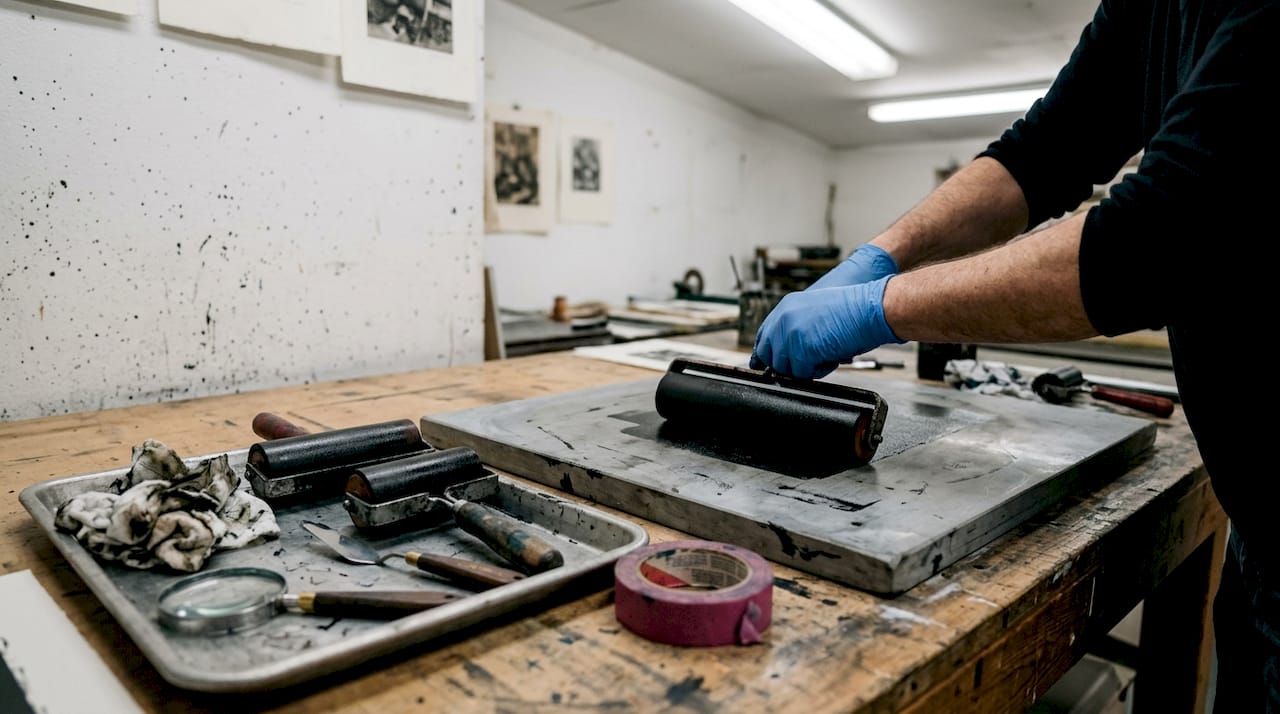
- Grinding and preparing the limestone. The stone surface is ground flat and smooth using a levigator and abrasive grit. This removes any previous image and creates a consistent grain.
- Drawing the image. The artist draws directly onto the stone using greasy crayons, pencils, or tusche (a liquid drawing material). This is where the creative work happens.
- Dusting and etching. The image is dusted with rosin and talc to protect it, then treated with a mixture of gum arabic and nitric acid. This chemical etch fixes the drawing and desensitizes the non-image areas.
- Washing off the drawing. The original drawing material is washed away, leaving behind a thin, invisible layer of fatty acid in the stone that will attract ink.
- Dampening and inking. Water is applied to the stone, then oil-based ink is rolled across the surface. Ink sticks only to the image areas.
- Pressing and printing. Paper is laid on the stone and run through a press. The image transfers cleanly to the paper.
“The stone acts as both the canvas and the printing plate. What makes lithography remarkable is that the artist draws the image exactly as it will appear, without thinking in reverse or cutting into a surface.”
Pro Tip: When examining a stone lithograph, look at the edges of marks under magnification. Genuine stone prints show soft, slightly irregular edges from the stone’s grain. Offset prints look sharper and more uniform.
Knowing how art prints are made helps collectors distinguish authentic works from reproductions. Proper archival preservation methods also start with understanding how the print was produced.
Lithography techniques: Stone, plate, and offset
With a clear view of how lithography works, it is useful to compare it to other methods and the innovations it inspired.
Lithography differs from relief and intaglio printing in a fundamental way. Relief printing (like woodblock) uses raised surfaces. Intaglio (like etching) uses incised grooves. Lithography uses a flat surface treated chemically. That flat surface is what defines the entire category of planographic printing.
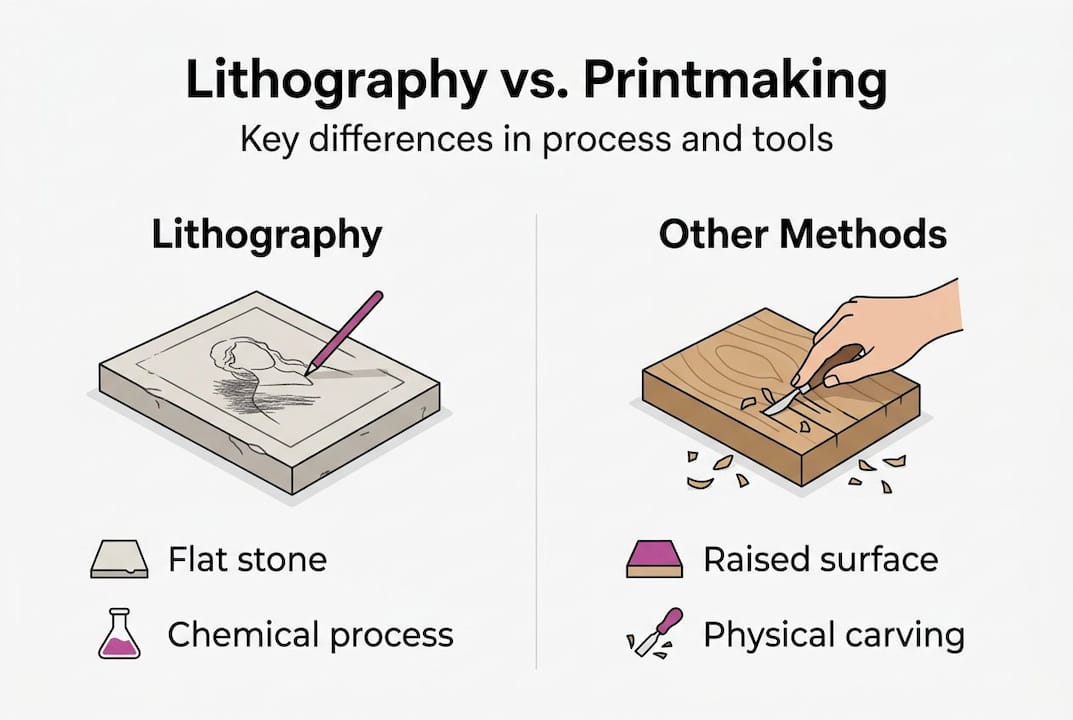
| Technique | Surface type | How ink is applied | Common use |
|---|---|---|---|
| Stone lithography | Flat limestone | Chemical attraction | Fine art editions |
| Plate lithography | Aluminum or polyester | Chemical attraction | Studio art, accessibility |
| Offset lithography | Flat plate via rubber blanket | Mechanical transfer | Commercial printing |
| Relief (woodblock) | Raised surface | Direct contact | Fine art, traditional |
| Intaglio (etching) | Incised grooves | Wiped into recesses | Fine art editions |
Key differences collectors and enthusiasts should know:
- Stone lithography produces prints with subtle tonal variations and a texture that reflects the stone’s grain
- Plate lithography uses aluminum or polyester plates as modern alternatives, offering greater accessibility without sacrificing much quality
- Offset lithography transfers the image via a rubber blanket for mass production, and lacks the artist-hand variations that make fine art prints valuable
Polyester and aluminum plates serve as modern alternatives for accessibility, though traditional stone remains preferred for authenticity. This is an important distinction when comparing digital art prints to hand-pulled lithographs in terms of collectibility and value.
Contemporary lithography: Evolution, challenges, and collecting
After understanding lithography’s methods and variations, it is worth looking at how today’s artists and collectors engage with this evolving process.
Stone lithography is still practiced in fine art studios worldwide, but the shift toward metal and polyester plates has made the technique more accessible. Limestone blocks are heavy, expensive, and require specialized storage. Plates solve many of those logistical problems while preserving the core chemical process.
Common defects to watch for in lithographs:
- Scumming: Ink adheres to non-image areas, creating unwanted marks
- Over-etching: Too much acid removes the image, resulting in faint or broken lines
- Under-inking: Thin ink coverage leaves gaps in solid areas
- Fading: Poor quality inks or paper cause color shifts over time
Stone wear limits editions, though one stone can theoretically yield thousands of prints before the image degrades. In practice, artists often limit editions intentionally to maintain value.
| Edition size | Typical value impact | Notes |
|---|---|---|
| 1 to 25 prints | Highest value | Rare, highly collectible |
| 26 to 100 prints | Strong value | Standard fine art edition |
| 101 to 500 prints | Moderate value | Larger studio editions |
| Open edition | Lower value | Unlimited reproduction |
Pro Tip: Always ask for a certificate of authenticity and check the edition number when collecting limited editions. A print marked “AP” (artist’s proof) is outside the main edition and often more desirable.
For storage and display, follow established art print care instructions to prevent yellowing and damage. Knowing how to store art prints safely extends the life of any lithograph significantly.
Why lithography endures: An artist’s perspective
Conventional wisdom treats lithography as a historical footnote, something that mattered before digital printing took over. That view misses what the technique actually offers.
Lithography preserves drawing’s spontaneity in a way no other printmaking method can match. The artist works directly on the surface without the resistance of carving or the indirection of a screen. Every mark reads exactly as it was made. That authenticity is not a nostalgic preference. It is a measurable quality that collectors and curators can see and verify.
In a world saturated with digital reproduction, the value of a hand-pulled print is increasing, not decreasing. Artists who engage with traditional advanced printmaking insights bring something to their work that software cannot replicate: physical decision-making under real constraints. The stone does not allow edits. The press does not offer undo. That constraint produces a kind of honesty in the final image that resonates with serious collectors.
Lithography is not outdated. It is simply demanding. And that demand is exactly what gives the resulting work its lasting value.
Explore and collect unique lithographic art
Inspired to discover more or start your own collection? Eman’s Gallery offers museum-quality wall art prints that bring the same commitment to craftsmanship and visual authenticity found in traditional printmaking. Each piece is produced with care for detail, color accuracy, and lasting quality.
If you are looking for something specific, you can commission bespoke pieces tailored to your space and taste. For a starting point, the Fragments of Memory canvas print is a strong example of how contemporary art translates expressive mark-making into collectible wall art. Browse the full collection and find the piece that speaks to you.
Frequently asked questions
How does lithography differ from other printmaking techniques?
Lithography uses flat surfaces with chemical treatments, unlike relief printing (raised surfaces) or intaglio printing (incised grooves). The image area and non-image area sit at the same level, separated only by chemistry.
Can I collect or buy original lithographs today?
Yes, many galleries and independent artists offer original lithographs and limited edition prints to collectors. Checking edition numbers and certificates of authenticity is the best starting point.
Is stone lithography still used in contemporary art?
Yes, artists continue to use stone lithography for its authenticity and expressive potential. Polyester and aluminum plates serve as modern alternatives that make the process more accessible without eliminating its core qualities.
What are common defects in lithographs?
Scumming, over-etching, and faded color are the most common issues. Over-etching or under-inking causes visible defects in the printed image, and these can often be spotted by examining the print closely under good light.
Recommended
- Printmaking Techniques: Elevating Artistic Expression
- How Art Prints Are Made: Methods and Steps Explained
- Art Print Mediums Explained: Key Types and Uses - Eman’s Gallery
- Why Artists Make Prints: Complete Expert Guide - Eman’s Gallery
Stay Connected
- Explore Eman's Gallery Original Mini-Art Cards, hand-painted by Eman Khalifa
- ✨ Explore Eman Khalifa’s original art, fine art prints & art merchandise
- 📸 Follow Eman Khalifa’s art journey on: Instagram @emans_gallery and Facebook Eman’s Gallery
- 📹 Watch Eman Khalifa creating live art on: YouTube @emans_gallery
