


Archival printing: preserve your art's beauty for decades
TL;DR:
- Many prints labeled “archival” depend on a coordinated system of materials and environmental conditions to ensure longevity.
- Proper system components include pigment inks, acid-free substrates, calibrated color management, and protective coatings, not just a single feature.
The term “archival” appears on countless fine art print listings, yet many collectors treat it as a simple guarantee of permanence. That assumption leads to costly mistakes. Longevity claims depend on both ink and paper, as well as environmental and display conditions, which means a print labeled “archival” can still degrade when one component in the chain fails. This guide breaks down what archival printing actually involves, which materials and conditions determine real longevity, and how collectors, interior designers, and fine art enthusiasts can protect every piece they acquire.
Table of Contents
- Defining archival printing: More than a marketing label
- What makes a print truly archival? Materials and conditions
- Archival printing vs. standard printing: What’s the difference?
- Practical guide: How to display, frame, and care for archival prints
- Why most collectors get archival printing wrong—and how to do it right
- Explore archival-grade art prints for your collection
- Frequently asked questions
Key Takeaways
| Point | Details |
|---|---|
| Archival is a system | True archival printing combines stable inks, quality paper, careful display, and proper storage for lasting results. |
| Materials are critical | Both ink and paper chemistry must meet archival standards or longevity is compromised. |
| Storage and framing matter | Even the best archival prints can fade quickly without proper display, framing, and protection. |
| Ask beyond the label | Don’t trust ‘archival’ claims without evidence—request details on print materials and processes. |
Defining archival printing: More than a marketing label
The word “archival” is not regulated by a single universal body, so manufacturers and studios apply it with considerable freedom. In practice, archival printing refers to a coordinated system rather than a single product feature or printer setting.
A professional print studio that meets archival standards aligns several variables at once:
- Pigment-based inks with demonstrated chemical stability over time
- Acid-free, lignin-free substrates that resist yellowing and brittleness
- Precise color management including ICC profiles calibrated to the specific ink and paper combination
- Protective coatings or laminates applied after printing to shield the surface
- Finishing and framing that seals the print from pollutants, humidity, and UV radiation
No single element can carry the entire burden. As Red River Paper notes, “archival printing” usually means a system engineered for longevity, not a single printer setting, and even pigment prints can be compromised by non-archival media or harsh display and storage choices.
“Archival quality” and “fade resistance” are related concepts, but they are not identical. Media stability and image stability each depend on the full combination of components.
What archival does NOT mean
Archival does not mean immune to aging. All prints change over decades. The goal of archival practice is to slow degradation to a rate that preserves visual integrity across a human lifetime or longer. Prints that carry vague “archival quality” labels without specifying ink type, paper pH, or coating details deserve closer scrutiny before a collector commits real money.
For guidance on protecting prints once they are acquired, reviewing art print care instructions provides a practical starting point.
| Component | Archival standard | Common shortcut |
|---|---|---|
| Ink type | Pigment-based, UV-resistant | Dye-based ink |
| Paper | Acid-free, lignin-free, buffered | Standard coated stock |
| Coating | UV-protective laminate or varnish | No coating |
| Color management | ICC-profiled, calibrated workflow | Generic printer driver |
| Framing | Archival mat board, UV glass | Standard frame, no UV filter |
What makes a print truly archival? Materials and conditions
With the system defined, the next step is understanding which specific materials matter and how environmental conditions either protect or undermine them.
Inks
Pigment inks consist of solid color particles suspended in a carrier fluid. Unlike dye inks, which dissolve into the paper fiber and can break down under light or moisture, pigment particles sit on or near the surface and bond more stably. Well-formulated pigment inks tested under accelerated aging conditions show projected lifespans of 70 to 200 years under controlled display. Dye inks, by comparison, can show visible fading within 10 to 25 years under similar conditions.
That said, ink alone is insufficient. Longevity claims depend on both ink and paper and on environmental conditions. An unstable ink on stable paper, or a stable ink on acidic paper, can still produce a degraded result well ahead of any projected timeline.
Paper and substrates
Acid-free paper maintains a neutral or slightly alkaline pH. Paper with residual acid gradually breaks down its own cellulose fibers, causing yellowing and brittleness. Lignin-free paper goes one step further by removing the organic compound in wood pulp that accelerates oxidation and discoloration.
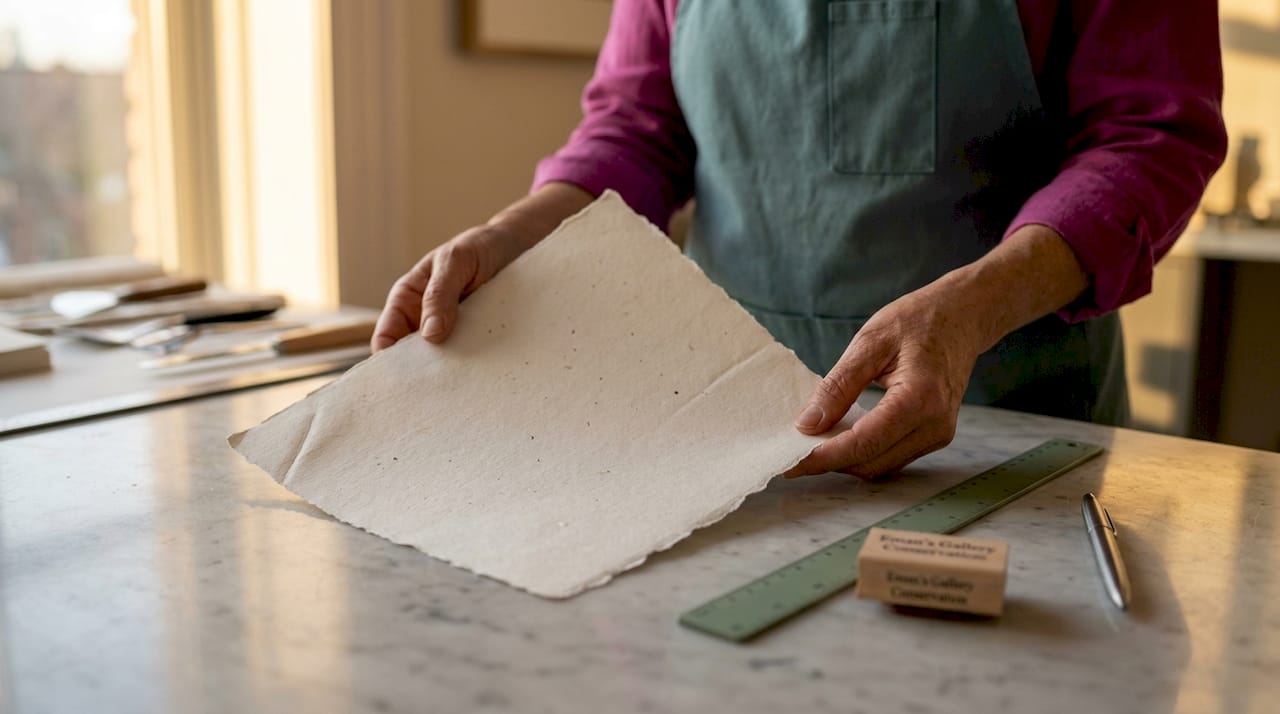
Museum-quality cotton rag paper contains no wood pulp at all. It has been the preferred substrate for archival documents and artwork for centuries precisely because cotton fibers remain chemically stable far longer than wood-based alternatives.
Environmental conditions
Materials alone cannot guarantee longevity. The display and storage environment matters just as much.
- Light exposure. Ultraviolet radiation is the primary cause of photochemical fading. Direct sunlight can noticeably fade even pigment prints within months. Indirect natural light and LED lighting with low UV output are both significantly safer.
- Relative humidity. The ideal range for print storage is 30 to 50 percent relative humidity. Levels above 60 percent encourage mold growth and cause paper to expand and contract in ways that crack coatings over time.
- Temperature stability. Fluctuating temperatures stress materials more than a consistently moderate temperature. A steady 65 to 70 degrees Fahrenheit is preferable to a room that swings between extremes seasonally.
- Airborne pollutants. Ozone, sulfur compounds, and particulates from cooking, cleaning products, and urban air accelerate ink oxidation. Sealed framing significantly reduces this exposure.
Pro Tip: If you display a print in a room with south-facing windows, use UV-filtering glass or acrylic in the frame. This single step can extend the visible life of a print by decades.
Reviewing archival care methods and following a structured art print maintenance workflow helps translate these principles into routine practice.
Archival printing vs. standard printing: What’s the difference?
The practical gap between archival and standard printing becomes visible in two ways: the composition of materials used and the long-term behavior of the print in real-world conditions.
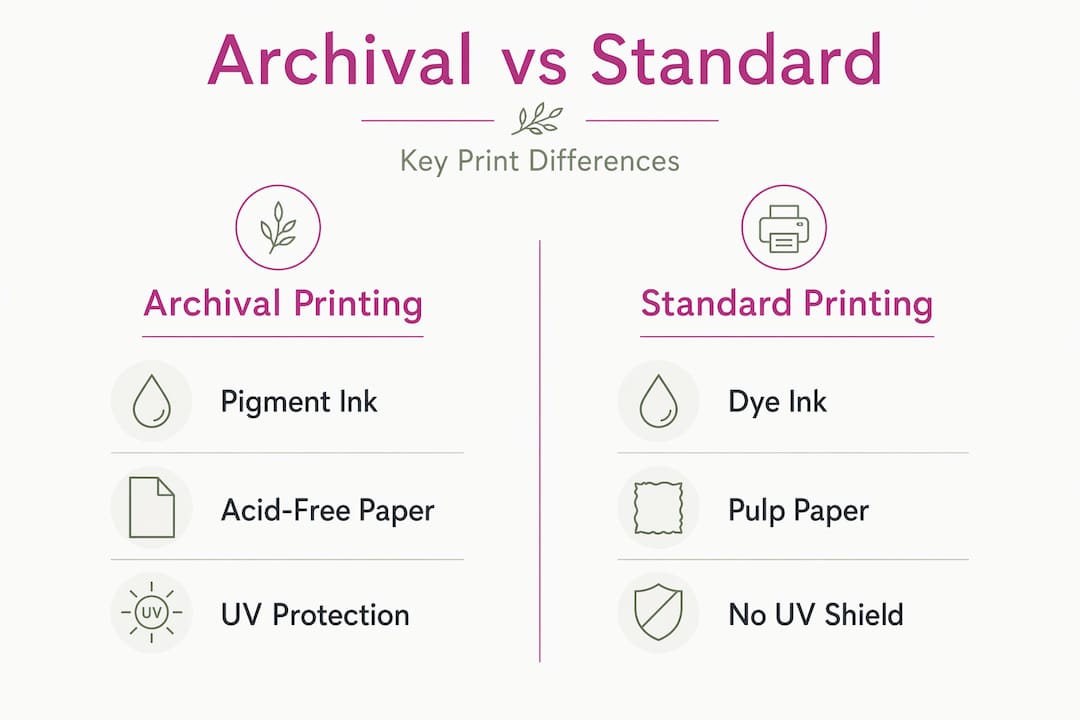
Archival quality and fade resistance are distinctly affected by each component in the print process, not just one factor. Standard printing optimizes for cost and speed. Archival printing optimizes for material stability and color integrity over time.
| Feature | Archival printing | Standard printing |
|---|---|---|
| Ink chemistry | Pigment-based | Dye-based |
| Paper quality | Acid-free, lignin-free | Standard coated or uncoated |
| Expected lifespan | 70 to 200+ years | 10 to 25 years |
| UV protection | Built into ink and substrate | Minimal or none |
| Color accuracy over time | High | Degrades faster |
| Cost | Higher | Lower |
| Museum acceptance | Yes | Rarely |
Why collectors and museums choose archival
Art collectors purchasing limited edition or one-of-a-kind prints treat them as both aesthetic and financial assets. Color shift or physical deterioration reduces both the display value and the resale or estate value of a piece. Museums operating under conservation mandates will not acquire prints that cannot meet projected stability standards, which effectively makes archival production a prerequisite for institutional recognition.
Interior designers specifying art for high-end residential or hospitality projects face similar requirements. A print installed in a luxury hotel corridor needs to look the same in year five as it did on installation day, without a costly replacement cycle.
Standard printing serves legitimate purposes, including short-run commercial work, event materials, or proofs. For any print intended to hold its visual and monetary value, standard printing is not a suitable choice.
- Archival prints retain color gamut and tonal range across decades
- Standard prints may show noticeable color shift within a few years, particularly in highlight areas
- Archival substrates resist yellowing, warping, and surface cracking
- Non-archival paper can become brittle within 20 years under typical indoor conditions
For collectors comparing surface options, understanding matte vs. glossy prints is a useful next step since the finish affects both aesthetics and how UV-protective coatings are applied. Those building a broader collection may also find practical value in guidance on starting an art collection from a collector’s perspective.
Practical guide: How to display, frame, and care for archival prints
Owning an archival-quality print is the first step. Maintaining its condition requires a consistent set of practices. Even pigment prints can be compromised by non-archival media or harsh display and storage choices, so the practices below are essential for protecting the investment.
Display checklist
- Position away from direct sunlight. Place prints on walls that do not receive direct sun at any point in the day. North-facing walls in the Northern Hemisphere are typically the safest option.
- Use UV-filtering glass or acrylic. Standard picture frame glass transmits the majority of UV radiation. Museum glass or UV-filtering acrylic blocks 99 percent of UV light without distorting color or adding significant glare.
- Choose archival mat board. Mat board that contacts the print surface must be acid-free. Non-archival mat board transfers acidic compounds to the print over time, producing characteristic brown staining called “mat burn.”
- Seal the frame package. Use a backing board and seal the perimeter of the frame with archival tape to limit dust and pollutant infiltration.
- Maintain stable humidity and temperature. Avoid displaying prints in bathrooms, kitchens, or near HVAC vents where temperature and humidity fluctuate significantly.
- Handle with clean cotton gloves. Skin oils transfer to paper surfaces and can cause lasting staining. Always handle unframed prints at the edges.
- Store flat or rolled in acid-free materials. Prints not currently displayed should be stored flat in acid-free sleeves or boxes, or rolled in acid-free tissue inside archival tubes.
Pro Tip: When hanging multiple prints in a room, place the most light-sensitive pieces (watercolor reproductions, works with delicate pastel tones) on the wall farthest from any window source.
For detailed guidance, the resources on essential art print caring tips, framing prints for home decor, and safe storage for art prints each address a specific stage of long-term print care. Additional perspective on integrating framed works into a designed space is available through guidance on decorating with wall art for those combining archival prints with broader interior schemes.
Why most collectors get archival printing wrong—and how to do it right
Many collectors follow a straightforward pattern: they identify a reputable print studio, pay for pigment printing on quality paper, and consider the archival requirement met. That logic is understandable, but incomplete.
The purchase of an archival print is the beginning of a commitment, not the end of one. The print still needs to be framed correctly, displayed under appropriate conditions, and periodically inspected for early signs of degradation. Collectors who skip any of these steps effectively pay premium prices for a result that standard printing could have delivered at a fraction of the cost.
One pattern that appears repeatedly is the premium print in a cheap frame. The print itself may be produced to the highest standard, but the non-archival mat board, the standard glass, and the unsealed backing create an internal environment that accelerates exactly the kind of degradation the print was engineered to resist. Within a decade, brown staining at the margins and subtle fading near the edges can appear on prints that should have been stable for a century.
A second overlooked issue is the storage period. Collectors often store prints flat in standard plastic sleeves waiting for an ideal display moment. Standard plastic can off-gas compounds that react with ink and paper surfaces. Acid-free polyester or polypropylene sleeves are the correct choice for any storage period longer than a few weeks.
As Red River Paper’s framework confirms, archival printing means a system engineered for longevity, not a single printer setting. Collectors who internalize this shift—from viewing “archival” as a product attribute to viewing it as an ongoing practice—consistently achieve better preservation outcomes.
The practical takeaway is this: invest in systems, not just products. That means allocating budget not only to the print itself but to the framing, the display environment, and the ongoing care protocol. Reviewing art print display strategies provides specific guidance on optimizing the full display system for long-term results.
Even experienced designers sometimes focus exclusively on aesthetics when specifying art for a project and defer care protocols to the client. Building a basic archival care briefing into every project handover closes that gap and protects the client’s investment alongside the designer’s reputation.
Explore archival-grade art prints for your collection
Applying these principles starts with sourcing prints that meet the full archival standard from the outset.
Eman’s Gallery offers museum-quality wall art prints produced with archival-grade materials, spanning abstract, geometric, floral, landscape, seascape, and still-life subjects by artist Eman Khalifa. Each print is designed to meet both aesthetic and longevity requirements, giving collectors and interior designers confidence that the work will retain its visual integrity over time. Original handmade paintings and fine art prints ship worldwide from fulfillment locations in the UK, USA, Canada, Australia, Germany, France, Italy, Spain, Portugal, Greece, the UAE, and the Netherlands.
Frequently asked questions
How long do archival prints actually last?
When produced and cared for correctly, archival prints can last 70 to 200 years or more before noticeable fading occurs, though longevity depends on both ink and paper as well as display conditions.
Is pigment ink required for archival printing?
Pigment inks are strongly preferred for archival printing, but ink alone is not sufficient. An unstable ink on stable paper, or the reverse, can still produce a degraded result ahead of any projected timeline.
What environmental factors shorten the lifespan of archival prints?
Direct sunlight, high humidity, temperature fluctuations, and airborne pollutants are the primary threats. Harsh display or storage choices compromise even well-produced pigment prints over time.
Are all “archival” labeled prints truly archival?
Not all “archival” labels reflect genuine longevity standards. “Archival quality” and “fade resistance” are related but not identical, so verifying ink type, paper specifications, and framing materials before purchase is advisable.
Does archival printing matter for decorative art or just investment pieces?
Archival printing benefits any work intended to last, whether its value is sentimental or financial. Prints in residential interiors, hospitality settings, and personal collections all benefit from the same material standards as museum-acquired pieces.
Recommended
- How to Store Art Prints & Preserve Quality - Eman’s Gallery
- Art Print Care: 40% Longer Life with Archival Methods
- Art Print Maintenance Workflow for Long-Lasting Beauty - Eman’s Gallery
- History of Art Prints: Legacy and Modern Impact - Eman’s Gallery
Stay Connected
- ✨ Explore Eman Khalifa’s original art and fine art prints
- 📸 Follow Eman Khalifa’s art journey on: Instagram @emans_gallery and Facebook Eman’s Gallery
- 📹 Watch Eman Khalifa creating live art on: YouTube @emans_gallery
