


What is monochrome art? Origins, meaning, and collector insights
TL;DR:
- Monochrome art uses a single hue and its variations, challenging the idea that art needs multiple colors.
- Historically, it spans from prehistoric cave pigments to 20th-century abstraction and contemporary media.
- Today, monochrome art offers clarity, meditative depth, and adaptability, valued by collectors for its subtlety and surface detail.
Some of the world’s most provocative, meditative, and valuable artworks use just one color. That challenges a common assumption: that art must be visually complex or richly colorful to carry emotional weight or artistic depth. Monochrome art uses a single hue and its many variations in tint, tone, and shade to create works that can be as demanding, layered, and powerful as any painting packed with color. This guide covers the definition of monochrome art, its history from ancient caves to contemporary galleries, the techniques behind it, and what collectors should know before adding a piece to their space.
Table of Contents
- Defining monochrome art: Beyond black and white
- The history and evolution of monochrome art
- Monochrome methods: Technique, nuance, and materials
- Monochrome art today: Contemporary relevance and collecting
- A fresh perspective: Why monochrome art is underestimated
- Explore monochrome and minimalist originals and prints
- Frequently asked questions
Key Takeaways
| Point | Details |
|---|---|
| Single color, rich variations | Monochrome art uses one color in many shades to create complex visual experiences. |
| Deep historic roots | It spans from ancient caves to avant-garde and modern minimalism, evolving with cultural trends. |
| Techniques add nuance | Artists use material, texture, and light instead of multiple colors for dramatic effect. |
| Modern meditative power | In a world of overload, monochrome art offers focus, clarity, and calm for collectors and viewers. |
Defining monochrome art: Beyond black and white
The word monochrome comes from Greek: mono meaning one, and chroma meaning color. In practice, monochrome art is artwork created using a single color or hue and its variations in tints, tones, and shades, rather than multiple colors. That single color can be any hue. Black, white, blue, red, or green. The restriction is the palette, not the possibilities.
Many people assume monochrome means black and white photography or a flat, single-tone painting. In reality, the range within one color is vast. A cobalt blue painting can shift from near-white at the lightest highlight to near-black in the deepest shadow, and every value between those extremes is part of the same monochrome family.
It helps to distinguish monochrome from two related movements. Minimalism focuses on stripping art down to its most essential elements, often using simple geometry and a restrained palette, but it is not always monochromatic. Minimalist art and monochrome art overlap, but the intent differs. Color field painting, a mid-20th-century movement, used large areas of a single or few colors to create emotional responses, but it sometimes employed more than one hue. Monochrome art is defined specifically by its color restriction, regardless of style or intent.
Common types of monochrome art include:
- All-black paintings using matte and gloss variations for visual contrast
- All-white works that depend entirely on surface texture and light
- Grisaille: paintings using only shades of gray, often to create a three-dimensional, sculptural illusion
- Blue monochromes, made famous by Yves Klein with his signature International Klein Blue
- Ink wash paintings from East Asian traditions, using only black ink in diluted layers
| Type | Color used | Notable characteristic |
|---|---|---|
| Grisaille | Grays | Sculptural illusion on flat surface |
| Ink wash | Black | Dilution creates depth and form |
| Color field monochrome | Any single hue | Large scale, emotional impact |
| All-white | White | Texture and light as primary tools |
Monochrome art spans media too. It appears in oil painting, watercolor, sculpture, printmaking, photography, and mixed media installations. The color restriction is what unites them.
Pro Tip: When viewing a monochrome work in person, focus on texture and surface variation first. These are the elements that photographs rarely capture accurately, and they often carry the most visual information in the piece.
For anyone interested in how monochrome fits within broader trends, contemporary wall art guides can help connect specific works to current styles and contexts.
The history and evolution of monochrome art
Monochrome art is not a modern invention. Its roots trace back further than most people expect.
Key milestones in monochrome art history:
- Prehistoric cave art used single pigments, primarily ochre and charcoal, to create images without concern for color variety.
- Medieval Cistercian monasteries favored black and white as symbols of purity and austerity, deliberately rejecting color ornamentation.
- 17th-century grisaille became a refined technique among European painters, using gray tones to simulate stone sculpture or relief carvings on flat surfaces.
- Early 20th century avant-garde saw Kazimir Malevich exhibit some of the first purely abstract monochromes, including his iconic Black Square around the 1910s.
- Mid-20th century brought Yves Klein’s blue monochromes and Mark Rothko’s color field works, treating color as a philosophical and emotional force rather than just a visual element.
- Contemporary practice extends into digital media, large-scale installations, and unconventional materials, with artists exploring monochrome’s potential at new scales.
The history of monochrome traces through ancient cave paintings, medieval Cistercian monasteries focused on black and white for purity, 17th-century grisaille for sculptural illusion, and the 20th-century avant-garde, where Malevich, Klein, and Rothko made philosophical statements on color, form, and abstraction.
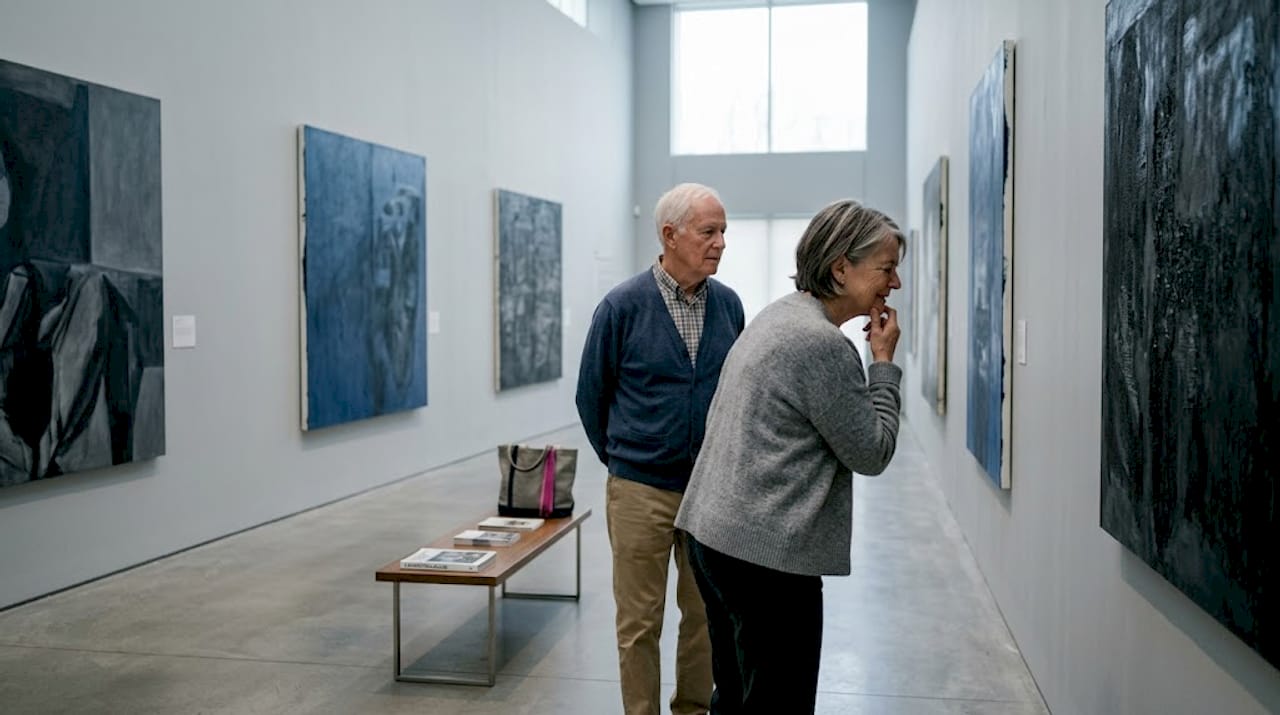
What changed over time was not the technique itself but the intent behind it. Medieval artists restricted color for spiritual reasons. Renaissance painters used grisaille to demonstrate technical mastery. Twentieth-century artists used monochrome to make arguments about what art could and should be. Malevich’s Black Square was not simply a painting of a black square. It was a statement that painting had moved beyond representation entirely.
Rothko’s large-scale color fields created psychological atmospheres in which viewers could feel immersed in a single hue. Klein’s blue monochromes claimed that color alone could carry meaning without form or image.
Statistic: Yves Klein created over 200 monochrome works in his signature International Klein Blue, a color he patented in 1960, before his death in 1962 at age 34.
These shifts did not happen in isolation. Each movement responded to cultural pressures: industrialization, war, the proliferation of images, and the challenge of defining what art means. Monochrome was often the medium artists chose when they wanted to make the strongest possible argument. For more context on how these ideas connect to minimalist art movements, the overlap between these traditions is worth examining.
Monochrome methods: Technique, nuance, and materials
Understanding how monochrome art is made shifts how you look at it. The techniques are specific, and the materials matter.
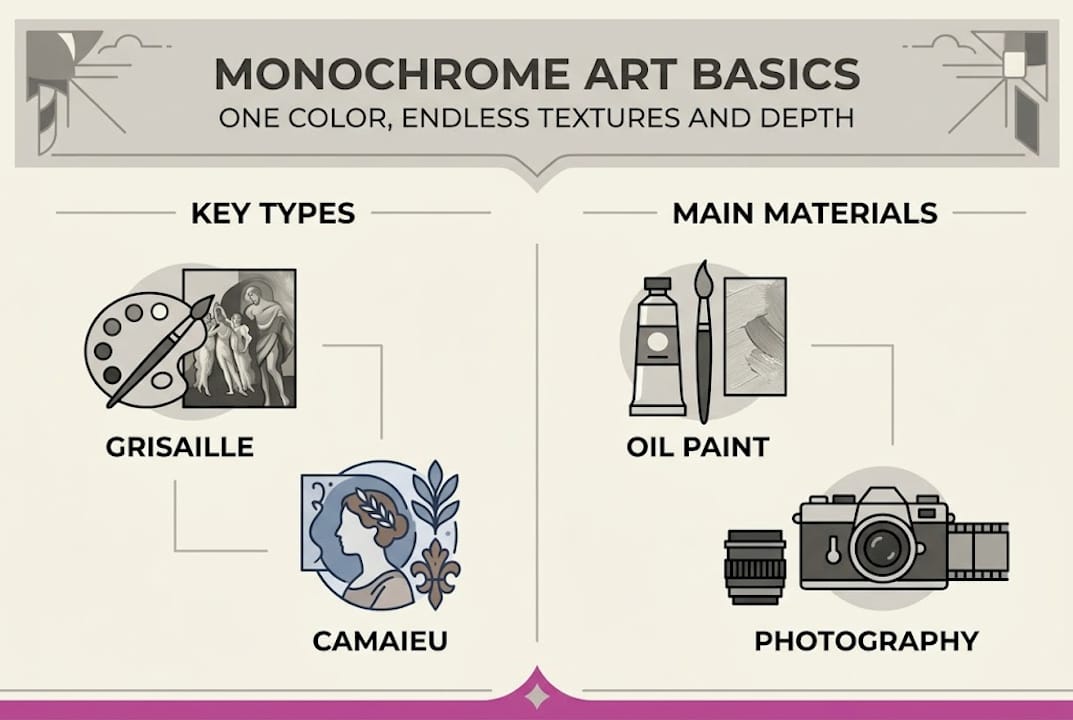
Grisaille is one of the most technically demanding monochrome approaches. Artists use only shades of gray, from near-white to near-black, to create the illusion of three-dimensional form on a completely flat surface. Grisaille is a specific monochrome subtype using grays for sculptural illusion, popular in Renaissance exteriors and Rembrandt’s etchings. The technique requires precise control of value, the lightness or darkness of a tone, without the assistance of hue to guide the eye.
Traditional media for monochrome work include:
- Oil paint, which allows for slow layering and subtle value transitions
- Ink, particularly in East Asian brush painting traditions
- Charcoal, used both for drawing and as a surface medium in its own right
- Graphite, often used in monochrome works that hover between drawing and painting
Contemporary materials extend the possibilities considerably. Artists now work with found objects, industrial materials, and unconventional surfaces. Gabriel de la Mora, a Mexican artist, has created monochrome works using eggshells and other found materials, adding nuance through texture rather than color. His practice shows how material choice becomes the primary expressive tool when hue is removed from the equation.
“In today’s visual overload, monochrome offers a meditative clarity” that few other approaches can provide, making it as relevant now as in any prior period.
Surface texture and light manipulation replace color contrast as the main visual tools in monochrome work. A painting that appears flat in a photograph may reveal dramatic depth in person when raking light catches raised paint edges, brushstroke ridges, or embedded material.
Pro Tip: Collectors examining monochrome works should always view pieces under different lighting conditions. A work that appears uniform under gallery lighting may reveal entirely different qualities under natural or directional light. Always ask about surface materials and layering techniques before purchasing.
For guidance on how monochrome pieces interact with interior light and color, resources on wall art color tips and choosing color schemes offer practical frameworks. Tips on styling art prints can also help when placing a monochrome piece within a finished room.
Monochrome art today: Contemporary relevance and collecting
Monochrome art has found a strong audience in contemporary culture, and the reasons are practical as much as aesthetic.
In today’s era of visual overload, monochrome offers clarity and meditation in a way that busier compositions often cannot. Interiors filled with pattern, texture, and competing visual elements often benefit most from a monochrome work that provides visual rest without sacrificing interest.
Why collectors choose monochrome art:
- Versatility: a monochrome piece adapts more easily to changing interiors than a work with specific color relationships
- Meditative quality: the reduction of color complexity encourages longer, slower looking
- Statement value: a large-scale monochrome can anchor an entire room without competing with furniture or architectural details
- Investment potential: works by established monochrome artists have performed consistently at auction, with pieces by Klein and Rothko reaching into the tens of millions
- Material interest: contemporary monochrome works often feature unconventional surfaces that reward close inspection
Practical tips for displaying monochrome art:
- Use directional or adjustable lighting to reveal surface texture
- Scale matters more with monochrome than with polychrome work; a small monochrome can disappear on a large wall
- Neutral wall colors allow the work’s internal variations to show clearly
- Avoid placing monochrome works directly opposite windows; reflected glare can flatten the surface
Current market trends show growing interest in emerging artists working with monochrome formats, particularly in acrylic, digital print, and mixed media. For anyone building a collection, resources on choosing art prints and understanding home decor art types provide useful entry points. Advice on using art prints for decor is equally relevant when selecting monochrome works for a specific space.
A fresh perspective: Why monochrome art is underestimated
The common assumption that more color equals more emotion is worth questioning directly. Monochrome art does not reduce visual experience. It redirects it.
When color is removed from the equation, the viewer’s attention shifts to form, texture, scale, and surface. These are the elements that often carry the most structural and emotional weight in a composition. They are also the elements most overlooked when color is present to distract. In that sense, monochrome art can actually heighten sensory engagement rather than diminish it.
This effect is especially pronounced in person. Photographs of monochrome works often look flat or simple, which contributes to the undervaluation. The actual experience of standing in front of a large-scale monochrome, watching it shift as you move, noticing how light changes the surface, is not something a screen image communicates.
Collectors and viewers who look past the apparent simplicity of minimalism in art and monochrome traditions consistently report deeper, more sustained engagement with these works over time. They are not difficult to live with. They tend to become more interesting as the space around them changes, as seasons shift the quality of light, and as the viewer’s own eye develops.
Monochrome is not a lesser form of art. It is a more demanding one, for the artist and ultimately for the attentive collector.
Explore monochrome and minimalist originals and prints
For those ready to move from understanding monochrome art to experiencing it firsthand, Eman’s Gallery offers a curated selection of original paintings and museum-quality canvas prints that bring these ideas into focus.
Browse the wall art prints collection for a range of works suited to both minimalist and maximalist interiors. The Contours of Orient canvas print demonstrates how a restrained palette can carry significant visual presence, while the Good Tidings original shows the expressive range available within a focused color approach. Eman’s Gallery ships worldwide from multiple fulfillment locations, including the UK, USA, and UAE.
Frequently asked questions
Can monochrome art include more than one material or texture?
Yes, monochrome art can use various materials or textures as long as they stay within the same hue or color family. Contemporary artists use materials like eggshells or found objects for creative monochrome expression.
What is the difference between monochrome and grisaille?
Grisaille is a type of monochrome art specifically created using various shades of gray, while monochrome can use any single color. Grisaille is a specific monochrome subtype using grays for sculptural illusion.
Why do collectors value monochrome art?
Collectors value monochrome art for its meditative simplicity, adaptability to spaces, and unique focus on form and subtlety. In the current era, monochrome offers clarity and meditation that polychrome works often cannot provide.
Are famous artists known for monochrome works?
Yes, artists like Kazimir Malevich, Yves Klein, and Mark Rothko are renowned for their monochrome pieces. The 20th-century avant-garde made philosophical statements using monochrome as their primary tool.
Recommended
- Minimalist Art Explained: Principles, History, and Impact
- 7 Essential Modern Abstract Art Trends for Collectors - Eman’s Gallery
- Popular art genres: Find the perfect style for your collection
- Art Collecting Terminology: Complete Guide - Eman’s Gallery
Stay Connected
- ✨ Explore Eman Khalifa’s original art and fine art prints
- 📸 Follow Eman Khalifa’s art journey on: Instagram @emans_gallery and Facebook Eman’s Gallery
- 📹 Watch Eman Khalifa creating live art on: YouTube @emans_gallery
