


Minimalist Art Explained: Principles, History, and Impact
TL;DR:
- Minimalist art emerged in the 1950s as a reaction against Abstract Expressionism’s emotional excess.
- It features geometric forms, industrial materials, and restrained color palettes emphasizing space and perception.
- Notable minimalist artists include Judd, Flavin, and LeWitt, whose work influences contemporary design and collection.
Minimalist art is frequently dismissed as blank canvases or empty gestures. That reaction is understandable but inaccurate. Minimalism emerged in the late 1950s as a direct response to the emotional intensity of Abstract Expressionism, and it brought with it a strict visual language built on deliberate choices. Far from being simple, it demands precision, restraint, and a deep understanding of how form, material, and space interact. This guide covers minimalist art’s origins, defining characteristics, key artists, and lasting influence on contemporary design and collecting.
Table of Contents
- Origins and evolution of minimalist art
- Defining characteristics of minimalist art
- Notable minimalist artists and iconic works
- Minimalist art’s influence on contemporary spaces and products
- Why minimalist art’s depth is often overlooked
- Explore minimalist and modern art with Eman’s Gallery
- Frequently asked questions
Key Takeaways
| Point | Details |
|---|---|
| Intentional simplicity | Minimalist art strips down to essentials, using form and material to create impact. |
| Influence beyond galleries | Minimalism shapes architecture and design, not just fine art. |
| Key artists to know | Donald Judd, Agnes Martin, and Dan Flavin are pillars of the minimalist movement. |
| Viewer interaction matters | Minimalist works engage viewers with space, scale, and perception. |
Origins and evolution of minimalist art
Minimalist art did not appear without context. It grew out of a specific cultural and artistic moment in New York, shaped by decades of prior movements pushing toward reduction and objectivity.
The minimalist art movement took shape in the late 1950s and reached its peak visibility through the 1960s. Artists working in New York at the time were reacting against Abstract Expressionism, which prioritized emotional gesture, personal expression, and painterly drama. Minimalists rejected all of that. They wanted art to exist on its own terms, without narrative, symbolism, or the artist’s emotional fingerprint.
Several earlier movements laid the groundwork. De Stijl, the Dutch movement of the early 20th century, championed pure geometric abstraction and primary colors. The Bauhaus school in Germany merged fine art with industrial design, emphasizing function and clean form. Russian Constructivism, led by figures like Kazimir Malevich, stripped painting down to its most basic geometric elements. Malevich’s Black Square (1915) is often cited as a direct ancestor of minimalist thinking.
“Minimalism emerged in the late 1950s to 1960s in New York as a reaction against the emotional excess of Abstract Expressionism.”
A landmark moment came in 1966 with the exhibition Primary Structures at the Jewish Museum in New York. It brought together artists like Donald Judd, Carl Andre, and Dan Flavin, and it gave the movement institutional recognition. The show made clear that minimalism was not a passing trend but a serious and evolving direction in contemporary art.
| Influence | Origin | Key contribution to minimalism |
|---|---|---|
| De Stijl | Netherlands, 1917 | Geometric abstraction, primary colors |
| Bauhaus | Germany, 1919 | Form follows function, industrial materials |
| Russian Constructivism | Russia, 1915 | Reduction to pure geometric forms |
| Abstract Expressionism | USA, 1940s | Provided the emotional excess minimalism rejected |
The evolution did not stop in the 1960s. Minimalist principles continued to influence sculpture, architecture, and design well into the late 20th century and remain active in contemporary practice today.
Defining characteristics of minimalist art
With the origins clear, let’s break down what actually makes minimalist art distinct and recognizable.
Minimalist art is not defined by what it lacks. It is defined by what it keeps, and why. According to minimalist art features, key methodologies include serial repetition of modules, industrial fabrication to eliminate the artist’s hand, use of raw materials like steel, aluminum, fluorescent lights, bricks, and plywood, precise geometric forms, limited color palettes, and a strong emphasis on scale, proportion, and viewer interaction with space.
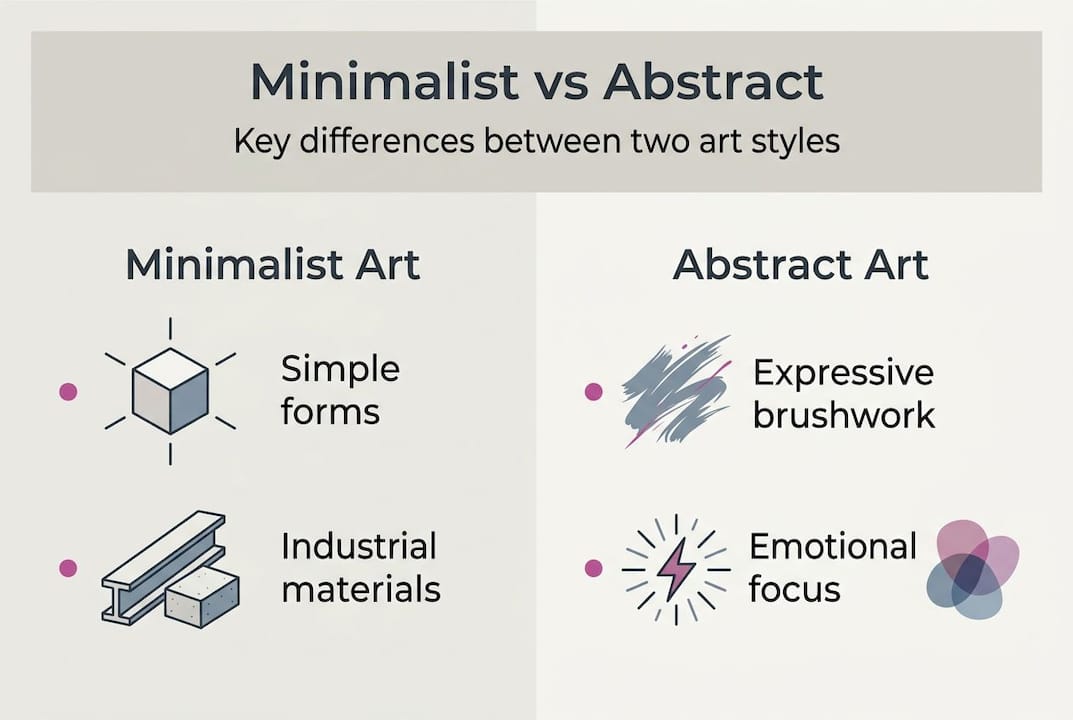
These are not aesthetic preferences. They are deliberate strategies. By using industrial fabrication, minimalist artists removed evidence of personal touch. The work was not painted by hand in the traditional sense. It was planned, specified, and often manufactured. This shifted focus from the artist’s skill to the object itself and its relationship with the viewer.
Core characteristics at a glance:
- Geometric forms: squares, rectangles, cubes, and grids dominate
- Industrial materials: steel, aluminum, fluorescent light tubes, bricks, plywood
- Monochrome or restricted color palettes, often using raw material colors
- Serial repetition of identical or similar units
- Large scale that physically engages the viewer’s body and perception
- Absence of visible brushwork or personal mark-making
| Feature | Minimalist art | Abstract Expressionism |
|---|---|---|
| Emotional content | None intended | Central to the work |
| Materials | Industrial, raw | Paint, canvas, gestural media |
| Color palette | Restricted, often monochrome | Varied, expressive |
| Artist’s hand | Eliminated | Celebrated |
| Viewer relationship | Spatial, physical | Emotional, interpretive |
Scale matters more than most people realize. A minimalist sculpture placed in a gallery is designed to be experienced in relation to the human body. Walking around a large steel cube by Donald Judd is not the same as looking at a photograph of it. The physical presence is the point.
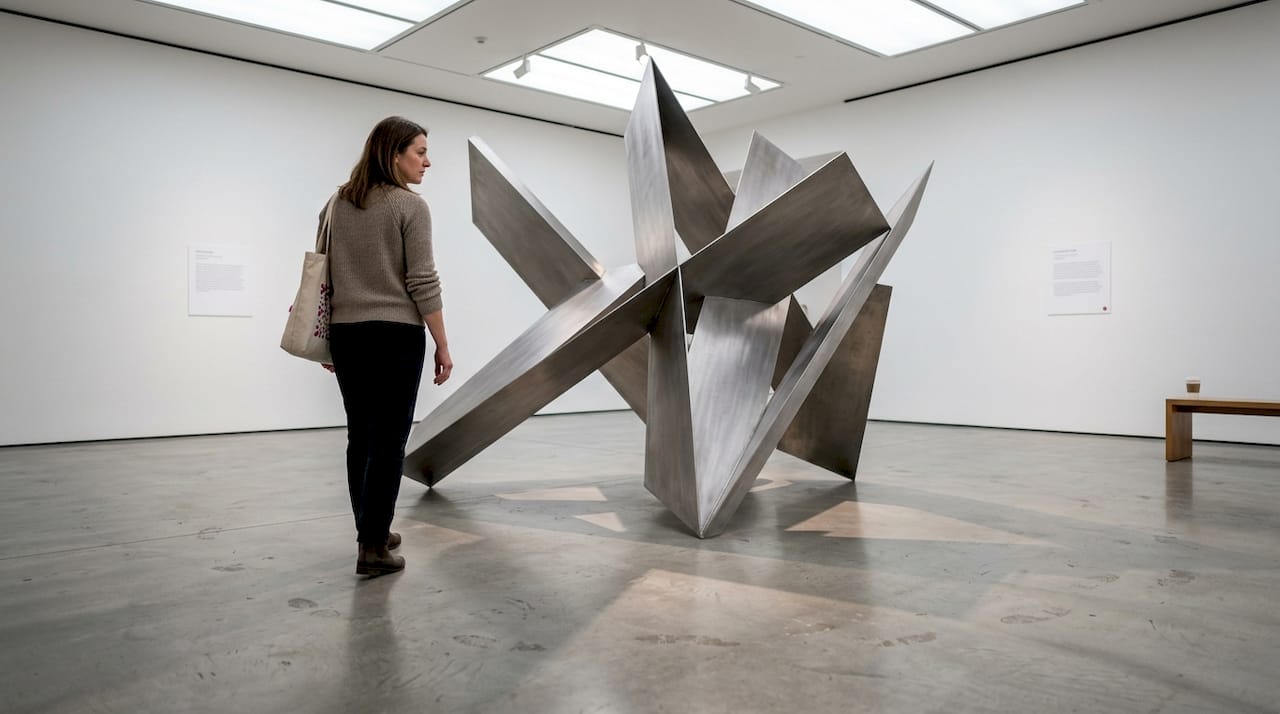
Pro Tip: When viewing minimalist art in a gallery or museum, move around the piece rather than standing still. The work is designed to change as your position shifts.
For collectors interested in contemporary wall art, understanding these characteristics helps when selecting pieces that carry minimalist sensibility without being strictly historical works. Knowing how to approach displaying minimalist art in a home setting also becomes easier once you understand what the work is trying to do spatially.
Notable minimalist artists and iconic works
Understanding key features is easier when seen through the work of famous minimalist artists.
Key minimalist artists include Donald Judd, Dan Flavin, Carl Andre, Sol LeWitt, Frank Stella, Agnes Martin, and Robert Morris. Each brought a distinct approach to shared principles.
Donald Judd is perhaps the most recognized name in minimalism. He rejected the term himself, preferring “specific objects” to describe his work. His stacked aluminum box structures, often mounted on walls at precise intervals, are studies in proportion, material, and repetition. Judd insisted that art should not refer to anything outside itself.
Dan Flavin worked almost exclusively with commercially available fluorescent light tubes. His installations used light as both material and form, transforming gallery spaces through color and illumination. The work was temporary by nature, since the tubes could be replaced, which challenged conventional ideas about art as a permanent object.
Carl Andre placed industrial materials directly on the floor. His grid of firebricks at Tate Modern, titled Equivalent VIII (1966), became one of the most debated works in British art history when it was acquired in 1972. The public controversy around its perceived simplicity is itself a useful case study in how minimalism provokes.
Agnes Martin occupied a quieter corner of minimalism. Her subtle grid paintings, executed in pencil and pale washes of color on large canvases, reward sustained looking. They are often described as meditative, though Martin herself resisted that label.
Sol LeWitt developed the concept of wall drawings, where the instructions for creating the work were the art itself. Execution could be carried out by others. This further separated the idea from the physical act of making.
- Frank Stella: large-scale shaped canvases with geometric stripe patterns
- Robert Morris: process-based sculpture and performance, exploring perception
The global market for works by these artists reflects their lasting status. Judd’s works regularly sell at major auction houses for seven figures, confirming that minimalism’s perceived simplicity has not diminished collector demand. For those exploring wall art styles informed by this tradition, the range is broader than many expect.
Minimalist art’s influence on contemporary spaces and products
Having explored individual artists, let’s see how minimalist thinking transforms spaces and current design.
The impact of minimalist art extends well beyond gallery walls. Its emphasis on simplicity, material honesty, and spatial clarity has directly shaped architecture, product design, and interior practice.
Architect Mies van der Rohe, whose phrase “less is more” became a defining motto of modern design, built spaces that operate on minimalist principles. His Barcelona Pavilion (1929) used a restricted palette of marble, glass, and steel in precise geometric arrangements. The building feels like a minimalist sculpture you can walk through.
In product design, the influence is visible in everything from Apple’s hardware to Scandinavian furniture. Clean lines, absence of ornament, and honest use of materials are minimalist values translated into everyday objects.
For collectors and interior designers, minimalist art offers specific practical advantages:
- It works across a wide range of interior styles without competing with other elements
- Geometric and monochrome works anchor a room without overwhelming it
- Large-scale minimalist pieces can function as architectural elements
- Restricted color palettes make coordination with existing furnishings straightforward
Pro Tip: When placing minimalist art in a room, give it space. Crowding it with other objects defeats the work’s purpose. A single piece on a clear wall is more effective than several competing for attention.
For those working on modern art for interiors, minimalist principles provide a reliable framework. Works with nature-inspired minimalist art qualities can bridge the gap between organic and geometric sensibilities. Practical wall art color tips are especially useful when working with restricted palettes in luxury spaces.
Why minimalist art’s depth is often overlooked
Minimalist art gets dismissed more than almost any other contemporary movement. The complaint is always the same: “Anyone could do that.” That reaction reveals a misunderstanding of what the work is actually doing.
Creating a genuinely effective minimalist work is harder than it looks. Every decision carries full weight because there is nothing else in the composition to absorb errors. A slightly wrong proportion, an inconsistent surface finish, or an ill-considered scale relationship will be immediately visible. There is no gestural energy or complex imagery to redirect the viewer’s attention.
The discipline required is significant. Artists like Judd spent years developing systems for proportion and material that could hold up under sustained examination. Agnes Martin’s grids required extraordinary consistency of hand and mind across large canvases.
For viewers, minimalist art asks something different than most work does. It does not tell you what to feel. It creates conditions for you to notice your own perception. That is a more active experience than it appears. Collectors who engage with contemporary wall art insights often find that minimalist pieces reward longer ownership, revealing new qualities over time as context and light change.
Explore minimalist and modern art with Eman’s Gallery
Ready to bring minimalist inspiration into your own environment?
Eman’s Gallery offers a curated selection of geometric and minimalist-inspired original paintings and museum-quality canvas prints by artist Eman Khalifa. Each piece is handmade and one of a kind, designed to work in contemporary and minimalist spaces.
Whether you are building a collection or sourcing art for an interior project, the gallery’s range covers abstract, geometric, and nature-inspired works that align with minimalist principles. Browse shop wall art prints to find pieces suited to clean, modern environments, or explore the Golden Fracture minimalist print as a starting point for geometric wall art. Shipping is available worldwide from the UK, USA, Canada, Australia, UAE, and across Europe.
Frequently asked questions
What defines minimalist art?
Minimalist art is defined by geometric forms, industrial materials, and limited color palettes that prioritize objectivity, material presence, and the viewer’s spatial experience over personal expression.
Who are the most famous minimalist artists?
Donald Judd, Dan Flavin, Agnes Martin, Carl Andre, and Sol LeWitt are among the most recognized figures in minimalist art, each known for distinct approaches to reduction and material.
How has minimalist art influenced modern design?
Minimalist art’s principles are visible in architecture and design through clean lines, honest use of materials, and the elimination of ornament, seen in everything from modernist buildings to consumer product design.
What is the main difference between minimalist art and abstract art?
Minimalist art is restrained and objective, focusing on pure form and material, while abstract art often centers on emotional expression and dynamic visual energy, which is precisely what minimalism was reacting against.
Recommended
- Art and Interior Design Explained: Transforming Modern Spaces - Eman’s Gallery
- Why Display Art at Home: Transforming Modern Spaces
- Art Styles Explained: Shaping Luxury Interiors - Eman’s Gallery
- Geometric Art Explained: Styles, History, and Uses - Eman’s Gallery
Stay Connected
- Explore Eman's Gallery Original Mini-Art Cards, hand-painted by Eman Khalifa
- ✨ Explore Eman Khalifa’s original art, fine art prints & art merchandise
- 📸 Follow Eman Khalifa’s art journey on: Instagram @emans_gallery and Facebook Eman’s Gallery
- 📹 Watch Eman Khalifa creating live art on: YouTube @emans_gallery
