


What is vintage art print: complete 2026 guide
Many assume all vintage prints command high value, but reality is far more nuanced. Understanding what truly defines a vintage art print requires examining authenticity, historical context, and multiple value factors. This guide teaches you to identify genuine vintage prints, distinguish them from reproductions and antiques, assess their market worth, and incorporate them into contemporary design with confidence.
Table of Contents
- Definition And Characteristics Of Vintage Art Prints
- Historical Context And Era Identification
- Authenticity And Provenance
- Comparing Vintage To Antique And Collectible Art
- Value And Market Significance
- Common Misconceptions About Vintage Prints
- Incorporating Vintage Prints In Contemporary Design
- Explore Original And Canvas Art At Eman’s Gallery
Key takeaways
| Point | Details |
|---|---|
| Definition matters | Vintage prints are original works created 20 to 100 years ago, near the time of the original artwork or negative. |
| Authentication is crucial | Provenance, material analysis, and expert evaluation determine authenticity and prevent costly mistakes. |
| Value varies widely | Rarity, condition, artist reputation, and historical significance drive market prices more than age alone. |
| Era knowledge helps | Understanding Art Nouveau, Art Deco, and other periods aids identification and appreciation. |
| Design applications abound | Vintage prints add nostalgic character and sustainable value to modern interiors. |
Definition and characteristics of vintage art prints
Vintage art prints are original prints created close to the time the negative or artwork was first made, typically before 1970, and are considered authentic pieces of historical art. These works capture the essence of their era through original printmaking techniques rather than modern reproduction methods.
The age range generally spans 20 to 100 years, positioning vintage prints between contemporary reproductions and antique works. This timeframe reflects both cultural significance and collectible appeal without crossing into the rarer antique category.
Authentic vintage prints include several distinct mediums:
- Lithographs created through stone or metal plate processes
- Etchings and engravings produced by incising metal plates
- Photographic prints developed from original negatives
- Screen prints made using stencil techniques
- Woodblock prints carved and inked by hand
Reproductions differ fundamentally because they lack direct historical connection to the original creation date. Modern copies may mimic vintage aesthetics but were produced decades after the original artwork, eliminating the temporal authenticity that defines genuine vintage pieces.
Provenance documentation and material analysis establish legitimacy. Paper stock, ink composition, and printing technique reveal whether a print originated in its claimed era or represents a later reproduction. Collectors who spot authentic art through these markers avoid costly mistakes and build meaningful collections.
Pro Tip: Examine paper edges under magnification. Genuine vintage prints often show age-appropriate wear patterns and paper fiber composition consistent with historical manufacturing methods.
Historical context and era identification
The term vintage art typically refers to artworks created between 20 and 100 years ago, distinct from antique art which is usually over 100 years old, capturing the aesthetics and cultural characteristics of their eras. This age distinction helps collectors and designers identify pieces that reflect specific historical moments.
Art Nouveau dominated from 1890 to 1910, featuring organic forms, flowing lines, and natural motifs. Prints from this period showcase ornate botanical designs and stylized human figures that defined turn-of-the-century visual culture.
Art Deco emerged in the 1920s and flourished through the 1940s, bringing geometric patterns, bold colors, and streamlined elegance. These prints reflect the machine age optimism and luxury aesthetics that characterized the interwar period and post-war prosperity.
Key stylistic identifiers include:
- Line quality and composition reflecting period-specific techniques
- Color palettes matching historical pigment availability
- Subject matter addressing contemporary social themes
- Typography styles popular during creation dates
- Signature placement and artist markings consistent with era standards
Understanding these historical markers enables collectors to authenticate pieces and appreciate their cultural context. A print’s era reveals not just artistic style but also social values, technological capabilities, and cultural priorities of its time.
The 20 to 100 year range positions vintage prints in a sweet spot between accessible recent history and increasingly rare antique status. This timeframe makes vintage works particularly appealing for collectors seeking historical authenticity without extreme rarity premiums. Learning to spot authentic art from specific eras builds confidence and prevents misattribution.
Authenticity and provenance
Authenticating vintage prints requires examining provenance, print materials, the date of creation relative to the original negative or artwork, and expert evaluation including scientific testing where applicable. These verification methods protect buyers from reproductions falsely marketed as vintage originals.

Prints made closest to the original negative’s creation date carry highest authenticity value. A photographic print developed from the original negative in the same decade holds greater historical significance than later prints struck from the same negative decades afterward.
Provenance documentation traces ownership history, exhibition records, and acquisition details. This paper trail confirms a print’s journey through time and validates its claimed origin. Gallery receipts, auction records, and expert certificates strengthen provenance claims substantially.
Material analysis examines:
- Paper composition matching historical manufacturing methods
- Ink chemistry consistent with period-appropriate materials
- Printing technique evidence visible under magnification
- Age-related wear patterns authentic to claimed timeframe
- Signature analysis comparing to verified artist examples
Expert appraisals from qualified authenticators provide professional validation. Specialists examine technical details invisible to untrained eyes, comparing prints against verified examples and documented production records.
Scientific testing offers objective verification when provenance alone proves insufficient. Radiocarbon dating, spectroscopic analysis, and microscopic examination reveal material composition and age markers that confirm or contradict claimed origins.
Beware of sellers unable to provide provenance documentation or who discourage independent authentication. Legitimate vintage prints have verifiable histories, while reproductions often lack credible ownership records or material consistency. Understanding art authenticity explained principles helps buyers make informed decisions.
Pro Tip: Request high-resolution images of signature areas, paper edges, and any visible printing marks before purchasing. These details reveal authenticity markers difficult to fake convincingly.
Comparing vintage to antique and collectible art
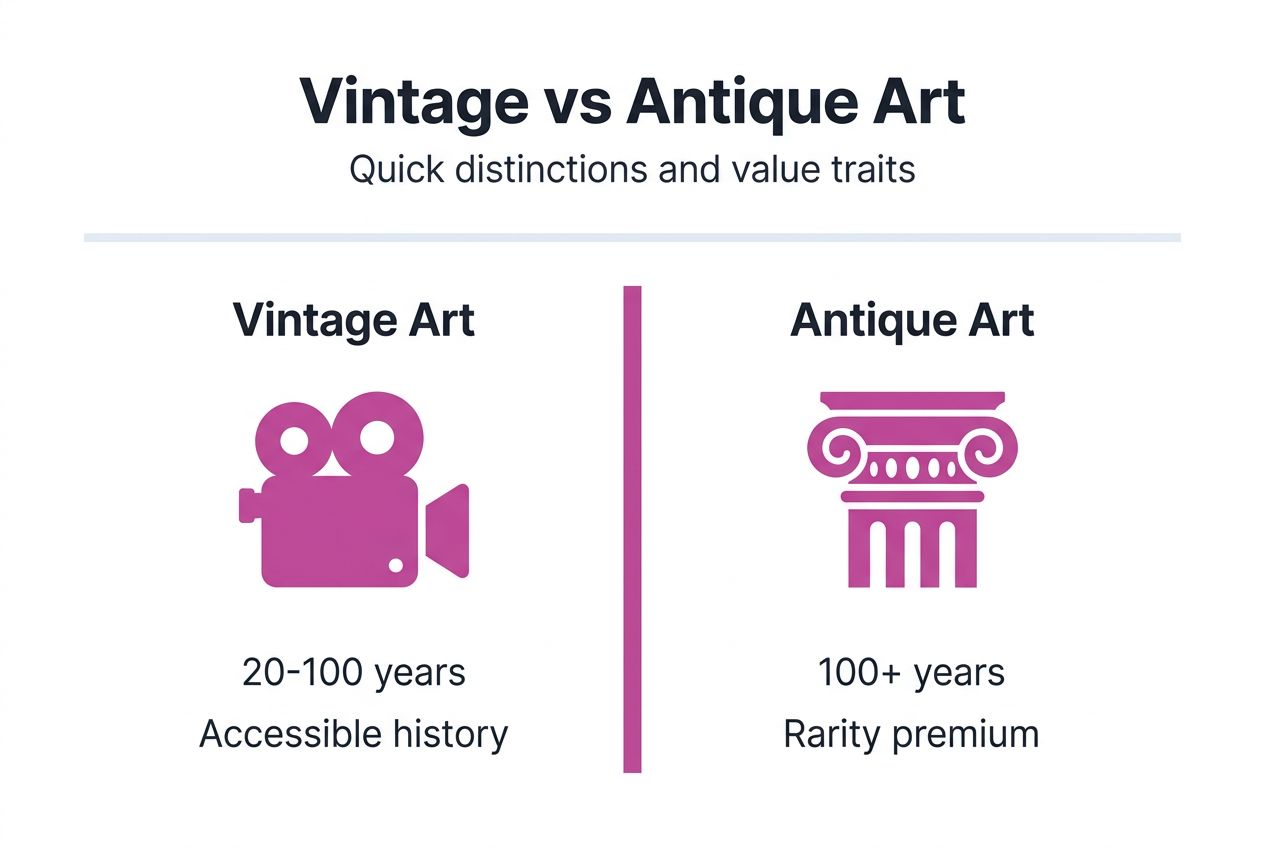
The distinction between vintage, antique, and collectible art is crucial for understanding market value: antiques are over 100 years old, vintage is typically 20 to 100 years old, and collectibles can be any age but valued for rarity or desirability. These categories impact pricing strategies and collector expectations significantly.
| Category | Age Range | Primary Value Drivers | Market Position |
|---|---|---|---|
| Antique | Over 100 years | Historical rarity, preservation | Premium pricing, limited supply |
| Vintage | 20 to 100 years | Era appeal, condition, provenance | Accessible investment, growing interest |
| Collectible | Any age | Rarity, desirability, cultural significance | Variable pricing, trend-driven |
Antique art commands premium prices due to extreme age and survival rarity. Pieces over a century old have weathered time’s test, making well-preserved examples increasingly scarce. Collectors value antiques for their direct connection to distant historical periods.
Vintage art occupies a middle ground between contemporary accessibility and antique rarity. The 20 to 100 year timeframe provides historical authenticity while maintaining reasonable availability. Vintage pieces capture recognizable recent history without requiring the preservation expertise antiques demand.
Collectible art breaks age conventions entirely. A contemporary print by a sought-after artist may command higher prices than vintage works if demand and rarity align favorably. Collectible status depends on cultural cachet, limited editions, and market trends rather than chronological age.
Understanding these distinctions prevents overpaying for mislabeled works. A 30-year-old print marketed as antique misrepresents its category and likely its value. Similarly, calling any old print collectible ignores whether actual market demand exists.
Market behavior differs across categories. Antiques appreciate steadily due to fixed supply and increasing age. Vintage pieces fluctuate with collector interest in specific eras. Collectibles swing dramatically based on artist reputation and cultural trends. Knowing how to value art prints within their correct category supports accurate appraisal.
Value and market significance
The value of vintage art prints depends on rarity, condition, provenance, artist significance, and historical importance, with some prints appreciating significantly if well preserved. Understanding these factors helps collectors identify investment-worthy pieces and avoid overpriced mediocrity.
Rarity drives scarcity premiums. Limited edition prints or works by artists who produced few pieces in specific periods command higher prices. Common prints by prolific artists offer lower investment returns despite age.
Condition dramatically affects market value:
- Pristine prints with minimal fading retain maximum worth
- Minor defects reduce value proportionally to severity
- Restoration quality impacts authenticity and pricing
- Storage history influences long-term preservation prospects
- Frame quality and archival materials protect investment value
Artist reputation amplifies or diminishes value regardless of age. Vintage prints by recognized masters appreciate steadily, while works by forgotten artists languish despite authentic vintage status. Artist career trajectories and critical reevaluation shift valuations over time.
Historical significance adds investment appeal beyond purely aesthetic considerations. Prints documenting important events, social movements, or cultural shifts carry premiums reflecting their documentary value. Cultural institutions seeking representative period pieces create demand.
Market trends fluctuate based on collector demographics and cultural interests. Mid-century modern aesthetics surged in popularity during the 2010s, elevating 1950s and 1960s print values. Current sustainability trends boost vintage art as eco-conscious alternatives to new production.
Some vintage prints have appreciated considerably, particularly works by artists who gained posthumous recognition or pieces representing now-prized aesthetic movements. Investment returns vary wildly based on acquisition timing and selection judgment.
Pro Tip: Track auction results for comparable prints to gauge current market valuations. Public sale records reveal what collectors actually pay versus asking prices. Understanding what makes art valuable supports smarter acquisition decisions across categories.
Common misconceptions about vintage prints
Contrary to popular belief, some early vintage prints, such as Ansel Adams’ Parmelian prints from the 1920s, can be less valuable than later prints due to degradation of materials and print quality. This reality challenges assumptions that older always means better or more valuable.
Age alone guarantees nothing about value or quality. A poorly executed 80-year-old print by an unknown artist holds less worth than a carefully crafted 25-year-old work by a recognized master. Market value reflects multiple factors beyond chronological age.
Key misconceptions include:
- Assuming all vintage prints appreciate steadily over time
- Believing early printing techniques always produce superior results
- Expecting vintage status to overcome poor condition or common subjects
- Thinking reproduction detection is impossible without expert help
- Presuming vintage prints always cost more than modern alternatives
Early printing materials sometimes degraded faster than later innovations. Some photographic papers yellowed badly, inks faded rapidly, or chemical processes destabilized over decades. Later prints using improved materials may preserve better and look more appealing.
Authenticity standards vary by medium and era. What constitutes an authentic vintage lithograph differs from photographic print standards. Buyers must understand medium-specific authentication criteria rather than applying universal rules.
Market flooding diminishes value despite authentic vintage status. If thousands of identical prints survived, scarcity premiums vanish regardless of age. Common vintage prints trade near reproduction prices when supply overwhelms demand.
Condition trumps age in valuation equations. A pristine 30-year-old print outperforms a damaged 80-year-old work in most markets. Restoration costs can exceed purchase prices for badly deteriorated pieces, making condition assessment critical.
Understanding art authenticity explained principles helps buyers avoid expensive misconceptions and focus on genuine value indicators rather than age-based assumptions.
Incorporating vintage prints in contemporary design
Vintage art prints add unique character and historical depth to contemporary interiors, offering a mix of nostalgia and sustainability by repurposing existing artworks instead of creating new pieces. This dual appeal makes vintage prints increasingly popular in modern design schemes.
Nostalgia creates emotional connections that pure contemporary art rarely achieves. Vintage prints evoke specific eras, triggering memories and cultural associations that resonate with viewers. This emotional depth transforms walls into conversation starters rather than mere decoration.
Sustainability benefits align with growing eco-conscious design priorities. Purchasing existing vintage prints avoids environmental costs of new art production, including material extraction, manufacturing energy, and shipping impacts. Repurposing vintage works extends their lifecycle while reducing consumption.
Design integration strategies include:
- Mixing vintage prints with contemporary furniture for layered visual interest
- Creating gallery walls combining different eras and styles cohesively
- Using vintage botanical or architectural prints in modern minimalist spaces
- Pairing bold Art Deco prints with clean-lined contemporary furnishings
- Incorporating vintage landscapes in biophilic design schemes
Vintage prints provide timeless focal points that transcend trend cycles. While contemporary art dates quickly as styles evolve, quality vintage pieces maintain relevance through historical authenticity and proven aesthetic appeal.
Historical richness adds sophistication impossible to achieve with new reproductions. Authentic vintage prints carry stories, provenance, and cultural weight that reproductions cannot replicate. This depth elevates interiors from decorated to curated.
Luxury and sustainable approaches converge in vintage print collecting. High-end designers increasingly specify authentic vintage pieces for clients seeking both exclusivity and environmental responsibility. Learning how to use art prints home decor effectively maximizes impact while understanding why decorate with prints reveals broader design benefits.
Explore original and canvas art at Eman’s Gallery
While vintage prints offer historical appeal, original contemporary artwork provides fresh perspectives for collectors and designers. Eman’s Gallery features handmade original paintings and museum-quality canvas prints that echo timeless aesthetics while delivering modern sensibilities.
Our contemporary realism original art collection showcases one-of-a-kind pieces blending classic techniques with current themes. Each original painting carries the authenticity and uniqueness that collectors value, creating instant focal points for luxury interiors.
Discover statement pieces like Good Tidings Original or explore accessible options such as Private Eye Canvas Print that bring gallery-quality art to any space. From abstract expressions to detailed landscapes, our curated selection complements both vintage collections and contemporary design schemes.
Frequently asked questions
What qualifies a print as vintage?
A print qualifies as vintage when it was created 20 to 100 years ago, close to the time of the original artwork or negative. Authenticity requires documentation proving the print originated near its claimed creation date, not as a later reproduction.
How can I verify a vintage print’s authenticity?
Verify authenticity through provenance documents, material analysis matching period-appropriate papers and inks, expert appraisal, and sometimes scientific testing. Compare signatures and printing techniques to verified examples, and request detailed ownership history before purchasing.
What’s the difference between vintage and antique prints?
Antique prints are over 100 years old, while vintage prints span 20 to 100 years. Antiques command rarity premiums due to extreme age, whereas vintage pieces offer historical authenticity with greater availability and more accessible pricing.
Which printing techniques appear in vintage works?
Vintage prints use lithography, etching, engraving, screen printing, woodblock printing, and photographic processes. Each technique produces distinct visual characteristics that help authenticate age and origin when examined by knowledgeable collectors. Learning to spot authentic art guide improves identification skills.
Do vintage prints always increase in value?
No, vintage status alone does not guarantee appreciation. Value depends on artist reputation, rarity, condition, historical significance, and market demand. Some vintage prints by unknown artists or in poor condition may never appreciate significantly despite their age.
Recommended
- What Is an Art Print? Complete Guide for 2025 - Eman’s Gallery
- Complete Guide to Valuing Art Prints - Eman’s Gallery
- Why Artists Make Prints: Complete Expert Guide - Eman’s Gallery
- Complete Guide to Why Collect Art Prints - Eman’s Gallery
Stay Connected
- ✨ Explore Eman Khalifa’s original art and fine art prints
- 📸 Follow Eman Khalifa’s art journey on: Instagram @emans_gallery and Facebook Eman’s Gallery
- 📹 Watch Eman Khalifa creating live art on: YouTube @emans_gallery
