


How to write artist statements that elevate your career
TL;DR:
- An artist statement connects your creative process to viewers, supporting career opportunities.
- Follow a clear structure: Why, How, and So What, focusing on the artwork itself.
- Tailor length, tone, and content for different contexts, avoiding jargon and vague language.
Most artists can describe their work in conversation. Put them in front of a blank page labeled “artist statement,” and that clarity disappears. Suddenly, every sentence feels either too vague or too technical. The good news is that writing a compelling artist statement is a skill, not a talent. It follows a clear structure, responds to specific contexts, and gets better with practice. This guide breaks down every step, from understanding what a statement actually does to fixing the most common mistakes, so you can write one that opens doors rather than closes them.
Table of Contents
- Understanding the purpose and impact of artist statements
- Core structure of an effective artist statement
- Length, tone, and tailoring: Artist statement formats for different contexts
- Common mistakes and best practices for writing artist statements
- A fresh perspective: What separates a memorable artist statement from a forgettable one
- Showcase your art with Eman’s Gallery
- Frequently asked questions
Key Takeaways
| Point | Details |
|---|---|
| Art statement purpose | Your artist statement bridges your creative vision with viewers and curators, influencing professional opportunities. |
| Effective structure | Follow a clear structure: introduce your theme, detail your process, and highlight the impact of your work. |
| Tailored for context | Adapt your statement’s length and tone for applications, galleries, or online profiles. |
| Avoid common pitfalls | Steer clear of jargon and overused phrases; edit for clarity and brevity. |
| Stand out with authenticity | Make your statement memorable by expressing your unique voice and showing specifics of your practice. |
Understanding the purpose and impact of artist statements
An artist statement is not a biography. It is not a description of your tools. It is a bridge between your creative process and the person reading it, whether that is a gallery curator, a grant panel, or a first-time collector.
Clear statements demonstrate professional maturity, helping curators and galleries advocate for your work with confidence. When a curator presents your work to a committee, they rely on your statement to tell your story. A weak statement forces them to guess. A strong one hands them the argument.
Here is what a well-crafted artist statement can do for your career:
- Support gallery applications and solo show proposals
- Strengthen grant submissions and residency applications
- Anchor your website’s “About” page for collectors and press
- Provide context for your art’s impact in small spaces or large installations
- Complement your artist biography without repeating it
Grants are intensely competitive. Arts grants have success rates around 23.5%, according to Canada Council data. A sharp, specific statement is one of the few parts of an application that you fully control.
| Application type | Statement role | Common outcome without one |
|---|---|---|
| Gallery submission | Frames the work | Rejection without context |
| Grant application | Demonstrates intent | Low scoring on criteria |
| Residency program | Shows growth potential | Overlooked candidacy |
| Website/portfolio | Builds collector trust | High bounce rate |
“The artist statement is not about impressing anyone. It is about communicating clearly enough that the right people can see themselves in your work.”
Now that you know why statements matter, let us look at how to build one from the ground up.
Core structure of an effective artist statement
Every strong artist statement follows a three-part logic. You can think of it as Why, How, and So What. This structure works whether you are writing 100 words or 400.
Artist statements follow a core structure: hook or central theme (why you make the work), process and methods (how you make it), and meaning or impact (what it means for the viewer). The order matters. Starting with process before establishing why you create often confuses readers.
Here is a numbered sequence you can use as a drafting framework:
- Open with your central theme or driving question
- Name the specific materials, methods, or subjects you work with
- Explain the relationship between your process and your intent
- State what you want viewers to feel, notice, or question
- Close with a sentence that links your body of work together
Notice what is missing from that list: your biography, your influences, and your credentials. Those belong in a separate bio. Your statement needs to focus on the work itself.
Write in first person, present tense, and active voice, and keep the focus on one body of work. “I paint” is stronger than “My paintings have been created.” Present tense signals that this is living, current practice, not a history lesson.

| Element | Strong version | Weak version |
|---|---|---|
| Opening line | “I paint to examine how light distorts memory” | “I have always loved art” |
| Process description | “I layer oil paint and sand back to expose earlier marks” | “I use various techniques” |
| Meaning statement | “My work asks viewers to sit with ambiguity” | “I hope people like my paintings” |
Pro Tip: Before writing your statement, spend 15 minutes journaling without editing. Answer three questions: What problem or question drives my work? What does my process feel like? What do I want someone to carry with them after seeing it? Your raw answers will reveal your authentic voice faster than any template.
A statement art piece’s interior impact depends partly on how well viewers understand what they are seeing. Your words shape that understanding before anyone enters the room. When you understand gallery quality standards, you also understand why written context matters as much as visual presentation.
Before drafting your own statement, it helps to know how long it should be and what to include for different settings.
Length, tone, and tailoring: Artist statement formats for different contexts
One size does not fit all. A 400-word statement that works for a grant panel will overwhelm a gallery wall label. Knowing the right length for each context is as important as knowing what to say.
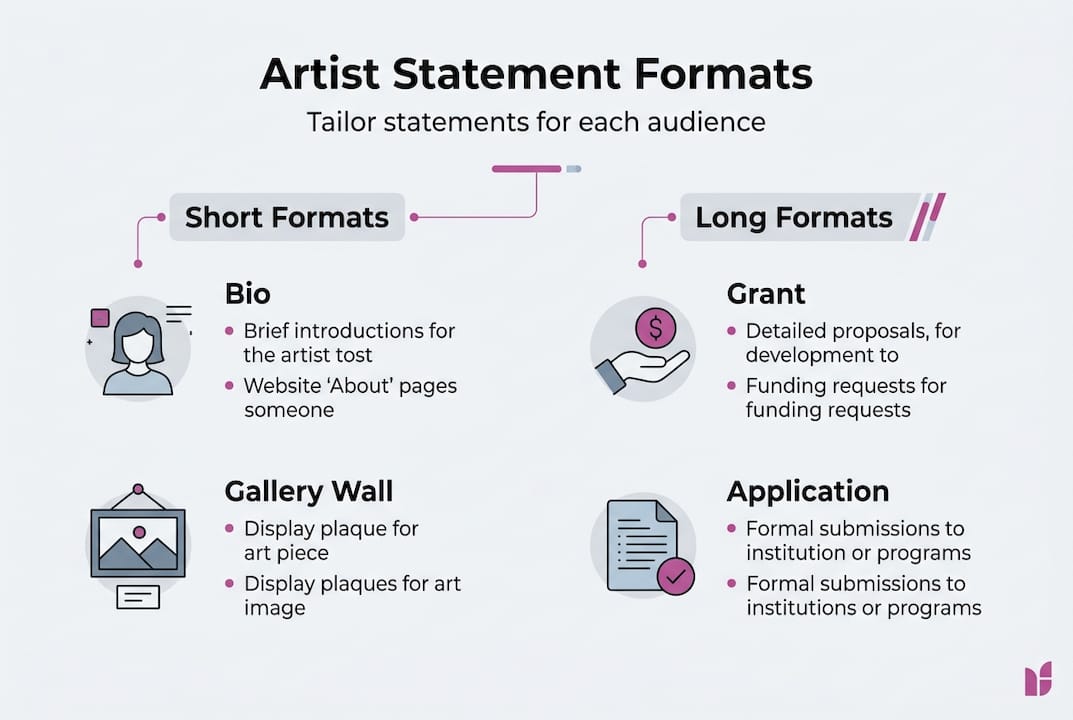
Recommended lengths vary by context: 50 words for bios and social media, 100 to 150 words for gallery walls and exhibitions, 150 to 300 words for standard applications and websites, and 250 to 500 words for grants and residency applications.
| Context | Word count | Primary goal |
|---|---|---|
| Social media bio | 50 words | Quick impression |
| Gallery wall label | 100 to 150 words | Immediate context |
| Website about page | 150 to 300 words | Collector confidence |
| Grant or residency | 250 to 500 words | Demonstrate depth |
Tone stays consistent across versions: present tense, active voice, first person. What changes is depth and emphasis. Tailor each version to context: grant statements emphasize intentionality and artistic development, while gallery statements connect directly to what is on the wall. Multiple versions are recommended.
Here is what to adjust for each audience:
- Gallery curators: Prioritize the central idea and the visual experience
- Grant panels: Emphasize how your practice is developing and what this project adds to it
- Collectors: Focus on meaning, mood, and why this work belongs in a home
- Press and media: Lead with your most quotable, clear sentence
Your reason for making art is the constant. How you frame that reason shifts depending on who is reading it and why. Understanding gallery wall presentation also helps you see how your words land in a physical context.
Pro Tip: Keep a master document with all your statement versions labeled by context and word count. When a new application comes in, you adapt rather than start from scratch. This saves hours and keeps your voice consistent.
With an understanding of structure and tone, it is time to focus on writing, editing, and refining your statement.
Common mistakes and best practices for writing artist statements
Knowing what to write matters less than knowing what to cut. Most first drafts have the right ideas buried under language that obscures them.
Common mistakes include jargon and art-speak, vague adjectives and clichés like “unique” or “beautiful,” listing influences or biographical details, passive voice construction, and statements that run too long.
Here is a checklist of what to eliminate in your edit:
- Phrases like “I explore” or “I seek to” (show the work instead)
- References to artists who inspired you (they have their own statements)
- Adjectives that do not carry specific meaning: beautiful, powerful, unique, dynamic
- Sentences beginning with “My work is about…” followed by an abstraction
- Any sentence that could describe another artist’s work without changing a word
The editing process should follow a clear sequence: brainstorm and journal freely, write a full draft, edit with the goal of cutting 20 percent, share with someone outside the art world for feedback, and revise based on what they did not understand. Update whenever your practice shifts significantly.
Here is a step-by-step revision sequence:
- Read the draft aloud. Mark every sentence that slows you down.
- Cut any sentence that could appear in another artist’s statement unchanged.
- Replace every vague adjective with a specific observation.
- Ask one non-artist to read it and explain back what you make and why.
- Revise based on their explanation, not their praise.
“Authenticity over pretense: your statement should read like a polished conversation, not a grant committee’s idea of what art sounds like.”
Art that connects to ideas of awareness and meaning deserves a statement that conveys those qualities without forcing them. When you are also thinking about gallery wall presentation and personal style, a clear statement ties the visual and the verbal together.
Having reviewed best practices, let us explore what happens when you get your artist statement right.
A fresh perspective: What separates a memorable artist statement from a forgettable one
Most guides tell you to follow a template. Fill in your medium, your theme, your intention. Done. But formulaic statements blend together. Curators read hundreds. What they remember is a statement that sounds like a specific person, not a category of artist.
Some statements are poetic and personal, while others are direct and process-focused. The right approach matches your voice and your practice, not a format someone handed you.
For visual artists, process detail often grounds a statement. For writers or performers, motivation and emotional truth carry more weight than methodology. The structure adjusts. The specificity stays constant.
The practical wisdom here is simple: show, do not tell. Instead of saying your work “explores identity,” name the specific object, place, or moment that sparked it. That specificity is what makes a statement memorable. A statement art piece’s impact scales with the clarity behind it. Your words are part of the artwork.
Showcase your art with Eman’s Gallery
A polished artist statement is your professional foundation. Once you have it, the next step is putting your work in front of the right audience.
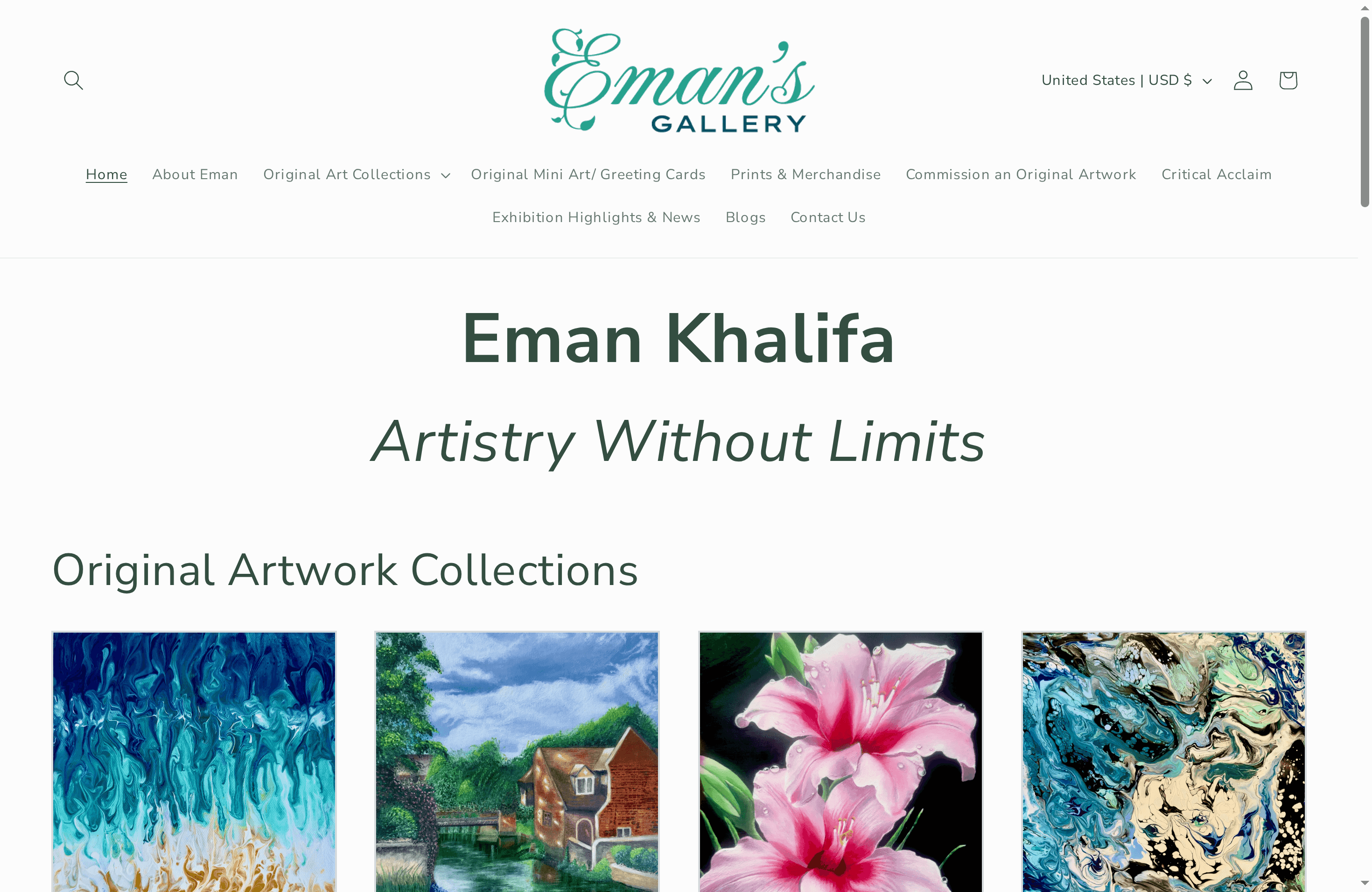
Eman’s Gallery offers original handmade paintings and museum-quality canvas prints by artist Eman Khalifa, shipped worldwide. Whether you are building a portfolio or looking for examples of how professional work is presented, browsing wall art prints gives you a clear benchmark. Original works like Good Tidings and canvas editions like Fragments of Memory show how visual work and professional presentation connect to support a serious art practice.
Frequently asked questions
How long should my artist statement be for a gallery wall?
For gallery walls, aim for 100 to 150 words to keep your statement concise and immediately readable for visitors.
Should I use first person or third person in my artist statement?
Always write in first person. First person, present tense, and active voice are standard for artist statements because they communicate authenticity and directness.
What’s the most common artist statement mistake?
Using jargon, vague adjectives, and over-length is the most frequent problem. Readers outside the art world should understand your statement without a glossary.
Can I use the same statement for grants and exhibitions?
No. Tailor each version to context and keep multiple versions ready. Grant statements need more depth on intent and development; exhibition statements prioritize clarity for a general audience.
How often should I update my artist statement?
Update your statement whenever your practice or themes shift significantly. Revise it before major applications so it reflects your current work, not where you were two years ago.
Recommended
- Statement Art Piece: Transforming Interior Spaces
- Role of Artist in Design Projects: Impact and Value - Eman’s Gallery
- Why Art Matters at Home: Elevate Living Spaces
- Role of Art in Self-Expression for Luxury Spaces
Stay Connected
- ✨ Explore Eman Khalifa’s original art and fine art prints
- 📸 Follow Eman Khalifa’s art journey on: Instagram @emans_gallery and Facebook Eman’s Gallery
- 📹 Watch Eman Khalifa creating live art on: YouTube @emans_gallery
