


What is print on demand? A clear guide for art lovers
TL;DR:
- Print on demand is a flexible, inventory-free fulfillment method for artists and hobbyists.
- Success relies on building a large design portfolio and actively marketing on social platforms.
- Quality control issues like color shifts and misalignment require careful testing and sample orders.
Print on demand is often sold as a quick side hustle with minimal effort and automatic income. That picture is not accurate. The reality is a structured, flexible business model that lets artists and hobbyists sell custom merchandise without holding a single unit of inventory. This guide covers exactly what print on demand is, how it works step by step, where quality can break down, and what it genuinely takes to succeed as a creative seller. Whether you are an art collector curious about how merchandise is made, or a hobbyist ready to launch your first product, this guide gives you a clear, factual picture.
Table of Contents
- Understanding print on demand
- Print on demand versus traditional printing
- Quality and fulfillment challenges in print on demand
- Success factors and pitfalls for art-focused POD sellers
- Why print on demand is a creative playground but not a shortcut
- Discover unique art merchandise and original artworks
- Frequently asked questions
Key Takeaways
| Point | Details |
|---|---|
| No inventory risks | Print on demand lets artists sell custom merchandise without managing stock or upfront investment. |
| Quality and marketing matter | Success depends on reviewing samples, tracking issues, and continuously promoting your work. |
| Volume drives income | Most artists need hundreds of designs and active traffic building to earn steady income from print on demand. |
| Creativity over shortcuts | Print on demand is best for experimenting and building an art brand, not for instant, passive profits. |
Understanding print on demand
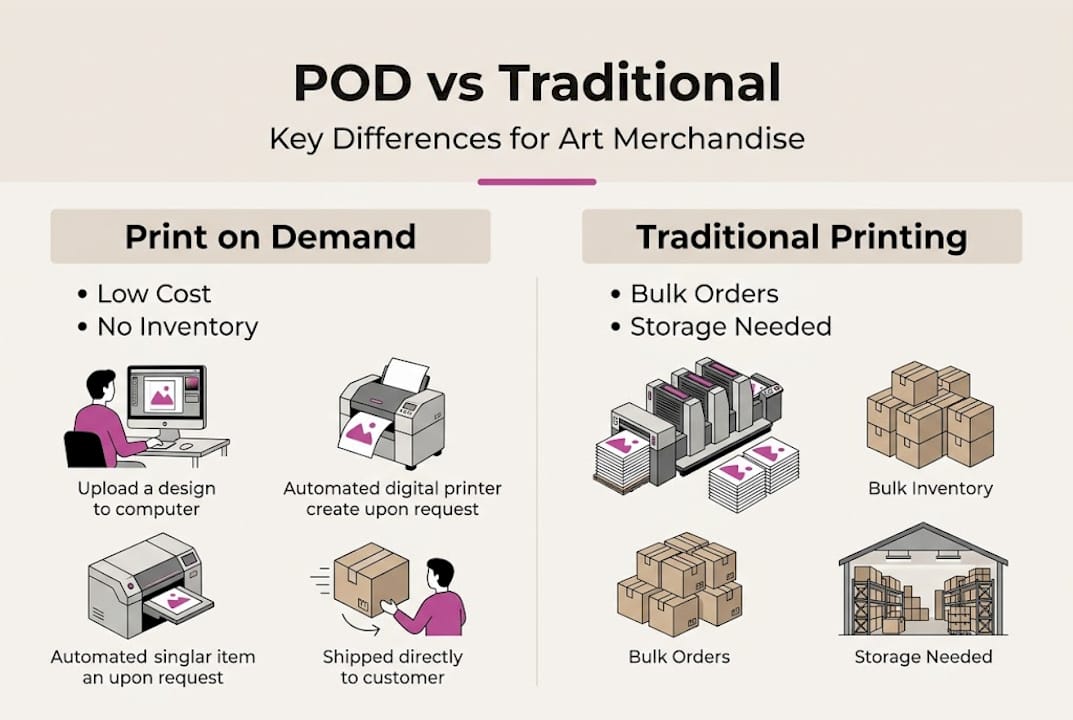
Print on demand (POD) is a fulfillment method where products are only manufactured after a customer places an order. There is no bulk production run, no warehouse full of unsold stock, and no upfront investment in physical goods. A customer orders a tote bag printed with your artwork, the POD platform produces it, and the item ships directly to the buyer. You never touch the product.
Here is how the process works from start to finish:
- Upload your design. You submit your artwork file to a POD platform such as Printful, Printify, or Redbubble.
- List your product. You choose which items to apply the design to, set your retail price, and publish the listing on your store or marketplace.
- Customer orders. A buyer purchases the item through your storefront.
- Platform prints and ships. The POD provider prints the design on the chosen product and ships it directly to the customer.
- You receive your margin. You keep the difference between your retail price and the platform’s base cost.
Artists and creatives choose POD for several practical reasons. There is no inventory risk, which means you can experiment with new designs without financial exposure. You can offer a wide range of products, from art prints and canvas panels to t-shirts, mugs, and throw pillows, all from a single artwork file. Learning how art prints are made helps you understand which file formats and resolutions produce the sharpest results on each product type.
POD is a low-risk, inventory-free way for artists to sell products, but income is not automatic. The platform handles logistics, but you are responsible for driving traffic, managing customer expectations, and maintaining design quality.
Pro Tip: Always order a physical sample of any new product before listing it publicly. What looks sharp on screen can print differently depending on the substrate, ink type, and printer calibration used by the fulfillment partner.
Print on demand versus traditional printing
Understanding how POD compares to traditional printing helps you make smarter decisions about which approach fits your goals.
| Factor | Print on demand | Traditional printing |
|---|---|---|
| Upfront cost | Low to none | High (bulk minimum orders) |
| Profit margin | Lower (typically around 20%) | Higher at volume |
| Quality control | Variable by provider | More consistent |
| Speed to market | Fast | Slower setup |
| Risk | Low | Higher |
| Color accuracy | Can shift between runs | More predictable |
POD has lower margins around 20% and less quality control compared to traditional bulk print methods. That tradeoff is acceptable when you are testing a new design or entering a new product category. Traditional printing becomes more cost-effective once you know a specific product sells reliably and you can commit to a minimum order quantity.
When POD works best:
- Testing new artwork or design concepts with zero financial risk
- Offering a wide product catalog without managing stock
- Selling to a global audience through multiple platforms simultaneously
- Starting a creative business with limited capital
When traditional printing is the better choice:
- You need consistent Pantone-matched color across a large run
- You are producing high-end finishes like foil stamping or embossing
- Your per-unit cost needs to be as low as possible for competitive pricing
- You already have confirmed demand for a specific product
A common misconception is that POD is effortless and highly profitable from day one. The platform handles fulfillment, but the margin per sale is narrow. Reviewing an art prints on merchandise comparison and a art print merchandise comparison can help you identify which product types deliver the best value for your specific artwork style.
Quality and fulfillment challenges in print on demand
Quality is the most frequently underestimated challenge in POD. Because you are not present during production, variability is built into the process.
The most common print issues include:
- Color shifts: Colors on screen (RGB) often appear differently when printed (CMYK). Blues can shift toward purple, and saturated reds may appear muted.
- Misalignment: Designs can print slightly off-center, especially on apparel where fabric movement during printing causes drift.
- Low-resolution output: Uploading artwork below 300 DPI results in blurry or pixelated prints, particularly on large-format products.
| Issue | Frequency | Primary cause |
|---|---|---|
| Color shift | High | RGB to CMYK conversion |
| Misalignment | Moderate | Substrate movement during print |
| Low resolution | Moderate | Incorrect file preparation |
| Shipping delay | Variable | Production backlog or customs |
Order samples due to variability across providers; top issues include color shifts, misalignment, and return rates of around 2 to 3%. Ordering samples before launch is not optional if you care about your reputation as a seller.
Fulfillment delays are a separate challenge. Most POD platforms combine production time (2 to 5 business days) with shipping time. During peak seasons, this can extend to 2 to 3 weeks. Localizing your fulfillment by choosing a POD provider with print facilities close to your primary customer base significantly reduces delivery windows.
For guidance on achieving sharper output, resources on getting high-quality art prints and evaluating custom art print services provide practical benchmarks for file preparation and provider selection.
Pro Tip: Track every return by reason code, whether it is color, size, damage, or delay. After 20 to 30 returns, patterns emerge that point directly to fixable production or listing issues.
Success factors and pitfalls for art-focused POD sellers
Most artists who try POD and quit within three months share the same story: they listed a handful of designs, saw minimal sales, and concluded the model does not work. The model works, but not the way most people expect.
Here is what successful art-focused POD sellers actually do:
- Build design volume. Success requires launching 200 to 500 designs, persistent marketing, and realistic margin expectations. A catalog of five designs will not generate consistent income.
- Drive their own traffic. Pinterest and Instagram are the primary organic traffic sources for art merchandise. Consistent posting, keyword-optimized boards, and community engagement build discoverability over time.
- Iterate based on data. They track which designs sell, which products convert, and which customer segments respond. They drop what does not work and expand what does.
- Protect their brand. They maintain their own website or art brand presence alongside marketplace listings on Etsy or Redbubble.
Common pitfalls to avoid:
- Relying solely on marketplace algorithms for all traffic and visibility
- Ignoring customer feedback on sizing, color, or product quality
- Using AI-generated artwork without verifying commercial licensing rights
- Setting prices too low to compete on marketplaces, which erodes already thin margins
- Neglecting product photography and mockup quality, which directly affects conversion rates
For a structured overview of what works across different product categories, reviewing best art merchandise strategies offers practical direction on product selection and positioning.
Pro Tip: Use Etsy and social media platforms to build initial traffic, but always maintain your own art brand site. Marketplace policies change, and owning your audience and storefront gives you long-term control that no third-party platform can take away.
Why print on demand is a creative playground but not a shortcut
Most guides focus on the mechanics of POD and skip the harder conversation about expectations. The appeal of listing a design and waiting for passive income is real, but it is also misleading. The artists who get the most from POD are not chasing quick revenue. They are using the model to experiment with new formats, test audience response to different styles, and build a direct relationship with collectors and buyers over time.
The best use of POD is not as a primary income source from day one. It is as a low-cost laboratory. You can test whether your abstract paintings translate well to throw pillows, or whether your geometric work resonates more as a canvas print versus a tote bag, without committing to bulk production runs.
Reviewing an art print shops comparison helps identify which platforms align with your quality standards and target audience. Most artists who succeed with POD long-term treat it as one channel in a broader creative business, not the entire business itself.
Discover unique art merchandise and original artworks
Ready to see print on demand in action or support original artists? Eman’s Gallery offers museum-quality canvas prints and original handmade paintings by artist Eman Khalifa, shipped worldwide from fulfillment centers across the UK, USA, Canada, Australia, and Europe.
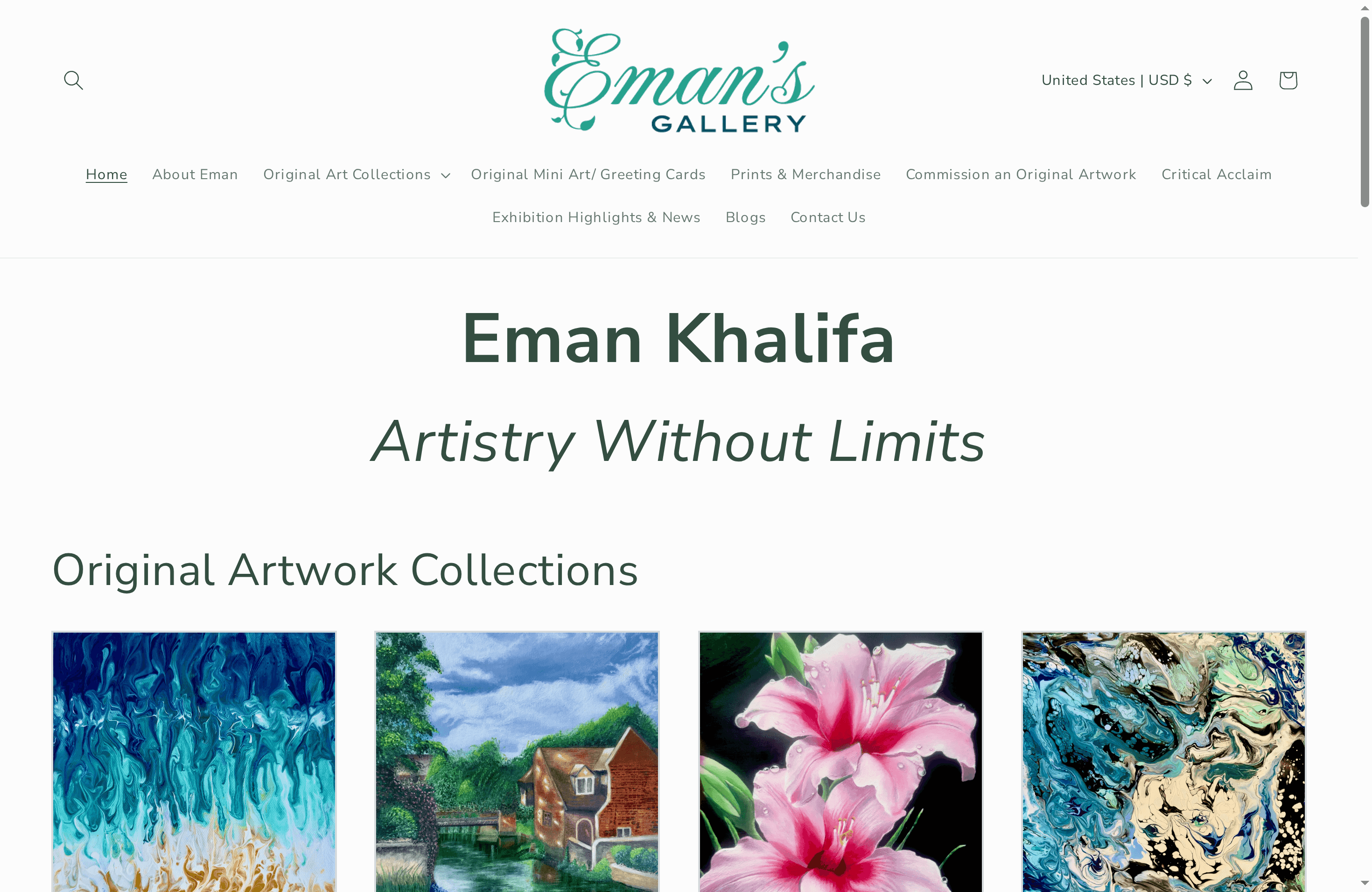
Browse the Private Eye canvas print and the Fragments of Memory canvas print to see how high-resolution artwork translates to print. The full wall art prints collection includes abstract, geometric, floral, and landscape works available as canvas prints and original paintings. Whether you are an art collector, interior designer, or gift buyer, the gallery offers a curated selection of one-of-a-kind pieces and quality print merchandise.
Frequently asked questions
How does print on demand work for art merchandise?
Print on demand lets you upload your artwork to a platform that prints and ships merchandise like prints or shirts when someone orders. It is a low-risk, inventory-free model where artwork is made to order, so no stock is held at any point.
How much money can an artist make with print on demand?
Most artists make $500 to $2,000 a month if they create hundreds of designs and drive their own marketing. Success requires high design volume and sustained marketing effort, not just listing products and waiting.
What are the main quality issues with print on demand?
The most common problems are color differences, misalignment, and occasional shipping delays. Top quality issues are color shifts, misalignment, and printer errors, so ordering test prints before selling is essential.
Can I use AI-generated art for print on demand?
Yes, but you must have clear commercial licenses for the AI art, especially on platforms like Etsy. AI art needs licensing documentation for sale via print on demand, and platforms may remove listings that lack proper rights verification.
Recommended
- What Is an Art Print? Complete Guide for 2025 - Eman’s Gallery
- Why Artists Make Prints: Complete Expert Guide - Eman’s Gallery
- Complete Guide to Why Collect Art Prints - Eman’s Gallery
- Art Print Terminologies: Complete Reference Guide - Eman’s Gallery
Stay Connected
- Explore Eman's Gallery Original Mini-Art Cards, hand-painted by Eman Khalifa
- ✨ Explore Eman Khalifa’s original art, fine art prints & art merchandise
- 📸 Follow Eman Khalifa’s art journey on: Instagram @emans_gallery and Facebook Eman’s Gallery
- 📹 Watch Eman Khalifa creating live art on: YouTube @emans_gallery
