


What is pop art? Origin, meaning, and modern impact
TL;DR:
- Pop art challenged traditional art by incorporating mass media, consumer objects, and celebrity images.
- It uses techniques like silkscreen printing, collage, and repetition to blur art and commercial culture.
- The movement remains influential in contemporary decor and culture, emphasizing bold visuals and conceptual depth.
Pop art elevated soup cans, comic strips, and celebrity photos into fine art, and that alone was enough to outrage critics and captivate audiences. Emerging in the mid-1950s in Britain and spreading rapidly to the United States by the late 1950s, pop art challenged every assumption about what belonged in a gallery. It borrowed from advertisements, product packaging, and mass media, then presented those familiar images with total seriousness. This article covers how the movement started, what defines it visually and conceptually, who shaped it most, and why its influence continues to show up in homes, museums, and online culture today.
Table of Contents
- The origins of pop art: From Britain to America
- Defining pop art: Characteristics, techniques, and signature imagery
- Iconic pop artists and their works: From Hamilton to Warhol
- Critique and impact: Celebration or societal critique?
- Why most explanations of pop art miss its deeper meaning
- Bring pop art inspiration into your own space
- Frequently asked questions
Key Takeaways
| Point | Details |
|---|---|
| Roots in consumer culture | Pop art arose from a fascination with mass media and everyday imagery. |
| Critical and playful | The movement both poked fun at and critiqued society’s obsession with consumerism. |
| Lasting artistic impact | Pop art’s legacy still shapes contemporary visual culture and home decor. |
| Accessible and democratic | Pop art made modern art approachable for a wider audience. |
The origins of pop art: From Britain to America
Pop art did not arrive fully formed. It grew out of frustration with Abstract Expressionism, which dominated the art world in the late 1940s and early 1950s. Abstract Expressionism valued raw emotion and personal gesture above all else. Pop artists looked at that approach and turned it on its head by embracing exactly what fine art had always excluded: mass-produced imagery, brand logos, and commercial design.
Pop art emerged in the mid-1950s in Britain before gaining momentum in the United States, though the two scenes developed along very different lines. The British version was intellectual and analytical. The Independent Group, a collective of artists, architects, and critics that met at the Institute of Contemporary Arts in London, treated mass culture as serious subject matter worth examining. Members like Richard Hamilton and Eduardo Paolozzi studied American magazines, advertisements, and product catalogs as cultural artifacts, not as entertainment.
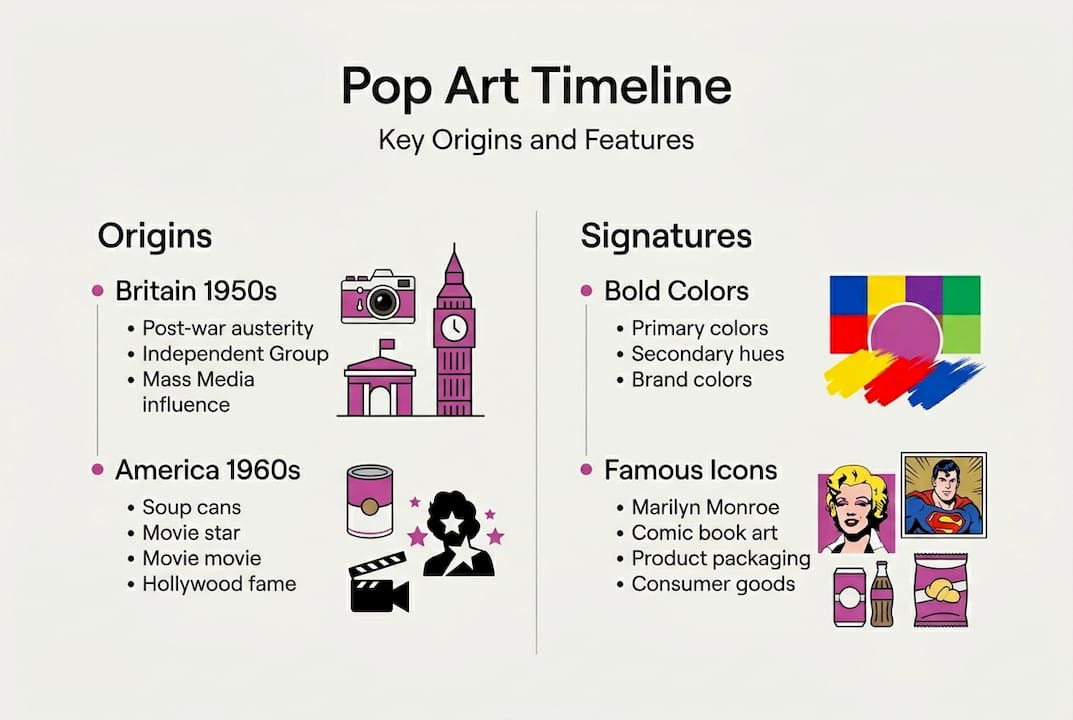
The American pop art scene took a different approach. It was faster, louder, and less theoretical. American artists were living inside consumer culture rather than observing it from a distance. They responded with irony, deadpan humor, and a deliberate flattening of the distinction between high and low culture. Galleries in New York began showing these works in the early 1960s, and the public reaction was immediate.
Key differences between British and American pop art:
- British pop art: Intellectual, rooted in cultural criticism, influenced by transatlantic media imports from the US
- American pop art: Ironic, high-energy, directly embedded in consumer experience
- Tone: British works often questioned consumer culture; American works appeared to revel in it
- Imagery: Both used brand imagery and media, but American artists scaled it up dramatically
| Feature | British pop art | American pop art |
|---|---|---|
| Origin decade | Mid-1950s | Late 1950s to early 1960s |
| Primary influence | Imported American media | Domestic consumer culture |
| Tone | Analytical, critical | Ironic, celebratory |
| Key figures | Hamilton, Paolozzi | Warhol, Lichtenstein |
| Scale | Modest, collage-based | Often large-format, bold |
You can see how this tension between critique and celebration continued to define pop art everywhere it traveled. If you are curious how these same themes of repetition and bold imagery translate to art prints on merchandise, the parallels to pop art’s use of mass reproduction are worth exploring. Understanding what made top art print merchandise visually compelling also connects back to how pop art treated image-making as both art and product simultaneously, which was a genuinely radical stance in the pop art glossary of the era.
Defining pop art: Characteristics, techniques, and signature imagery
With an understanding of pop art’s roots, let’s unpack what visually and conceptually sets it apart. Pop art is instantly recognizable, but its visual identity is the result of very deliberate choices about subject matter, color, and process.
Pop art drew its imagery from advertisements, comic books, and everyday objects, treating these sources as valid raw material for serious artistic expression. The result was a visual language that felt familiar to anyone who had ever read a newspaper, watched television, or walked through a grocery store.
Common pop art motifs include:
- Comic strip panels: Bold outlines, speech bubbles, Ben-Day dots
- Brand packaging: Soup cans, cola bottles, cigarette boxes
- Celebrities: Marilyn Monroe, Elvis Presley, Mao Zedong
- Advertisements: Cropped slogans, product close-ups, smiling consumers
- Food and household objects: Flags, targets, dollar signs
Pop art’s techniques were just as distinctive as its subjects. Silkscreen printing allowed artists to reproduce images mechanically, producing multiples that blurred the line between original artwork and mass production. Collage combined clippings from magazines and newspapers into layered compositions. Bold, flat colors replaced painterly gradation. Repetition was not a limitation but a strategy.
“The thing about pop art is that it made you look twice at things you had stopped seeing entirely.”
Pro Tip: When you notice deliberate imperfections in pop art prints, such as slightly misaligned colors or uneven ink coverage, those are not mistakes. Artists like Warhol used these printing irregularities to draw attention to the mechanical nature of mass production itself, turning flaws into conceptual statements about commodification.
For anyone thinking about using art prints in home decor, pop art’s approach offers a useful lesson: bold, simple imagery holds visual weight across large surfaces. Exploring types of home decor art shows how pop art’s graphic clarity continues to influence contemporary interior choices. The movement also helped define what makes a pop art definition distinct from related movements like Dada or Neo-Expressionism.

Iconic pop artists and their works: From Hamilton to Warhol
To further grasp pop art, let’s look at the creative minds and iconic pieces that brought the movement to life. Major pop artists include Richard Hamilton, Eduardo Paolozzi, Andy Warhol, Roy Lichtenstein, Jasper Johns, Robert Rauschenberg, and Claes Oldenburg, each contributing a distinct voice to the movement.
| Artist | Nationality | Landmark work | Key contribution |
|---|---|---|---|
| Richard Hamilton | British | Just What Is It That Makes Today’s Homes So Different, So Appealing? | Collage as cultural criticism |
| Eduardo Paolozzi | British | I Was a Rich Man’s Plaything | Early use of mass media imagery |
| Andy Warhol | American | Campbell’s Soup Cans, Marilyn Diptych | Silkscreen, celebrity, repetition |
| Roy Lichtenstein | American | Whaam!, Drowning Girl | Comic strip aesthetic, Ben-Day dots |
| Jasper Johns | American | Flag, Target with Four Faces | Everyday symbols as art objects |
| Robert Rauschenberg | American | Bed | Combines: mixed media and found objects |
| Claes Oldenburg | American | Soft sculptures of everyday objects | Scale and material subversion |
Here are five landmark works that define the movement:
- Campbell’s Soup Cans (Warhol, 1962): 32 canvases, each depicting a different Campbell’s soup variety. Warhol presented them in a grid, forcing viewers to treat commercial packaging as fine art.
- Whaam! (Lichtenstein, 1963): A large-scale painting directly based on a comic book panel, complete with Ben-Day dots and onomatopoeia.
- Just What Is It… (Hamilton, 1956): A collage assembled from American magazine clippings, often cited as the first true pop art work.
- Flag (Johns, 1954 to 1955): An American flag painted in encaustic, raising the question of whether a painting of a flag is a painting or a flag.
- Soft Typewriter (Oldenburg, 1963): A vinyl sculpture of a typewriter, rendered limp and useless, mocking the status of everyday objects.
If you are interested in buying contemporary paintings that carry some of this visual energy, understanding how these artists approached subject matter can sharpen your eye for what makes an artwork genuinely original versus merely decorative. For deeper context, the pop art authority at Oxford Reference traces how these figures were received by critics and collectors.
Critique and impact: Celebration or societal critique?
Understanding pop art’s creators leads to the bigger question: what does all this signify for society and art? The debate has never fully settled. British pop art tended toward intellectual critique, while American pop art operated with more irony, but both strands raised the same uncomfortable question: is this art celebrating consumer culture or exposing its absurdity?
Arguments on both sides remain credible:
- Celebration: Pop artists glorified commercial imagery with the same scale and reverence previously reserved for religious or historical subjects
- Critique: Repetition and mechanical reproduction stripped the glamour from celebrity and brand imagery, revealing the emptiness beneath
- Mirror: Some scholars argue pop art simply reflected consumer society back at itself, neither approving nor condemning
- Democratization: By making art from common imagery, pop art lowered the barrier between artist and audience
Warhol’s mass production approach critiqued commodification while simultaneously participating in it, a contradiction that made his work endlessly debatable. Pop art also helped shape postmodernism by dismantling the idea that art required a unique, sacred object made by hand.
“Pop art did not ask you to admire skill. It asked you to question what you were looking at and why.”
Pro Tip: When visiting auction results for pop art, notice that Warhol, Lichtenstein, and Hockney consistently achieve record prices. This is not nostalgia. It reflects how central these works are to the story of modern Western culture, and collectors know it.
Pop art’s visual language continues to shape contemporary interiors. If you want to apply this thinking practically, guidance on choosing art prints for home reflects many of the same principles: bold color, strong graphic identity, and imagery that holds attention. Advice on displaying art prints in modern spaces draws directly from the lessons pop art taught about scale and visual impact.
Why most explanations of pop art miss its deeper meaning
Most introductions to pop art stop at the surface: bright colors, funny subjects, Warhol made soup cans famous. That reading is accurate but incomplete. Pop art was not simply fun. It was philosophically loaded from the start.
The movement had direct roots in Dada, the early 20th-century movement that elevated readymade objects into art by placing them in a gallery context. Pop art continued that logic, arguing that the framing of an object determines its meaning more than the object itself. When you repeat an image 32 times, you are not honoring it. You are dissecting it.
Repetition is where the real critique lives. When Warhol printed the same celebrity face across a canvas with slight color shifts, he was showing how mass media flattens individuals into products. The imperfections in printing were not accidents. They were the point.
This logic maps directly onto today’s internet culture. Memes work exactly like pop art: they take a recognizable image, strip it of context, repeat it across platforms, and gradually hollow it out until only the shell remains. Pop art predicted this dynamic decades before social media existed. Understanding that connection makes the movement far more relevant than most gallery labels suggest. Exploring how styling art prints intersects with this visual language can help you choose works that carry genuine conceptual weight, not just surface appeal.
Bring pop art inspiration into your own space
Ready to bring pop art’s visual energy into your home or office? At Eman’s Gallery, original handmade paintings and museum-quality canvas prints draw from the same bold graphic traditions that pop art put on the map.
The Private Eye canvas print is a strong example of how contemporary art channels pop art’s directness and visual confidence. For a wider selection, the contemporary realism collection features original works that balance clarity and depth. If you are decorating a specific space, the original artworks for home decor collection is organized to help you find the right scale and style. Eman’s Gallery ships worldwide from the UK, USA, Canada, Australia, and beyond.
Frequently asked questions
Who are the most famous pop artists?
Andy Warhol and Roy Lichtenstein are the most widely recognized, while British pioneers Richard Hamilton and Paolozzi were equally foundational to the movement’s intellectual origins.
How did pop art influence home decor?
Pop art introduced bold graphics and accessible imagery into everyday spaces, and the movement’s democratization of art made it acceptable to hang visually striking, non-traditional works in domestic interiors.
Is pop art considered a critique of consumerism?
Yes, though the debate continues. Contrasting readings frame pop art as either a celebration, a mirror, or a critique of consumer culture, and the ambiguity was often intentional.
What techniques define pop art?
Silkscreen printing, collage, flat bold colors, and deliberate repetition are the core techniques. Imagery drawn from advertisements and comic books provided the raw visual material that artists then recontextualized.
Recommended
- History of Art Prints: Legacy and Modern Impact - Eman’s Gallery
- Popular art genres: Find the perfect style for your collection
- Contemporary Wall Art Explained: Full Overview - Eman’s Gallery
- Minimalist Art Explained: Principles, History, and Impact
- Why Graphic Tees Are Popular: Expression, Trends, and Culture – 3 Wizard Clothing
Stay Connected
- ✨ Explore Eman Khalifa’s original art and fine art prints
- 📸 Follow Eman Khalifa’s art journey on: Instagram @emans_gallery and Facebook Eman’s Gallery
- 📹 Watch Eman Khalifa creating live art on: YouTube @emans_gallery
