


Master line drawing: techniques, styles, and expert tips
TL;DR:
- Line drawing enhances observation skills and adds expressiveness to all artistic work.
- Techniques like contour, hatching, and stippling create different textures and depth with lines.
- Varying line quality and weight dramatically improve the realism and emotional impact of art.
Line drawing is one of the oldest and most demanding art forms in existence, yet many artists overlook it in favor of color, texture, and mixed media. A single well-placed line can communicate volume, movement, and emotion with no shading, no pigment, and no fill. Whether you are a beginner building foundational skills or an experienced artist looking to sharpen your technique, understanding line drawing opens a level of control and expressiveness that directly improves everything else you create.
Table of Contents
- What is line drawing? (Definition and fundamentals)
- Core techniques every line artist should know
- Essential elements: Line quality, weight, and negative space
- Comparing line drawing styles: From tradition to modern digital
- Practical exercises and real-world applications
- Why mastering line drawing matters more than you think
- Explore and collect line drawing art
- Frequently asked questions
Key Takeaways
| Point | Details |
|---|---|
| Foundational skills | Line drawing is the basis for mastering all forms of visual art, helping you see and create with clarity. |
| Technique diversity | There are multiple styles and methods—from hatching to continuous line—that suit expressive or realistic goals. |
| Expressive possibilities | Adjusting line quality, weight, and spacing brings life, depth, and movement to your drawings. |
| Cultural and digital variety | Styles range from traditional ink to digital tools, with cultural nuances influencing the way lines are used. |
| Practical application | Practical exercises and mindful practice grow both skill and personal expression in drawing and décor. |
What is line drawing? (Definition and fundamentals)
Line drawing, also known as line art or lineart, is a form of visual art composed primarily of lines such as contour lines, cross-hatching, or stippling, without broad tonal shading or color fills, used to define shapes, imply depth, texture, and movement. That definition covers a wide range of approaches, from architectural blueprints to botanical illustration to manga panels.
Unlike painting or pastel work, line drawing relies solely on the marks you make with a pen, pencil, or stylus to carry the full visual weight of the composition. There are no washes of color to fall back on, no blended shadows to cover imprecise edges. The line is the art.
This discipline sits at the core of artistic education for good reason. Drawing with lines trains your eye to observe edges, proportions, and spatial relationships before anything else. Painters, sculptors, and digital artists who return to line drawing consistently report sharpened observation skills and more confident mark-making across all their work. Line drawing also appears across many types of home decor art, from framed botanical prints to geometric wall pieces, showing its relevance far beyond the sketchbook.
Key functions of line in visual art include:
- Defining shape: Outlines and contours establish the boundaries of objects and figures.
- Implying depth: Overlapping lines and varying density create the illusion of space.
- Suggesting movement: Gestural and directional lines guide the viewer’s eye through the composition.
- Creating texture: Repeated marks like hatching and stippling simulate surface quality.
- Establishing focus: Bold lines draw attention; lighter lines recede.
Core techniques every line artist should know
With a foundation set, let’s explore how these ideas come to life with proven techniques. Line drawing is not one single method. It is a collection of distinct techniques, each suited to different effects and skill levels.
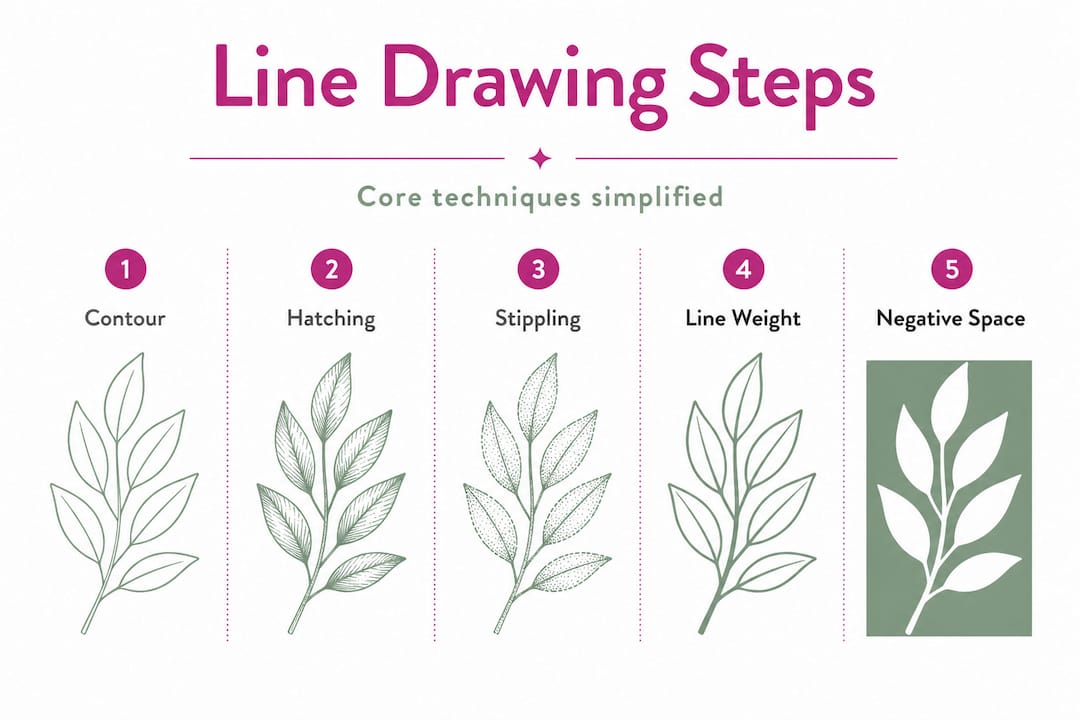
According to drawing fundamentals research, the primary methodologies in line-based mark making include contour drawing, hatching, cross-hatching, stippling, gesture drawing, and continuous or one-line drawing.
Here is a practical breakdown of each:
- Contour drawing: You trace the outer edges and interior edges of a subject. Blind contour drawing, where you look only at your subject and never at the paper, forces genuine observation and produces expressive, often surprising results.
- Hatching: You draw a series of parallel lines close together to suggest shadow, volume, or texture. The closer and darker the lines, the denser the tone appears.
- Cross-hatching: You layer hatching in two or more intersecting directions. This creates richer tonal depth and is widely used in engraving, printmaking, and pen illustration.
- Stippling: You build up images using only dots. The density of dots controls light and shadow. This technique is slow but produces fine, detailed results often seen in scientific illustration and portrait work.
- Gesture drawing: You make quick, fluid lines to capture the energy or movement of a figure or scene, usually within 30 seconds to two minutes. Gesture prioritizes expression over accuracy.
- Continuous or one-line drawing: You draw a subject without lifting your pen or pencil from the paper. The resulting image is simplified, often abstracted, and carries a distinct graphic quality popular in modern illustration and fashion design.
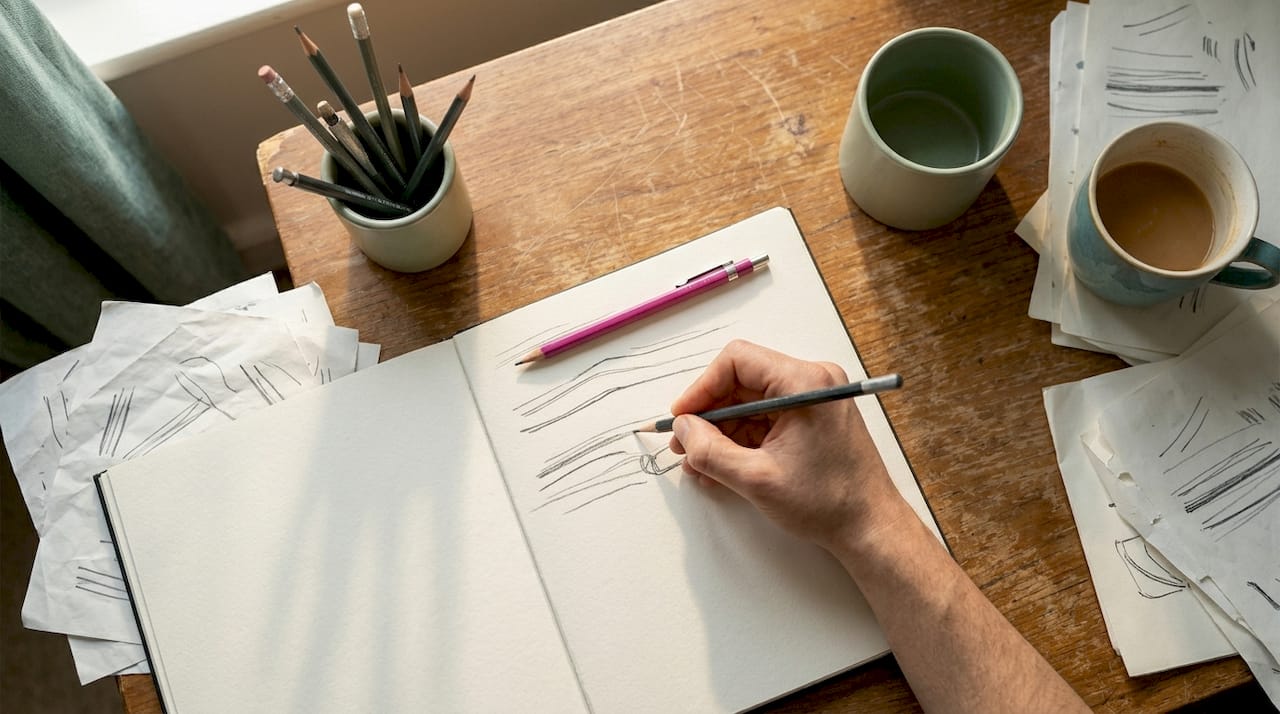
Pro Tip: Begin every new drawing session with five minutes of straight-line exercises. Draw sets of parallel horizontal, vertical, and diagonal lines as evenly spaced as possible. This warms up hand control and directly improves every technique above.
| Technique | Primary tool | Best for | Skill level |
|---|---|---|---|
| Contour | Pen, pencil | Proportion, observation | Beginner |
| Hatching | Pen, pencil, marker | Tone, volume | Beginner to intermediate |
| Cross-hatching | Fine liner, dip pen | Realism, shading | Intermediate |
| Stippling | Fine liner | Texture, detail | Intermediate to advanced |
| Gesture | Any | Movement, looseness | All levels |
| Continuous line | Pen | Abstraction, design | All levels |
Experimenting with wall art color tips alongside monochrome line work can also help you understand how value and contrast function independently of hue, a valuable lesson for any line artist.
Essential elements: Line quality, weight, and negative space
Understanding the motion of your hand matters, but the way you handle the very lines themselves can transform your art. Three elements control most of the expressive power in a line drawing: line quality, line weight, and negative space.
Research into drawing mechanics confirms that varying line weight suggests proximity, shadow, or delicacy, while line quality (smooth versus scratchy) contributes expressiveness, and thoughtful use of negative space builds composition and depth.
Line quality refers to the character of the line itself:
- Smooth lines convey control, calmness, and precision, ideal for technical illustration or architectural work.
- Jagged or scratchy lines suggest energy, nervousness, or roughness, and can add personality to figure drawing or expressive portraits.
- Broken lines imply partial visibility or fragility, useful when depicting translucent materials or suggesting distance.
Line weight is the thickness of your line. Thick lines advance toward the viewer and appear closer or heavier. Thin lines recede and feel lighter or more distant. Skilled artists vary line weight within a single object, making it feel three-dimensional without any shading at all. The outside contour of a figure might be heavy, while the internal details are rendered in finer lines to maintain clarity without visual noise.
“The difference between a flat drawing and a convincing one often has nothing to do with technique complexity. It comes down to deliberate control of line weight.” This principle applies whether you work in ink, pencil, or digitally.
Negative space is the area around and between your drawn subjects. Many beginners focus entirely on the subject and ignore the space it occupies. Drawing the negative shapes rather than the positive subject is a classic exercise that quickly improves compositional thinking. It is also a core principle in decorating with art, where the breathing room around a framed line drawing can be as deliberate as the artwork itself.
Pro Tip: Pick a simple object such as a chair or a pair of scissors and draw only using line weight variation, no hatching or stippling. Push the weight differences further than feels comfortable. The result will teach you more about depth than any shading exercise.
Key line quality considerations:
- Consistent smooth lines for technical precision and graphic design
- Varied jagged marks for expressive, gestural, and emotional work
- Deliberate broken lines to indicate texture, distance, or transparency
- Heavy-to-light transitions within a single form for three-dimensional effect
Comparing line drawing styles: From tradition to modern digital
Once these essential elements are familiar, experimenting with style can help you find your artistic voice. Line drawing exists in a wide range of cultural and stylistic traditions, and knowing the major categories helps you make intentional choices.
Research into contemporary line art confirms that traditional ink and pen work emphasizes discipline and precision, drawing on Renaissance contour traditions, while modern digital tools add pressure sensitivity and stabilization. Some artists prioritize minimalism (such as the Ligne Claire style with no hatching) against others who prefer the dense texture of copperplate cross-hatching.
Additionally, styles vary by culture: Baimiao from China uses rhythmic, even brushstrokes; Ligne Claire (associated with Belgian comics like Tintin) uses clean, uniform line weights with no hatching; manga uses speed lines and dynamic angles to convey motion. Each style suits specific scenarios. Continuous line drawing fits fashion illustration well. Cross-hatching is preferred for realistic portrait and scientific work.
| Style | Origin | Key features | Best application |
|---|---|---|---|
| Baimiao | Chinese art tradition | Rhythmic, even brush lines | Figurative, decorative |
| Ligne Claire | Belgian comics | Clean, uniform, no hatching | Comics, editorial |
| Manga | Japanese illustration | Speed lines, dynamic angles | Sequential, narrative |
| Copperplate | European printmaking | Dense, fine cross-hatching | Realism, portraiture |
| Digital minimal | Contemporary | Pressure sensitivity, smooth | Design, commercial |
Choosing a style depends on your medium, your subject, and your goal. A fashion designer working on editorial illustrations may favor the clean simplicity of continuous line or Ligne Claire. An artist illustrating a scientific textbook will reach for stippling or dense cross-hatching for its clarity and detail. Exploring original art gifts from different traditions can expose you to these styles in their finished, professional form and accelerate your understanding of what each achieves.
Practical exercises and real-world applications
After appreciating the range of styles, the next step is active hands-on practice and seeing real-world impact. The following exercises build line control systematically, from the most basic to more advanced.
Drawing fundamentals research confirms that line density and direction create a three-dimensional illusion, and beginner exercises like straight-line control and continuous outlines are ideal starting points. Separately, blind contour and imperfect overlaps in one-line art serve as expressive strengths rather than errors.
- Straight-line grids: Fill a page with evenly spaced horizontal lines, then vertical, then diagonal. Focus on consistent pressure and spacing. This is the most basic and most effective warm-up exercise.
- Contour drawing of a hand: Place your non-dominant hand on the paper and draw its outline slowly without looking at the page (blind contour). Repeat while looking. Compare the two. The blind version reveals how your eye actually perceives edges.
- Hatching value scales: Draw five small rectangles and fill them with hatching, going from very sparse to very dense across the five boxes. Repeat with cross-hatching. This builds tonal control quickly.
- Stippling a simple sphere: Draw a circle and stipple it from light at the top to dark at the base. Use dot clustering rather than shading lines. This trains patience and tonal gradation.
- Continuous line portrait: Set a timer for two minutes and draw a face without lifting your pen. The overlapping lines and distorted proportions that result are part of the technique, not failures.
- Negative space exercise: Choose an object with interesting shapes between its parts (a bicycle works well). Draw only the negative spaces around it, not the object itself. This retrains how you see composition.
Pro Tip: Do not erase or correct imperfect overlapping lines in continuous line drawings. Those overlaps add individuality and visual interest that clean, corrected lines never achieve. Many collectors and interior designers specifically seek out this quality in original line art.
Real-world applications for line drawing are broader than most artists realize. Illustration, architectural drafting, botanical and medical illustration, fashion design, comics, branding, and tattoo design all rely heavily on line work. For home decor and gift purposes, framed line drawings are among the most versatile art choices available. They complement almost any interior palette and scale well from small prints to large-format canvases. Browse unique art gift ideas for examples of how professional line-based artwork translates into memorable, display-ready pieces.
Why mastering line drawing matters more than you think
Most artists encounter line drawing early and move past it quickly, treating it as a stepping stone rather than a destination. That is a missed opportunity. The artists who return to rigorous line practice consistently report gains in observational accuracy, compositional instinct, and confidence across every medium they work in.
Color and paint allow a degree of correction and layering that line does not. A painted mistake can be overworked, blended, or covered. A line placed wrong is visible. That constraint forces the kind of deliberate observation that builds real skill faster than almost any other practice.
Many artists skip serious line technique because they find it frustrating early on. The lines wobble, the proportions shift, the stippling takes forever. But those same frustrations are what make line drawing such an efficient teacher. You see every error immediately. You correct it immediately. The feedback loop is tight and honest.
There is also the question of personal style. Artists often search for their “voice” through subject matter or color choices. In reality, line drawing reveals your hand in the most literal sense. The specific pressure you apply, the speed at which you work, the places where your contour line thickens or breaks: these are yours alone. Imperfections in line weight or the quirky rhythm of your hatching are not flaws to correct. They are the visual fingerprints that make original line work identifiable and genuinely personal.
Mastering line technique also accelerates progress in painting, digital illustration, and design work. A painter with strong line instincts plans compositions more effectively and handles edges more confidently. A digital illustrator who trained in traditional line drawing uses pressure-sensitive tools with greater purpose. For anyone considering an artful gift guide for a fellow artist, a set of quality drawing pens or a line drawing course resource is almost always the right call precisely because it addresses this foundational layer.
Explore and collect line drawing art
If you are eager to experience or own line drawing in its many forms, here is where to start.
Eman’s Gallery offers original handmade artworks and museum-quality canvas prints that demonstrate professional line-based composition in finished, collectible form. Whether you are decorating a living room, furnishing a workspace, or finding a gift for someone who appreciates art, line-inspired pieces offer timeless visual clarity.

The monochrome outline canvas print is a strong starting point for seeing how clean line work translates into large-scale wall art. For a broader selection of sizes and styles, the full range of wall art prints at Eman’s Gallery ships worldwide from the UK, USA, Canada, Australia, Germany, France, Italy, Spain, and beyond. Original line-based artwork is available for collectors, interior designers, and gift buyers at every level.
Frequently asked questions
What supplies do I need to start line drawing?
You will need a basic sketchbook, pencils or ink pens, and an eraser. Most beginners start effectively with just paper and a fine liner pen.
What is the difference between contour, hatching, and stippling?
Contour drawing traces the edges of a subject, hatching uses parallel lines for tone and shading, and stippling builds texture and value entirely through dots.
How can I use line drawing in home decor?
Line drawings work as versatile and elegant wall art, particularly in minimalist, modern, or Scandinavian-style interiors where clean graphic imagery holds visual focus without competing with other design elements.
Is digital line drawing different from traditional?
Digital tools offer pressure sensitivity and stabilization that traditional media does not, but the fundamental skills of contour, weight variation, and composition transfer directly from traditional practice to digital.
How do I improve my line control?
Practice straight lines and continuous outlines daily and deliberately vary your pressure during each session. Consistent repetition over even short daily sessions builds measurable control within a few weeks.
Recommended
- 7 Essential Tips for Exploring Different Art Mediums
- Art Styles Explained: Shaping Luxury Interiors - Eman’s Gallery
- Textured Artwork: Styles, Techniques & Uses - Eman’s Gallery
- Printmaking Techniques: Elevating Artistic Expression
- Top 3 Geschenkideen mit Zeichnungen 2026 | Picassify
Stay Connected
- ✨ Explore Eman Khalifa’s original art and fine art prints
- 📸 Follow Eman Khalifa’s art journey on: Instagram @emans_gallery and Facebook Eman’s Gallery
- 📹 Watch Eman Khalifa creating live art on: YouTube @emans_gallery
