


Common Art Themes Every Collector and Creator Should Know
TL;DR:
- Common art themes such as identity, migration, and ecology act as arguments that shape contemporary artworks’ meaning. Understanding these themes enhances critical appreciation, collection, and creative exploration, with institutions organizing programs around them. Recognizing what a work argues about its theme rather than just its style fosters deeper engagement and intentional collecting.
Common art themes are recurring subjects and motifs, including identity, migration, environmentalism, and memory, that connect contemporary artworks across mediums, movements, and cultures. Understanding these themes is the most direct path to deeper art appreciation, sharper collecting decisions, and stronger creative work. Institutions like Art21, the Fenix Museum of Migration, and major international biennials organize their entire programs around these recurring themes in art, confirming that thematic literacy is not optional for serious engagement with contemporary art. This article maps the most prominent themes, explains how artists deploy them, and shows how you can use thematic frameworks to guide your own exploration.
1. Common art themes and why they matter
Identity and the body/02%3A_Developing_a_Unified_Body_of_Work/2.04%3A_Themes_of_Art) are the most consistently foregrounded subjects in contemporary art, covering gender, ethnicity, disability, and resistance. These are not abstract concepts. They are the organizing arguments that determine whose reality gets represented and whose gets erased. When you understand what a work is arguing about identity, you stop seeing it as decoration and start reading it as a position.

Migration and displacement rank alongside identity as the most universal of all popular art motifs. Every culture across every century has produced art about movement, belonging, and loss. The Fenix Museum of Migration in Rotterdam built its entire collection around this theme, spending five years assembling works that give stage to artists’ stories rather than presenting migration as data or policy.
Environmental and ecological concerns have moved from symbolic imagery to what critics now call discursive infrastructure. Artists are no longer just painting dying forests. They are using computational tools, policy language analysis, and multi-medium installations to expose ecological harm at the systemic level. Memory and time complete the core set, with artists using personal and collective histories/02%3A_Developing_a_Unified_Body_of_Work/2.04%3A_Themes_of_Art) to examine what persists, what disappears, and what gets deliberately forgotten.
Pro Tip: When you encounter a new artwork, identify its theme before you assess its style or medium. Theme tells you what the work is arguing. Style tells you how it argues. Sequence matters.
2. Identity and the body as sites of power
The body in contemporary art is not simply a subject. It is a site where power, politics, and personal history intersect. Artist Yumna Al-Arashi uses nude self-portraiture as resistance, framing the body explicitly as a political statement rather than an aesthetic object. This approach reframes who controls representation and whose body is considered worthy of visibility.
Works centered on the body frequently address gender norms, racial identity, and physical ability. These are not separate concerns. They overlap in ways that produce what scholars call intersectional narratives, where a single artwork carries multiple simultaneous arguments. For collectors, this means a single piece can anchor conversations about several social questions at once, making it both intellectually rich and culturally durable.
The body theme also extends to performance documentation, medical imagery, and digital self-representation. Artists working in these areas are not illustrating identity. They are constructing it in real time, using the artwork as the argument itself.
3. Migration and displacement across history and now
Migration is one of the oldest artistic themes in history, and it remains one of the most urgent in 2026. The Fenix Museum’s curatorial approach makes a critical distinction: the collection prioritizes artist perspectives over facts or numbers, which is exactly what separates art from journalism on this subject. Art about migration asks what it feels like, not just what happened.
For collectors and creators, migration as a theme offers unusual depth. Works in this category span painting, sculpture, textile, video, and installation. They connect to geography, language, family, and political systems simultaneously. A single seascape painting can carry the weight of displacement if the artist’s context is understood.
The theme also intersects with post-colonial historical reckoning, which has been dominant in biennial curations for over a decade. This is not a trend. It is an institutional research program that major curators return to repeatedly because the subject has not been resolved.
4. Environmental and ecological themes in contemporary art
Ecological art has undergone a significant transformation. Early environmental art used nature imagery to evoke concern. Contemporary ecological practice goes further, using technology and language analysis to expose harm that is invisible to the eye. The (Un)Natural Language project, for example, uses a fine-tuned BERT model to classify ecological threats buried in government documents, turning policy language itself into an art medium.
This shift matters for anyone building a collection or seeking creative inspiration. Ecological art is no longer confined to landscape painting or nature photography. It now includes sound installations, data visualization, plant-based materials, and computational projects. The theme has expanded to encompass climate crisis, biodiversity loss, and the ethics of human relationships with non-human life.
For creators, the ecological theme offers a framework that connects personal observation to global systems. You do not need to make grand political statements. A careful study of a single plant, a local waterway, or a seasonal change can carry the full weight of the theme if the intention is clear.
5. Post-colonial reckoning and colonial memory
Post-colonial historical reckoning has been a persistent biennial theme for more than a decade, and its presence shows no sign of diminishing. This theme examines how colonial histories continue to shape contemporary power structures, cultural narratives, and physical spaces. It is one of the most intellectually demanding themes in contemporary art because it requires historical knowledge to read correctly.
Artists working in this area often use archival materials, maps, monuments, and official documents as their raw material. They are not illustrating history. They are interrogating it, asking which version was recorded, who recorded it, and what was deliberately omitted. For collectors interested in art with lasting cultural relevance, post-colonial works offer both intellectual depth and long-term institutional interest.
The theme connects directly to identity, migration, and language, which is why it appears so frequently in curatorial programs that treat themes as overlapping research questions rather than isolated categories.
6. Language, text, and narrative as thematic devices
Language and text in art explore communication beyond verbal forms, integrating visual and symbolic messages to produce complex expression that neither medium could achieve alone. Artists use words, scripts, symbols, and typographic systems to question what communication means, who controls it, and what gets lost in translation.
This theme appears in neon sign installations, painted text works, calligraphic abstractions, and conceptual pieces where the written word is the entire visual content. For viewers unfamiliar with the language used, these works create a deliberate experience of exclusion that itself becomes the subject. For viewers who can read the text, the meaning often shifts depending on cultural context.
Language as a theme also connects to post-colonial reckoning, since colonial projects frequently suppressed indigenous languages as a tool of control. Contemporary artists reclaiming those languages in their work are making arguments about cultural survival, not just aesthetic choices.
7. Social and political activism as artistic practice
Activism as an art theme is distinct from propaganda. Activist art does not simply illustrate a position. It creates conditions for the viewer to arrive at a position through their own encounter with the work. This distinction is what gives activist art its staying power and its critical credibility.
Art21’s thematic framework includes activism as a core category alongside the body, migration, and climate crisis. This institutional recognition confirms that political and social critique is not a subcategory of contemporary art. It is one of its defining modes. Artists working in this area use public installation, community participation, and institutional critique as their primary tools.
For collectors, activist art carries a specific responsibility. The work’s meaning is inseparable from its context. Collecting it without understanding that context produces a category error, where a political object becomes purely decorative. Understanding the theme protects both the work and the collection.
8. How thematic frameworks from institutions guide discovery
Art21’s thematic index functions as a practical map for exploring contemporary art. It organizes works by theme, medium, and artist, allowing cross-filtering that reveals unexpected connections. A viewer interested in migration can filter by painting, then by a specific geographic region, and arrive at works they would never have found through a chronological or stylistic search.
The Fenix Museum applies a similar logic at the exhibition level. Its collection design prioritizes artist stories over institutional narratives, which means the thematic framework is built from individual perspectives rather than imposed from above. This produces a more complex and honest picture of the migration theme than any single curatorial argument could achieve.
The table below compares how two major institutions use thematic frameworks to organize and present contemporary art.
| Institution | Thematic approach | Primary benefit for audiences |
|---|---|---|
| Art21 | Tag-based cross-filtering by theme and medium | Enables discovery across artists and styles |
| Fenix Museum | Story-centered curation around migration | Builds emotional and contextual depth |
Pro Tip: Use Art21’s thematic index as a starting point before visiting any gallery or auction. Identifying which themes interest you most will sharpen your eye and make every viewing more productive.
9. Recurring and emerging themes shaping art’s future
Post-colonialism, ecology, and identity are not fading. Biennial curatorial programs treat them as long-term research questions rather than seasonal trends, which means institutional support for these themes will continue to grow. For collectors, this signals that works addressing these subjects will remain relevant in major museum and gallery contexts for the foreseeable future.
Several emerging directions are worth tracking:
- Critical science fiction and poetic science as thematic frameworks, where artists use speculative futures to examine present conditions in ecology, technology, and governance.
- Computational and AI-driven methods integrated into ecological and identity themes, as seen in projects like (Un)Natural Language that use machine learning to expose ecological threats in administrative language.
- Plants, soundscapes, and multi-sensory installations as thematic expressions of ecological ethics, moving beyond visual representation into embodied experience.
- Social infrastructure and administrative systems as subjects, with artists examining how bureaucratic structures shape daily life and mobility, a direction visible in exhibitions like those at the Fenix Museum.
These directions share a common logic. They expand the definition of what counts as a thematic subject, moving from visible imagery toward systems, processes, and structures that are usually invisible.
Key takeaways
The most effective way to engage with contemporary art is to identify its theme first, then read its medium and style as the argument it makes in support of that theme.
| Point | Details |
|---|---|
| Theme before style | Identify what a work argues before assessing how it looks or what medium it uses. |
| Core themes persist | Identity, migration, ecology, and post-colonialism are institutional research programs, not trends. |
| Cross-filter for discovery | Use thematic indexes like Art21’s to find unexpected connections across artists and mediums. |
| Context protects meaning | Collecting activist or political art without understanding its theme reduces it to decoration. |
| Emerging themes expand scope | Computational, speculative, and multi-sensory approaches are extending established themes into new territory. |
Why themes are the real language of contemporary art
I have spent years working with contemporary art across abstract, figurative, and conceptual modes, and the single most common mistake I see from collectors and creators alike is treating themes as labels rather than arguments. A painting labeled “migration” is not about migration the way a documentary is about migration. It is making a specific claim about what migration feels like, costs, or means, and that claim is embedded in every formal decision the artist made.
The most rewarding shift I made in my own practice was stopping the habit of asking “what does this look like?” and starting with “what is this arguing?” That question unlocks the work in a way that purely aesthetic analysis never does. It also makes collecting far more intentional. When you know you are drawn to works that argue about memory and time, you stop buying things that simply look good on a wall and start building a collection that holds a conversation.
I also think the institutional frameworks from Art21 and the Fenix Museum are genuinely underused by individual collectors and creators. These are not academic tools. They are practical discovery maps. Cross-filtering by theme and medium on Art21’s platform, for example, will surface artists you have never heard of who are making exactly the kind of work you are looking for. For anyone exploring types of art for interiors or building a personal collection, thematic literacy is the fastest route from passive appreciation to active, informed engagement.
— Eman
Explore themed original artworks at Emansgallery
Emansgallery offers original handmade paintings and museum-quality canvas prints that engage directly with the themes discussed in this article. Whether you are drawn to works exploring memory and abstraction, cultural identity, or the natural world, the collection includes pieces that carry genuine thematic weight.
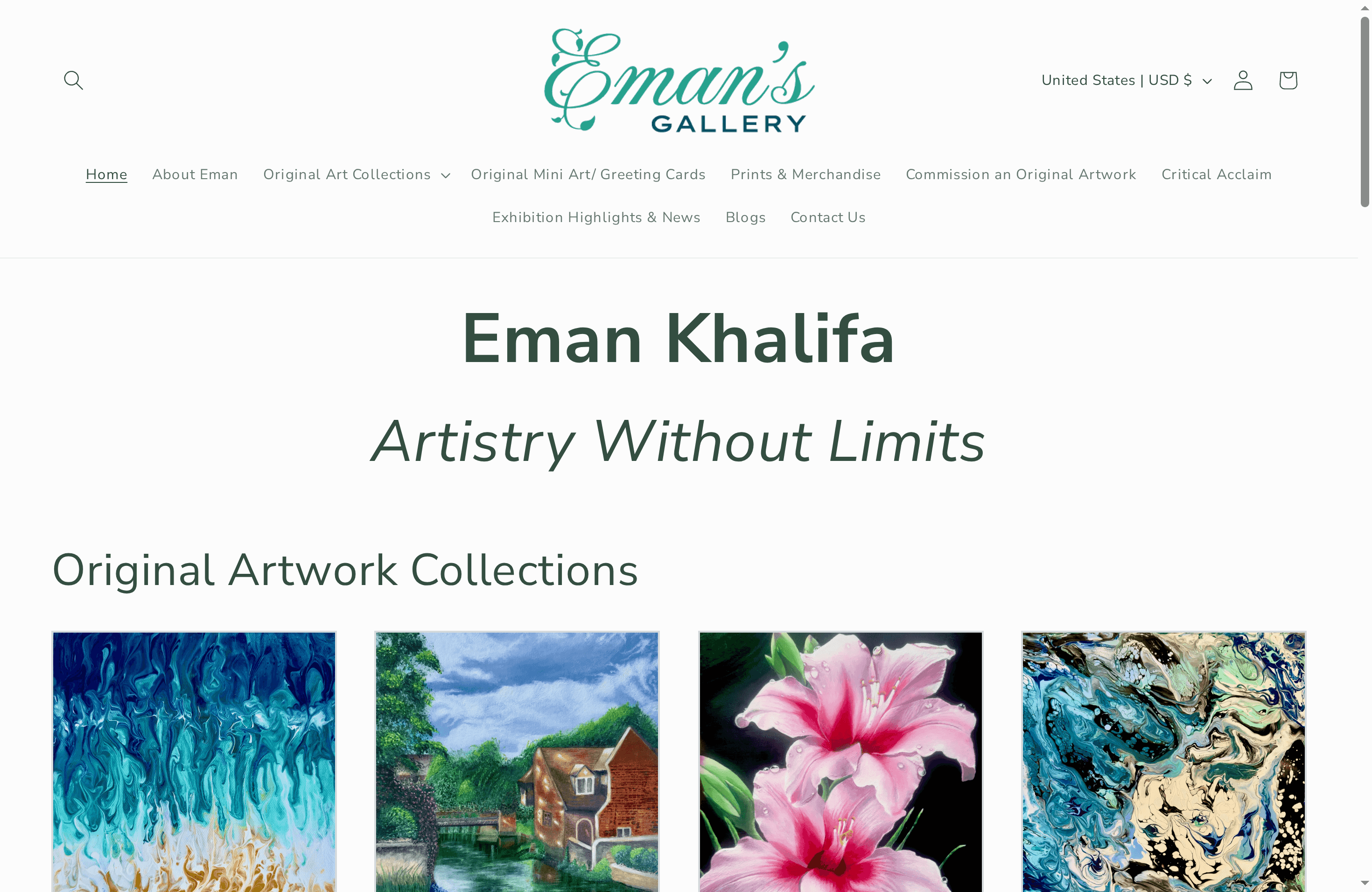
The Fragments of Memory canvas print exemplifies the memory and time theme through abstract ink splash composition, making it a strong anchor for any collection built around personal or collective history. For collectors interested in identity and cultural narrative, the Contours of Orient canvas print offers a minimalist exploration of geographic and cultural identity. Every piece ships worldwide from the UK, USA, Canada, Australia, Germany, France, the UAE, and beyond.
FAQ
What are the most common art themes in contemporary art?
The most common art themes in contemporary art include identity and the body, migration and displacement, environmental and ecological concerns, post-colonial historical reckoning, language and text, social activism, and memory and time. Art21’s thematic framework confirms these as the core recurring categories across contemporary practice.
Why are themes important in art?
Themes function as the organizing arguments of an artwork, determining what the work claims and why it matters beyond its visual surface. Understanding a work’s theme is the difference between seeing it as decoration and reading it as a position on something real.
How do museums use art themes to organize collections?
Institutions like Art21 use tag-based thematic indexes that allow cross-filtering by theme, medium, and artist, while the Fenix Museum of Migration builds its entire collection around the migration theme through artist-centered storytelling rather than factual or political framing.
What is the difference between a theme and a subject in art?
A subject is what an artwork depicts, such as a figure, a landscape, or a city. A theme is the argument the artwork makes about that subject, such as what the figure’s body means politically, what the landscape reveals about ecological ethics, or what the city says about social infrastructure and power.
Are art themes the same across different mediums?
The same theme can appear across painting, sculpture, video, installation, and computational art, but each medium makes a different kind of argument. Ecological themes in landscape painting operate through imagery and color, while the same theme in a computational project like (Un)Natural Language operates through data classification and policy language analysis.
Stay Connected
- ✨ Explore Eman Khalifa's original art, fine art prints and art-inspired merchandise.
- Follow Eman Khalifa's art journey on: Instagram @emans_gallery and Facebook
- Watch Eman Khalifa creating live art on: YouTube @emans_gallery
