


Art reproduction guide: understand, identify, and appreciate
You walk into a gallery and stand before a stunning Van Gogh. The swirling blues captivate you, but something feels off. That’s because you’re looking at a reproduction, not the original. Many art lovers struggle to understand what art reproduction truly means, how it differs from the real thing, and why it matters. This guide demystifies art reproduction by explaining the methods used, how to spot authenticity, the legal landscape, and practical ways reproductions enhance your collection or home decor affordably.
Table of Contents
- Key takeaways
- What is art reproduction: definition, methods, and why it matters
- Authenticity and detection: how to tell originals from reproductions
- Legal and ethical considerations in art reproduction
- Practical uses and value of art reproductions for collectors and home decorators
- Explore original and reproduction artworks at Eman’s Gallery
- FAQ
Key Takeaways
| Point | Details |
|---|---|
| Texture versus detail | Reproductions capture most visual details but cannot replicate the original brushwork texture or the aged patina of the painting. |
| Giclee advantages | Giclee prints offer superior color accuracy with archival inks and high DPI, along with longevity on museum grade substrates. |
| Legal transparency | Legal reproduction depends on copyright status and requires transparency about licensing and provenance. |
| Authentication methods | Scientific analysis such as fractal dimension assessment helps distinguish originals from replicas with high accuracy. |
| Accessibility and impact | Reproductions democratize art access for homes and collections while offering a different emotional impact than owning the original. |
What is art reproduction: definition, methods, and why it matters
Art reproduction creates copies of original artworks using various printing or fabrication techniques. These copies allow museums, collectors, and everyday art lovers to enjoy famous masterpieces without owning the priceless originals. Reproductions serve educational purposes, make art accessible to broader audiences, and offer affordable decoration options for homes and offices.
Several reproduction techniques exist, each with distinct characteristics:
- Lithography uses stone or metal plates to transfer ink onto paper, producing limited edition prints with moderate detail
- Digital printing employs inkjet or laser technology for quick, affordable copies with variable quality
- Giclée printing utilizes specialized inkjet printers with archival inks on museum-grade substrates for superior results
- Screen printing layers ink through mesh stencils, creating bold, graphic reproductions popular in contemporary art
The quality and longevity of reproductions vary dramatically based on the method chosen. Understanding these differences helps you make informed decisions when purchasing art reproductions for your collection or space.
| Method | Color accuracy | Detail level | Longevity | Texture |
|---|---|---|---|---|
| Lithograph | Moderate | Good | 50-75 years | Slight grain |
| Digital print | Variable | Fair to good | 10-30 years | Flat |
| Giclée | Excellent | Exceptional | 100-200 years | Minimal |
| Screen print | Limited palette | Moderate | 50-100 years | Layered |
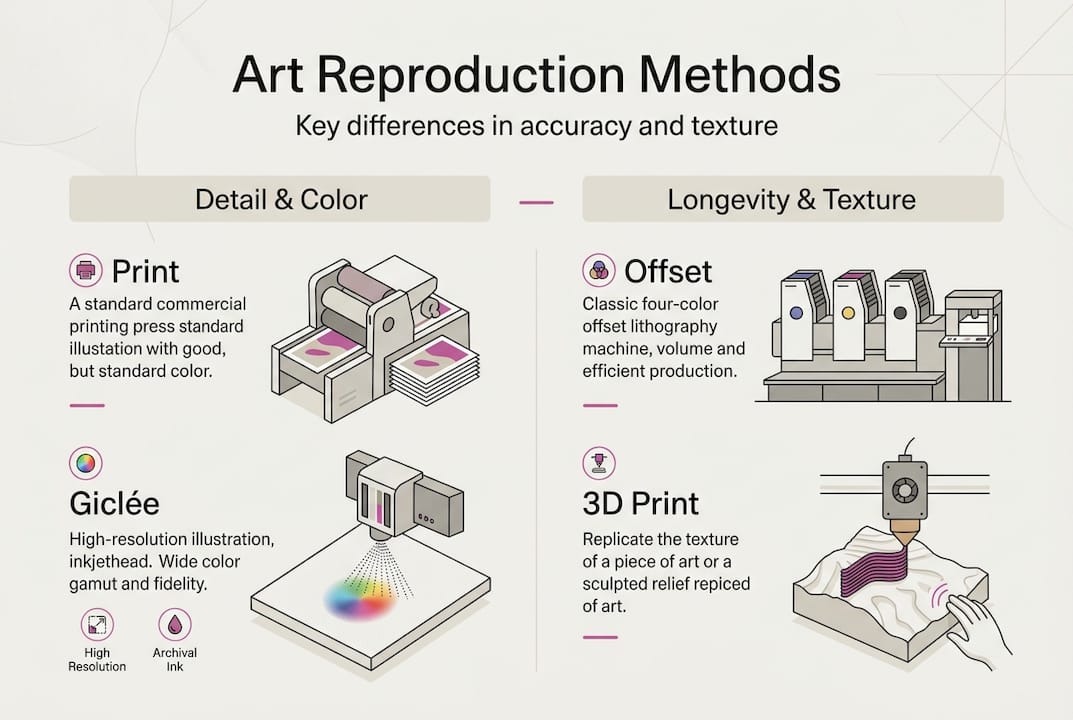
Giclée prints offer superior color accuracy using 8-12 pigment inks, exceptional detail at 2400+ DPI resolution, and impressive longevity spanning 100-200 years when printed on archival substrates. These reproductions capture approximately 95% of an original’s color range and visual detail, making them virtually indistinguishable from originals when viewed from normal distances. However, they cannot replicate the physical texture of brushstrokes, impasto techniques, or the aged patina that develops on original canvases over decades.
The art reproduction process guide involves high-resolution photography or scanning of the original artwork, followed by careful color calibration to match the source material. Professional reproduction studios invest heavily in color management systems and lighting controls to ensure accuracy. The final prints undergo quality checks comparing them side by side with originals or high-quality reference images.
Pro Tip: Store giclée prints away from direct sunlight and maintain stable humidity levels between 40-60% to preserve color vibrancy and prevent paper degradation. Frame reproductions with UV-protective glass to extend their lifespan significantly.
Authenticity and detection: how to tell originals from reproductions
Distinguishing original artworks from high-quality reproductions challenges even experienced collectors. As reproduction technology advances, the visual gap between originals and copies narrows, making authentication increasingly complex. Museums and auction houses employ multiple verification methods to confirm authenticity before acquisition or sale.

Scientific analysis provides objective authentication tools. Fractal dimension analysis discriminates originals from replicas with 91.7% accuracy when comparing works by the same artist and 96.6% accuracy for different artists. This technique analyzes the mathematical patterns inherent in brushstrokes and paint application that human hands naturally create. Reproductions, even high-quality ones, fail to replicate these subtle fractal signatures because printing processes introduce different pattern structures.
Collectors use practical inspection methods to evaluate artwork authenticity:
- Examine the surface texture under raking light to reveal brushstroke depth and paint buildup
- Check the signature for consistency with known examples and appropriate aging
- Review provenance documentation tracing ownership history back to the artist or original sale
- Inspect the canvas or paper substrate for period-appropriate materials and aging patterns
- Look for printer dots or regular patterns visible under magnification that indicate mechanical reproduction
Modern authentication combines traditional connoisseurship with scientific testing. X-ray fluorescence reveals pigment composition, helping verify whether paints match those available during the artist’s lifetime. Infrared reflectography penetrates surface layers to expose underdrawings and pentimenti that prove an artwork’s developmental process.
“Transparency remains the cornerstone of ethical art reproduction. Scientific methods like fractal analysis and spectroscopy provide objective data, but human expertise interpreting these results in context separates legitimate reproductions from deceptive forgeries. Collectors should always demand clear disclosure about an artwork’s status before purchase.”
Artificial intelligence and 3D printing technologies create reproductions with simulated texture, complicating visual authentication. These advanced fakes may fool casual observers but reveal themselves through inconsistencies. AI-generated brushwork lacks the spontaneous variations human artists create, while 3D-printed texture shows mechanical regularity absent in hand-painted originals. Understanding art authenticity explained helps collectors navigate these challenges.
When purchasing artwork, especially high-value pieces, engage professional authenticators who specialize in the specific artist or period. Their trained eyes combined with scientific testing provide the most reliable verification. Learning how to spot authentic art protects your investment and ensures you acquire genuine pieces for your collection.
Legal and ethical considerations in art reproduction
Navigating the legal landscape of art reproduction requires understanding copyright law, public domain status, and ethical responsibilities. Copyright protects artists’ creative works from unauthorized reproduction during their lifetime and for 70 years after death in most countries. Once this protection expires, artworks enter the public domain, allowing anyone to reproduce them freely without permission or payment.
Legal reproduction depends on copyright status and transparency. Works by artists who died before the 1950s generally fall into public domain, making reproductions of paintings by Van Gogh, Monet, or Rembrandt perfectly legal. Contemporary artists retain copyright protection, requiring licenses for reproduction. Unauthorized copying of protected works constitutes infringement, exposing violators to substantial fines and legal action.
To legally produce and sell art reproductions, follow these essential steps:
- Verify the artist’s death date and calculate copyright expiration based on applicable laws in your jurisdiction
- Obtain written licenses from living artists or their estates for works still under copyright protection
- Clearly label all reproductions as copies, never misrepresenting them as original artworks
- Maintain documentation proving legal right to reproduce, including licenses and public domain verification
- Respect moral rights that protect artists’ reputations even after copyright expires in some countries
- Ensure your reproduction methods and marketing avoid creating confusion about authenticity
Common legal mistakes carry serious consequences. Selling reproductions without disclosure constitutes fraud, potentially resulting in criminal charges beyond civil liability. Reproducing copyrighted works without permission infringes intellectual property rights, leading to cease-and-desist orders, financial damages, and destroyed inventory. Even legal reproductions marketed deceptively violate consumer protection laws and damage your business reputation permanently.
Ethical considerations extend beyond legal compliance. Transparency builds trust with buyers and respects the original artist’s legacy. Reproductions should enhance art appreciation and accessibility, not deceive collectors into believing they own originals. The art market depends on integrity, and ethical dealers clearly distinguish between authentic works and reproductions in all communications.
Some jurisdictions impose additional requirements. The Visual Artists Rights Act in the United States protects artists’ attribution and integrity rights, preventing modifications that harm their honor or reputation. European moral rights persist indefinitely, restricting how reproductions can be altered or presented. Understanding art print vs painting differences helps communicate these distinctions to customers.
Pro Tip: Before reproducing any artwork, search the U.S. Copyright Office database or equivalent resources in your country to verify copyright status. For artists who died between 1950 and 1955, calculate the exact expiration date carefully, as copyright terms vary based on publication dates and renewals.
Practical uses and value of art reproductions for collectors and home decorators
Art reproductions democratize access to masterpieces that would otherwise remain locked in museums or private collections. A high-quality giclée print of a Monet water lily painting costs a few hundred dollars compared to millions for an original. This affordability allows art enthusiasts to surround themselves with beauty regardless of budget constraints, making sophisticated design accessible to everyone.
Reproductions serve multiple practical purposes in modern life:
- Home decoration that reflects personal taste without requiring museum-level security or insurance
- Educational tools for students studying art history, composition, and technique up close
- Commercial spaces seeking sophisticated ambiance through recognizable masterworks
- Gift giving that shares artistic appreciation without financial strain
- Collection building that explores diverse styles and periods before investing in originals
The emotional and financial differences between originals and reproductions significantly impact collecting decisions. Understanding these distinctions helps align purchases with your goals and values.
| Factor | Original artwork | Reproduction |
|---|---|---|
| Cost | Thousands to millions | Tens to hundreds |
| Emotional impact | Profound connection to artist’s hand | Aesthetic appreciation |
| Investment potential | Can appreciate significantly | Minimal resale value |
| Uniqueness | One of a kind | Multiple copies exist |
| Insurance needs | Substantial coverage required | Standard homeowner’s policy |
| Longevity | Centuries with care | Decades to century+ |
Brain studies show stronger emotional responses to original artworks compared to reproductions, though context and expectations influence these reactions. The knowledge that you stand before an object the artist physically touched creates psychological resonance that reproductions cannot replicate. However, this research contains methodological limitations, and many people derive genuine pleasure from high-quality reproductions in their daily lives.
Reproductions excel at making art part of everyday experience rather than rare museum visits. You can live with a Rothko color field in your living room, absorbing its meditative qualities daily. Children grow up surrounded by masterworks, developing visual literacy and appreciation organically. This constant exposure to great art enriches life in ways that occasional museum trips cannot match.
The benefits of art prints extend beyond affordability. Reproductions allow experimentation with different styles and periods without major financial commitment. You can rotate pieces seasonally, refreshing your space and exploring new artistic movements. This flexibility supports evolving tastes and design preferences over time.
Interior designers leverage reproductions to achieve specific aesthetic goals within client budgets. A series of botanical prints creates cohesive gallery walls, while large-scale reproductions serve as focal points in commercial lobbies. Learning using art prints for home decor techniques helps maximize visual impact through strategic placement and framing choices.
Pro Tip: Balance your collection between reproductions of masterworks you love and affordable original works by emerging artists. This approach satisfies your desire for recognized masterpieces while supporting living artists and potentially acquiring pieces that appreciate in value over time.
Explore original and reproduction artworks at Eman’s Gallery
Whether you seek the unique character of original paintings or the accessibility of high-quality reproductions, Eman’s Gallery offers curated options for every collector and decorator. Our original handmade paintings by artist Eman Khalifa bring one-of-a-kind abstract, geometric, floral, landscape, seascape, and still-life works to your space.
Discover pieces like Good Tidings original painting that showcase authentic artistic expression with genuine brushwork and texture. For those seeking museum-quality reproductions, explore options such as Private Eye canvas print that deliver exceptional color accuracy and detail. Browse our complete wall art prints collection to find the perfect addition to your home or collection, with worldwide shipping available.
FAQ
Is art reproduction legal to own and sell?
Owning and selling reproductions is legal when the original artist died more than 70 years ago, placing the work in public domain. For contemporary artists, you need written permission or licenses to reproduce their work legally. Always disclose that items are reproductions, never misrepresenting them as originals, to avoid fraud charges and maintain ethical standards in the art market.
How can I tell if an artwork is an original or a reproduction?
Examine the surface texture under angled lighting to detect brushstroke depth and paint buildup that reproductions cannot replicate. Fractal dimension analysis distinguishes originals with 91.7% accuracy by detecting mathematical patterns in brushwork. Check provenance documentation, inspect signatures for consistency, and use magnification to spot printer dots or mechanical patterns that indicate reproduction. Professional authentication combines these methods for reliable verification.
Are reproductions less valuable than original art?
Reproductions provide affordable access to masterworks but hold minimal resale value compared to originals that can appreciate significantly over time. Original artworks generate stronger emotional responses due to their unique historical connection to the artist’s hand. However, reproductions offer practical benefits including lower costs, reduced insurance needs, and the ability to enjoy famous works daily in your home. Value depends on your goals, whether collecting for investment or enhancing your living environment with beautiful art.
What is giclée printing and why does it matter?
Giclée printing uses specialized inkjet technology with 8-12 pigment inks and 2400+ DPI resolution to create museum-quality reproductions. These prints capture approximately 95% of an original’s color range and visual detail while lasting 100-200 years on archival substrates. The superior color accuracy and longevity make giclée the preferred method for serious collectors and galleries seeking reproductions that honor the original artwork’s visual impact.
Can reproductions help me learn about art before buying originals?
Reproductions serve as excellent educational tools, allowing you to live with different styles and periods before committing to expensive originals. You can experiment with various artists, color palettes, and compositions in your space to discover what truly resonates with you. This hands-on experience builds confidence and refines your taste, preparing you to make informed decisions when investing in original artworks that align with your aesthetic preferences and collecting goals.
Recommended
- Art Reproduction Process 2026: 95% Color Accuracy Guide
- Art Print Terminologies: Complete Reference Guide - Eman’s Gallery
- How to Spot Authentic Art: A Step-by-Step Guide - Eman’s Gallery
- The Essential Guide to Art Appreciation - Eman’s Gallery
- 7 Ways to Experience African Art and Crafts on Safari
Stay Connected
- ✨ Explore Eman Khalifa’s original art and fine art prints
- 📸 Follow Eman Khalifa’s art journey on: Instagram @emans_gallery and Facebook Eman’s Gallery
- 📹 Watch Eman Khalifa creating live art on: YouTube @emans_gallery
