


What Is Geometric Abstraction in Art: A Clear Guide
TL;DR:
- Geometric abstraction uses precise shapes and flat compositions to evoke contemplation without referencing the physical world. It emphasizes harmony, tension, and emotional resonance through formal qualities rather than narrative or illusion. The movement remains relevant today, influencing contemporary art, digital design, and large-scale public works.
Geometric abstraction is defined as a form of non-representational art that uses precise geometric shapes such as squares, triangles, and circles arranged in compositions that refer to nothing in the physical world. The style prioritizes shape, color, balance, and flatness over storytelling or illusion. Pioneers like Kazimir Malevich, Piet Mondrian, and Josef Albers established its foundational principles in the early twentieth century, and the movement continues to shape contemporary painting, sculpture, and design. If you want to understand what geometric abstraction means and why it still matters, this guide covers its principles, history, key artists, and living relevance.
What is geometric abstraction and what defines it visually?
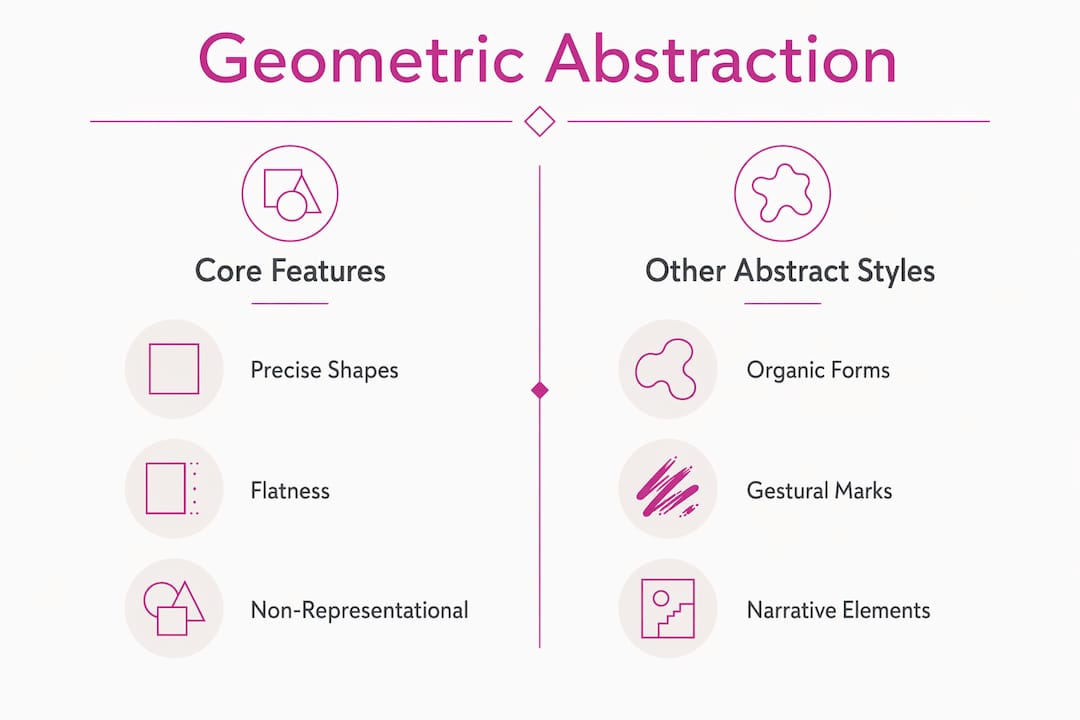
Geometric abstraction is a subcategory of abstract art built entirely on non-objective compositions. There are no figures, landscapes, or objects. The entire visual experience comes from the arrangement of shapes, the relationships between colors, and the rhythm of the composition.
The core visual traits that define the style include:
- Precise geometric shapes. Squares, rectangles, circles, triangles, and grids are the primary vocabulary.
- Flatness. The canvas is treated as a two-dimensional surface, not a window into a three-dimensional world. Depth and shadow are minimized or eliminated.
- Formal balance. Compositions are organized around symmetry, repetition, or deliberate tension between elements.
- Color as structure. Color is not used to describe light or atmosphere. It defines form, separates planes, and creates rhythm.
- Non-illusionistic space. Shapes exist on the surface of the canvas, not within a simulated space.
The goal is contemplation through formal qualities rather than narrative. A viewer is not meant to decode a scene. They are meant to experience proportion, color weight, and visual order directly.
Pro Tip: When looking at a geometric abstract work, try covering half the canvas with your hand. If the remaining half still feels complete and balanced, the artist has achieved formal harmony. That balance is the point.
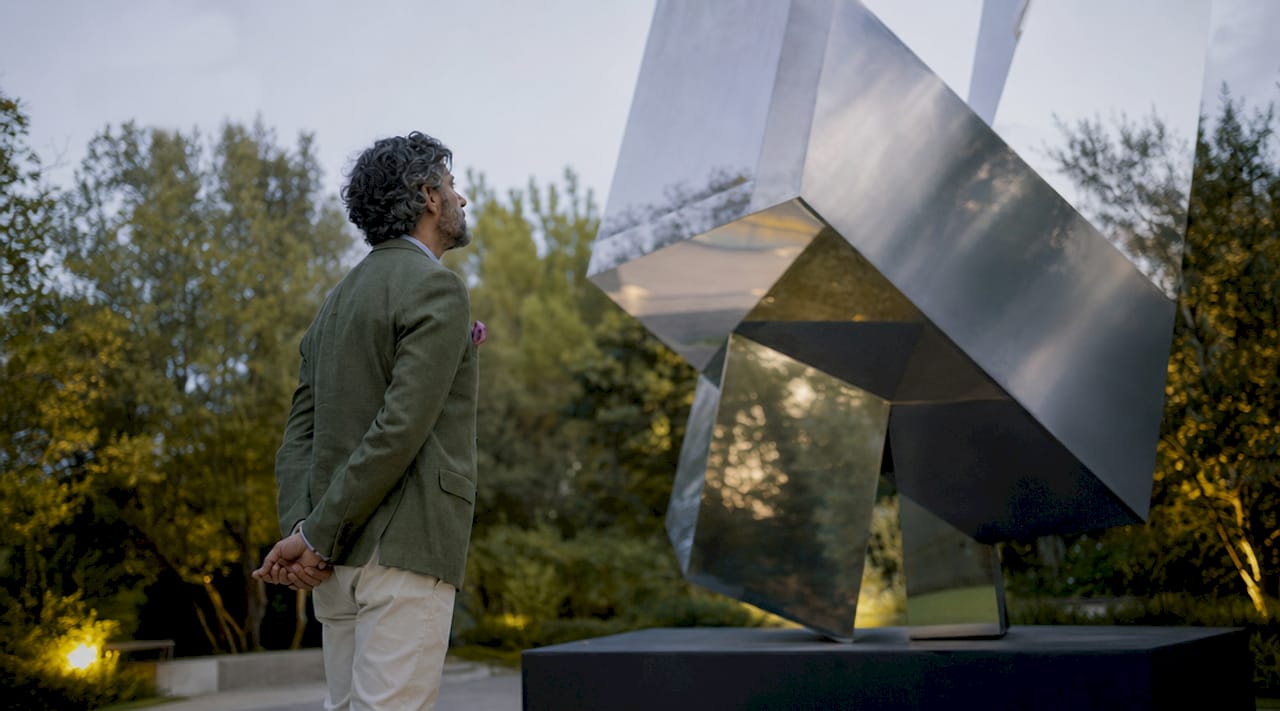
One common misconception is that geometric abstraction is purely mechanical or computer-calculated. Mondrian, for example, worked through intuition to achieve harmony, adjusting proportions by eye rather than ruler. The precision is a result, not a process.
Who are the key artists and how has the movement evolved?
Geometric abstraction emerged in the early twentieth century as modernist artists sought to move beyond illusionistic painting. The rejection of illusionistic perspective was a deliberate philosophical position, not just a stylistic preference. Artists like Wassily Kandinsky, Kazimir Malevich, and Piet Mondrian each arrived at geometric abstraction through different routes but shared the conviction that pure form could carry meaning without representation.
The founding generation
- Kazimir Malevich painted Black Square in 1915, a single black square on a white ground. It was a radical declaration that a painting needed no subject beyond itself.
- Piet Mondrian developed his signature primary-colored grids through years of reducing natural forms to their horizontal and vertical essentials. His De Stijl movement treated the grid as a universal visual language.
- Josef Albers spent decades on his Homage to the Square series, placing concentric squares of different colors against each other to study how color perception changes depending on context.
“The goal is not to create a beautiful object, but to demonstrate a truth about visual experience.” This is the operating principle behind Albers’s lifelong investigation into color and form.
The movement also extended beyond painting. Georges Vantongerloo and Max Bill applied mathematical art principles to sculpture, proving that geometric abstraction was a spatial and conceptual approach, not just a canvas-based one.
The contemporary generation
| Artist | Contribution |
|---|---|
| Carmen Herrera | Reduced compositions to two-color geometric fields; recognized internationally after age 89 |
| Agnes Martin | Used hand-drawn grids and pale washes to bring meditative quiet to geometric structure |
| Victor Vasarely | Developed Op Art, using geometric repetition to create optical movement and illusion |
| Stanley Whitney | Blends color-block grids with jazz-influenced improvisation, treating structure as rhythm |
Stanley Whitney and Victor Vasarely represent a significant shift: geometric abstraction as a living, evolving form rather than a fixed historical style. Whitney’s grids pulse with color decisions made in real time. Vasarely’s patterns vibrate. Neither artist treats the geometry as a cage.
Artists today also incorporate musical and rhythmic improvisation within geometric structures, which shows how far the movement has traveled from Malevich’s austere black square.
How does geometric abstraction differ from other abstract styles?
Abstract art is any art that does not attempt to represent external reality accurately. Geometric abstraction is one specific approach within that broad category. Understanding where it sits helps clarify what makes it distinct.
Geometric abstraction vs. organic abstraction. Organic abstraction uses curvilinear, freeform, and biomorphic shapes. Artists like Jean Arp and Joan Miró worked with shapes that suggest living organisms, cells, or natural growth. Geometric abstraction uses hard edges and mathematical forms. The contrast is between the irregular and the precise.
Geometric abstraction vs. representational art. Representational art depicts recognizable subjects: people, places, objects. Geometric abstraction contains no reference to the physical world. A Mondrian grid does not represent a city, even if it resembles one. The resemblance is coincidental.
Geometric abstraction vs. gestural abstraction. Artists like Jackson Pollock and Willem de Kooning used gesture, accident, and physical energy as primary tools. Geometric abstraction removes the visible trace of the hand in favor of controlled form. The two approaches represent opposite ends of the abstract art spectrum.
| Style | Key feature | Example artist |
|---|---|---|
| Geometric abstraction | Hard-edged shapes, flatness, non-objective | Piet Mondrian |
| Organic abstraction | Biomorphic, curvilinear, nature-derived | Jean Arp |
| Gestural abstraction | Expressive mark-making, visible process | Jackson Pollock |
| Op Art | Geometric repetition creating optical effects | Victor Vasarely |
The style uses mathematical shapes while blending artistic freedom, and that combination is what separates it from both pure design and purely expressive painting. It occupies a precise middle ground between order and intuition.
Pro Tip: If you are building a collection and want works that hold visual authority in a room without competing with furniture or architecture, geometric abstraction is the category to study first. Its clarity reads well at scale.
For a broader look at how geometric thinking applies across art styles, the guide to geometric art at Emansgallery covers the wider territory.
Why geometric abstraction remains relevant in contemporary art and design
Geometric abstraction is fundamental in modern visual culture, influencing murals, digital installations, and print design. Its appeal comes from something specific: it offers clarity, rhythm, and emotional expression through pure form, without requiring the viewer to know anything about art history.
Several factors explain its continued presence in contemporary practice:
- Scalability. Geometric compositions translate from a small canvas to a building-sized mural without losing coherence. This makes the style a natural fit for public art and architectural integration.
- Digital compatibility. Vector-based design tools like Adobe Illustrator are built around geometric forms. Contemporary designers and digital artists work in a medium that is structurally geometric, which keeps the visual language current.
- Emotional range. A composition of warm reds and yellows in a grid reads differently from cool blues and grays in the same format. Geometry does not limit emotional expression. It channels it.
- Interior design demand. Art collectors and interior designers consistently choose geometric abstract works for large-scale wall installations because the style holds visual weight without overwhelming a space.
- Cross-cultural legibility. Geometric forms carry no language, no cultural narrative, and no figurative content. They communicate across cultural boundaries in a way that figurative art cannot.
The top practitioners know that effective geometric abstraction blends high intuition with structural rigor. The result balances mathematical order with human imperfection to achieve harmony and rhythm. That balance is what separates a compelling geometric work from a diagram.
Stanley Whitney’s recent work is a useful example. His canvases are organized into color-block grids, but the color choices follow an improvisational logic closer to jazz than to mathematics. The structure is rigid. The content within that structure is free. That tension is what makes the work feel alive rather than mechanical.
Key takeaways
Geometric abstraction is a non-representational art form defined by precise shapes, flatness, and formal composition, with roots in early modernism and a living presence in contemporary art and design.
| Point | Details |
|---|---|
| Core definition | Geometric abstraction uses shapes like squares and circles in non-objective compositions with no real-world reference. |
| Founding artists | Kazimir Malevich, Piet Mondrian, and Josef Albers each established distinct approaches that still define the movement. |
| Not purely mechanical | Artists like Mondrian worked intuitively, balancing precision with human judgment to achieve visual harmony. |
| Distinct from other abstraction | Geometric abstraction uses hard edges and mathematical forms, separating it from organic and gestural abstraction. |
| Contemporary relevance | The style shapes murals, digital design, and large-scale wall art because its clarity and rhythm translate across contexts. |
Why I think geometric abstraction is misunderstood by most people who love it
Most people who say they love geometric abstraction are actually responding to something more specific: they love the feeling of order. That is not the same thing. Order is a byproduct. The actual subject of geometric abstraction is tension. The tension between a red square and a blue rectangle. The tension between a grid that almost resolves and one that refuses to.
When I work on a geometric piece, the hardest part is not placing the shapes. It is knowing when to stop adjusting. Mondrian reportedly moved tape around his canvases for weeks before committing to a line position. That is not mechanical precision. That is obsessive human judgment operating at a very fine scale.
What I find most interesting about the movement right now is how artists like Stanley Whitney have broken the assumption that geometric abstraction has to be cool and cerebral. His work is warm, physical, and rhythmic. It proves that the grid is a starting point, not a conclusion.
For anyone building a collection or exploring the style for the first time, I would say this: do not look for the geometry. Look for the feeling the geometry creates. If a work makes you feel something before you can explain why, the artist got the balance right. That is the whole point of the form.
You can see how that balance works in practice by exploring the geometric original art collection at Emansgallery, where each piece reflects a different approach to structure and color.
— Eman
Bring geometric abstraction into your space
Emansgallery offers original handmade geometric abstract paintings and museum-quality canvas prints by artist Eman Khalifa, shipped worldwide from the UK, USA, Canada, Australia, and across Europe and the UAE. Each work is one of a kind, built around the principles of color, form, and balance that define the movement. The City in Grids canvas print applies urban grid geometry to a large-scale format that holds authority on any wall. The Solar Burst original painting demonstrates how geometric structure and bold color interact at full scale. Both are available now for art collectors, interior designers, and anyone ready to bring the clarity of geometric abstraction into their home.
FAQ
What is the simplest definition of geometric abstraction?
Geometric abstraction is art that uses geometric shapes such as squares, circles, and triangles arranged in non-representational compositions, with no reference to real-world objects or scenes.
What does geometric abstraction mean in terms of artistic intent?
The intent is to provoke a visual and emotional response through pure form, color, and composition rather than through narrative or recognizable subject matter.
What are some well-known geometric abstraction examples?
Kazimir Malevich’s Black Square (1915), Piet Mondrian’s primary-colored grid paintings, and Josef Albers’s Homage to the Square series are the most widely cited examples of geometric abstraction in art.
How is geometric abstraction different from Op Art?
Geometric abstraction focuses on formal balance and non-objective composition. Op Art, developed by Victor Vasarely, uses geometric repetition specifically to create optical illusions of movement or depth, making it a specialized branch of the broader style.
Is geometric abstraction still relevant today?
Geometric abstraction directly influences contemporary murals, digital design, and large-scale wall art. Artists like Stanley Whitney and Carmen Herrera continue to expand the movement, and its visual clarity makes it one of the most collected styles in contemporary art.
Stay Connected
- ✨ Explore Eman Khalifa's original art,
- Follow Eman Khalifa's art journey on: Instagram @emans_gallery and Facebook Eman's Gallery
- Watch Eman Khalifa creating live art on: YouTube @emans_galler
