


Abstractionism Meaning in Art: What You Need to Know
TL;DR:
- Abstract art is a deliberate visual language emphasizing internal form, color, and composition over representation. It exists on a spectrum from realistic depiction to pure non-representational work, shaping its meaning through formal principles. Understanding these principles and historical context enriches viewers’ appreciation and interpretation of abstract art.
Abstract art gets dismissed more than almost any other art form. People stand in front of a Rothko or a Pollock and ask, “But what does it mean?” The assumption is that if you cannot identify an object, the work must be random. That assumption is wrong. The abstractionism meaning in art runs far deeper than surface appearances suggest. Abstract art requires sophisticated understanding of color theory, composition, and spatial relationships. This article covers the definition of abstractionism, its history, its visual principles, and how to actually look at it.
Table of Contents
- Key takeaways
- What abstractionism means in art
- The history and cultural rise of abstractionism
- Visual principles behind abstract art
- How to appreciate abstractionism in contemporary art
- Abstractionism vs other art movements
- My perspective on why this understanding matters
- Explore abstract art at Eman’s Gallery
- FAQ
Key takeaways
| Point | Details |
|---|---|
| Abstractionism is not random | It is a deliberate approach prioritizing internal form and visual principles over representation. |
| Abstraction exists on a spectrum | Five stages range from realistic simplification to pure non-representational work. |
| History shapes meaning | Abstract Expressionism emerged in 1940s New York and reshaped global contemporary art culture. |
| Science supports its appeal | Research confirms abstract artists often follow a structural “golden rule” in shape placement. |
| Interpretation belongs to you | Pure abstraction shifts meaning-making to the viewer, based on emotion and formal qualities. |
What abstractionism means in art
The definition of abstractionism in specialist usage focuses on internal form rather than pictorial representation or concrete objects. It is not a casual term. It refers to a defined art genre with its own principles, history, and formal logic. When an artwork is abstract, it does not try to show you the world as your eyes see it. It shows you something else: structure, feeling, movement, color relationships, or pure visual energy.
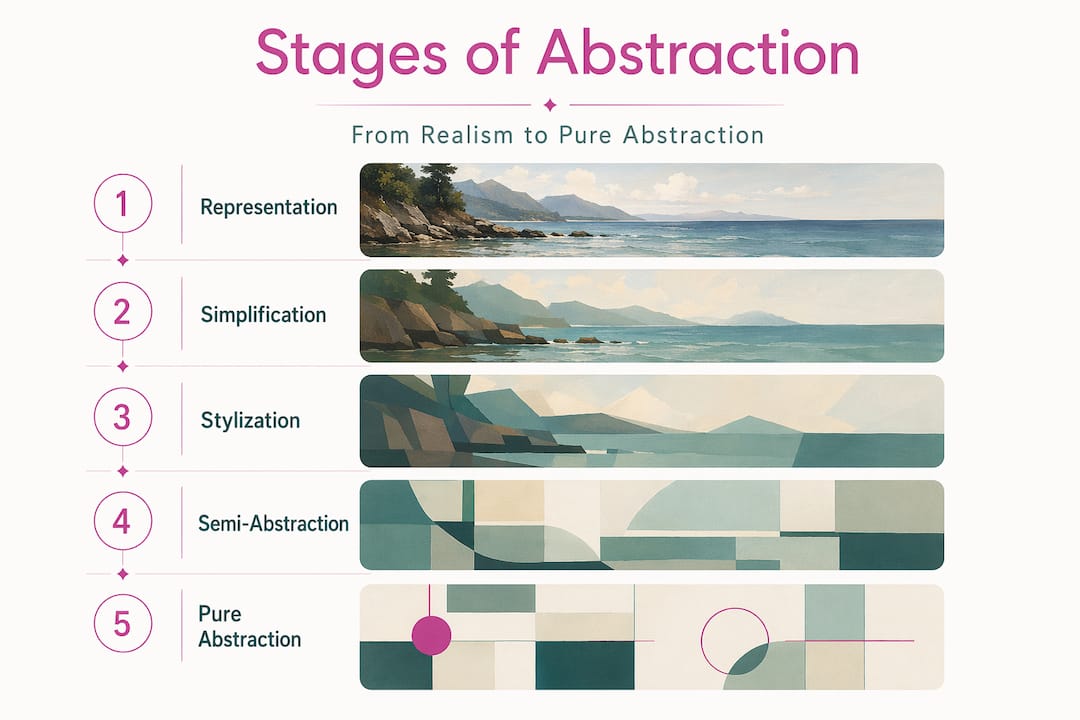
What trips most people up is treating abstraction as a yes-or-no category. It is not. Abstraction exists on a spectrum with five recognizable stages:
- Realistic representation. The subject is depicted with accuracy and detail.
- Simplification. Details are reduced, but the subject remains clear.
- Stylization. The subject is distorted or exaggerated through the artist’s personal style.
- Semi-abstraction. Recognizable elements appear but are heavily distorted or fragmented.
- Pure abstraction. No identifiable subject exists. The work operates entirely through form, color, and composition.
Most artists working in an abstract mode sit somewhere between stylization and pure abstraction. Picasso’s Cubist portraits occupy the semi-abstract zone. Mondrian’s grid paintings sit firmly in pure abstraction. Understanding where a work falls on this spectrum tells you a great deal about what the artist was trying to do.
Pro Tip: When you look at an abstract painting, try to locate it on this five-stage spectrum before forming any other opinion. It reframes your entire viewing experience.
The history and cultural rise of abstractionism
Abstract Expressionism did not appear out of nowhere. It emerged in 1940s New York as a direct response to the trauma of World War II, the influence of European Surrealism, and a growing desire to break from representational traditions. It helped establish New York City as the global center of contemporary art, a title previously held by Paris.
The movement had two main currents. Jackson Pollock and Lee Krasner led what became known as action painting. Their work was physical and gestural. Pollock dripped, poured, and flung paint, treating the canvas as a record of movement and process rather than a planned composition. Mark Rothko took a different path. His color field paintings used large, luminous expanses of color to create contemplative, almost spiritual experiences. Both approaches are abstractionism, but they feel completely different to stand in front of.
“Abstract Expressionism’s dual paths, action painting and color field, symbolize abstractionism’s broad expressive range, from raw physical process to contemplative color meditation.”
These artists were not just making pretty work. They were challenging the institutional logic of art itself. Galleries, museums, and critics had long favored academic realism and European masters. Abstract Expressionism forced a reckoning with what art was supposed to do. Was it meant to represent, or was it meant to express? That question still drives abstractionism in contemporary art today.
The cultural significance of this shift is hard to overstate. Abstraction opened doors to minimalism, conceptual art, installation art, and much of what fills galleries in 2026. Every contemporary artist working in non-representational modes owes something to those mid-century New York painters.
Visual principles behind abstract art
One of the most persistent myths about abstract art is that anything goes. In practice, the opposite is true. Skilled abstract artists work within strict formal constraints, even when those constraints are self-imposed rather than traditional.
The primary elements are line, color, shape, and form. These replace subject matter as the main carriers of meaning and feeling. A thick diagonal line reads differently than a soft curved one. Warm reds advance toward the viewer while cool blues recede. These are not accidents. They are deliberate compositional decisions.
Recent research adds a striking layer to this understanding. Scientists using a mathematical technique called persistent homology found that famous abstract artists follow a “golden rule” in how they place shapes across a canvas. This balance appears both consciously and unconsciously in the work of celebrated abstractionists, and it is a significant factor in why viewers find their work visually compelling. The research suggests that what feels like instinctive aesthetic appeal in abstract art is often grounded in measurable compositional harmony.
| Principle | What it does | Example in abstract work |
|---|---|---|
| Color relationships | Creates emotional tone and spatial depth | Rothko’s warm-to-cool gradients |
| Line quality | Conveys energy, direction, and texture | Pollock’s layered drip networks |
| Shape placement | Guides the eye and creates balance | Mondrian’s precisely spaced grids |
| Negative space | Defines form by what is absent | Franz Kline’s black brushwork on white |
Pro Tip: Stand at a distance from any abstract work before moving close. The overall composition, your first read from ten feet away, often reveals the artist’s primary intent far more clearly than close inspection does.
How to appreciate abstractionism in contemporary art
Moving from understanding to genuine appreciation takes practice. Here is a practical sequence for engaging with abstract art at a gallery, in a book, or on a screen.
- Observe before you analyze. Give yourself thirty seconds of unfiltered looking. Note your immediate physical and emotional responses before your brain starts asking questions.
- Identify the dominant element. Is the work primarily about color? Line? Texture? Scale? That dominant element is usually the artist’s main focus.
- Locate the work on the abstraction spectrum. Knowing whether you are looking at semi-abstraction or pure abstraction changes what questions you ask.
- Consider the gesture. Brushwork, drips, marks, and textures carry information about the artist’s physical process and intent. A controlled, measured surface tells a different story than a chaotic, energetic one.
- Let go of narrative expectations. Pure abstraction shifts meaning-making to you as the viewer. Your interpretation based on emotion and formal response is not wrong. It is the point.
When thinking about buying or displaying abstract art at home, the same principles apply. Pay attention to how a work makes you feel in a space rather than searching for what it depicts. Abstract art interacts with light, scale, and room tone in ways that representational work rarely does. A large-scale fluid abstract in deep navy and gold reads completely differently in a room at noon versus at dusk.
The five-stage abstraction framework is also useful for collectors. It helps you articulate what you are drawn to, which makes finding and buying work far less overwhelming.
Abstractionism vs other art movements
Not everything that looks non-representational is abstractionism, and that distinction matters.
Stylization vs. abstraction. A highly stylized portrait, think Art Nouveau figures or Japanese woodblock prints, transforms a subject through a strong visual style but keeps the subject recognizable. Stylization differs from abstraction because the representational content is still present. Abstract art reduces or removes that content entirely.
Surrealism vs. abstraction. Surrealism works with recognizable imagery drawn from dreams and the subconscious. Dalí’s melting clocks are strange but still identifiable objects. Abstractionism is not primarily concerned with subconscious imagery. It is concerned with form and the elimination of representation.
Here is a quick reference for common confusions:
| Movement | Key concern | Representational? |
|---|---|---|
| Abstractionism | Internal form, color, structure | No (or minimally) |
| Surrealism | Dream imagery, subconscious | Yes, but distorted |
| Minimalism | Reduction to essential form | Borderline, overlaps with abstraction |
| Stylized realism | Subject through strong personal style | Yes |
| Decorative art | Pattern, ornament, surface | Often, but not always |
Minimalism is the closest neighbor to pure abstraction and the most frequent source of confusion. Both strip away narrative content. The difference is that minimalism makes the reduction itself the subject, while abstractionism prioritizes expressive or formal qualities over the act of reduction.
My perspective on why this understanding matters
I spent years making abstract paintings before I could articulate what I was actually doing. Viewers would ask what a piece was “about,” and I would struggle to answer, not because the work lacked meaning but because the meaning lived in the color and form rather than in a story.
What I have learned is that most frustration with abstract art comes from applying the wrong framework. When you approach abstraction expecting representation, you will always feel like you are missing something. When you shift your expectation to formal experience, the work opens up completely.
The part that surprised me most was discovering that abstraction has rules. Serious, consistent, learnable rules about composition, balance, and color relationships. The research on shape placement in famous abstract works confirmed what I had felt intuitively for years. Good abstract art is not free-form chaos. It is structured freedom.
My honest take: most people who say they “don’t get” abstract art have never been given the spectrum framework. Once you understand that a Monet water lily series and a Pollock drip painting both qualify as abstraction but sit at opposite ends of a spectrum, the entire movement becomes far more coherent and accessible.
You do not need to love every abstract work. But understanding the concepts of abstract art gives you something more valuable than preference. It gives you language, context, and a way of seeing that enriches every gallery visit.
— Eman
Explore abstract art at Eman’s Gallery
If this article has shifted how you see abstraction, the next step is looking at actual work.
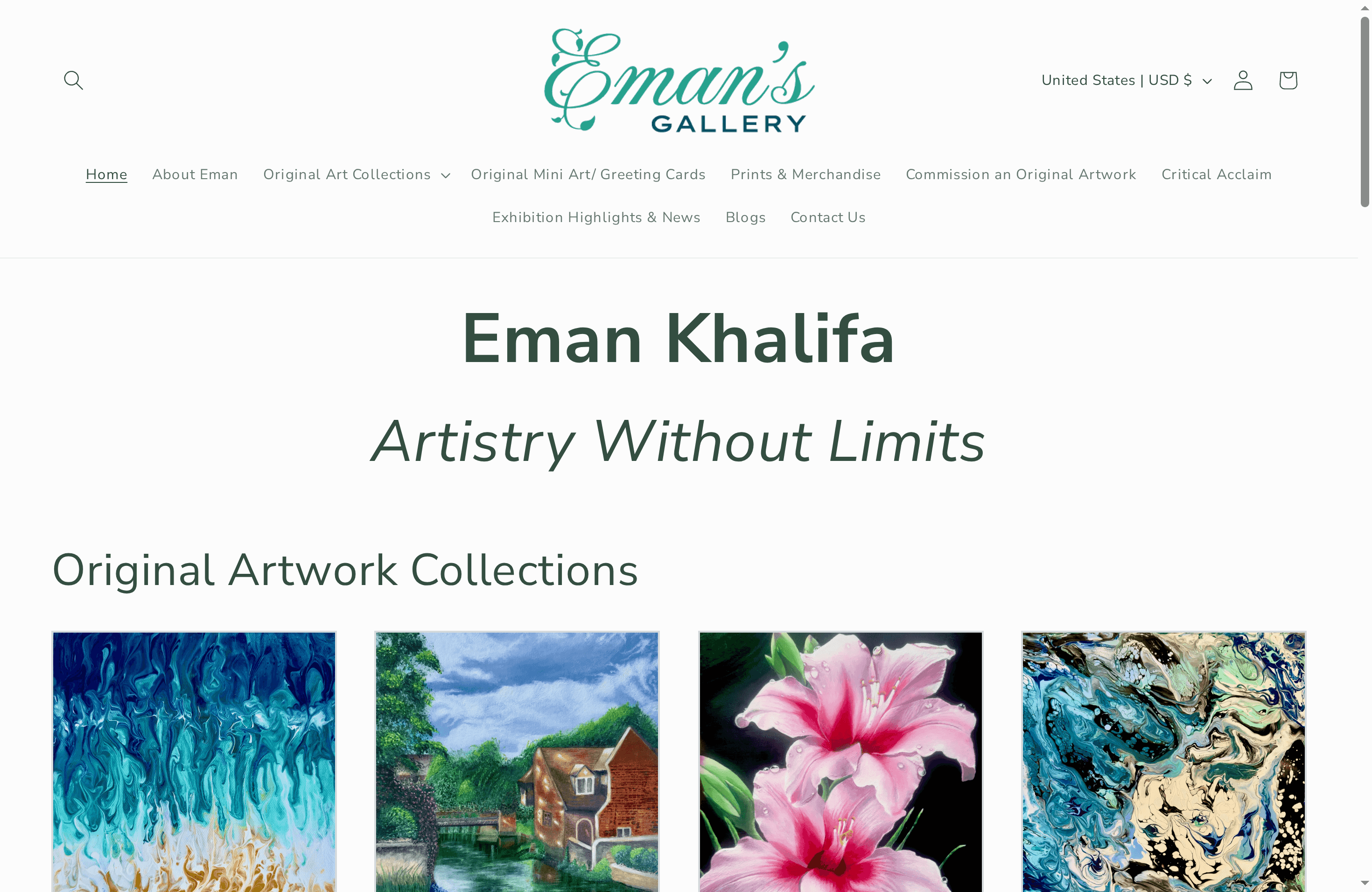
Emansgallery offers original handmade abstract paintings by Eman Khalifa, each one a unique exploration of color, form, and composition. The Good Tidings fluid abstract in blue and gold is a strong example of semi-abstraction with deeply expressive color relationships. For those starting with prints, the abstract wall art print collection covers a wide range of styles from gestural ink work to geometric color fields. Prints ship worldwide and arrive ready to frame. Whether you are building a collection or looking for one strong piece, Emansgallery offers original works and museum-quality reproductions that put these principles into practice on your wall.
FAQ
What is the basic definition of abstractionism in art?
Abstractionism is defined as an art genre that focuses on internal form rather than pictorial representation of concrete objects. It prioritizes visual principles like color, line, and composition over recognizable subject matter.
What are the five stages of abstraction?
The five stages are realistic representation, simplification, stylization, semi-abstraction, and pure abstraction. Each stage represents a degree of abstraction from fully representational to completely non-representational work.
How does abstractionism differ from realism?
Abstractionism replaces the goal of depicting recognizable subjects accurately with an emphasis on form, color, and visual structure. Realism aims to represent the world as the eye perceives it; abstraction rejects that as the primary objective.
Who are the key figures in the history of abstractionism?
Jackson Pollock, Mark Rothko, and Lee Krasner are central to Abstract Expressionism, the most influential movement in the history of abstractionism. Their work in 1940s New York established foundational approaches that still shape contemporary abstract art.
Is abstract art harder to create than realistic art?
Yes. Creating compelling abstract art demands sophisticated understanding of color theory, composition, and spatial relationships. The absence of a recognizable subject means the formal elements must carry all the weight of the work.
Stay Connected
-
✨ Explore Eman Khalifa's original art, fine art prints & art merchandise
-
Follow Eman Khalifa's art journey on: Instagram @emans_gallery and Facebook Eman's Gallery
-
Watch Eman Khalifa creating live art on: YouTube @emans_gallery
-
Supported by BabyLoveGrowth
