


What Are Limited Edition Prints? A Collector's Guide
TL;DR:
- Limited edition prints are finite reproductions that increase in value due to scarcity and authenticity. The edition number, artist’s signature, and Certificate of Authenticity verify their legitimacy and worth. Collector demand is highest for small editions under 50 copies with complete provenance documentation.
Limited edition prints are fixed-quantity art reproductions produced in a predetermined number that will never be exceeded, creating scarcity and collectible value. Each print in the edition carries a unique number, an artist’s signature, and a Certificate of Authenticity that together confirm its place in the series. Understanding what are limited edition prints means grasping why that fixed quantity matters: once the edition sells out, no additional copies exist. That scarcity is what separates a fine art print from a decorative poster and what drives collector demand in galleries from Christie’s to independent studios worldwide.
What are limited edition prints and how are they authenticated?
A limited edition print is numbered using a fraction format. A marking of 5/30 means you own the fifth print from a total edition of 30. Lower edition sizes indicate higher rarity and stronger market desirability. The number is typically written in pencil below the image, alongside the artist’s hand signature.

Authentication rests on three pillars: the edition number, the artist’s signature, and the Certificate of Authenticity (COA). A valid COA must include the artist’s name, title of the work, edition size, print number, materials used, printing method, and date of production. The COA functions as the title deed for the print in resale and insurance contexts. Without it, provenance becomes difficult to verify and market value drops, even when the print itself is genuine.
Print quality also affects long-term value. Archival papers and pigment-based inks resist fading for decades, while standard inkjet prints on non-archival stock degrade noticeably within years. Reputable publishers like Artelino and Giclée UK specify materials on the COA precisely because those details affect both the physical print and its investment profile.
- Edition number written in pencil (format: print number / total edition size)
- Artist’s hand signature, typically in pencil below the image
- Certificate of Authenticity with full provenance details
- Archival materials: acid-free paper, pigment inks, UV-resistant coatings
- Publisher or printer information confirming production standards
Pro Tip: If a seller cannot produce a complete COA with all required fields, treat the print as unverified. A missing or incomplete COA is the single most common red flag in the secondary art market.
What types of prints and proofs exist, and how do they differ in value?
Beyond the standard numbered edition, several proof categories exist and each carries distinct collector significance. Artist’s proofs (A.P.) are prints set aside for the artist’s personal use before the main edition is released. Printer’s proofs (P.P.) go to the printer or workshop as compensation or record. Hors de commerce (H.C.) prints are marked “not for sale” and are typically used for exhibition or promotional purposes.
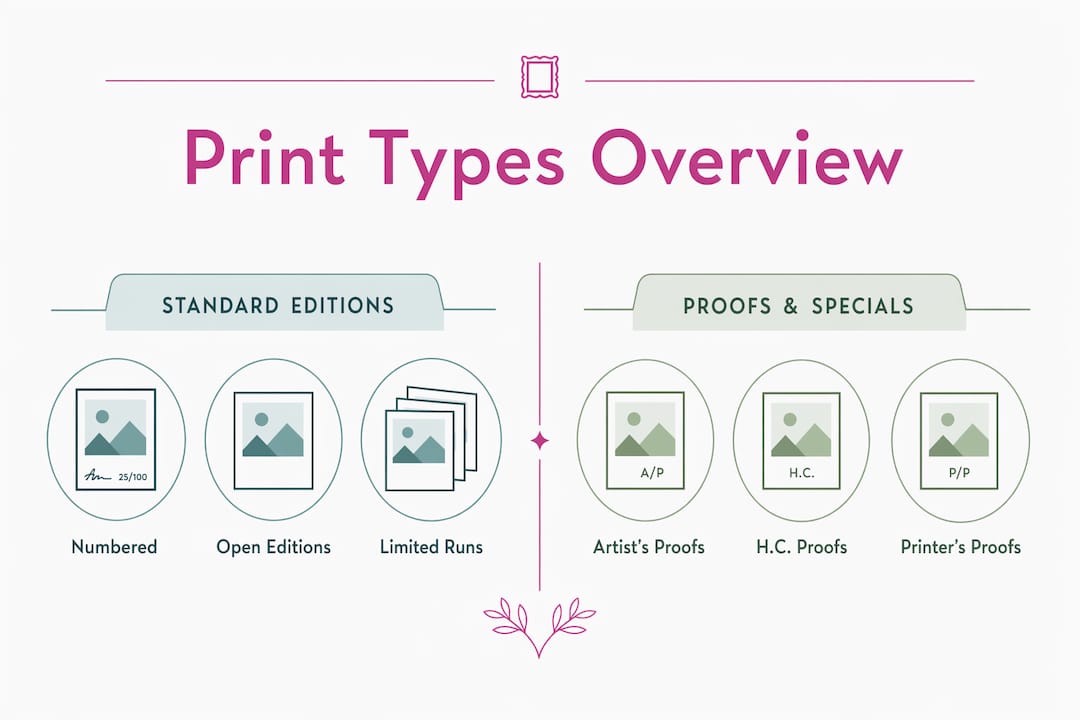
These proof categories add roughly 10% more prints beyond the stated edition size. A stated edition of 50 may therefore produce up to 55 total impressions when proofs are counted. Collectors who focus strictly on edition size without accounting for proofs may misjudge actual rarity.
Artist’s proofs carry a 20–30% price premium over standard numbered prints. That premium reflects both their scarcity and their status as the artist’s personal selection from the run.
| Edition Type | Typical Quantity | Investment Implication |
|---|---|---|
| Numbered edition | 7–295 prints | Core collectible; value tied to edition size and artist reputation |
| Artist’s proof (A.P.) | ~10% of edition | Commands 20–30% premium; high collector demand |
| Printer’s proof (P.P.) | 1–3 copies | Rare; primarily institutional or archival interest |
| Hors de commerce (H.C.) | 1–5 copies | Extremely limited; exhibition use; seldom on open market |
| Open edition | Unlimited | Minimal investment value; primarily decorative |
Open edition prints have no production limit and therefore carry little to no investment value. The distinction between a limited and open edition is not always obvious at the point of sale, which is why checking edition markings before purchase is non-negotiable.
Pro Tip: When buying a print marked A.P., confirm the total number of artist’s proofs produced. Some editions issue 10 or more A.P. copies, which reduces their scarcity advantage over the standard run.
Why does edition size determine the value of limited edition art prints?
Edition size is the primary driver of rarity in the print market. Small editions under 50 copies are considered significantly more desirable and command higher prices. Larger editions dilute exclusivity and typically sell at lower price points, even when print quality is identical.
Edition sizes range from around 7 copies to larger runs of 75–295 prints. That range shows how widely practices vary across artists and publishers. A print from an edition of 7 by an emerging artist with a growing reputation can appreciate faster than a print from an edition of 200 by a more established name.
Artist reputation interacts directly with edition size. A small edition from a recognized artist like Damien Hirst or Banksy carries compounding value: scarcity plus demand. A small edition from an unknown artist carries scarcity alone. For new collectors, this distinction matters when setting a budget and a time horizon for any potential resale.
MyArtBroker describes this dynamic as a contract of scarcity, an ethical commitment by the artist not to produce additional copies once the edition closes. That commitment is what separates a fine art print from a mass-produced decorative item. When an artist or publisher violates it by releasing additional prints after claiming an edition is closed, the entire edition loses credibility and market value.
How to identify and buy authentic limited edition prints safely
Buying authentic limited edition art prints requires a structured approach. The art market has no universal regulatory body, so buyer protection depends entirely on the seller’s reputation and the documentation they provide.
- Verify the COA before purchase. Confirm it lists the artist’s name, title, edition size, print number, materials, printing method, and date.
- Buy from reputable galleries or auction houses such as Christie’s, Sotheby’s, or established independent galleries with verifiable track records.
- Check the edition marking on the print itself. The number should be handwritten in pencil, not printed.
- Confirm the artist’s signature is original. Printed or stamped signatures do not carry the same authentication weight as hand-signed works.
- Research the artist’s catalog to confirm the edition size matches published records.
- Avoid unsigned prints or prints sold without any provenance documentation.
Resale value depends heavily on condition and documentation. A print stored in archival conditions with its original COA intact will consistently outperform an identical print with missing paperwork. For collecting limited edition art as an investment, documentation is as important as the artwork itself.
Expert collectors consistently emphasize building trusted gallery relationships over relying solely on online marketplaces. Galleries provide provenance verification, condition reports, and market context that anonymous online listings cannot match. That relationship also gives you access to new releases before they reach the secondary market.
Pro Tip: Ask any seller for the full print history: where it was published, how many copies were produced, and whether any proofs exist. A reputable seller answers these questions without hesitation. Reluctance to provide details is a clear warning sign.
For a deeper look at how signatures affect value, the guide on signed art print value at Emansgallery covers the specifics in detail.
Key takeaways
Limited edition prints derive their value from a fixed production quantity, verified documentation, and the artist’s commitment never to exceed the stated edition size.
| Point | Details |
|---|---|
| Fixed quantity defines value | Edition sizes range from 7 to 295 prints; smaller editions command higher prices. |
| COA is non-negotiable | A complete Certificate of Authenticity protects resale value and confirms provenance. |
| Proofs add complexity | Artist’s proofs can add 10% more prints to an edition and carry a 20–30% price premium. |
| Edition size drives rarity | Prints under 50 copies are the most desirable; larger editions reduce exclusivity. |
| Buy from verified sources | Reputable galleries and auction houses provide documentation and market protection. |
What i’ve learned from collecting and creating limited edition art
The most common mistake new collectors make is treating edition size as the only variable that matters. It is not. I have seen prints from editions of 10 sit unsold for years because the artist had no market presence, and I have seen editions of 150 appreciate steadily because the artist’s reputation grew after the edition closed.
My honest view is this: buy the work because it genuinely resonates with you. The financial upside of collecting limited edition art prints is real, but it is not guaranteed. What is guaranteed is that a work you love will hold personal value regardless of what the secondary market does. That emotional foundation also makes you a more patient collector, which tends to produce better financial outcomes over time.
Documentation matters more than most first-time buyers realize. I have handled situations where a print was clearly authentic but the missing COA made it nearly impossible to resell at fair value. Treat the paperwork as part of the artwork itself. Store it flat, keep it dry, and never discard it.
The 2026 market shows continued strong demand for small-edition prints by artists with active social media followings and gallery representation. Buyers are increasingly sophisticated about proof categories and edition transparency. Artists who publish clear edition records and provide complete COAs build collector trust faster than those who do not. That trust translates directly into secondary market performance.
If you are starting out, focus on understanding edition types before spending significant money. Read auction catalogs from Christie’s and Sotheby’s. Study how they describe edition markings, condition, and provenance. That education costs nothing and builds the judgment you need to buy confidently.
— Eman
Explore original art and fine prints at Emansgallery
Emansgallery offers original handmade paintings and museum-quality canvas prints by artist Eman Khalifa, each produced with full documentation and the quality standards serious collectors expect.
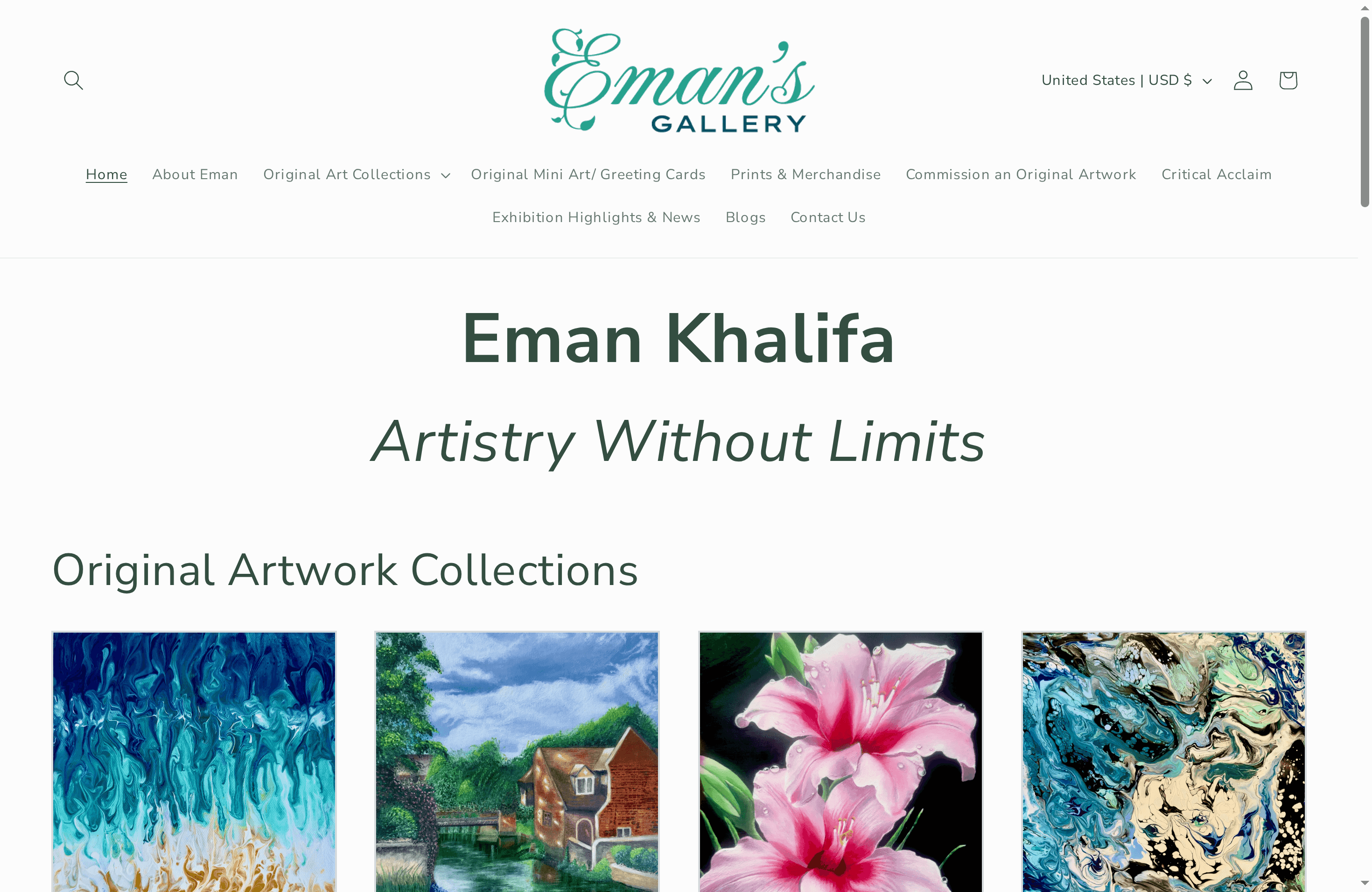
Every canvas print in the Emansgallery collection is produced on archival materials and ships worldwide from the UK, USA, Canada, Australia, and beyond. Whether you are building a first collection or adding a statement piece to an existing one, the wall art prints collection offers a curated range of original and fine art options. For a striking example of the quality available, the Fragments of Memory canvas print demonstrates the depth and precision that defines Emansgallery’s approach to fine art reproduction.
FAQ
What makes a print a limited edition?
A limited edition print is produced in a fixed, predetermined quantity that will never be exceeded. Each copy is individually numbered and typically signed by the artist to confirm its place in the edition.
How do i read the numbers on a limited edition print?
The number format is print number divided by total edition size. A marking of 5/30 means you own the fifth print from a total run of 30 copies.
Are limited edition prints a good investment?
Small edition sizes under 50 combined with a strong artist reputation and complete documentation produce the best investment outcomes. Open editions and unsigned prints carry minimal investment value.
What is an artist’s proof and why does it cost more?
An artist’s proof (A.P.) is a print set aside from the main edition for the artist’s personal use. These proofs are fewer in number and carry a 20–30% price premium over standard numbered prints due to their rarity and collector status.
Do i need a certificate of authenticity to resell a limited edition print?
A COA is the critical document for resale and insurance purposes. Without it, provenance is difficult to verify and the print’s market value drops significantly even if the work itself is genuine.
Stay Connected
- ✨ Explore Eman Khalifa's original art, fine art prints and art-inspired merchandise.
- Follow Eman Khalifa's art journey on: Instagram @emans_gallery and Facebook
- Watch Eman Khalifa creating live art on: YouTube @emans_gallery
