


Fine Art Print Meaning: What Collectors Must Know
TL;DR:
- A fine art print is a limited-edition artwork created through artist-supervised processes using archival materials. These prints are distinguished from posters by their quality, longevity, and attribution to the artist’s approval. Collectors value fine art prints for their rarity, material durability, and verified provenance.
A fine art print is defined as a limited edition artwork produced through close artist-printer collaboration using archival materials, specialized printing techniques, and deliberate edition controls. The term is used interchangeably with “original print” in the art market, though fine art print meaning extends beyond technique to include intent, material quality, and authenticity. Christie’s describes fine art prints as artist-approved finite editions, not mass commercial reproductions. For collectors, artists, and enthusiasts, understanding what separates a fine art print from a poster or a reproduction is the foundation of informed collecting.
What is fine art print meaning and definition?
A fine art print is not a photocopy of an artwork. It is an original work of art produced in multiple impressions through a controlled, artist-supervised process. Christie’s defines prints as multiple iterations created through transfer processes, not mere copies of existing paintings or drawings.
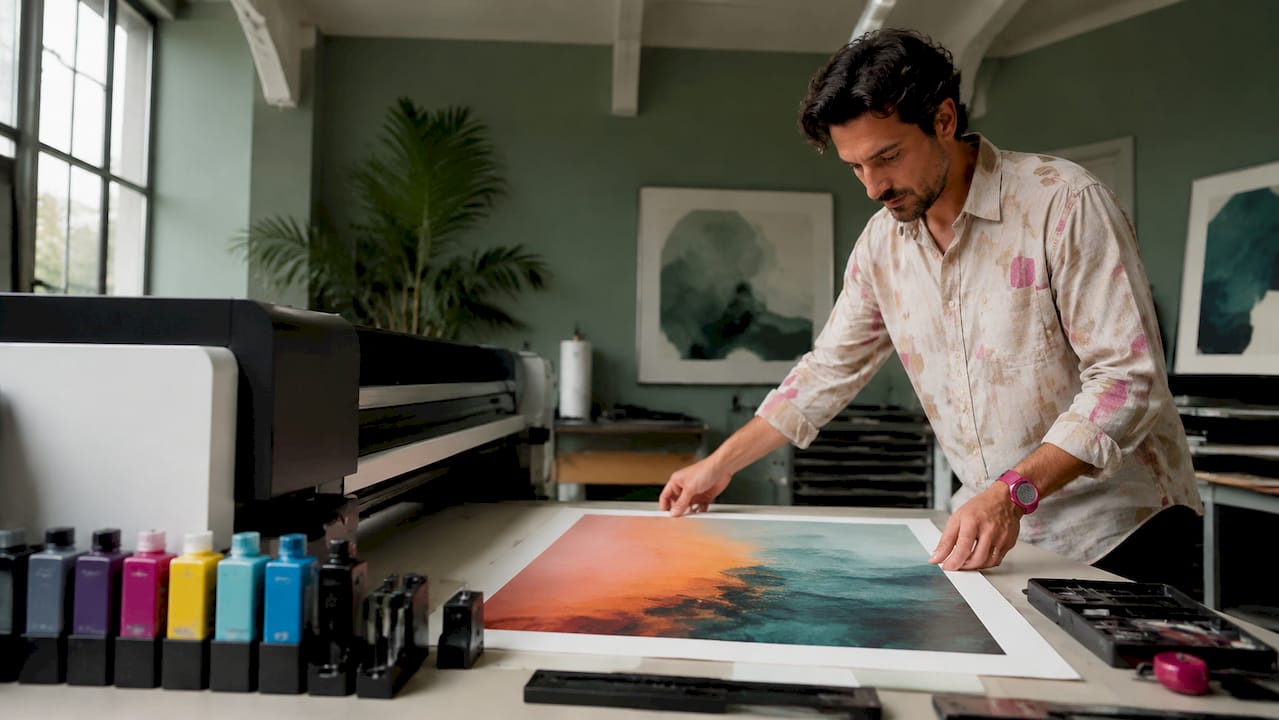
The fine art print definition rests on three pillars: artist involvement, material quality, and edition control. The artist either creates the print matrix directly or approves every stage of production with a master printer. The materials used are archival grade, meaning they are built to last generations. The edition is finite, meaning only a fixed number of impressions will ever exist.
Giclée printing is the most widely recognized modern fine art printing technique. It involves high-resolution inkjet printing using archival pigment inks on museum-grade papers, producing exceptional color accuracy and tonal depth. The word “giclée” comes from the French verb meaning to spray, describing how ink is applied. Traditional techniques such as etching, lithography, screenprinting, and woodcut also qualify as fine art printing techniques when produced under the same standards of artist oversight and archival materials.
How do fine art prints differ from posters and reproductions?
The difference between a fine art print and a poster is not just price. It is material, intent, and longevity.
| Feature | Fine Art Print | Commercial Poster |
|---|---|---|
| Paper weight | 250–400 gsm, acid-free cotton rag | 90–150 gsm standard stock |
| Ink type | Archival pigment-based inks | Dye-based or commercial inks |
| Color longevity | 70–100 years without fading | Fades within years under light |
| Edition size | Fixed, limited run (10–150 prints) | Open run, unlimited copies |
| Artist involvement | Signed, approved, supervised | None required |
| Documentation | Certificate of authenticity | Not standard |
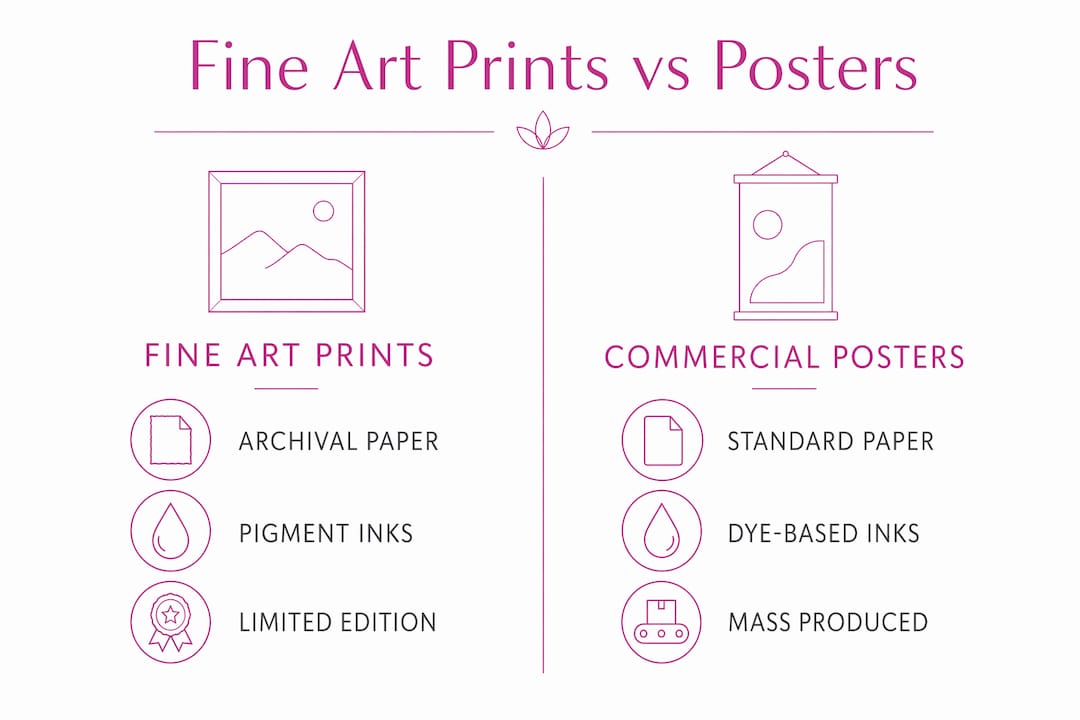
Fine art prints use acid-free archival paper weighing 250–400 gsm, which resists yellowing, brittleness, and curling over time. Standard poster stock at 90–150 gsm degrades noticeably within years. That difference in substrate is not cosmetic. It determines whether a print survives a century or a decade.
Pigment-based archival inks maintain color integrity for 70–100 years, offering richer colors and a wider gamut than commercial dye-based inks. A poster printed with dye inks will shift in color under UV light within a few years. A fine art print produced with pigment inks and UV-resistant coatings holds its original tonal range across generations.
Pro Tip: When evaluating any print for purchase, ask the seller to confirm the paper gsm and ink type in writing. If archival-grade paper and pigment inks are not explicitly mentioned, the print does not meet fine art standards.
How are fine art prints produced?
Fine art print production combines artistic decision-making with technical precision. The process varies by technique, but the principle is consistent: the artist controls the outcome.
The primary printmaking techniques used in fine art production include:
- Etching: The artist draws into a metal plate coated with wax. Acid bites the exposed lines. Ink fills the grooves and transfers to dampened paper under pressure.
- Lithography: The artist draws on a flat limestone or aluminum plate with a greasy medium. Water and ink repel each other, transferring the image to paper.
- Screenprinting: Ink is pushed through a mesh screen onto paper or canvas. Each color requires a separate screen, making multi-color prints labor intensive.
- Woodcut: The artist carves a design into a wood block. The raised surface holds ink and transfers it to paper.
- Giclée/digital printing: High-resolution digital files are output through professional inkjet printers using archival pigment inks onto museum-grade paper or canvas.
The role of the master printer is central to fine art print quality. A master printer is a specialist who works directly with the artist to translate their vision into a printed medium. They manage ink mixing, paper selection, press pressure, and color proofing. The artist reviews and approves each stage before the edition is printed.
Proof types are produced before the final edition. Artist’s Proofs (AP) are impressions pulled before the numbered edition, typically reserved for the artist. Printer’s Proofs (PP) are kept by the print studio. Both carry the same quality as numbered edition prints and often hold equal or greater collector value.
Pro Tip: When buying a fine art print, check whether it is from the numbered edition or an Artist’s Proof. Both are legitimate, but knowing the distinction helps you understand what you own and its relative scarcity.
What is edition numbering and why does it matter?
Edition numbering is the system that certifies a fine art print’s place within its total run. A notation like 5/30 means the fifth impression from an edition of thirty total prints. Christie’s confirms that edition numbers verify ownership and rarity, providing collectors with provenance data encoded directly on the print.
Here is how edition numbering works in practice:
- The fraction format: The top number is the individual print’s sequence. The bottom number is the total edition size. A print marked 3/10 is the third impression from an edition of ten.
- Edition size and value: Smaller editions drive higher collector demand and market price. An edition of 10 is significantly rarer than an edition of 150, and pricing reflects that directly.
- Artist’s Proofs (AP): These are marked “AP” rather than with a fraction. They are typically produced in a quantity equal to 10% of the edition size and are considered equal in quality to numbered prints.
- Printer’s Proofs (PP): Marked “PP,” these are retained by the print studio. They rarely enter the market but are occasionally sold.
- Hors Commerce (HC): Marked “HC,” these prints are not for sale and are used for exhibition or promotional purposes.
Limited edition fine art prints are produced in fixed runs of 10–150 prints, each signed and often accompanied by a certificate of authenticity. That certificate, combined with the edition number, forms the provenance record that underpins a print’s market value. Without documentation, even a high-quality print loses its verifiable status as a fine art edition.
Why do fine art prints hold value for collectors?
Fine art prints hold value because they combine rarity, artist authority, and material durability in a single object. Provenance and edition documentation differentiate fine art prints from open reproductions in the art market.
The key reasons collectors seek fine art prints include:
- Rarity: A fixed edition means supply is permanently capped. Once an edition sells out, no additional impressions can be made.
- Artist signature: A hand-signed print confirms the artist’s direct approval of that specific impression. It is not a printed signature. It is a mark made by the artist on the physical work.
- Archival durability: Fine art prints are designed to last 50–100+ years with UV resistance and color preservation built into the materials.
- Accessibility: Original paintings are often priced beyond the reach of most collectors. Fine art prints offer a way to own an artist’s work at a fraction of the cost of a unique original.
- Provenance: Documentation of edition number, artist signature, and certificate of authenticity creates a traceable ownership history that supports resale value.
“Fine art prints are valued as unique artworks due to the artist-printer collaboration, edition control, and deliberate creative choices, not just image reproduction.” — Christie’s
The artist-gallery collaboration behind fine art editions is strategic, not mechanical. Artists choose which images to release as prints, which studios to work with, and how large each edition will be. Those decisions shape the print’s place in the art market for decades. For collectors, understanding that process is as important as understanding the price.
Key takeaways
A fine art print is defined by artist involvement, archival materials, and a fixed edition size. These three factors together determine its authenticity, longevity, and market value.
| Point | Details |
|---|---|
| Fine art print definition | A limited edition, artist-approved artwork produced with archival materials and specialized printing techniques. |
| Material quality matters | Archival paper (250–400 gsm) and pigment inks preserve color integrity for 70–100 years. |
| Edition numbering verifies rarity | A notation like 5/30 confirms the print’s sequence and total edition size for provenance purposes. |
| Artist involvement is non-negotiable | Hand signatures, proof approvals, and master printer collaboration distinguish fine art prints from reproductions. |
| Documentation protects value | A certificate of authenticity combined with an edition number forms the provenance record collectors rely on. |
Why i think most people misunderstand fine art prints
Most people assume a fine art print is just a high-quality photograph of a painting. That misunderstanding costs collectors real money and real satisfaction.
When I work on prints at Emansgallery, the process starts long before ink touches paper. Selecting the right paper weight, confirming the pigment ink profile, reviewing color proofs against the original. Every step is a decision, not a default. The print is not a copy. It is a new object with its own physical presence.
The misconception I encounter most often is that edition size does not matter. Collectors sometimes buy an “open edition” print thinking it carries the same value as a limited run. It does not. An open edition has no fixed supply cap, which means its scarcity never increases. A limited edition of 20 prints, all signed, all documented, operates on entirely different market logic.
The other thing I want collectors to know: archival materials are not a marketing claim. They are a technical specification. If a seller cannot tell you the paper gsm or confirm pigment-based inks, that is information worth having before you buy. You can learn more about preserving fine art prints once you own them, but the quality has to be there from the start.
Fine art prints are one of the most accessible ways to build a serious collection. They carry the artist’s hand, the studio’s craft, and the materials’ permanence in a single object. That combination is what makes them worth understanding properly.
— Eman
Explore original art and fine art prints at Emansgallery
Emansgallery offers original handmade paintings and museum-quality canvas prints by artist Eman Khalifa, produced with the archival standards this article describes. Every canvas print is output on museum-grade material with pigment-based inks, and original paintings are one-of-a-kind works available to collectors worldwide.
If you are building a collection or looking for a statement piece, browse the canvas prints collection for limited-run wall art across abstract, geometric, and seascape subjects. For collectors seeking a unique original, the Good Tidings original painting is a fluid blue and gold ocean work available now. Emansgallery ships worldwide from the UK, USA, Canada, Australia, and across Europe and the UAE.
FAQ
What is the fine art print meaning in simple terms?
A fine art print is a limited edition artwork produced through artist-supervised printing on archival materials. It is treated as an original work of art, not a reproduction.
What are fine art prints made from?
Fine art prints use acid-free cotton rag paper weighing 250–400 gsm and archival pigment-based inks. These materials are chosen specifically for longevity, with color stability lasting 70–100 years.
How do i know if a print is a genuine fine art print?
Look for an edition number (such as 5/30), a hand-signed artist signature, and a certificate of authenticity. If those three elements are present, the print meets the standard fine art print definition.
What is the difference between a fine art print and a poster?
A fine art print is produced in a fixed limited edition on archival paper with pigment inks and carries artist approval. A poster is an open-run commercial reproduction printed on lightweight stock with no edition controls or artist involvement.
What fine art printing techniques are most common?
The most common fine art printing techniques are giclée (high-resolution inkjet on archival paper), etching, lithography, screenprinting, and woodcut. Each technique produces a distinct visual character and requires specialized studio equipment and expertise. You can read more about fine art printing processes to understand which technique suits your collecting goals.
Stay Connected
- ✨ Explore Eman Khalifa's original art, fine art prints and art-inspired merchandise.
- Follow Eman Khalifa's art journey on: Instagram @emans_gallery and Facebook
- Watch Eman Khalifa creating live art on: YouTube @emans_gallery
