


What Is an Abstract Expressionist? A Clear Guide
TL;DR:
- Abstract Expressionism is an American art movement that emerged in New York in the late 1940s, emphasizing large-scale canvases and emotional expression. It features key artists like Pollock and Rothko who revolutionized abstract art through spontaneous, physically engaged techniques that fostered immersive viewer experiences. Understanding the movement’s styles, techniques, and historical context enhances appreciation of modern art’s expressive potential.
Abstract Expressionism is defined as an American art movement that emerged in New York during the late 1940s, characterized by large-scale canvases, spontaneous technique, and the prioritization of emotional expression over realistic representation. The movement’s key figures, Jackson Pollock, Mark Rothko, and Willem de Kooning, collectively shifted the art world’s center from Paris to New York, establishing the United States as the dominant force in contemporary art for the first time. Understanding what an abstract expressionist is, and what separates this movement from other forms of modern art, gives you a sharper eye for everything from museum collections to contemporary gallery offerings.
What is an abstract expressionist and how is the movement defined?
An abstract expressionist is an artist who works within the tradition of Abstract Expressionism, a movement that flourished between the late 1940s and the 1960s and rejected both European academic tradition and American social realism in favor of raw, subjective emotional output. The term “Abstract Expressionism” was first applied in 1946 by critic Robert Coates, making it one of the few major art movements named by a journalist rather than its own practitioners. That origin matters because it signals how the movement was perceived from the outside: as something genuinely new and difficult to categorize.

The definition of abstract expressionism centers on two core ideas. First, the work is abstract, meaning it does not attempt to depict recognizable objects or scenes. Second, it is expressionist, meaning the artist’s inner emotional state drives every formal decision, from color choice to brushstroke weight. These two principles combine to produce paintings that feel immediate, physical, and psychologically charged in ways that traditional figurative art rarely achieves.
What makes the movement particularly significant is its ambition. Abstract expressionist paintings were not small, intimate works. They were designed to surround and overwhelm the viewer, turning the act of looking into a full-body experience.
What are the defining characteristics of abstract expressionism?
Abstract expressionism’s characteristics separate it from every prior art movement through a specific set of formal and conceptual choices. Recognizing these traits lets you identify the style confidently in any collection.
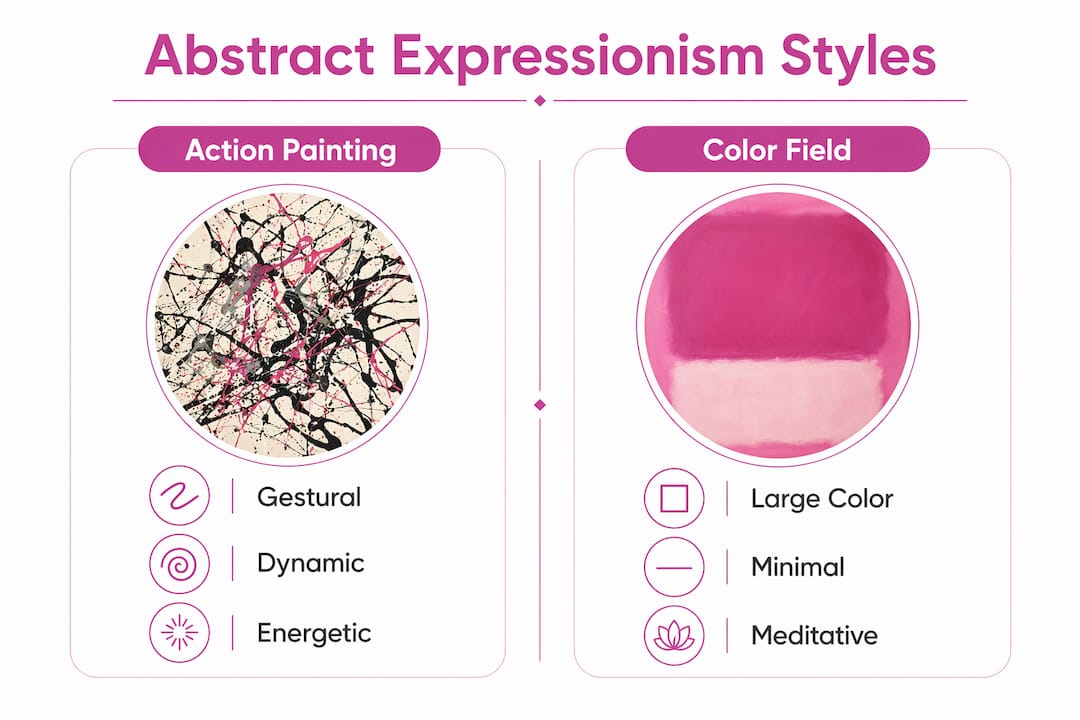
The movement divides into two primary styles:
- Action Painting: Associated with Jackson Pollock and Willem de Kooning, action painting treats the canvas as a physical arena. The artist’s body movement, gesture, and energy are recorded directly in the paint. Harold Rosenberg coined the term “Action Painting” in 1952, describing the canvas as an “event” rather than a static image. This reframing was radical. It meant the process of making the painting was as significant as the finished object.
- Color Field Painting: Associated with Mark Rothko and Clyfford Still, this approach uses large, unbroken expanses of color to produce meditative, emotionally resonant experiences. There is no gesture or visible brushwork. The color itself carries the entire emotional weight of the work.
Beyond these two camps, abstract expressionism shares several signature compositional techniques across the board:
- “All-over” composition, where the entire canvas surface is treated with equal visual weight rather than directing the eye to a single focal point
- Large-scale formats designed to fill the viewer’s peripheral vision
- Visible evidence of the artist’s physical process, whether drips, smears, or layered paint
- Rejection of preparatory sketches in favor of direct, spontaneous mark-making
- Emotional intensity as the primary measure of a work’s success
Pro Tip: When viewing abstract expressionist paintings in person, stand close enough that the canvas fills your entire field of vision. Rothko’s color fields and Pollock’s drip works were specifically designed to be experienced at that scale, not reproduced in a book.
How did history and culture shape the movement’s emergence?
Abstract Expressionism did not appear from nowhere. Four specific historical conditions made it possible, and understanding them explains why the movement happened in New York rather than anywhere else.
- Post-World War II displacement. The war drove many European artists, including Surrealists like André Breton and Max Ernst, to New York. Their presence exposed American painters to European avant-garde ideas while simultaneously making those ideas feel like something to move beyond rather than imitate.
- Rebellion against European dominance. Abstract Expressionism established a uniquely American style by rejecting the formal conventions of European painting. American artists wanted a visual language that was not borrowed from Paris or Berlin.
- The role of critics. Clement Greenberg and Harold Rosenberg were not passive observers. Greenberg promoted Abstract Expressionism by arguing that painting should pursue the purity of its own medium, while Rosenberg described the canvas as an “arena” of existential action. Their writing gave the movement intellectual credibility and a public identity.
- The New York School community. Artists gathered at Cedar Tavern and the Club in Greenwich Village, creating a dense intellectual and social environment where ideas moved fast. This community dynamic, contentious and competitive, produced the pressure that pushed individual artists toward more extreme formal experiments.
The movement also functioned as a rebellion against commercialization and the expectation that art should serve social or political messaging. That stance gave the work a sense of urgency that still reads clearly today.
Who were the key artists in abstract expressionism?
The following table profiles the most influential abstract expressionist artists, their signature approaches, and their most recognized works.
| Artist | Style | Signature technique | Notable works |
|---|---|---|---|
| Jackson Pollock | Action Painting | Drip and pour on floor-laid canvas | No. 5, 1948; Autumn Rhythm |
| Mark Rothko | Color Field | Large color blocks, soft edges | Orange and Yellow; No. 61 |
| Willem de Kooning | Gestural Abstraction | Loose, aggressive brushwork with figurative traces | Woman I; Excavation |
| Franz Kline | Action Painting | Bold black-and-white brushwork | Chief; Mahoning |
| Lee Krasner | Action Painting | Collage and gestural layering | The Seasons; Milkweed |
Jackson Pollock’s contribution was the most technically radical. His drip technique involved controlled rhythmic movements, not random splattering. Pollock moved around the canvas with deliberate physical awareness, using gravity and momentum as tools. The common assumption that his work was accidental is one of the most persistent misconceptions in modern art history.
Mark Rothko pursued the opposite approach. His large color fields were designed to produce a specific psychological state in the viewer, something close to grief or transcendence depending on the palette. Rothko reportedly said he wanted viewers to weep in front of his paintings, and many do.
Franz Kline’s black-and-white brushwork drew comparisons to Japanese calligraphy, though Kline himself resisted that interpretation. His forms were studied and deliberate despite their appearance of spontaneity, a tension that defines much of the movement’s best work.
Lee Krasner deserves more attention than she typically receives. Her work evolved through several distinct phases and demonstrated a formal rigor that matched any of her male contemporaries.
What techniques define abstract expressionist paintings?
The practical methods behind abstract expressionist paintings are as distinctive as the finished works themselves. Action painters abandoned the easel entirely/9.02%3A_Abstract_Expresssionism_(Late_1940s-1960s)), laying canvases flat on the floor to allow full physical engagement from all sides. This single change transformed painting from a controlled, upright activity into something closer to performance.
Pollock’s drip technique was highly controlled and physically demanding, requiring the artist to maintain consistent rhythm and pressure across canvases that could measure fifteen feet or more. The physical traces left by that process, the arcs, splashes, and overlapping layers, record the artist’s movement through time and space in a way no other technique achieves.
Color Field painters used entirely different methods. Rothko applied thin, translucent layers of paint that allowed earlier colors to show through, creating a luminous depth that photographs rarely capture. The edges of his color blocks were deliberately soft, producing a vibrating optical effect where two colors meet.
Several techniques appear consistently across both camps:
- Layering paint to build physical texture and visual depth
- Using scale to force an immersive viewing experience
- Allowing accidents and unexpected results to remain in the final work
- Treating the entire canvas surface as equally active, with no background or foreground
Pro Tip: When studying abstract expressionist works, look at the painting’s edges and corners. Many artists treated these areas with the same intensity as the center, which is the clearest visual signal of the “all-over” compositional approach.
How does understanding this movement improve your art appreciation?
Recognizing abstract expressionism’s characteristics directly improves your ability to read and evaluate modern and contemporary art. The movement’s influence on later art movements including Pop Art and Minimalism was substantial. Pop Art reacted against Abstract Expressionism’s seriousness by embracing commercial imagery. Minimalism pushed the movement’s formal reductions further, stripping away even the emotional gesture. Both movements are easier to understand when you know what they were responding to.
For collectors, understanding the movement’s two main camps, action painting and color field, helps you articulate what you are drawn to and why. Collectors who respond to energy and physicality tend to favor gestural works. Those who want contemplative, meditative pieces often gravitate toward color field traditions. Knowing the difference helps you make more deliberate choices when browsing popular art styles in the current market.
Abstract Expressionism also shaped modern American art identity in a lasting way. It established the idea that American artists could lead rather than follow, and that emotional directness was a legitimate artistic value rather than a sign of lack of discipline. That legacy runs through every major American art movement that followed.
For practical interpretation, approach abstract expressionist paintings by asking three questions: What physical process produced this surface? What emotional state does the color and scale suggest? How does the composition use the full canvas? Those three questions will take you further than any amount of art historical background.
Key takeaways
Abstract Expressionism is the defining American art movement of the 20th century, built on spontaneous technique, emotional directness, and the rejection of European formal tradition.
| Point | Details |
|---|---|
| Core definition | Abstract Expressionism prioritizes emotional expression through abstract forms, not realistic depiction. |
| Two main styles | Action Painting records physical gesture; Color Field uses large color areas for meditative effect. |
| Key artists | Pollock, Rothko, de Kooning, Kline, and Krasner each represent distinct approaches within the movement. |
| Historical context | Post-WWII New York, European immigration, and critics like Greenberg and Rosenberg shaped the movement’s rise. |
| Lasting influence | The movement directly shaped Pop Art and Minimalism and established New York as the global center of contemporary art. |
Why abstract expressionism still demands your attention
I find that most people approach abstract expressionist paintings with the wrong expectation. They look for something to decode, a hidden image or a symbolic message, and when they cannot find one, they conclude the work is empty. That is the wrong frame entirely.
What abstract expressionism actually offers is a record of a physical and psychological event. When you stand in front of Pollock’s Autumn Rhythm or a late Rothko, you are not reading a message. You are experiencing the residue of a specific human presence. The scale, the layering, the color choices, all of it was made by a body in a room, under pressure, making decisions in real time. That is not a lesser form of art. It is a more direct one.
The balance between spontaneity and control is what I find most instructive for my own work. Pollock’s drip paintings look chaotic but were physically disciplined. Rothko’s color fields look simple but required extraordinary sensitivity to get the edges and proportions right. The lesson is that freedom in art is not the absence of skill. It is skill applied in a different direction.
If you are new to abstract expressionism, I would encourage you to spend time with what makes abstract painting work before forming a judgment. The movement rewards patience and physical presence in a way that reproductions simply cannot replicate.
— Eman
Discover original abstract art at Emansgallery

Emansgallery offers original handmade paintings and museum-quality canvas prints that draw on the same expressive traditions explored in this article. Good Tidings, an original fluid blue and gold painting, captures the layered, color-driven energy of the Color Field tradition. The Private Eye canvas print reflects conceptual expressionism with bold, direct visual impact. For collectors who want the physicality of an original work, the Good Tidings original painting ships worldwide from multiple fulfillment locations. Each piece is one of a kind, made by hand, and available to art collectors, interior designers, and luxury homeowners globally.
FAQ
What is the definition of abstract expressionism?
Abstract Expressionism is an American art movement from the late 1940s to the 1960s defined by spontaneous, emotionally charged abstract painting. It prioritizes the artist’s inner experience over realistic or symbolic representation.
Who are the most famous abstract expressionist artists?
The most recognized abstract expressionist artists are Jackson Pollock, Mark Rothko, and Willem de Kooning. Franz Kline and Lee Krasner are also considered central figures in the movement.
What are the two main styles within abstract expressionism?
The movement divides into Action Painting, which emphasizes physical gesture and movement, and Color Field Painting, which uses large areas of color to create meditative emotional experiences.
How do you identify an abstract expressionist painting?
Look for large-scale canvases, all-over composition with no single focal point, visible evidence of physical process such as drips or gestural brushwork, and an absence of recognizable subject matter.
How did abstract expressionism influence later art movements?
Abstract Expressionism directly influenced Pop Art and Minimalism. Pop Art rejected its emotional seriousness, while Minimalism extended its formal reductions, making both movements responses to the abstract expressionist legacy.
Stay Connected
- ✨ Explore Eman Khalifa's original art,
- Follow Eman Khalifa's art journey on: Instagram @emans_gallery and Facebook Eman's Gallery
- Watch Eman Khalifa creating live art on: YouTube @emans_gallery
