


Surface pattern design: a creative guide for beginners
TL;DR:
- Surface pattern design involves creating decorative, repeatable artwork for various surfaces and products.
- It has deep historical roots and evolved through technological advances from hand-printing to digital methods.
- Beginners should observe nature, sketch motifs, build seamless repeats, and develop distinct styles to succeed.
Surface pattern design: a creative guide for beginners
Surface pattern design is widely misunderstood. Many people assume it is simply about repeating a shape across a page or fabric, but it is far more layered than that. It combines artistic judgment, historical awareness, material knowledge, and an eye for composition. From the bold floral wallpapers of the Victorian era to the geometric prints on today’s fashion collections and home merchandise, surface pattern design shapes the visual world around us in ways most people never stop to notice. This guide breaks down what the field actually is, where it came from, how it is applied today, and how you can start practicing it yourself.
Table of Contents
- Understanding surface pattern design
- History and evolution of surface pattern design
- Applications of surface pattern design today
- How to create your own surface pattern designs
- Why surface pattern design unlocks creative possibility
- Explore curated surface pattern art at Eman’s Gallery
- Frequently asked questions
Key Takeaways
| Point | Details |
|---|---|
| Definition clarified | Surface pattern design is about decorating surfaces with creative motifs and compositions. |
| Historical foundation | The field traces its roots to the decorative arts, with figures like William Morris shaping its legacy. |
| Modern applications | Surface pattern design influences home décor, textiles, and retail merchandise in contemporary settings. |
| Creative potential | Anyone can unlock new ideas and personal expression by experimenting with surface pattern design. |
Understanding surface pattern design
Surface pattern design is the creation of decorative artwork intended to be applied to a surface. That surface could be a roll of wallpaper, a length of fabric, a ceramic mug, a tote bag, or even a shower curtain. The design is made to be repeated, scaled, colorized, and printed onto physical objects that people use every day.
At its most basic level, a surface pattern design consists of five core elements:
- Motif: The individual unit or image that forms the visual foundation of the design. A motif can be a leaf, a geometric shape, an abstract brushstroke, or an illustrated character.
- Repetition: How the motif tiles or arranges itself across the surface. Common repeat structures include half-drop, brick, mirror, and full-drop repeats.
- Color: The palette chosen for the pattern, which sets mood, seasonal feel, and commercial appeal.
- Scale: The size relationship between motifs and the surface they cover. Large-scale patterns feel bold and dramatic; small-scale patterns tend to read as texture from a distance.
- Composition: The overall arrangement and spacing of motifs within the repeat unit, including how much negative space is used.
What separates surface pattern design from general illustration or fine art is its functional purpose. The design must work within industrial or manufacturing constraints. It must tile seamlessly, reproduce faithfully in print, and hold visual appeal across a full bolt of fabric or a wall. Fine art makes its own rules. Surface pattern design operates inside a defined system.
Historically, this discipline has roots deep in decorative arts. Ancient Egyptian textiles, Greek pottery, and Chinese silk weaving all demonstrate sophisticated early uses of repeated decorative elements. But the field gained its most recognizable identity during the nineteenth century Arts and Crafts movement in Britain.
“Historical examples show surface-pattern design has long existed in decorative arts; William Morris produced many block-printed wallpapers and textile patterns.”
Morris treated pattern design as serious artistic work. His method was to observe nature closely, abstract its forms carefully, and then arrange them into structured, printable repeats. His wallpaper designs like Willow Boughs and Acanthus remain widely recognized more than a century after they were created. Understanding that lineage helps modern designers appreciate the depth of the field they are entering.
History and evolution of surface pattern design
The history of surface pattern design cannot be separated from the history of making things. Every culture that produced textiles, ceramics, or architecture developed some form of decorative surface work. Pattern was functional before it was aesthetic. Repeating geometric borders protected the edge of a garment from fraying. Woven color blocks identified a tribe or clan. Printed florals on wallpaper transformed a cold plaster wall into a warm, livable environment.
The nineteenth century Arts and Crafts movement transformed decorative design from a craft tradition into a self-conscious design philosophy. William Morris was its most influential figure. He founded his company, Morris, Marshall, Faulkner and Co., in 1861, and dedicated much of his career to reviving hand-crafted standards in printed and woven textiles. His block-printed wallpaper designs demonstrated that decorative pattern could be both commercially successful and artistically serious.
Morris drew heavily from medieval tapestry, Persian carpet weaving, and his own botanical observations. He rejected the mechanical, mass-produced aesthetic of early industrialism. His patterns feel alive because they are structured but not rigid. They use symmetry without becoming sterile.
The evolution of the field from Morris’s era to the present follows a predictable arc tied to technology:
| Era | Primary method | Key development |
|---|---|---|
| Pre-industrial | Hand block printing | Slow but highly detailed output |
| Industrial revolution | Roller printing | Mass production of repeating patterns |
| Mid-20th century | Screen printing | Increased color range and fidelity |
| Digital age | Software and digital printing | Instant iteration and global distribution |
Today, a designer working on textile art print examples might start in a sketchbook, scan the artwork, and refine it in Adobe Illustrator or Procreate before sending a finished file to a print-on-demand manufacturer. That workflow would have been unimaginable to Morris. Yet the core design decisions, choosing a motif, establishing a repeat, selecting a palette, remain exactly the same.
Understanding texture in pattern design has become especially important in digital work, where simulated depth must compensate for the tactile quality that hand-printed surfaces carry naturally.
Pro Tip: Spend time studying historical pattern archives. Museums like the Victoria and Albert Museum in London offer free access to thousands of documented historic patterns, and analyzing their structure will teach you more about composition than most beginner tutorials.
Applications of surface pattern design today
Surface pattern design touches nearly every product category in retail. Once you start looking for it, you see it everywhere. The floral print on a throw pillow. The geometric repeat on a beach towel. The abstract watercolor washes on a phone case. All of these began as a pattern design file created by a designer.
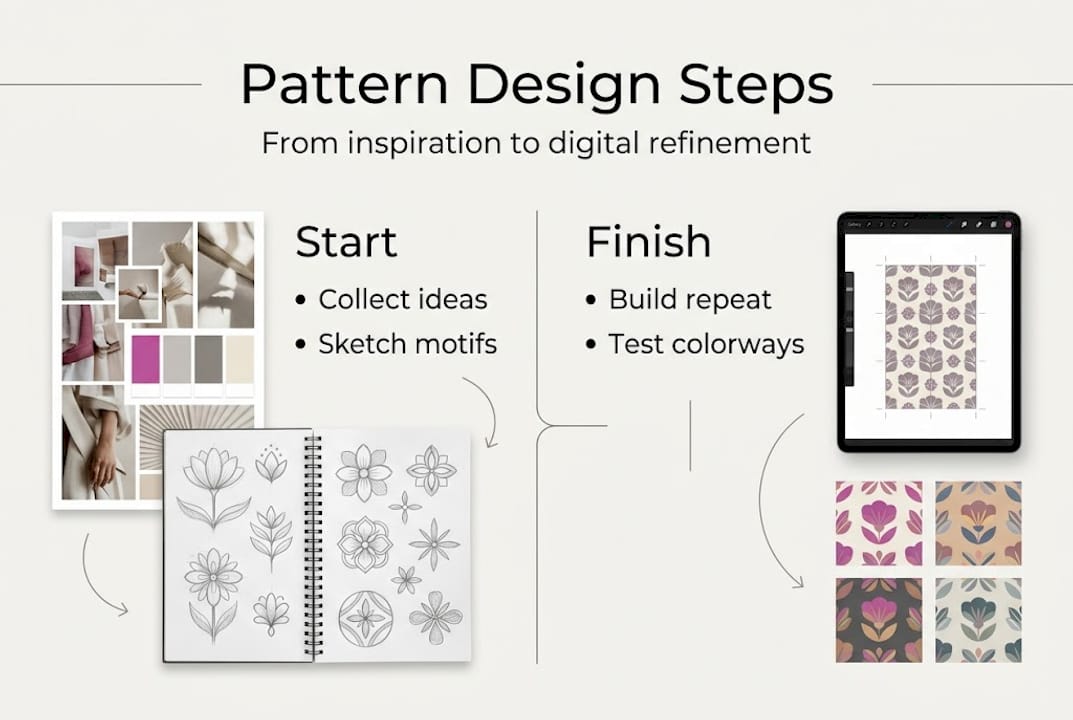
Here is how a pattern typically moves from a creative concept to a finished retail product:
- Concept development: The designer identifies a theme, season, or mood. They gather visual references, sketch rough motifs, and establish a loose color palette.
- Motif creation: Individual motif elements are drawn by hand or digitally, refined for clarity and printability, and saved as scalable vector or high-resolution raster files.
- Repeat construction: The motifs are arranged into a repeat structure. The designer checks that seams are invisible and that the pattern tiles correctly at different scales.
- Colorway development: Multiple color versions of the same pattern are produced to appeal to different market segments or seasonal trends.
- Technical file preparation: The final files are formatted to the specifications of each surface or product. Fabric panels, wallpaper rolls, and product mockups all have different technical requirements.
- Production and quality check: The pattern is printed or woven, and the designer reviews physical samples to confirm color accuracy and repeat alignment.
Today, surface patterns in retail appear on products that range from everyday commodities to premium design objects.
| Application | Hand-printed feel | Digitally reproduced |
|---|---|---|
| Wallpaper | Rich texture, slight variation | Uniform, precise repeats |
| Fabric/textiles | Soft edges, tactile depth | Sharp detail, color consistency |
| Home accessories | Artisanal character | Scalable, cost-efficient |
Morris’s approach, which described hand-produced woven and printed cloth as a craft worthy of serious artistic attention, is directly relevant here. Modern designers are rediscovering hand-printing methods and blending them with digital tools to achieve surfaces that feel crafted rather than manufactured.
For anyone seeking concrete examples of how pattern translates into home objects, products like designer pillowcases and designer bath towels show how refined surface pattern work appears on everyday functional items.
How to create your own surface pattern designs
Starting your own surface pattern practice does not require expensive software or a formal design education. It requires observation, patience, and a willingness to iterate. Here is a clear, practical path for beginners.
Step 1: Develop a source of inspiration. Before drawing anything, collect references. Nature is the most reliable starting point, and Morris proved this with enduring clarity. Look at leaves, seed pods, feathers, geometric architecture, or abstract textures. The key is to look closely at real things rather than copying existing designs.
Step 2: Sketch your motifs by hand. Even if you plan to work digitally, start with pencil and paper. Sketching by hand forces you to simplify. You cannot draw every vein in a leaf, so you choose which lines matter most. That simplification process is where your visual style begins to form.
Step 3: Choose your digital tool. For vector-based patterns, Adobe Illustrator is the industry standard. For hand-drawn digital styles, Procreate on iPad is highly accessible. Both allow you to build a seamless repeat and export files for professional print production.
Step 4: Build your repeat structure. Place your motifs inside a defined tile, then check how the tile repeats horizontally and vertically. A half-drop repeat, where each row is offset by 50%, gives patterns a more organic, flowing feel. A straight grid repeat is cleaner and more structured.
Step 5: Develop multiple colorways. Once your structure works, experiment with color. A single pattern can look completely different depending on whether you use a light background with muted tones or a dark background with saturated contrast colors.
Pro Tip: Morris’s block-printed, nature-based wallpaper designs, first produced for his 1861 company, succeeded because each motif was simplified enough to print clearly but complex enough to reward close inspection. Aim for that balance in your own work.
Common beginner mistakes to avoid:
- Overcrowding the tile: Filling every inch of space makes patterns feel claustrophobic. Negative space is a design element, not empty space.
- Ignoring repeat seams: If you do not check how your tile edges connect, the repeat will show obvious grid lines on the finished product.
- Copying trends without developing a style: Following trends is useful, but building a recognizable personal style is what makes a designer’s portfolio commercially valuable.
- Skipping physical tests: Viewing a pattern on screen does not tell you how it will look printed large. Order test prints before committing to full production runs.
For continued design inspiration as you build your practice, studying finished printed works by professional designers and galleries is one of the most efficient ways to train your eye. You can also explore top art merchandise to see how patterns translate across product types.
Why surface pattern design unlocks creative possibility
Many aspiring artists treat surface pattern design as a lesser discipline compared to fine art painting or sculpture. That view is both common and incorrect. The constraints of pattern design, the need for repetition, the requirement that a design work at multiple scales, the demand for seamless construction, are not limitations. They are creative engines.
Repetition, when used with intention, forces a designer to extract the most essential version of an idea. When you have to tile a motif fifty times across a fabric panel, you quickly learn which details survive and which ones create visual noise. That discipline translates directly to stronger, more focused work across every creative medium.
Decorative work also has a direct relationship with lived experience that pure fine art often lacks. A pattern that someone chooses for their bedroom walls, their kitchen towels, or their daily tote bag becomes part of their environment. It affects mood, comfort, and identity in practical, measurable ways.
For designers looking to build a commercial practice, surface pattern design offers a particularly clear path. Products that feature merchandise for creative designers demonstrate exactly how a single well-executed design can multiply across dozens of product formats, generating revenue while communicating a consistent visual identity. The idea that decorative work is somehow artistically inferior misses the point entirely. The challenge of making something beautiful within a strict functional system is one of the hardest problems a designer can face.
Explore curated surface pattern art at Eman’s Gallery
Surface pattern design reaches its full potential when it moves off the screen and onto real objects in real spaces. Eman’s Gallery offers a curated selection of artworks and printed merchandise that demonstrate exactly how pattern and composition translate from design file to finished product.
The city in grids canvas print is a strong example of geometric surface pattern elevated to gallery-quality wall art. For designers seeking reference material and visual inspiration, the full wall art prints collection showcases how color, scale, and composition interact across large-format printed works. The signature art merchandise range extends those same design principles into everyday objects, giving you practical examples of pattern applied to real products. All items ship worldwide.
Frequently asked questions
What is surface pattern design?
Surface pattern design is the art of creating decorative patterns for surfaces like textiles, wallpaper, and products. This discipline has a long history in decorative arts, spanning from ancient textile traditions to contemporary digital print production.
Who are some famous surface pattern designers?
William Morris is the most widely cited historical figure in surface pattern design, known for his nature-based block-printed wallpapers and handcrafted textiles produced from 1861 onward. Contemporary designers like Orla Kiely and Marimekko’s design teams have continued this tradition in modern contexts.
Where is surface pattern design used today?
Surface pattern design is used in home décor, fashion, stationery, ceramics, packaging, and printed merchandise across global retail industries. Morris’s hand-produced woven and printed cloth established a precedent for decorative design as functional art that continues in modern product categories.
How can I start creating surface pattern designs?
Begin by sketching motifs from nature or observation, then experiment with repetition and tiling in a digital tool like Procreate or Illustrator. Morris’s own method of block-printed, nature-based design is a useful model: start simple, simplify your motifs further, and build complexity only after your basic repeat structure works cleanly.
Recommended
- Textured Artwork: Styles, Techniques & Uses - Eman’s Gallery
- Complete Guide to the Role of Texture in Handart - Eman’s Gallery
- 7 Inspiring Examples of Textile Art Prints for Designers - Eman’s Gallery
- Choosing Art for Clients: An Interior Designer’s Guide
Stay Connected
- ✨ Explore Eman Khalifa’s original art and fine art prints
- 📸 Follow Eman Khalifa’s art journey on: Instagram @emans_gallery and Facebook Eman’s Gallery
- 📹 Watch Eman Khalifa creating live art on: YouTube @emans_gallery
