


Types of Printmaking in Art: A Complete Technique Guide
TL;DR:
- Printmaking transfers ink from a prepared surface to create artworks with four main techniques based on ink placement. Relief, intaglio, planographic, and stencil methods each produce distinct visual qualities and tactile textures.
Printmaking is defined as the process of transferring ink from a prepared matrix to paper, fabric, or another surface to create an original artwork. The four primary types of printmaking in art are relief, intaglio, planographic, and stencil. Each family is defined by how ink interacts with the printing surface, and these categories account for almost all printed imagery produced before the digital age. Artists, students, and collectors who understand these distinctions can read a finished print the way a musician reads sheet music: the marks reveal the method.
1. What are the main types of printmaking in art?
Printmaking divides into four technique families based on one principle: where the ink sits on the matrix. Relief printing inks the raised surface. Intaglio printing holds ink in grooves below the surface. Planographic printing works from a flat, chemically treated surface. Stencil printing pushes ink through open areas in a screen or cut sheet. Each family produces a distinct visual character, and each technique dictates different aesthetic qualities including texture, line quality, and tonal range.
Understanding this framework changes how you look at any print. A bold, graphic image with clean edges signals relief. A richly toned work with fine lines points to intaglio. A fluid, painterly surface suggests lithography. A flat, vibrant color field is almost certainly screen printing.
2. Relief printmaking: woodcut, linocut, and wood engraving
Relief printmaking is the oldest and most direct of all different printmaking methods. The artist carves away the non-printing areas of a block, leaving raised surfaces that receive ink and transfer it to paper under pressure.
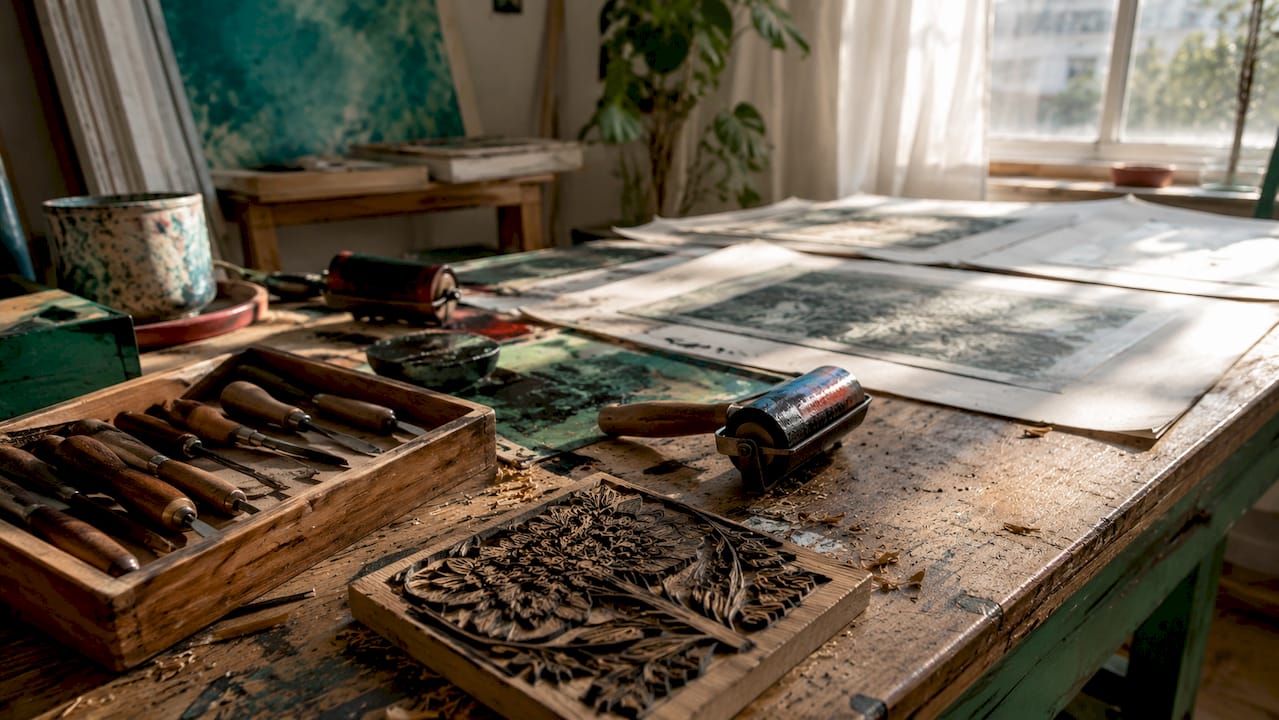
Woodcut is the oldest Western printmaking technique, in use since the early 15th century. Artists carve along the wood grain with gouges and knives, then roll ink across the raised surface. The grain itself often prints as a visible texture, giving woodcuts their characteristic energy.
Linocut uses linoleum instead of wood. The material cuts more easily in any direction, so artists can produce curved, fluid lines that woodcut resists. Linocut became popular in the 20th century and remains the most accessible relief method for beginners.
Wood engraving cuts across the end grain of a hard wood block, allowing finer detail than woodcut. Victorian book illustrators relied on wood engraving for its ability to hold intricate cross-hatching.
Key qualities of relief prints:
- Bold, graphic lines with strong contrast
- Visible texture from the block surface
- Clean, flat color areas in single-color editions
- Expressive, hand-carved marks that vary from print to print
Pro Tip: Start with linoleum before moving to wood. Lino cuts cleanly with basic tools, costs little, and lets you focus on composition rather than fighting the material.
3. How does intaglio printmaking work?
Intaglio is the technique family where ink sits in grooves below the surface of a metal plate. The plate is inked, the surface is wiped clean, and damp paper is pressed into the grooves under high pressure, pulling the ink out. The result is a print with raised ink lines you can feel with your fingertip.
Engraving
Engraving requires a burin, a small steel tool, to cut lines directly into a copper or steel plate. Engraving demands skill to produce precise lines, and the resistance of the metal means every mark is deliberate. Old Master engravers like Albrecht Dürer used cross-hatching to build tonal gradations of extraordinary subtlety.
Etching
Etching coats the plate in an acid-resistant ground. The artist draws through the ground with a needle, then submerges the plate in acid. The acid bites only the exposed lines, creating grooves. Because the needle meets no resistance, etching produces freer, more spontaneous marks than engraving.
Mezzotint and aquatint
Mezzotint roughens the entire plate surface so it holds ink and prints solid black. The artist then burnishes areas smooth to create lighter tones. Aquatint uses a resin dust fused to the plate to create tonal areas rather than lines. Both techniques produce the rich, velvety tonal depth that defines intaglio at its most expressive.
Intaglio print quality depends on paper dampness and press pressure. Paper that is too dry will not pull ink from the grooves. Paper that is too wet blurs the image or tears under the press.
Key qualities of intaglio prints:
- Fine, precise lines with tonal depth
- Raised ink lines visible and tactile on the paper surface
- A plate mark pressed into the paper at the image edge
- Rich tonal range from deep black to delicate gray
Pro Tip: Dampen intaglio paper evenly and let it rest between damp blotters for at least 20 minutes before printing. Uneven moisture causes uneven ink pickup across the plate.
4. What is planographic printmaking and how does lithography work?
Planographic printmaking prints from a flat surface with no raised or incised areas. The image and non-image areas sit at the same level. Separation between them is entirely chemical, not physical.
Lithography is the central planographic technique. Lithography was invented in 1796 and works on the principle that oil and water repel each other. The artist draws on a limestone slab or aluminum plate with a greasy crayon or tusche. The stone is then dampened with water. Oil-based ink sticks only to the drawn areas because the wet stone repels it everywhere else. Paper is pressed against the stone and the image transfers.
“Lithography gives artists a surface that responds like drawing paper. The mark you make with a greasy crayon is the mark that prints. No cutting, no acid, no resistance. That directness is why painters from Toulouse-Lautrec to Jasper Johns chose it.”
Color lithography multiplies this process. Each color requires a separate stone or plate, and the artist must register each layer precisely. A four-color lithograph involves four separate printing passes, each with its own chemistry and inking.
Monotype is a related planographic method. The artist paints directly onto a smooth plate and prints it once, producing a unique image rather than an edition. Monotype sits at the intersection of painting and printmaking, and understanding how art prints are made helps collectors recognize the difference between a monotype and a reproduction.
Key qualities of planographic prints:
- Fluid, painterly marks that mirror the artist’s drawing hand
- Subtle tonal gradations without visible line work
- Soft edges and atmospheric effects
- Potential for complex color layering in multi-stone editions
5. What role does screen printing play in modern printmaking?
Screen printing is the dominant stencil technique in contemporary art and commercial production. Ink is pushed through a fine mesh screen onto the substrate below, but only through areas where the stencil is open. Blocked areas receive no ink.
The stencil can be cut by hand from film or created photographically. Photographic screens expanded the possibilities of screen printing and were central to Pop Art. Andy Warhol’s repeated portrait series used photographic screen printing to flatten photographic images into bold, graphic color fields.
Screen printing suits artists who want flat, opaque color with sharp edges. Each color requires a separate screen and a separate pass through the press. A ten-color screen print involves ten precisely registered layers.
Key qualities of screen prints:
- Flat, vibrant, opaque color areas
- Sharp edges between color zones
- Visible layering when colors overlap
- Adaptable to paper, fabric, glass, and metal
Pro Tip: Screen printing is the most budget-accessible printmaking method for beginners. A basic hand-cut paper stencil, a squeegee, and a stretched mesh frame cost under $50 and produce professional-quality results on fabric or paper.
6. How do artists choose between printmaking techniques?
Technique choice in printmaking is not arbitrary. The process shapes the final image as much as the artist’s hand does. Relief prints appear bold and graphic; intaglio prints offer detail and tonal depth; lithographs appear fluid and painterly. An artist who wants atmospheric tonal gradations will reach for mezzotint or aquatint, not woodcut.
Fine art prints are original works created through collaborative processes involving the artist and skilled master printers. That collaboration matters because intaglio and lithography both require technical knowledge that takes years to develop. Many artists work with specialist print studios rather than producing editions alone.
Market and exhibition considerations also influence technique selection. Limited edition prints in intaglio or lithography carry strong collector appeal because the matrix degrades over time, naturally limiting the edition. Screen prints on fabric or paper suit wider commercial distribution. Artists building a limited edition print collection should understand how technique affects both rarity and price.
| Technique | Complexity | Line quality | Tonal range | Typical use |
|---|---|---|---|---|
| Woodcut | Low to medium | Bold, expressive | Limited | Fine art, illustration |
| Engraving | High | Precise, fine | Medium | Fine art, historical reproduction |
| Etching | Medium | Free, varied | Medium to high | Fine art editions |
| Mezzotint | High | Tonal, no lines | Very high | Fine art, portraiture |
| Lithography | High | Painterly, fluid | High | Fine art, posters |
| Screen printing | Low to medium | Flat, sharp | Low | Pop art, textiles, commercial |
Key takeaways
The four printmaking families, relief, intaglio, planographic, and stencil, each produce distinct visual results defined by how ink interacts with the matrix surface.
| Point | Details |
|---|---|
| Four core families | Relief, intaglio, planographic, and stencil cover all major printmaking methods. |
| Ink placement defines the technique | Where ink sits on the matrix determines the print’s texture, line quality, and tone. |
| Intaglio requires precise control | Paper dampness and press pressure both affect ink transfer in engraving and etching. |
| Lithography is purely chemical | Oil-and-water repulsion separates image from non-image areas on a flat stone or plate. |
| Fine art prints are originals | Prints made from a hand-worked matrix are original artworks, not reproductions. |
Printmaking’s balance between tradition and technology
I have spent years looking at prints and painting in ways that borrow from printmaking’s logic: layering, registration, the discipline of working within a process. What strikes me most about traditional printmaking is that the technique is never neutral. When you choose etching, the acid decides something. When you choose woodcut, the grain decides something. The artist sets the process in motion, but the material talks back.
The conventional wisdom says digital methods are replacing traditional printmaking. I disagree. Digital tools have expanded what artists can do, but they have not replaced the physical intelligence that comes from pulling a print by hand. The resistance of a burin in copper, the smell of an acid bath, the moment a damp sheet lifts off a lithography stone: these experiences build a kind of knowledge that no screen replicates.
My recommendation for emerging printmakers is to start with relief or screen printing, master the physical logic of one technique completely, then move to intaglio or lithography. Skipping the fundamentals produces technically weak work regardless of how good the image idea is. The reasons artists make prints are as varied as the techniques themselves, but the best print work always shows evidence of a maker who understood their process.
— Eman
Original prints and canvas art at Emansgallery
Emansgallery brings together original paintings and museum-quality canvas prints that reflect the visual language of printmaking: layered color, tonal depth, and expressive mark-making. Each work is created by artist Eman Khalifa and ships worldwide from studios in the UK, USA, Canada, Australia, and across Europe.
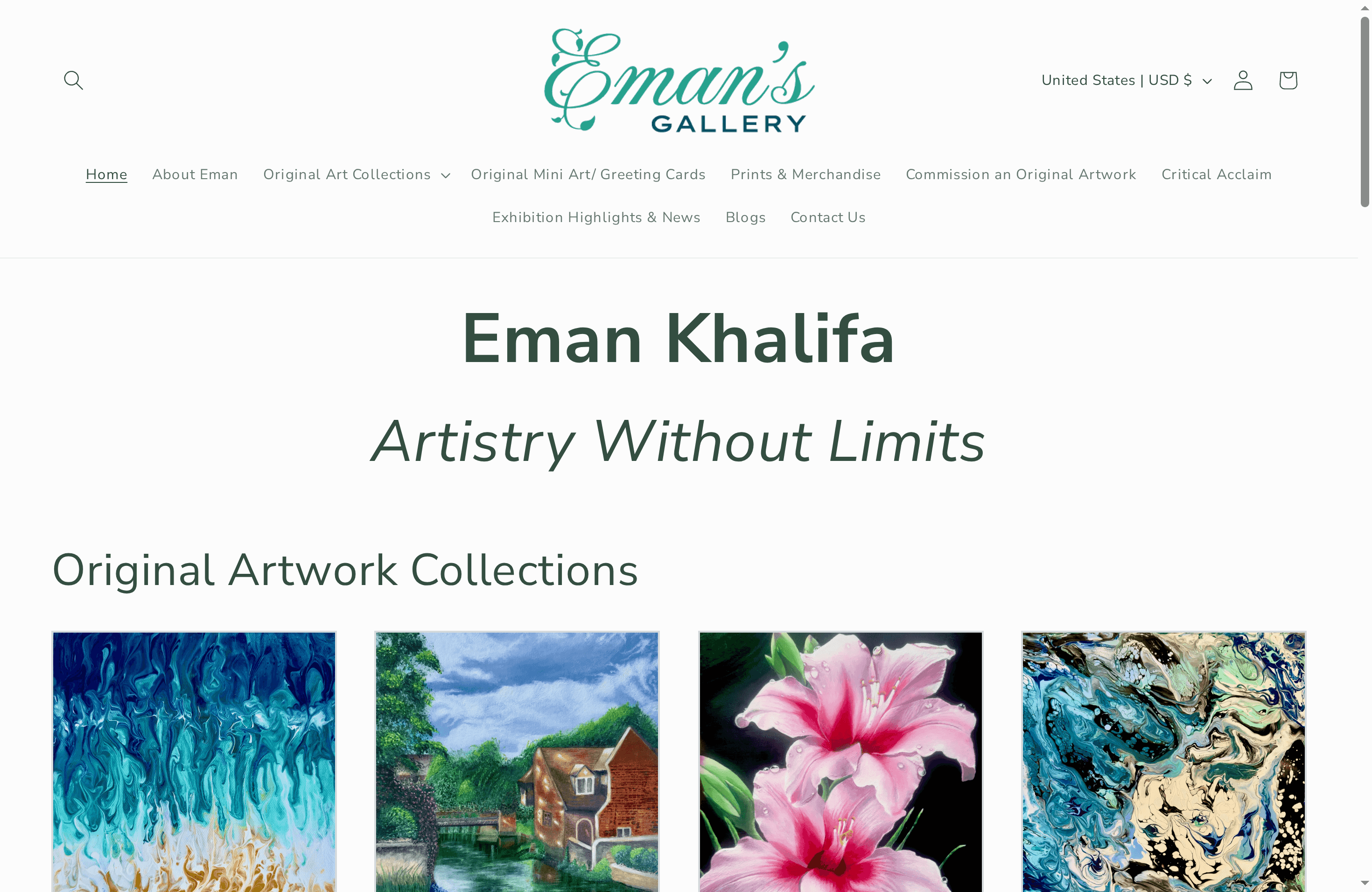
The abstract ink splash canvas print Fragments of Memory captures the spontaneous quality of monotype printmaking in a large-format canvas. The geometric urban canvas City in Grids reflects the precision and layering logic of screen printing. Both are available as high-resolution wall art prints ready to ship. Collectors and interior designers can browse the full collection at Emansgallery.
FAQ
What are the four types of printmaking in art?
The four types are relief, intaglio, planographic, and stencil. Each is defined by how ink is applied to or held by the printing matrix before transfer to paper or fabric.
What is the oldest printmaking technique?
Woodcut is the oldest printmaking technique in Western art, used since the early 15th century. It carves raised areas on a wood block to hold and transfer ink.
What is the difference between etching and engraving?
Engraving cuts lines directly into metal with a burin, requiring significant physical skill. Etching uses acid to bite lines drawn through an acid-resistant ground, producing freer and more spontaneous marks.
How does lithography work as a printmaking method?
Lithography prints from a flat limestone or aluminum surface using oil-and-water repulsion. The artist draws with a greasy material, and oil-based ink adheres only to those drawn areas when the stone is dampened.
Are fine art prints original artworks or reproductions?
Fine art prints created from a hand-worked matrix are original artworks, not reproductions. The artist directly manipulates the matrix, and each edition is a distinct original work.
Stay Connected
- ✨ Explore Eman Khalifa's original art, fine art prints and art-inspired merchandise.
- Follow Eman Khalifa's art journey on: Instagram @emans_gallery and Facebook
- Watch Eman Khalifa creating live art on: YouTube @emans_gallery
