


Non-Representational Art Meaning: A Clear Guide
TL;DR:
- Non-representational art uses color, shape, line, and form to communicate without recognizable subjects.
- It emphasizes sensory and emotional expression, relying on viewer perception and personal interpretation.
Non-representational art is defined as a form of abstract art that avoids depicting any recognizable objects, figures, or scenes, relying entirely on visual elements such as color, shape, line, and form to communicate meaning. Also called non-objective art or pure abstraction, this genre does not attempt to mirror the physical world. Instead, it speaks directly to the senses and emotions through composition alone. Understanding the non representational art meaning opens a door to one of the most intellectually rich and personally engaging categories in modern art history.
What is non-representational art meaning and where did it come from?
Non-representational art emerged in the early 20th century alongside movements like the Bauhaus school, which promoted art as a form of visual communication rather than mere depiction of the world. That shift was radical. For centuries, Western art had been anchored to representation: portraits, landscapes, religious scenes. Non-objective art broke that contract entirely.
The philosophical roots run deep. Theo van Doesburg, a key theorist of the period, linked non-representational art to utopian ideals of peace, spirituality, and inner emotional education. He argued that art could educate hearts and minds through what he called “pure thought,” expressed through abstract measures, proportions, and relationships rather than through imagery. That was not a decorative idea. It was a moral and spiritual claim about what art could do.
The Bauhaus school reinforced this by training artists to treat visual elements as a language in their own right. Color carried weight. Line carried tension. Form carried meaning. These were not decorative choices but communicative ones.
Key figures and movements that shaped this period include:
- Wassily Kandinsky, who theorized color and form as carriers of spiritual and emotional content
- Piet Mondrian, who reduced painting to pure geometric relationships
- Kazimir Malevich, whose Suprematism used basic shapes to express pure feeling
- The De Stijl movement, which pursued universal harmony through abstraction
“The aim of art is not to represent the outward appearance of things, but their inward significance.” This principle, widely attributed to Aristotle but embraced by early abstractionists, captures exactly what non-representational artists were reaching for: the inner truth beneath the visible surface.
How does non-representational art communicate without recognizable subjects?
Non-representational art uses visual language as its primary vocabulary. Color, shape, line, and texture function the way words function in a sentence. They carry meaning, create tension, and resolve into emotional statements without ever naming a single thing.

This is the concept that trips most viewers up. The absence of a recognizable subject does not mean the absence of content. A painting dominated by deep blues and slow horizontal lines communicates stillness and weight. A canvas of sharp red diagonals communicates urgency and conflict. These are not accidents. They are deliberate compositional choices made to produce specific emotional responses.
Abstract art speaks like music. Music does not depict a storm. It creates the feeling of one. Non-representational painting works the same way. The analogy is not poetic license. It is a precise description of how the form operates.
The characteristics of non-representational art that enable this communication include:
- Color relationships: warm against cool, saturated against muted, creating mood and energy
- Line quality: thick, thin, curved, jagged, each carrying distinct emotional weight
- Composition and balance: where elements sit on the canvas guides the eye and creates tension or calm
- Scale and proportion: large forms feel dominant; small forms feel fragile or distant
- Texture: visible brushwork or smooth surfaces change how the viewer physically relates to the work
Critics argue that non-representational art is superficial, lacking the depth of figurative work. Proponents counter that its strength lies in immediate sensory response and honest emotional connection, bypassing the filters of narrative and literal depiction. The viewer cannot hide behind “what is it a picture of?” They must engage directly with what they feel.
Pro Tip: When you stand in front of a non-representational work, close your eyes for five seconds, then open them. Your first unfiltered emotional response is the artwork communicating with you. Trust it.
How does viewer background shape abstract art interpretation?
Meaning in non-representational art is not fixed in the canvas. It is constructed in the viewer. A 2026 study published in Frontiers in Psychology found that art-trained viewers interpret non-representational works through a layered process: emotion first, then background knowledge, then formal reasoning and symbolic association. Non-art-trained viewers rely more heavily on emotional speculation and personal association, with less formal analysis.
That finding matters. It means both pathways are valid. The art student who reads a Kandinsky through the lens of color theory and the first-time gallery visitor who simply feels unsettled by the same painting are both engaging authentically. The difference is vocabulary, not depth of experience.
Viewer background also shapes what meaning is tied to: the observer’s internal framework rather than any fixed property of the image. This is not a weakness of the art form. It is its defining feature. Non-representational art creates space for multiple valid readings simultaneously.
A simple three-step framework helps any viewer engage confidently:
- “What do I see?” Name the literal visual elements: colors, lines, shapes, textures. This grounds your observation in what is actually there.
- “What do I feel?” Identify the emotional response without judging it. Calm, agitated, curious, melancholy. All responses are data.
- “What does this remind me of?” Allow personal metaphor. Does the composition feel like a storm, a conversation, a memory? This is your mind finding meaning.
This three-question method requires no academic training. It works because it mirrors the natural way humans process unfamiliar visual information: observe, feel, associate.
Pro Tip: Write down your answers to these three questions before reading any wall text or artist statement. Your uninfluenced reading is as legitimate as the curator’s interpretation.
Practical ways to appreciate non-representational artwork
Appreciating non-figurative art is a skill that develops with practice. The most common mistake is spending thirty seconds in front of a work and concluding it “means nothing.” Patience and prolonged viewing consistently deepen insight. Composition, balance, scale, and proportion create emotional effects that only reveal themselves over time.
Specific strategies that work:
- Spend at least three minutes with a single work before forming any opinion. Most viewers give abstract art far less time than they give figurative work.
- Change your physical distance. Step close to examine texture and brushwork. Step back to read the full composition. The work often looks like two different paintings at different distances.
- Look for relationships, not objects. Ask how the colors relate to each other, not what they depict. Ask how the shapes interact, not what they represent.
- Use the music analogy actively. If this painting were a piece of music, what genre would it be? What tempo? This reframes the experience in a familiar sensory mode.
- Avoid the “my kid could paint that” reflex. That response is a defense mechanism, not a critical judgment. It closes down engagement before it starts.
When incorporating non-representational art into a home or gallery setting, placement matters as much as selection. A large-scale geometric abstract piece on a neutral wall creates a focal point that shapes the entire room’s energy. Guides on displaying art at home and gallery display strategies offer practical frameworks for making these decisions well.
For collectors interested in what separates strong non-representational work from weak work, the qualities that define a good abstract painting apply directly: intentionality, compositional tension, and emotional coherence. Non-representational art also connects to broader traditions worth knowing, including abstract African art, which predates European modernism and contributed foundational ideas about abstraction and symbolic form.
Key Takeaways
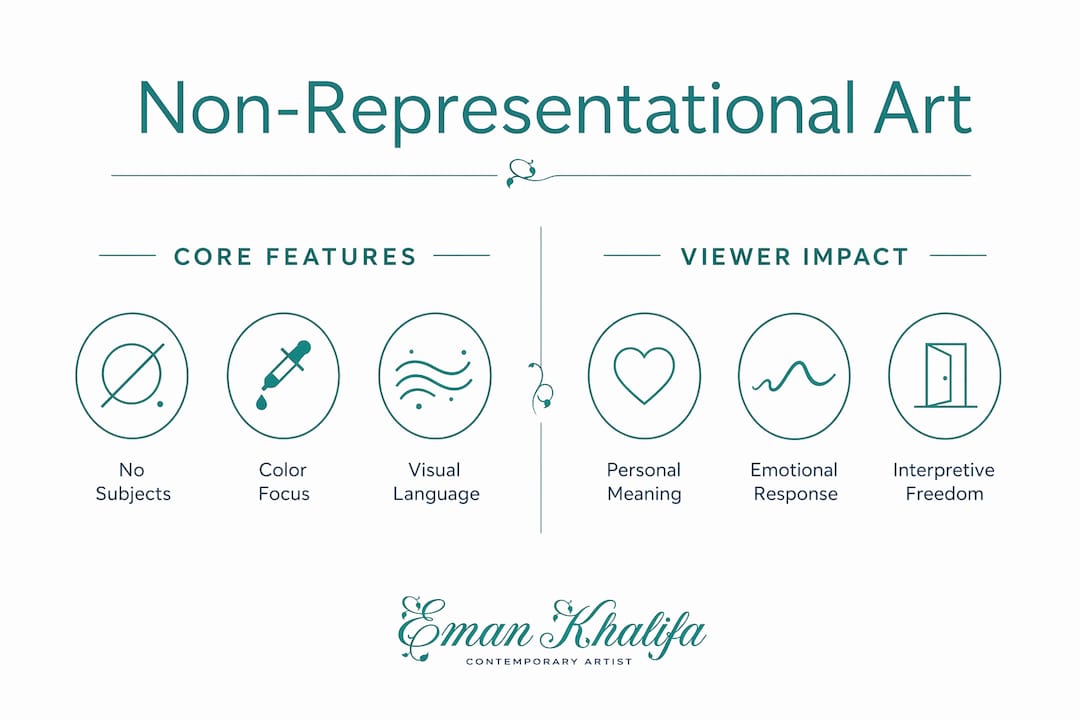
Non-representational art communicates through pure visual elements, and meaning is always co-created between the artwork and the viewer’s own emotional and cultural framework.
| Point | Details |
|---|---|
| Core definition | Non-representational art avoids recognizable subjects, using color, shape, line, and form as its sole vocabulary. |
| Historical roots | The Bauhaus school and theorists like Theo van Doesburg established abstraction as a vehicle for spiritual and emotional communication. |
| Viewer interpretation | Art-trained and non-trained viewers both form valid readings; meaning depends on the observer’s internal framework, not a fixed image property. |
| Engagement method | The three-question framework (“What do I see? What do I feel? What does this remind me of?”) works for any viewer regardless of background. |
| Practical appreciation | Prolonged viewing, changing physical distance, and metaphorical thinking consistently deepen engagement with non-objective works. |
Why I think we misread non-representational art most of the time
The most persistent misconception I encounter is that non-representational art is somehow easier to make and harder to understand than figurative work. Both halves of that belief are wrong, and they feed each other in a way that keeps people from genuinely engaging with the form.
When I work on a piece that has no subject in the traditional sense, every decision carries more weight, not less. There is no narrative to fall back on, no recognizable form to anchor the composition. The color relationships, the edge quality, the balance of mass and space: all of it has to work on its own terms. That is a harder problem than rendering a face or a landscape.
On the viewer side, I think the real barrier is permission. People feel they need the “right” answer before they commit to a response. Non-representational art removes that safety net, and for many viewers, that feels uncomfortable rather than freeing. The shift happens when you accept that your emotional response is the point. You are not failing to understand the work. You are completing it.
Greater art education helps, but it is not the prerequisite most people assume it is. The three-question framework works precisely because it bypasses academic gatekeeping. The abstract expressionist tradition built its entire identity around the idea that raw emotional response is a legitimate and serious form of engagement. That tradition was right.
— Eman
Original non-representational art from Emansgallery
Emansgallery offers a curated selection of original handmade paintings and museum-quality canvas prints that embody the principles of non-representational and fluid abstract art.
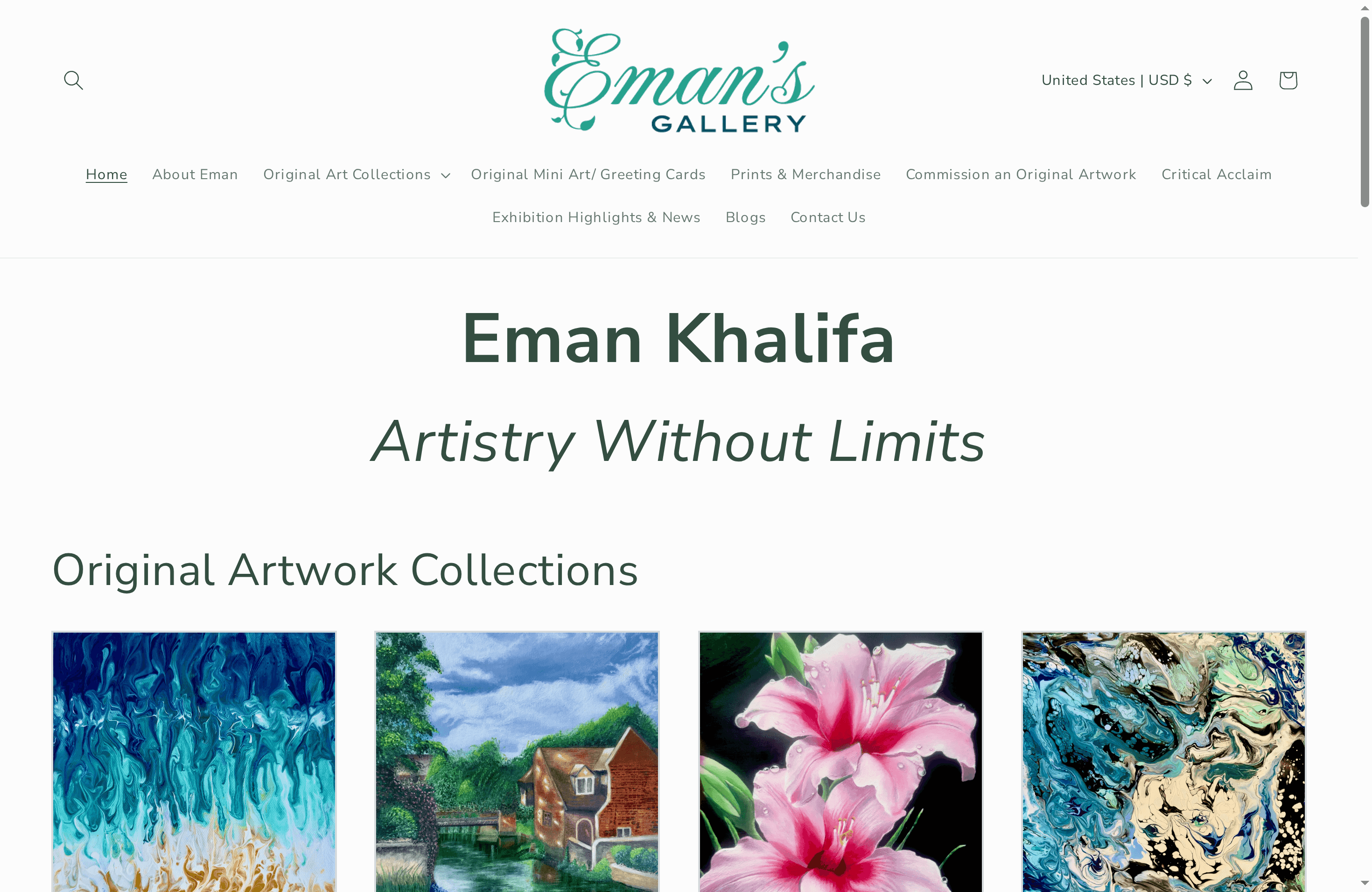
“Mystic Sea” is a fluid abstract original that works entirely through color, movement, and form, with no recognizable subject anchoring the composition. It is a direct example of pure abstract painting at its most intentional. For collectors who prefer print editions, the abstract ink splash print “Fragments of Memory” captures emotional expression through layered mark-making. Emansgallery ships worldwide from the UK, USA, Canada, Australia, and across Europe and the UAE. Browse the full wall art print collection to find non-representational works suited to any interior.
FAQ
What is non-representational art?
Non-representational art is a category of abstract art that contains no recognizable objects, figures, or scenes. It communicates exclusively through visual elements such as color, shape, line, and form.
How is non-representational art different from abstract art?
All non-representational art is abstract, but not all abstract art is non-representational. Abstract art may still reference real subjects in a distorted or simplified form, while non-representational art eliminates recognizable subjects entirely.
How do I interpret non-representational artwork?
Start with three questions: “What do I see?” (visual elements), “What do I feel?” (emotional response), and “What does this remind me of?” (personal association). This method requires no academic background and produces a valid personal reading.
Why did non-representational art develop in the early 20th century?
The Bauhaus school and theorists like Theo van Doesburg argued that art could communicate spiritual and emotional truths more directly without representational subjects. That philosophical position drove the movement’s emergence alongside broader modernist shifts in culture and design.
Does non-representational art have a single correct meaning?
No. Research confirms that meaning in non-representational art is tied to the observer’s internal framework rather than any fixed property of the image. Multiple valid interpretations of the same work can coexist.
Stay Connected
- ✨ Explore Eman Khalifa's original art, fine art prints and art-inspired merchandise.
- Follow Eman Khalifa's art journey on: Instagram @emans_gallery and Facebook
- Watch Eman Khalifa creating live art on: YouTube @emans_gallery
