


What Is Warhol? Andy Warhol and Pop Art Explained
“Warhol” refers to Andy Warhol (1928–1987), an American artist, filmmaker and publisher, and a leading figure of Pop art. He is best known for silkscreen paintings of Campbell’s soup cans and celebrities such as Marilyn Monroe. This guide covers who he was, what he made, how he made it and why his work still shapes art today. It also covers what to check when buying prints or art in the Pop tradition.
TL;DR
- Andy Warhol was born Andrew Warhola in Pittsburgh on August 6, 1928, and died in New York City on February 22, 1987.
- He started as a commercial illustrator, then became a central Pop artist in the early 1960s.
- His signature subjects are consumer products, advertising imagery and celebrities, often repeated in grids.
- His main technique was photographic silkscreen printing, adopted in 1962, combined with hand-painted color.
- His influence reaches artists from Jean-Michel Basquiat and Keith Haring to Damien Hirst, Takashi Murakami and Ai Weiwei.
Table of Contents
- Who was Andy Warhol?
- What is Warhol known for?
- Key Warhol works at a glance
- How Warhol made his art
- Pop art and what it meant
- The Factory and the Warhol brand
- Warhol’s influence on modern art
- The word “Warhol” in everyday use
- Buying art in the Warhol tradition
- Our perspective
- Original art and prints from Eman’s Gallery
- FAQ
- Sources
- Stay Connected
Who was Andy Warhol?
Andy Warhol was the youngest of three sons of Andrej Warhola and Julia Zavacky Warhola. His parents immigrated to the United States from the region now called Slovakia. He graduated from the Carnegie Institute of Technology with a Bachelor of Fine Art in Pictorial Design in 1949. He then moved to New York City to work as a commercial artist.
The same biography states that he moved into the fine art world in the early 1960s. He died in New York City on February 22, 1987, from complications following gall bladder surgery.
The illustrator years
Before the soup cans, Warhol was a working illustrator. During the 1950s he became one of the most successful illustrators of his time. His clients included Tiffany & Co., The New York Times, I. Miller Shoes, Bonwit Teller, Columbia Records and NBC.
This background matters. It explains why his fine art looks like advertising: clean, bold and made for fast recognition. Tate notes that he used a “blotted-line” technique for commercial illustrations in the 1940s and 1950s, before he moved to photographic silkscreen.
What is Warhol known for?
Warhol is known for bright, graphic paintings and prints of two kinds of subject. One is celebrities, including Marilyn Monroe, Elvis Presley and Elizabeth Taylor. The other is everyday products, such as soup cans and Brillo pads. Tate describes the flat, graphic quality of his work as similar to media and advertising.
He worked in many media: painting, film, photography, publishing, fashion, writing and music. His silkscreens remain the most recognized part of his output.
Campbell’s Soup Cans (1962)
In 1962, his series of Campbell’s Soup Cans created a buzz in the art world and launched him as a celebrity. The subject was ordinary on purpose. The Tate exhibition guide connects such images to an emerging aspirational culture that sold a dream of economic and social progress.
Marilyn Diptych (1962)
Marilyn Diptych has two canvases, each with 25 images of Marilyn Monroe in a grid. Tate says the rows of repeated heads suggest postage stamps, billboard posters or film strips. The repetition turns a person into a product image.
Green Coca-Cola Bottles (1962)
This work shows a single Coca-Cola bottle repeated in rows, seven high by sixteen across, above the company’s logo. The Whitney says the repetition and standard format evoke mechanical reproduction.
Other recurring series
The National Gallery of Art states that repetition was key to his work. His recurring series included flowers, Marilyn Monroe, Jacqueline Kennedy Onassis and Chairman Mao. Tate also describes his Death and Disaster series, built from newspaper and magazine photographs.
Key Warhol works at a glance
| Work | Year | Subject | What to notice |
|---|---|---|---|
| Campbell’s Soup Cans | 1962 | Packaged food | Ordinary product treated as a serious subject |
| Marilyn Diptych | 1962 | Marilyn Monroe | 50 images across two canvases |
| Green Coca-Cola Bottles | 1962 | Soft drink | Single image repeated in regular rows |
| Death and Disaster series | 1960s | News photographs | Over- and under-inking changes the emotional effect |
| Commissioned portraits | 1970s–1980s | Private sitters | Polaroid, silkscreen and painted color blocks |
The years for the first three works come from the Tate and Whitney pages cited above. The commissioned portrait process is described further below.
How Warhol made his art
From hand-painting to silkscreen
In 1960 Warhol began hand-painted pictures that combined advertising imagery with expressive painting. These soon gave way to a clean graphic style now known as Pop art. In 1962 he adopted screenprinting, a commercial technique, to speed up how he replicated images. He began to use photographs from newspapers and magazines.
Not a pure machine process
Warhol did not invent silkscreen printing. The Andy Warhol Museum says he developed his own technique by combining hand-painted backgrounds with photographic silkscreen images. That produced unique works.

Tate adds that he often allowed the screen to be over- or under-inked. The face of Marilyn Monroe became almost mask-like, and the emotional impact of the news images was both emphasized and undermined.
In a 1963 ARTnews interview he said he wanted to be a machine. The U.S. Department of State notes that each silkscreen or print was nonetheless one of a kind, shaped by his decisions on composition, color and format.
The commissioned portrait method
The Andy Warhol Museum describes the steps for his commissioned portraits:
- A photo shoot with a Polaroid camera.
- Enlargement of the image and transfer to a silkscreen.
- Underpainting of the canvas with blocks of color.
- Printing of the photographic silkscreen image on top.
Film and photography
Warhol also made films, including Sleep, and used photography to document his life, according to Tate.
Pop art and what it meant
The New York artists called Pop included Roy Lichtenstein, Andy Warhol, Tom Wesselmann, Jim Dine, James Rosenquist and Claes Oldenburg. The Museum of Modern Art describes their shared sensibility as bright colors, bold graphics and recognizable subject matter that challenged artistic preconceptions through its ordinariness.
The U.S. Department of State says Warhol drew on comics, advertisements, Hollywood stars and brands such as Campbell’s. His work both celebrated and critiqued the consumer-driven American experience of the post-war era.
The Whitney describes his stance as deadpan and ironic. He criticized and glorified consumerist idols at once. Both readings are valid, and that ambiguity keeps the work in discussion.

The Factory and the Warhol brand
Warhol’s New York studio was called The Factory. Tate Kids says the name referred to the mass-produced nature of his artworks. The National Gallery of Art notes that he deliberately gave his work a mechanical, impersonal character. This grew stronger with silkscreen. He employed a large group of assistants.
Tate observes that he understood the superficial nature of celebrity in American society. Public images are made by marketing companies to make money. He also built a powerful public image for himself, the Andy Warhol “brand”, with trademark straight blonde hair and dark glasses.
Warhol’s influence on modern art
The Andy Warhol Foundation states that Warhol changed the way we look at the world and the way the world looks at art. It credits him with expanding what counted as fine art and with treating painting, photography, film, publishing, branding, performance and even his own persona as valid ground for experiment.
A 2021 University of Chicago research paper analyzed art history narratives published since 2000. It finds that scholars and critics now judge Warhol to have surpassed Jackson Pollock and Jasper Johns as the most important modern American painter. The paper traces his rise first to his influence on Jean-Michel Basquiat, Keith Haring and others in the 1980s New York art world. It also names Damien Hirst, Takashi Murakami and Ai Weiwei as later artists he influenced.
For a longer treatment, see our article What Is Andy Warhol Famous For? Pop Art and Beyond.
The word “Warhol” in everyday use
Searchers asking “what is Warhol” are often looking for one of three things:
- A person: Andy Warhol, the artist, covered above.
- A style: work with repeated celebrity or product images, flat bright color and a screenprint look. People call this “Warhol-style” art.
- An artwork or print: a specific piece, poster or reproduction they have seen or want to buy.
The third group needs the most care, because reproductions and originals differ widely in kind and value.
Buying art in the Warhol tradition
Warhol’s market has many layers: unique paintings, editioned prints, posters and licensed reproductions. The terms matter. Before buying anything described as a Warhol, or as Warhol-inspired, collectors check the following:
- Artist and background. Confirm who made the work and when. Our guide covers researching the artist’s background.
- Materials and technique. Paper, ink and canvas should fit the claimed method and period. See examining materials and techniques.
- Provenance and documentation. A record of ownership and paperwork is part of the work. See checking provenance and documentation.
- Edition details. For numbered editions, a clear number, signature and certificate matter. These verification checks for numbered editions apply to collectible objects, and the same habit of confirming edition details carries over to prints.
- Signature and print type. Our guide to artist-signed prints explains what a signature does and does not tell you.
Prints versus originals
A print is a reproduction or an editioned multiple. An original is a single work made by the artist’s hand. Both have a place in a home or a collection, and the right choice depends on budget, space and purpose. We compare them in art prints versus originals and discuss what gives prints lasting value.
For reproductions, print quality is the main variable. Our piece on museum-quality giclée proofs lists what collectors should expect.
Our perspective
Warhol showed that an image can be repeated and still carry the maker’s decisions. Color, composition and format were his choices each time. We see the same principle in collecting today: the process behind a work matters as much as the subject.
At Eman’s Gallery, the work starts with the artist. Original paintings are one of a kind. Canvas prints and framed paper prints extend those paintings to more walls. Our positioning is artist-led curation, with direct access to bespoke commissions where buyers specify scale, palette and mood, and with active artist consultation.
For collectors who admire Pop art’s bold color and graphic clarity, we suggest looking at how a piece is made, who made it and what documentation comes with it. That is how an artwork becomes a lasting part of a collection.
Eman
Original art and prints from Eman’s Gallery
Eman’s Gallery is an online contemporary art gallery. The artist is Eman Khalifa. The range includes abstract, geometric, floral, landscape, seascape and still-life paintings. Available formats:
- Original one-of-a-kind paintings and bespoke commissions
- Art prints on canvas and framed paper
- Art-printed merchandise: mugs, throw pillows, T-shirts, sweatshirts, swimwear, bath towels and tote bags
- Art gift cards
We ship worldwide from the UK, USA, Canada, Australia, Germany, France, Italy, Spain, Portugal, Greece, UAE and the Netherlands. Prices are listed on each product page.
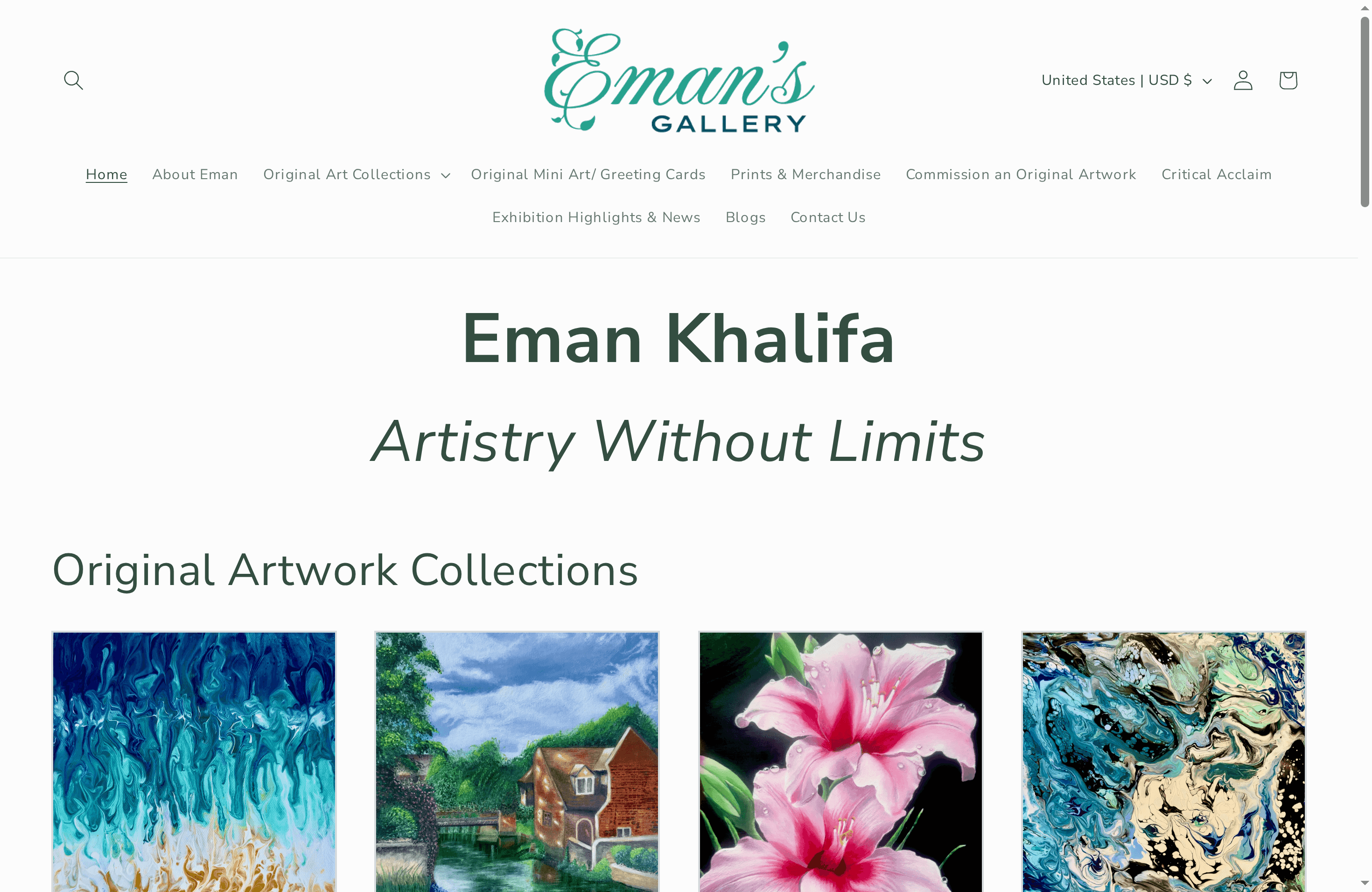
For bold, color-forward pieces, start with the original paintings collection or the original mini paintings. Return terms for originals are on the returns and refunds page.
FAQ
What is Andy Warhol art known for?
He is known for silkscreen paintings and prints of celebrities and consumer products. Examples are Campbell’s Soup Cans, Marilyn Diptych and Green Coca-Cola Bottles. The work uses bright color, bold graphics and repetition. It is regarded as both a celebration and a critique of consumer culture.
What is the definition of Warhol?
Warhol refers to Andy Warhol (1928–1987), an American artist and filmmaker who was one of the foremost figures of Pop art. The name is also used for his style: repeated, flat, brightly colored images taken from advertising and celebrity culture.
How did Warhol make his paintings?
From 1962 he used photographic silkscreen printing. He often combined it with hand-painted color backgrounds. For commissioned portraits, he started with a Polaroid photograph, transferred it to a silkscreen, underpainted the canvas in color blocks and printed the image on top.
Why is Warhol important to modern art?
He expanded what counted as fine art by working across painting, film, photography, publishing and branding. His influence is traced in the work of Basquiat, Haring, Hirst, Murakami and Ai Weiwei. A 2021 University of Chicago study finds that recent scholarship ranks him above Pollock and Johns among modern American painters.
How can I check that a print or artwork is authentic?
Research the artist, examine materials and technique, and ask for provenance and documentation. For editions, confirm the edition number, signature and certificate. Our authenticity guide walks through each step.
Sources
- Biography, The Andy Warhol Museum
- What Was Andy Warhol Thinking?, Tate
- Andy Warhol exhibition guide, Tate Modern
- Who is Andy Warhol?, Tate Kids
- Andy Warhol, U.S. Department of State
- Andy Warhol, National Gallery of Art
- Green Coca-Cola Bottles, Whitney Museum of American Art
- The maximal sixties: Pop, Op, figuration, Museum of Modern Art
- Underpainting and Photographic Silkscreen Printing, The Andy Warhol Museum
- Commissioned Portraits, The Andy Warhol Museum
- Warhol, The Andy Warhol Foundation for the Visual Arts
- Revising the Canon: How Andy Warhol Became the Most Important Modern American Painter, University of Chicago
Stay Connected
- ✨ Explore Eman Khalifa’s original art, fine art prints and art-inspired merchandise.
- Follow Eman Khalifa’s art journey on: Instagram @emans_gallery and Facebook
- Watch Eman Khalifa creating live art on: YouTube @emans_gallery
