


Non-Representational Art: Definition, Characteristics, and Examples
Non-representational art is visual work that deliberately avoids depicting any identifiable person, place, or object. Where representational art shows the world as it looks, and abstract art often distorts or simplifies real subjects, non-representational work carries no trace of external visual reference at all. Wassily Kandinsky, Piet Mondrian, Jackson Pollock, and Mark Rothko are the four names that appear most consistently in any serious discussion of this category. Each arrived at it differently, but all four built meaning entirely from formal elements: line, color, shape, texture, and composition.
The distinction between abstract and non-representational matters more than most introductory courses acknowledge. Abstract art exists on a continuum/01%3A_What_Is_Art/1.05%3A_Representational_Abstract_and_Nonrepresentational_Art) — a Cubist portrait is abstract, but it still derives from a face. Non-representational work sits at the far end of that continuum, where no derivation from a figure or object exists at any stage of the process.
Table of Contents
- What are the defining characteristics of non-representational art?
- How does non-representational art compare to abstract and representational work?
- How did non-representational art develop historically?
- Famous non-representational artists and works to study
- How do you read and interpret a non-representational work?
- Key Takeaways
- Why non-representational art rewards closer attention than it first appears
- Explore original non-representational and abstract works
- Further reading and authoritative sources
- FAQ
What are the defining characteristics of non-representational art?
The most immediate feature is the complete absence of identifiable subject matter. No figure, no landscape, no still-life object. What replaces those subjects is a set of formal relationships that carry the entire visual and expressive weight of the work.
Core characteristics include:
- Absence of recognizable imagery. No person, place, or thing can be identified.
- Emphasis on line. Lines may be gestural and loose (as in action painting) or precise and geometric (as in De Stijl).
- Color as primary carrier of meaning. Color relationships, contrasts, and fields do the communicative work that narrative does in figurative art.
- Shape and form. Geometric or organic shapes define spatial relationships without representing anything.
- Texture and surface. Physical application of paint, from thick impasto to smooth washes, becomes part of the content.
- Composition, balance, and rhythm. The arrangement of elements guides the eye and creates tension or resolution.
- Gesture. The physical act of mark-making is often visible and intentional, as in drip painting or gestural abstraction.
Two broad approaches illustrate how these elements work in practice. In gesture painting, the artist’s physical movement is recorded directly on the surface; Pollock’s drip technique makes the body’s arc visible. In color-field painting, large areas of flat or modulated color create mood and spatial depth without any drawn form; Rothko’s rectangles of luminous pigment are the clearest example.
Pro Tip: When you look at a non-representational work and wonder whether it is “just random,” ask whether the composition has balance, rhythm, or tension. Deliberate compositional decisions — where elements are placed, how colors relate, where the eye travels — are what separate intentional non-representational art from accidental mark-making.

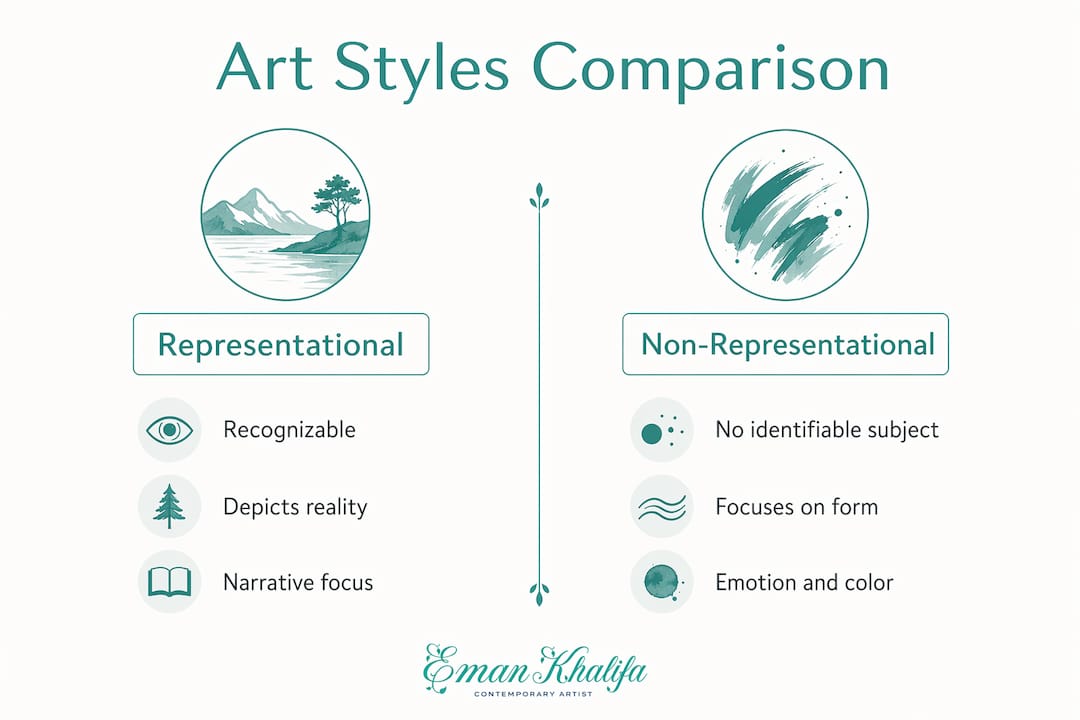
How does non-representational art compare to abstract and representational work?
The three categories sit on a single continuum ordered by how much visual reference to the real world remains.
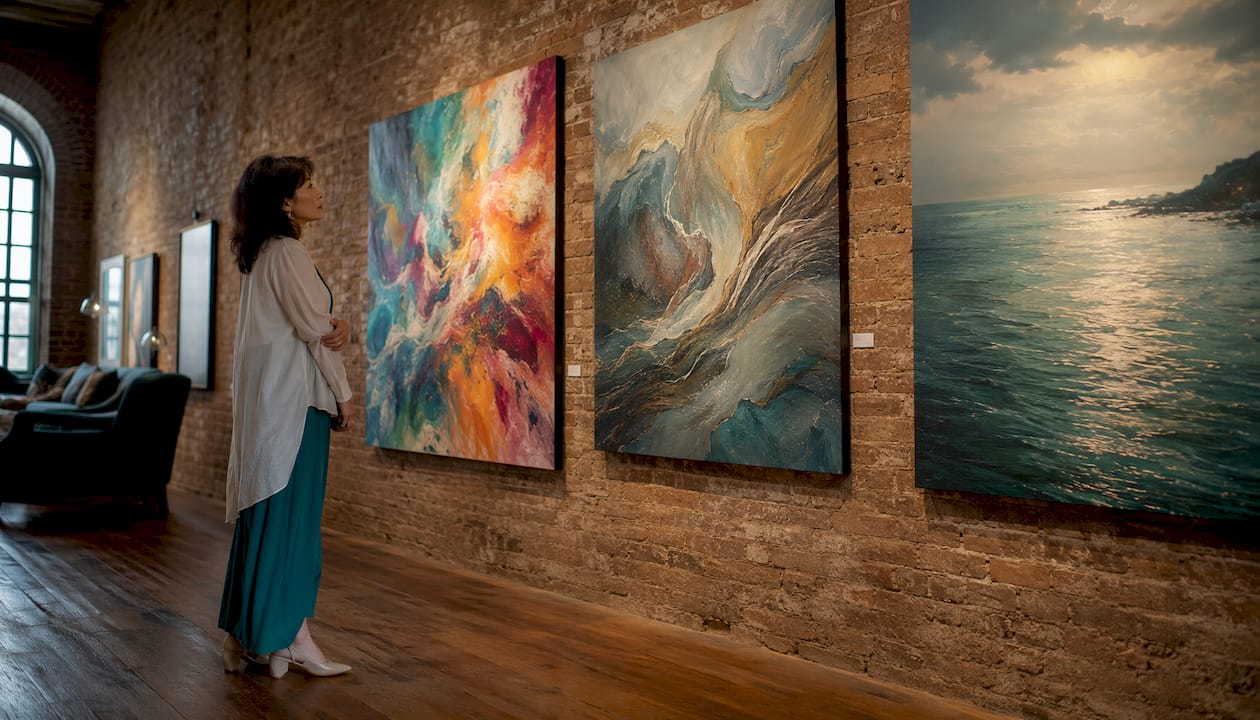
| Dimension | Representational | Abstract | Non-Representational |
|---|---|---|---|
| Degree of reference to the visible world | Literal — figures, places, objects clearly depicted | Partial — derived from real sources, then simplified or distorted | None — no derivation from figures or objects/01%3A_What_Is_Art/1.05%3A_Representational_Abstract_and_Nonrepresentational_Art) |
| Typical methods and techniques | Rendering, perspective, modeling, naturalistic color | Simplification, distortion, fragmentation, stylization | Pure formal exploration: gesture, color field, geometric construction |
| Common movements and periods | Renaissance, Baroque, Realism, Impressionism | Cubism, Expressionism, early 1900s | De Stijl, Abstract Expressionism, Color Field |
| Typical viewer experience | Narrative, iconic, recognizable story or scene | Emotional or conceptual, with residual subject recognition | Formal relationships, mood, spiritual or psychological response |
| Representative artists and works | Vermeer, Rembrandt, Monet | Picasso (Les Demoiselles d’Avignon), Cézanne | Mondrian (Composition II in Red, Blue, and Yellow), Rothko (No. 61) |
One work per column makes the difference concrete: Monet’s Water Lilies is representational, though loosely painted. Picasso’s Guernica is abstract — it derives from human figures and animals, then fractures them. Mondrian’s grids of primary color and black line reference nothing in the physical world.
A quick scanning rule: if you can name what the work depicts, it is representational. If you can sense a subject was once there but has been broken apart, it is abstract. If no subject was ever present, it is non-representational.
How did non-representational art develop historically?
The move away from depicting the visible world was gradual, driven by distinct movements across roughly five decades.
-
Early spiritual abstraction — Kandinsky, c. 1910–1920. Wassily Kandinsky is widely credited as the first artist to produce a fully non-representational painting. Working in Munich, he argued that color and form could communicate spiritual states directly, without the mediation of recognizable imagery. His Composition series from this period shows the shift from landscape-derived forms to pure visual music.
-
De Stijl and Geometric Abstraction — Mondrian, 1917 onward. The Dutch movement De Stijl, anchored by Piet Mondrian, pursued a universal visual language built from horizontal and vertical lines and the three primary colors. Geometric abstraction prioritized mathematical relationships and pure form, rejecting any naturalistic reference. Mondrian’s mature grids are among the most recognizable non-representational works in Western art history.
-
Abstract Expressionism — New York School, 1940s–1950s. After World War II, a generation of American artists pushed non-representational painting toward raw emotional and physical expression. The movement split broadly into two tendencies: action painting (Pollock, de Kooning) and color-field painting (Rothko, Newman). Both rejected figuration entirely, though by very different means.
-
Color Field painting — Rothko, Newman, Louis, 1950s–1960s. Color Field painters stripped away gesture and texture to let large areas of color carry the full expressive load. Mark Rothko’s stacked rectangles of luminous, slightly trembling pigment were designed to produce an almost physiological response in viewers standing close to the canvas.
-
Post-painterly abstraction and Minimalism — Frank Stella, 1960s onward. Stella’s shaped canvases and stripe paintings removed any residual expressiveness, reducing non-representational work to its most literal formal terms: the shape of the support, the direction of the line.
Famous non-representational artists and works to study
These six artists and works give you a focused starting point for building visual literacy in this area.
-
Wassily Kandinsky — Composition VIII (1923). Study the interplay of circles, triangles, and lines. Notice how color temperature (warm vs. cool) creates spatial push and pull without depicting space literally. The Solomon R. Guggenheim Museum holds this work.
-
Piet Mondrian — Composition II in Red, Blue, and Yellow (1930). Focus on the tension between the asymmetric placement of color blocks and the rigid orthogonal grid. The formal element to notice: how much visual weight a small red square carries against large areas of white.
-
Jackson Pollock — Number 1A, 1948. Look at the all-over composition — no center, no hierarchy, no focal point. The gesture is the content. The Museum of Modern Art (MoMA) in New York holds this work.
-
Mark Rothko — No. 61 (Rust and Blue) (1953). Stand close, if you can. The edges of the color rectangles are soft and breathing, not hard. The formal element: how scale and edge quality affect the emotional register of color.
-
Frank Stella — Hyena Stomp (1962). A study in how geometric precision and optical rhythm can generate visual energy without any expressive gesture at all.
-
Joan Miró — late works. Miró occupies a border zone: his biomorphic shapes suggest living things without depicting them. Useful for understanding where non-representational work edges toward the symbolic.
Pro Tip: When studying these works online, search the artist’s name alongside the holding museum’s collection database (MoMA, Guggenheim, Tate) rather than relying on image searches. Museum pages carry accurate titles, dates, and medium information — details that matter when writing a paper or catalog entry.
How do you read and interpret a non-representational work?
Without a subject to anchor attention, viewers often feel uncertain where to start. A structured sequence helps.
- Scan for overall form. Before analyzing anything, let your eye move across the whole surface. Note the dominant shapes: geometric or organic, large or small, dense or sparse.
- Identify the dominant formal elements. Which element carries the most visual weight? Color? Line? Texture? Scale? Name it specifically.
- Map tensions and balance. Where does the composition feel stable? Where does it feel unresolved or dynamic? Tension between elements is often where meaning lives.
- Consider color relationships. Are colors contrasting or harmonious? Warm or cool? Saturated or muted? Color temperature and saturation affect mood in measurable ways — art and room mood research both confirm this.
- Account for scale. A Rothko seen in reproduction looks very different from one seen at full size. Scale is a compositional decision, not a practical one.
- Connect to expressive or historical intent. Once you have described the formal elements, ask what they might communicate. Kandinsky wanted spiritual transcendence. Pollock wanted physical presence. Rothko wanted an almost religious encounter with color.
A short model analysis, applied to a hypothetical color-field work: The canvas is dominated by two large rectangles of deep ochre and muted violet, separated by a narrow band of raw canvas. The edges of each field are soft, slightly irregular, giving the boundary a quality of breathing rather than division. The composition is symmetrical on the vertical axis but asymmetrical in color weight — the ochre reads as heavier, pulling the eye downward. No gesture, no texture variation, no line interrupts the fields. The effect is one of sustained, low-frequency tension.
- Describe before interpreting.
- Name the specific element (color, line, texture) before assigning it a feeling.
- Ground every interpretive claim in something you can point to on the surface.
Pro Tip: The most common student error is to assume that because a work has no subject, it has no structure. Non-representational works are carefully composed, not random. If your interpretation cannot be tied to a specific formal choice — a color, a line, a scale decision — revise it until it can.
Key Takeaways
Non-representational art is defined by the complete absence of recognizable subject matter, with meaning carried entirely through formal elements such as color, line, shape, texture, and composition.
| Point | Details |
|---|---|
| Core definition | Non-representational art contains no identifiable figures, places, or objects at any stage of its creation. |
| Continuum position | It sits at the far end of the abstract art continuum, beyond partial abstraction derived from real-world sources. |
| Formal elements to watch | Color relationships, compositional balance, rhythm, gesture, and scale carry all expressive meaning. |
| Key historical movements | De Stijl, Abstract Expressionism, and Color Field painting are the primary movements to know. |
| Viewing strategy | Describe formal elements first; connect to expressive intent only after grounding observations in what is visible on the surface. |
Why non-representational art rewards closer attention than it first appears
The assumption that non-representational work is easier to make or easier to dismiss than figurative painting is one of the more persistent misreadings in art education. Mondrian’s grids look simple until you try to understand why one placement of a red square works and another does not. Rothko’s color fields look like painted walls until you stand in front of one at full scale and realize the edges are doing something a wall cannot do.
What these works ask of a viewer is not recognition but attention. The Getty’s Art & Architecture Thesaurus distinguishes carefully between “non-objective” and “non-representational” for exactly this reason: precision in vocabulary reflects precision in looking. A student who can tell the difference between a Mondrian grid and a Pollock drip, and explain why both qualify as non-representational while a Cézanne landscape does not, has developed a genuinely useful analytical skill.
For collectors and those living with art, this matters practically. A non-representational work placed in a room does not compete with the furniture for narrative attention. It operates at the level of color temperature, scale, and surface energy. Understanding how to choose abstract art that functions well in a specific space starts with understanding what formal elements the work actually contains.
Explore original non-representational and abstract works
Emansgallery offers original paintings and museum-quality prints that work across the formal range discussed in this article. Good Tidings is a fluid blue and gold original that demonstrates color-field and gestural techniques on a single canvas. For geometric sensibility, the City in Grids canvas print applies non-representational geometric form to an accessible format. Both ship worldwide.
Further reading and authoritative sources
These sources are reliable starting points for students, collectors, and educators researching non-representational art.
- ThoughtCo — “What Is Nonrepresentational Art?” A clear, accessible definition with named examples. Good first stop for students writing introductory papers.
- LibreTexts — “Representational, Abstract, and Nonrepresentational Art”/01%3A_What_Is_Art/1.05%3A_Representational_Abstract_and_Nonrepresentational_Art) Covers the continuum concept in depth. Useful for understanding where the categories begin and end.
- Fiveable — “Non-Representational Art” Concise key-term entry with characteristics and viewing guidance. Useful for exam review.
- Getty Art & Architecture Thesaurus The professional standard for terminology. Use when writing museum labels, catalog entries, or academic papers that require precise vocabulary.
- Wikipedia — “Abstract art” Broad historical overview with movement-by-movement coverage. Best used as a map for further research, not as a citable academic source.
- Wikipedia — “Nonfigurative art” Covers geometric abstraction and De Stijl in useful detail.
- Art History Glossary — “Nonrepresentational art” Concise glossary definition. Useful for quick reference and vocabulary checks.
- Emansgallery — Non-Representational Art Meaning: A Clear Guide An in-depth internal explainer from Eman Khalifa’s gallery, connecting the concept to collecting and display.
FAQ
What is an example of non-representational art?
Jackson Pollock’s Number 1A, 1948 and Mark Rothko’s No. 61 (Rust and Blue) are two of the most studied examples. Both contain no identifiable figures or objects; meaning is carried entirely through gesture, color, and composition.
What is a key characteristic of non-representational art?
The defining characteristic is the complete absence of recognizable subject matter. Non-representational works rely on formal elements — color, line, shape, texture, balance, and rhythm — to convey meaning rather than depicting anything from the visible world.
Is the Mona Lisa a non-representational work?
No. The Mona Lisa is representational: it depicts an identifiable human figure in a recognizable setting. Non-representational art contains no such reference to a person, place, or object.
What is the difference between representational and non-representational art?
Representational art depicts recognizable figures, places, or objects from the real world. Non-representational art contains no such reference at any stage of its creation, relying instead on pure formal relationships. Abstract art sits between them on the continuum, often derived from a real source but simplified or distorted beyond easy recognition.
Stay Connected
- ✨ Explore Eman Khalifa's original art, fine art prints and art-inspired merchandise.
- Follow Eman Khalifa's art journey on: Instagram @emans_gallery and Facebook
- Watch Eman Khalifa creating live art on: YouTube @emans_gallery
