


What Is an Artist Proof Print? A Collector's Guide
TL;DR:
- Artist proof prints are impressions reserved for the artist, marked “AP” or “A/P,” and outside the main edition. These proofs are typically 10-15% of the edition and hold value due to rarity and provenance, not physical differences. Understanding edition size and documentation is crucial for collectors evaluating their actual worth.
An artist proof print is an impression from a limited edition reserved specifically for the artist, marked “AP” or “A/P” and kept outside the main numbered sequence. These prints represent a distinct category in printmaking, and artist proofs typically account for 10–15% of a total edition. That small proportion is exactly what makes them appealing to collectors. Whether you are buying your first print or building a serious collection, understanding the artist proof definition helps you evaluate what you are actually acquiring and what it is worth.
What is an artist proof print, and where did it come from?
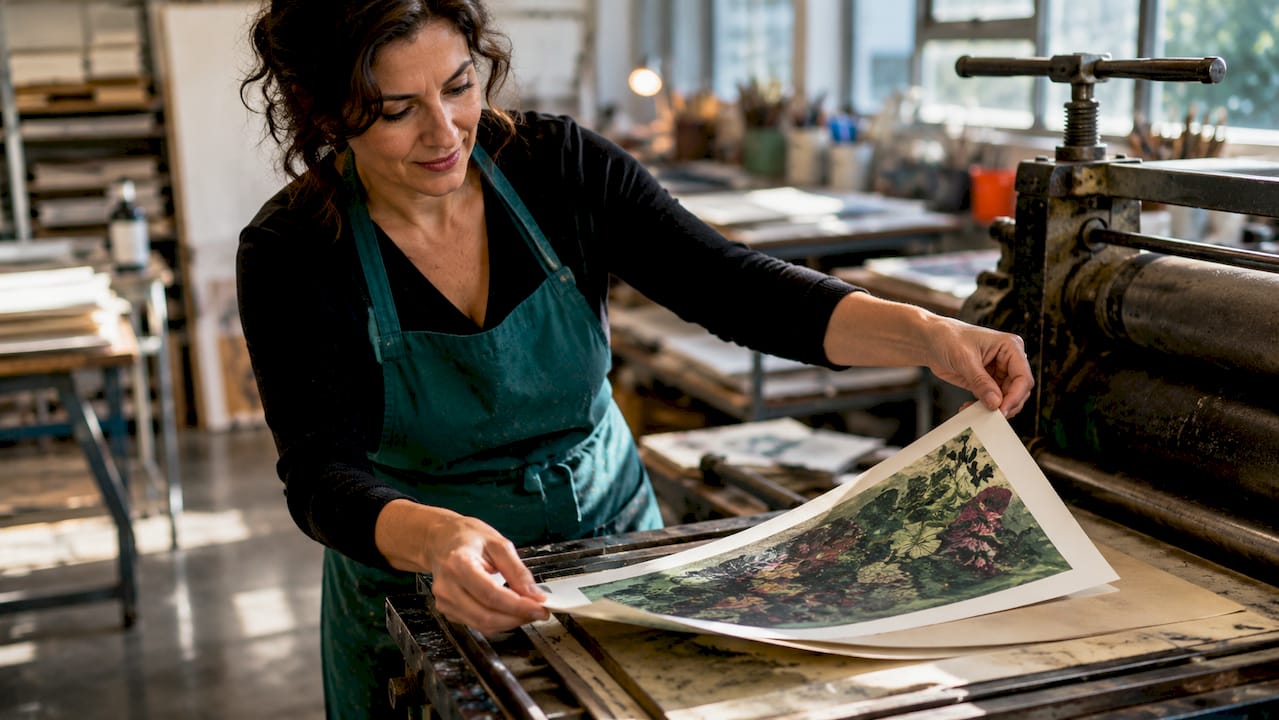
The artist proof originated as a technical necessity, not a collectible category. Before an edition went to press, printmakers pulled early impressions to check ink coverage, plate registration, and color accuracy. These test prints let the artist approve the work before committing to a full run. The French term for the final approval print is “bon à tirer,” which translates roughly to “good to pull.” The bon à tirer print set the quality standard for the entire edition and carries unique provenance value beyond ordinary artist proofs.
The printmaking process produced several types of proofs at different stages:
- Working proofs: Pulled during plate development, often showing corrections or unfinished states
- Trial proofs: Impressions made to test color variations or compositional changes before the edition is finalized
- Artist proofs: Final impressions, identical in quality to the numbered edition, reserved for the artist’s personal use
- Bon à tirer (BAT): The single definitive approval print used to set the standard for all numbered copies
Historically, early impressions held a quality advantage because printing plates wore down over time, making later pulls slightly less sharp. Artists kept the best early impressions for themselves. That practical advantage no longer exists. Modern printing technology produces uniform quality across every impression in an edition, from the first to the last.
The tradition of reserving artist proofs continued even after the technical reason disappeared. Today, AP prints are also distributed to print technicians as compensation and kept by print shops as archival reference copies. The category evolved from a quality control tool into a recognized collecting tier.
How do artist proofs differ from regular limited edition prints?
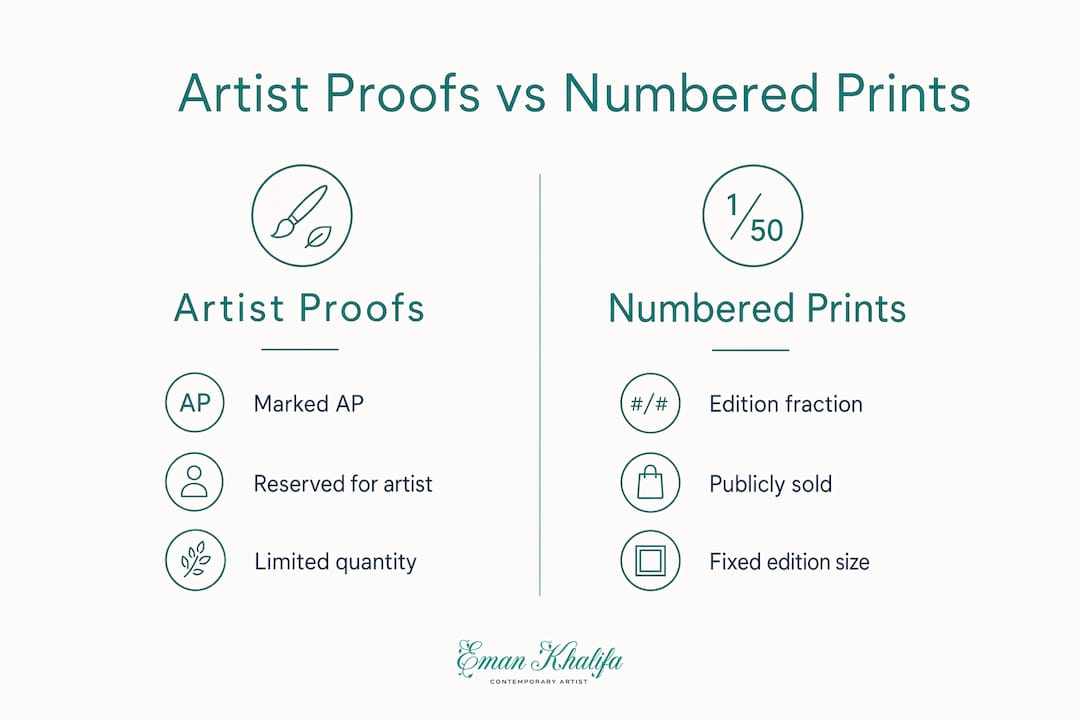
The most common misconception about artist proofs is that they are physically superior to numbered prints. They are not. Modern artist proofs are identical in production method, paper stock, ink, and image quality to every other impression in the edition. The difference is entirely in designation and numbering.
A numbered print carries a fraction notation such as 45/200, meaning it is the 45th impression from an edition of 200. An artist proof carries “AP” or “A/P” instead of a number and is not counted within that 200. This distinction matters because the AP exists outside the stated edition size, which affects how collectors calculate total supply.
| Feature | Artist proof | Numbered print |
|---|---|---|
| Marking | “AP” or “A/P” | Fraction (e.g., 45/200) |
| Counted in edition | No | Yes |
| Print quality | Identical | Identical |
| Typical quantity | 10–15% of edition | Full stated edition run |
| Primary recipient | Artist, technicians | General collectors |
| Market price | Often higher | Standard edition price |
Pro Tip: When evaluating a print marked “AP,” ask the gallery or seller for the total edition size and the total number of APs produced. Both figures together tell you the actual supply.
The limited edition prints guide at Emansgallery covers how edition numbering works in detail, which is useful context for collectors comparing AP and standard prints side by side.
Why do artist proofs hold special appeal in the art market?
Rarity drives collector interest in artist proofs, but the story is more specific than simple scarcity. Because APs fall outside the numbered edition, a collector who owns one holds a print that the general public could not access through the standard edition. That exclusivity carries real psychological and market weight.
Several factors shape AP desirability:
- Lower quantity: APs represent a fraction of total output, making them genuinely scarcer than numbered prints
- Artist connection: APs were originally held by the artist personally, giving them a stronger provenance story
- Signature and inscription: Many APs carry additional inscriptions or dedications beyond a standard signature
- Archival significance: Some APs were used as reference copies, adding documentary value
“Collectors should weigh provenance and documented AP quantities rather than assuming an automatic premium due to AP status. Rarity alone does not guarantee increased investment value.” — Sotheby’s
The provenance story matters as much as the designation. An AP that passed directly from the artist’s studio carries more weight than one that entered the secondary market without documentation. Spotting authentic art requires examining certificates, signatures, and chain of ownership, not just the “AP” marking on the margin.
One risk collectors often overlook: some artists sell APs after the main edition sells out, effectively extending supply without changing the edition number. Undisclosed AP quantities can dilute the scarcity that made the AP appealing in the first place. This is not a theoretical concern. It happens regularly in the secondary market, and it is why documentation matters more than the label.
What should collectors and artists know before acquiring or issuing artist proofs?
Buying or issuing an artist proof without understanding the documentation requirements is the most common mistake in this category. The following steps apply whether you are a collector evaluating a purchase or an artist preparing to release an edition.
- Verify the total edition size. Ask for the complete edition number, including all APs, printer’s proofs, and any other out-of-edition impressions. The stated edition number alone does not tell you total supply.
- Request a certificate of authenticity. A proper certificate lists the artist’s name, title, medium, edition size, AP quantity, and the specific impression’s designation. No certificate means no verifiable provenance.
- Distinguish trial proofs from final APs. Confusion between trial proofs and finalized artist proofs affects market value significantly. A trial proof showing an unfinished state is not the same as a final AP, even if both carry the artist’s signature.
- Check for post-edition sales. Research whether the artist has a history of releasing additional APs after editions close. Artists who sell APs after editions sell out undermine the scarcity argument for every AP in that edition.
- Evaluate condition and storage. APs stored in studio conditions may show handling wear. Ask for condition reports and inspect margins for foxing, creasing, or fading before purchasing.
Pro Tip: For investment-grade purchases, use a specialist print appraiser or consult auction records for the specific artist to benchmark AP pricing against numbered prints from the same edition.
Artists issuing their own editions should document AP quantities before release, not after. Deciding how many APs to retain and disclosing that number upfront protects both the artist’s reputation and the collector’s investment. Resources like designer resources on original art offer practical frameworks for artists managing edition documentation.
Key Takeaways
An artist proof print is defined by its designation outside the numbered edition, not by any difference in physical quality from standard prints.
| Point | Details |
|---|---|
| AP definition | Artist proofs are impressions reserved for the artist, marked “AP,” and excluded from the numbered edition count. |
| Quantity standard | By industry convention, APs generally represent 10–15% of the total edition size. |
| Quality parity | Modern APs are identical in paper, ink, and image quality to every numbered print in the same edition. |
| Value drivers | Provenance, documented AP quantity, and artist connection matter more than the “AP” label alone. |
| Collector risk | Undisclosed or post-edition AP releases can dilute scarcity and reduce the premium collectors expect. |
Why the “AP” label tells only half the story
The art market treats artist proofs as a premium tier, and in many cases that premium is justified. But I have seen collectors pay significantly more for an AP without asking the one question that actually matters: how many APs exist for this edition?
The tradition of artist proofs developed when printmaking was a craft with real technical variation between early and late impressions. That variation is gone. What remains is a naming convention that carries historical weight but no longer reflects a physical difference. Collectors who understand this are better positioned than those who assume “AP” automatically means “better.”
Digital printing has made this even more complicated. When an edition can be reprinted on demand, the concept of a limited run requires active enforcement by the artist, not just a label on the margin. I think the most honest thing an artist can do is publish the complete edition breakdown upfront, including every AP, printer’s proof, and BAT, so collectors know exactly what they are buying into.
The why artists make prints resource at Emansgallery covers the printmaking process from the artist’s perspective, which gives collectors useful context for evaluating edition decisions. My advice: treat the AP designation as a starting point for research, not a conclusion.
— Eman
Original art and fine art prints at Emansgallery
Collectors who understand artist proofs know that provenance and quality documentation are what separate a meaningful acquisition from a speculative one.
Emansgallery offers original handmade paintings by artist Eman Khalifa alongside museum-quality canvas prints, each produced with full documentation and clear edition details. The Private Eye canvas print is a high-priority piece for collectors seeking a documented, gallery-quality work. For collectors drawn to fluid abstract seascape work, the Good Tidings original painting offers a one-of-a-kind acquisition with full provenance. Emansgallery ships worldwide from the UK, USA, Canada, Australia, Germany, France, the UAE, and beyond.
FAQ
What does “AP” mean on a print?
“AP” stands for artist proof. It marks an impression that falls outside the numbered edition and was originally reserved for the artist’s personal use.
How many artist proofs are in a typical edition?
Artist proofs typically represent 10–15% of the total edition. An edition of 100 prints would conventionally include no more than 10–15 APs.
Are artist proofs worth more than numbered prints?
Artist proofs often sell at a premium due to perceived rarity, but provenance and documented AP quantity determine actual value. An undisclosed or large AP run can eliminate any price advantage.
What is the difference between an artist proof and a bon à tirer?
A bon à tirer (BAT) is the single approval print the artist signs to set the quality standard for the entire edition. Artist proofs are a broader group of impressions outside the numbered run, while the BAT is one specific, definitive print.
How do I verify an artist proof is authentic?
Request a certificate of authenticity listing the edition size, total AP quantity, and the specific impression’s designation. Cross-reference with the gallery or print publisher, and check authentication details including signature placement and paper quality.
Stay Connected
- ✨ Explore Eman Khalifa's original art, fine art prints and art-inspired merchandise.
- Follow Eman Khalifa's art journey on: Instagram @emans_gallery and Facebook
- Watch Eman Khalifa creating live art on: YouTube @emans_gallery
