


Terry Smith on What Is Contemporary Art: A Clear Guide
TL;DR:
- Contemporary art is defined as art created since the late 1970s, emphasizing conceptual complexity and social context. Terry Smith’s theory of contemporaneity states that true contemporary works reactivate historical themes to engage with present issues, involving multiple times simultaneously. Market forces and institutions actively shape what is considered contemporary, prioritizing ideas, critique, and dialogue over aesthetic standards.
Contemporary art is defined as art produced from the late 1970s to the present, shaped primarily by conceptual complexity and its relationship with current social, political, and cultural conditions. Terry Smith, Andrew W. Mellon Professor of Contemporary Art History and Theory at the University of Pittsburgh, is the leading academic voice on this subject. His framework goes far beyond asking when a work was made. Smith argues that contemporary art is a complex social construct shaped by artists, curators, critics, and market forces, where institutional validation often carries more weight than traditional aesthetic standards. Understanding his perspective changes how you see every gallery you walk into.
What characteristics define contemporary art in practice?
Contemporary art is not a style. It is a set of conditions and attitudes that art produced since the late 20th century tends to share. Contemporary art exhibitions grew 42% from 2010 to 2020. That growth reflects a global appetite for art that speaks directly to present-day experience rather than historical tradition.
The clearest way to understand contemporary art characteristics is through what it prioritizes:
- Concept over form. Technical skill is de-emphasized; the idea driving the work is the primary creative engine. An artist like Damien Hirst places a shark in formaldehyde not to demonstrate painting technique, but to force a confrontation with mortality.
- Diverse media. Video, performance, installation, digital art, and found objects all qualify. 68% of contemporary artists use digital or interactive components. That figure shows how far the field has moved from canvas and paint.
- Social and political engagement. Works by artists like Kara Walker, Ai Weiwei, and Barbara Kruger address identity, power, globalization, and injustice directly.
- Viewer participation. The audience is no longer a passive observer. Installations by artists like Olafur Eliasson require physical movement through space, making the viewer’s experience part of the artwork itself.
- Nontraditional materials. Contemporary artists use whatever material serves the idea, from industrial steel to human hair to social media feeds.
Nicholas Bourriaud describes contemporary art as a space of negotiation that engages with sociopolitical climates. His point is that the value of a contemporary work lies in the dialogue it opens, not in a fixed interpretation the viewer must decode correctly.
Pro Tip: When you encounter a contemporary artwork that confuses you, ask “What conversation is this starting?” rather than “What does this mean?” That shift in question changes everything.

How does Terry Smith’s theory of contemporaneity reshape understanding of contemporary art?
Terry Smith’s most significant contribution to art theory is the concept of “contemporaneity.” It is not simply a synonym for “current.” Smith defines contemporaneity as multiple ways of being in time simultaneously, where past, present, and future contexts interact within a single artwork.
This distinction matters because it separates two ideas that are often confused:
- Being made now. A painting completed this year is recent, but that alone does not make it contemporary in Smith’s sense.
- Being contemporary. A work is truly contemporary when it reactivates historical contexts to address present-day issues, creating a dialogue across time rather than simply reflecting the moment of its creation.
Smith’s framework explains why a curator might place a 15th-century altarpiece alongside a 2020 video installation. Both works can be “contemporary” if they speak to the same present concerns about faith, power, or the body. The history of contemporary art is non-linear, characterized by overlapping moments and the reactivation of past narratives within present contexts.
“Contemporaneity entails multiple temporal layers simultaneously, enabling dialogue between historical and current contexts.” — Terry Smith, as interpreted in University of Edinburgh curatorial research
Smith’s framework is also intentionally open-ended. His theory encourages ongoing critical debate rather than rigid definitions. That openness frustrates readers who want a clean answer, but it is the point. Contemporary art resists fixed meaning by design, and Smith’s theory reflects that resistance rather than fighting it.
The practical implication is significant. When you visit a museum like MoMA or the Tate Modern, the curators are not simply hanging recent work. They are making arguments about which works are in active dialogue with the present. Smith’s concept of contemporaneity is the intellectual framework behind those curatorial decisions, even when it goes unnamed.
What role do institutions and market forces play in defining contemporary art?
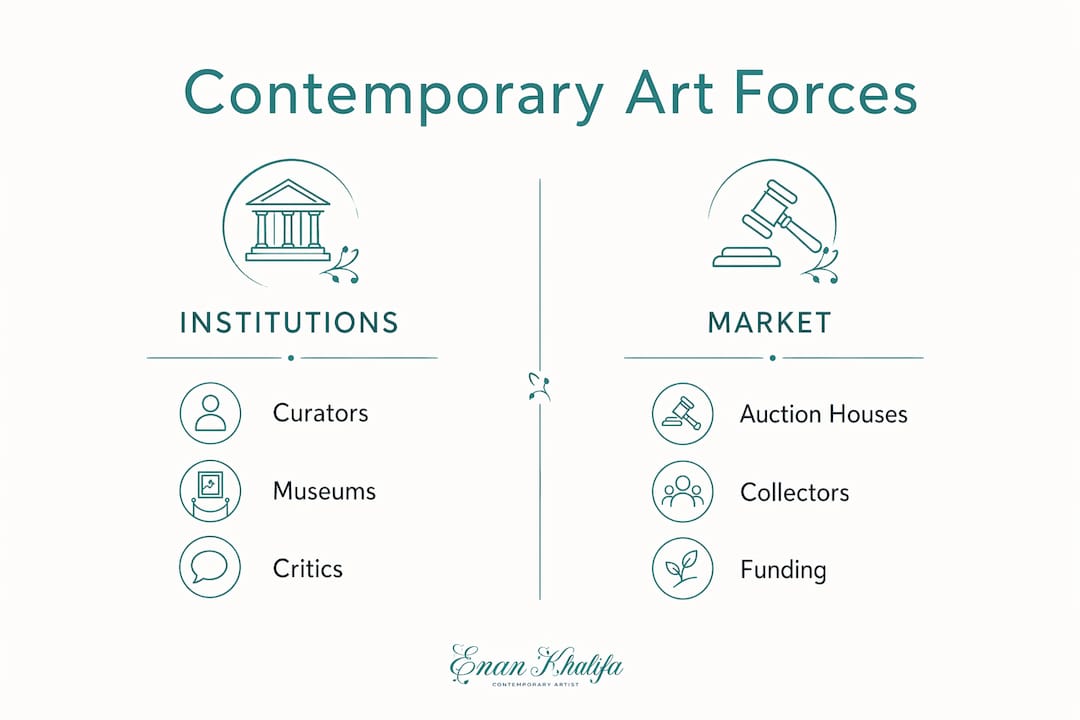
Institutions do not just display contemporary art. They define it. Terry Smith asserts that contemporary art is a complex social construct involving artists, curators, critics, and market influence, where institutional validation often outweighs traditional aesthetic standards.
| Factor | Traditional art world | Contemporary art world |
|---|---|---|
| Value criteria | Technical mastery, beauty, historical lineage | Conceptual strength, institutional endorsement, critical discourse |
| Gatekeepers | Academies, salons, royal patrons | Museums, biennials, auction houses, critics |
| Artist recognition | Decades-long career trajectory | Can emerge rapidly through gallery shows or social media |
| Market driver | Rarity and craft | Narrative, provenance, and institutional backing |
MoMA notes that contemporary art often critiques the museums and galleries exhibiting it, challenging how art is displayed and debated. That self-referential quality is unique to the contemporary period. An artist like Hans Haacke built an entire career exposing the financial relationships between museums and corporate donors, using the museum’s own walls to do it.
The market operates similarly. When a work sells at Christie’s or Sotheby’s for a record price, that transaction does not just reflect existing value. It creates value. Collectors, critics, and curators then respond to the market signal, and the cycle reinforces itself. Understanding this dynamic is part of what Smith means when he calls contemporary art a social construct.
Pro Tip: Before visiting a major contemporary art exhibition, look up who funded it. Knowing the institutional and financial relationships behind a show gives you a sharper lens for reading the work on the walls.
How can beginners engage with and appreciate contemporary art today?
Engaging with contemporary art does not require an art history degree. It requires a willingness to sit with uncertainty and ask questions rather than demand answers. Contemporary art challenges viewers to engage in sociopolitical dialogues and accept multiple interpretations rather than seek a single correct meaning.
Practical starting points for readers new to the field:
- Read the wall text, then ignore it. Museum labels give context, but your physical and emotional response to a work is data too. Both matter.
- Focus on what the artist is questioning. Works by artists like Jenny Holzer or Jean-Michel Basquiat are not decorative. They are arguments. Identify the argument before evaluating the aesthetics.
- Visit biennials and art fairs. Events like the Venice Biennale, Art Basel, and Frieze London present the widest cross-section of contemporary art styles in one place, making comparison easy.
- Use context about artists and institutions. Knowing that Yoko Ono’s “Cut Piece” was performed in 1964 Tokyo changes how you read its commentary on vulnerability and gender.
- Engage with installations physically. Walk around them, through them, and at different distances. Many works by artists like James Turrell only reveal their full effect through movement.
Collecting contemporary art is also more accessible than most readers assume. Buying original contemporary paintings online has opened the market to collectors at every budget level, and owning a work deepens your relationship with it in ways that museum visits alone cannot replicate.
Key Takeaways
Terry Smith’s concept of contemporaneity defines contemporary art not by when it was made, but by its capacity to hold multiple time periods in active dialogue with present-day concerns.
| Point | Details |
|---|---|
| Terry Smith’s core definition | Contemporary art is a social construct shaped by artists, curators, critics, and market forces, not aesthetics alone. |
| Contemporaneity vs. “made now” | A work is contemporary when it reactivates historical contexts to address present issues, not simply because it is recent. |
| Key characteristics | Concept-driven, interdisciplinary, socially engaged, and reliant on viewer participation as part of the work itself. |
| Institutional power | Museums, biennials, and auction houses actively define contemporary art’s value, not just reflect it. |
| Beginner approach | Focus on the question an artwork asks rather than searching for a single correct interpretation. |
Why contemporaneity is the most useful idea in art today
I have spent years looking at contemporary art, and the single most useful shift in my thinking came from encountering Smith’s concept of contemporaneity. Before that, I evaluated work by asking whether it felt current. That is the wrong question entirely.
The right question is whether a work is in genuine dialogue with the present, regardless of when it was made. That reframe opened up my appreciation for works I had previously dismissed as “old” or “irrelevant.” A 1970s feminist performance piece by Marina Abramović speaks directly to conversations happening right now about bodily autonomy and institutional power. It is contemporary in the truest sense.
What I find most honest about Smith’s framework is that it refuses to give you a clean answer. Many readers find that frustrating. I find it accurate. Contemporary art is genuinely contested territory, and any definition that pretends otherwise is selling you something. The discomfort of open-ended meaning is not a flaw in the work. It is the work.
— Eman
Original contemporary art at Emansgallery
Emansgallery offers original handmade paintings and museum-quality canvas prints by artist Eman Khalifa, spanning abstract, geometric, seascape, and landscape styles that engage directly with the concept-driven spirit of contemporary practice.

Works like the Private Eye canvas print bring conceptual expressionism into your space, while pieces like Mystic Sea and Good Tidings demonstrate how fluid abstraction carries emotional and cultural weight. Every piece ships worldwide from the UK, USA, Canada, Australia, and across Europe and the UAE. For readers ready to move from understanding contemporary art to living with it, Emansgallery’s full collection of wall art prints is a direct next step.
FAQ
What is Terry Smith’s definition of contemporary art?
Terry Smith defines contemporary art as a complex social construct shaped by artists, curators, critics, and market forces, where institutional validation typically carries more weight than traditional aesthetic standards.
What does “contemporaneity” mean in Terry Smith’s art theory?
Contemporaneity refers to multiple ways of being in time simultaneously. A work is contemporary when it reactivates historical contexts to address present-day issues, not simply because it was recently made.
What are the main characteristics of contemporary art?
Contemporary art is concept-driven, interdisciplinary, socially engaged, and incorporates diverse media including video, installation, performance, and digital formats. Viewer participation is considered part of the artwork itself.
How do institutions shape the meaning of contemporary art?
Museums, biennials, auction houses, and critics actively define contemporary art’s value through curatorial decisions and market transactions. Many contemporary artworks critique these very institutions from within their walls.
How should beginners approach understanding contemporary art?
Focus on the question or argument an artwork raises rather than searching for a single correct meaning. Reading about the artist’s context and engaging physically with installations deepens appreciation significantly.
Stay Connected
- ✨ Explore Eman Khalifa's original art, fine art prints and art-inspired merchandise.
- Follow Eman Khalifa's art journey on: Instagram @emans_gallery and Facebook
- Watch Eman Khalifa creating live art on: YouTube @emans_gallery
