


Printmaking Types: A Collector's Guide to Fine Art Prints
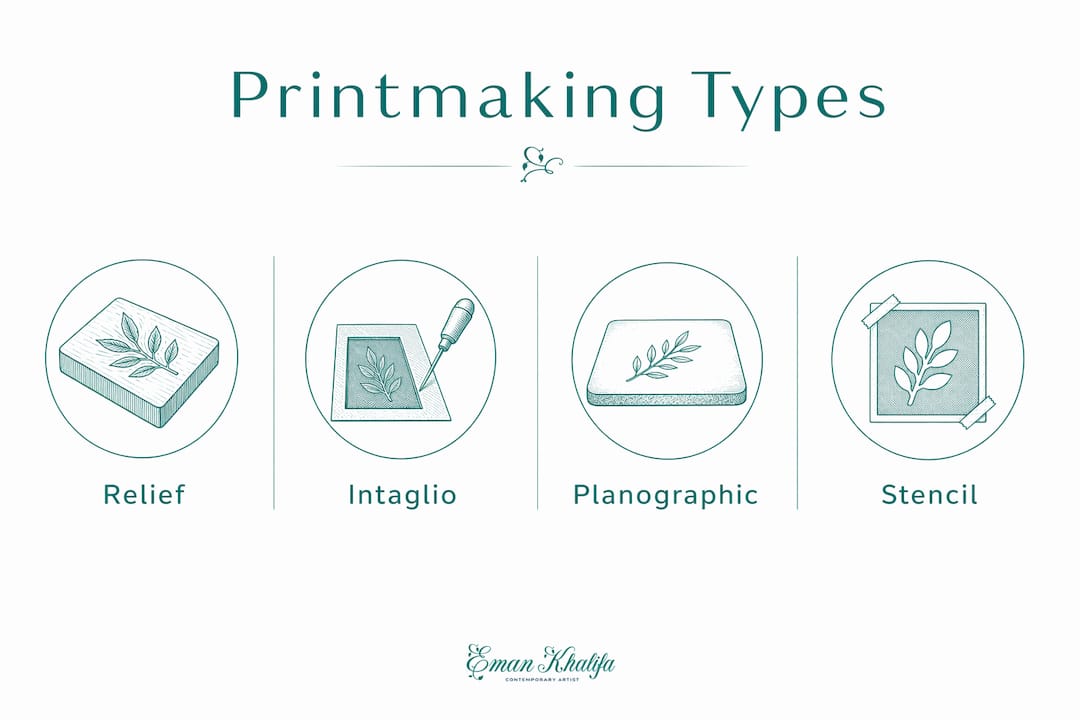
Fine art printmaking divides into four primary types: Relief, Intaglio, Planographic, and Stencil. Each type is defined by how ink transfers from a matrix to paper, producing a distinct visual language that shapes every print’s texture, line quality, and emotional character.
- Relief: Ink sits on raised surfaces; carved areas stay blank. Examples: woodcut, linocut.
- Intaglio: Ink fills incised grooves below the plate surface. Examples: etching, engraving.
- Planographic: Ink transfers from a flat surface using chemical separation. Examples: lithography, monotype.
- Stencil: Ink is pushed through open areas of a mesh or cut material. Examples: screenprinting, pochoir.
Collectors who understand these categories can read a print’s physical evidence, recognize authentic handmade works, and make confident acquisitions. The type of process used is not a technical footnote. It determines what the finished work looks and feels like on the wall.
What are the main relief printmaking methods?
Relief printmaking carves away the areas around an image, leaving the design raised. Ink is rolled onto those raised surfaces, paper is pressed against them, and the image transfers. The carved recesses print white; the uncut surfaces print in color.
- Woodcut: The oldest printmaking technique, dating to the 5th century in China and reaching Europe around 1400. Artists carve along the wood grain with knives and gouges. The grain itself often shows in the final print, adding texture. Albrecht Dürer elevated woodcut to a fine art medium in the 15th century; Expressionists Ernst Ludwig Kirchner and Emil Nolde later used its bold, graphic quality for raw emotional effect.
- Linocut: Uses linoleum instead of wood. Easier to carve and free of grain, linocut produces cleaner, more fluid lines. Henri Matisse used linocut extensively in his later years for its directness.
- Wood engraving: Cut on the dense end-grain of the block rather than the plank face, allowing finer, more detailed lines than standard woodcut.
The visual result of relief printing is bold: strong contrasts, flat color planes, and visible texture from the matrix surface. Detail is limited by the carving process, which is precisely what gives relief prints their graphic power.
Pro Tip: When examining a relief print, look for faint impressions of the wood grain or linoleum texture in the ink. That physical trace confirms hand-printing from a carved matrix.
How does intaglio printmaking work, and why do collectors value it?
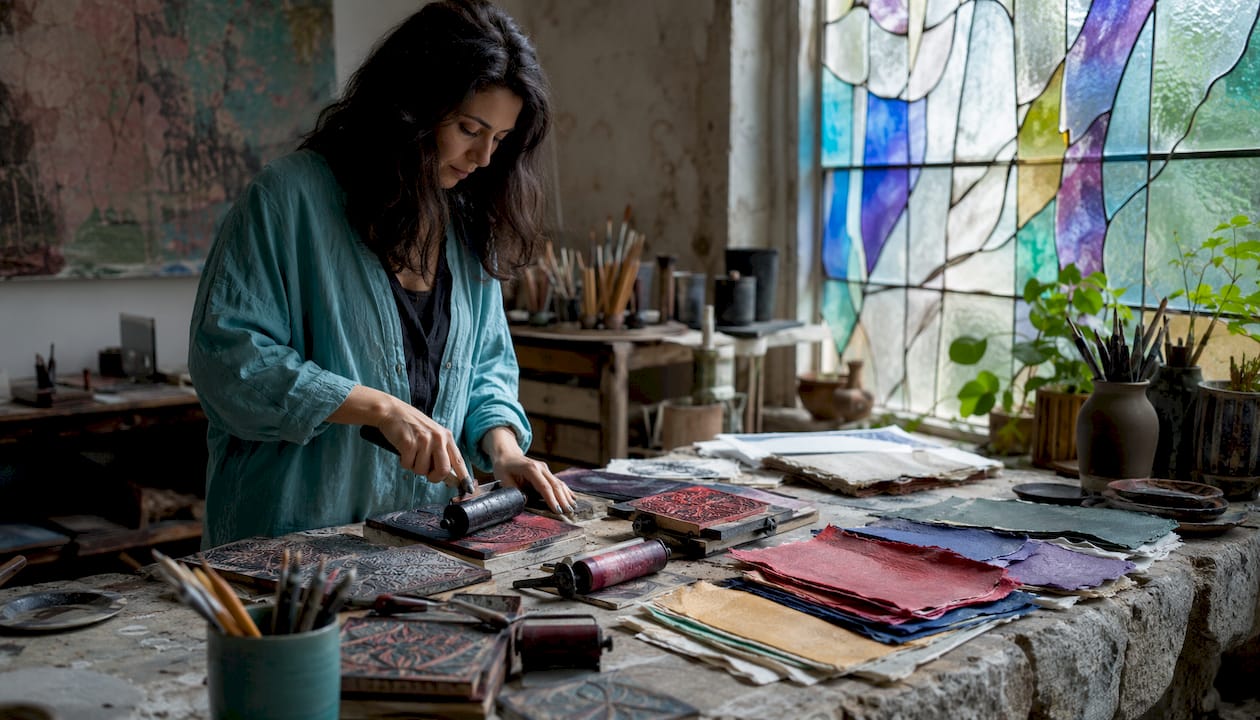
Intaglio reverses the relief logic. The image is cut or bitten into a metal plate, ink is pushed into those recessed grooves, the surface is wiped clean, and damp paper is pressed through a press under high pressure. The paper pulls ink directly from the grooves.
Key intaglio processes:
- Engraving: A burin cuts lines directly into copper or steel. The result is clean, deliberate, and precise. Albrecht Dürer, Pablo Picasso, and Alberto Giacometti all worked in engraving.
- Etching: A wax ground covers the plate; the artist draws through it with a needle, then acid bites the exposed metal. Rembrandt is the canonical master. Francisco Goya, Otto Dix, and Cy Twombly also produced major etched bodies of work.
- Drypoint: A needle scratches directly into the plate, raising soft burrs that hold ink and produce velvety, slightly blurred lines. Rembrandt’s Clump of Trees with a Vista shows this quality clearly.
- Aquatint: A porous resin ground creates tonal areas rather than lines, allowing subtle gradations of shade. Goya used aquatint extensively in Los Caprichos.
- Mezzotint: The plate is roughened all over with a rocker, then burnished smooth in areas to create light. It prints from dark to light and produces rich, velvety tonal gradations.
The plate mark is the rectangular indentation left in the paper by the metal plate’s edge during pressing. It is a direct physical record of the printing process and a key authentication marker for collectors.
Pro Tip: Run a fingertip lightly across an intaglio print. You can feel the slight relief of ink sitting above the paper surface, pulled from the grooves under press pressure. No reproduction replicates that tactile quality.
What makes planographic printmaking different from other methods?
Planographic printing works from a completely flat surface. No carving, no incising. Image and non-image areas sit on the same plane and are separated by chemistry, not topography.
Key planographic processes:
- Lithography: Based on the repulsion of oil and water. The artist draws on limestone or a zinc plate with a greasy medium (tusche or wax crayon). The surface is treated with gum arabic and weak acid, fixing the image. Water is applied; it adheres to blank areas and is repelled by the greasy drawing. Oil-based ink then sticks only to the greasy image areas. The plate and paper pass through a press together. Lithography, developed in Germany in the late 18th century, produces subtle tonal gradations and a quality close to drawing or painting.
- Monotype: The artist paints or draws directly onto a smooth plate, then presses paper against it to transfer the image. Because nearly all the ink transfers in one pull, the image cannot be exactly repeated. Monotypes are unique by definition. Edgar Degas and Jean Dubuffet both worked extensively in monotype, valued for its painterly spontaneity.
Planographic techniques offer collectors a different aesthetic register: softer edges, tonal richness, and a closeness to drawing that relief and intaglio cannot replicate.
Pro Tip: A second, much fainter impression pulled from a monotype plate is called a “ghost.” It is considered a lesser work and should be priced and labeled accordingly.
How does stencil printmaking produce its characteristic look?
Stencil printmaking forces ink through open areas of a prepared screen or cut material onto the surface below. Blocked areas receive no ink; open areas receive full, saturated color.
Key stencil processes:
- Screenprinting (serigraphy): A mesh of silk or synthetic fabric is stretched over a frame. A stencil blocks selected areas. Ink is pushed across the screen with a squeegee, passing through open mesh onto paper or fabric below. Each color requires a separate screen. The result is flat, vivid color with sharp edges. Andy Warhol’s use of screenprinting in the 1960s brought the technique into the fine art canon.
- Pochoir: A hand-cut stencil technique used for limited edition fine art prints, often combined with hand-applied color. More labor-intensive than screenprinting and associated with early 20th-century French print publishing.
Screenprinting does not require a press, which makes it accessible and adaptable. Its bold color saturation and graphic clarity suit both fine art and street art contexts. Contemporary printmakers also use it in hybrid workflows alongside lithography or relief processes.
Pro Tip: Look at the edges of color areas in a screenprint. Crisp, hard edges with flat, opaque color are characteristic. Slight misregistration between color layers, visible as a thin halo, confirms hand-pulled printing rather than digital reproduction.
What collectors should know about printmaking technique and value
Technique shapes every physical and visual quality of a print. Collectors who understand how a print was made can assess its texture, detail capacity, and rarity with confidence.
- Edition numbering: Original prints are produced in limited editions, with each impression numbered (e.g., 4/30) and signed by the artist. The matrix is often destroyed after printing to guarantee that number. Limited editions ensure scarcity and protect the print’s market value.
- Artist signature: A hand-signed print confirms the artist’s direct involvement and approval of each impression.
- Plate mark: Present only on intaglio prints. Its absence on a work described as an etching or engraving is a red flag.
- Paper quality: Original fine art prints use acid-free, archival paper. Check for foxing, yellowing, or brittleness when assessing older works.
- Care: Store prints flat or rolled in acid-free materials, away from direct light. Frame with UV-protective glass. Humidity fluctuations cause paper to expand and contract, damaging the print over time.
Artists also combine printmaking types in a single work, layering screenprint over lithography or adding hand-drawn elements to an etching. These hybrid works expand the expressive range available to contemporary printmakers.
Pro Tip: When buying a collectible print, ask for a certificate of authenticity that specifies the technique, edition size, and paper type. A reputable gallery provides this as standard.
How to tell an original handmade print from a mechanical reproduction
An original print is an artwork where the artist created the matrix and directly controlled the printing process. A reproduction is a photographic or digital copy of a pre-existing painting or drawing, printed mechanically without the artist’s hand in the matrix.
- Original prints bear edition numbers, artist signatures, and physical evidence of the printing process (plate marks, ink relief, screen texture).
- Reproductions are typically printed on coated stock with uniform dot patterns visible under magnification. They carry no plate mark and show no tactile ink quality.
- Market value: Original prints, particularly from limited editions with destroyed matrices, hold and appreciate in value. Reproductions, regardless of print quality, are decorative objects rather than collectible artworks.
- Common misconception: A high-quality giclée reproduction on canvas is not an original print. It is a reproduction, even when signed by the artist after printing.
Understanding this distinction is the foundation of informed collecting. The difference between originals and reproductions affects both the cultural and financial value of a work.
Eman Khalifa and Emansgallery: expertise in contemporary printmaking
Eman Khalifa is a London-based British-Egyptian-American contemporary artist whose practice spans oil, acrylic, and mixed media. Her work moves across abstract nature, seascapes, landscapes, and florals, with consistent attention to atmosphere, movement, and light. Emansgallery offers original handmade paintings and museum-quality fine art prints alongside educational content that helps collectors understand the techniques behind the works they acquire.
Emansgallery’s printmaking techniques blog covers the technical and aesthetic dimensions of print processes in depth. Collectors interested in commissions, original paintings, or fine art prints can engage directly with Eman’s practice through the gallery. Press recognition from FAD Magazine and Artlyst reflects the growing public profile of Eman Khalifa as a serious contemporary artist.
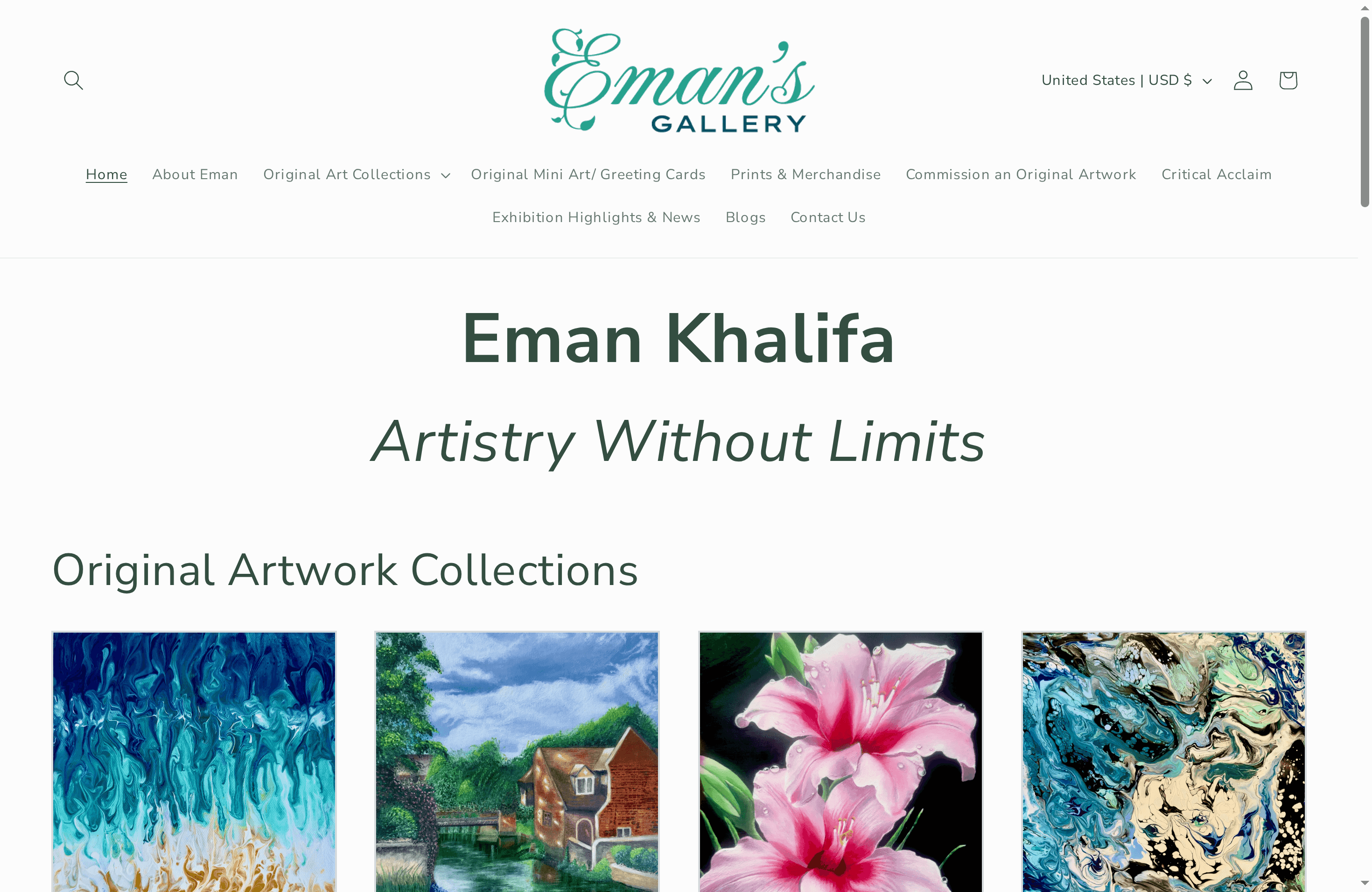
Collectors looking for original works can explore pieces such as Good Tidings, a fluid blue and gold ocean painting, or Mystic Sea, a fluid abstract ocean work in gold. Both are one-of-a-kind originals available through Emansgallery, with worldwide shipping from the US, UK, and twelve other countries.
How each printmaking type evolved historically
Relief printing is the oldest category. Woodblock printing appeared in China by the 5th century, initially for textiles and text, then for images on paper. It reached Europe around 1400 and became a primary medium for book illustration and devotional images. Japanese ukiyo-e woodblock prints, including Hokusai’s The Great Wave off Kanagawa, brought multi-color relief printing to a technical peak in the 18th and 19th centuries and directly influenced European Post-Impressionist and Expressionist artists.
Intaglio engraving developed in Europe during the 15th century, initially among goldsmiths who adapted their metal-working tools for printmaking. Etching followed in the early 16th century, credited to Daniel Hopfer (1470–1536), who used acid to decorate armor before applying the technique to copper plates. Rembrandt transformed etching into a primary fine art medium in the 17th century.
Lithography was invented in Germany in the late 18th century by Alois Senefelder, who discovered the oil-and-water principle accidentally while experimenting with limestone. It became the dominant commercial and artistic printing method of the 19th century. Screenprinting emerged as a commercial technique in the early 20th century and entered the fine art world in the 1960s, largely through Pop Art. Digital printmaking, using archival inkjet processes, has been recognized as an original print medium when the artist creates the image directly as a digital file rather than reproducing an existing work.
Key Takeaways
Fine art printmaking divides into four types: Relief, Intaglio, Planographic, and Stencil, each defined by how ink transfers from matrix to paper.
| Point | Details |
|---|---|
| Four primary types | Relief, Intaglio, Planographic, and Stencil cover all major fine art printmaking processes. |
| Plate mark as authenticator | The plate mark indentation on intaglio prints confirms hand-press printing and distinguishes originals from flat reproductions. |
| Edition numbers and signatures | Limited editions with numbered impressions and artist signatures validate original handmade prints and protect collector value. |
| Originals vs. reproductions | Original prints involve an artist-created matrix; reproductions are photographic copies with no tactile ink quality or plate evidence. |
| Hybrid techniques | Contemporary printmakers combine types, such as screenprint over lithography, producing works that cross traditional category boundaries. |
FAQ
What are the four main printmaking types?
Fine art printmaking divides into Relief, Intaglio, Planographic, and Stencil, each defined by how ink transfers from a matrix to paper.
What is a plate mark, and why does it matter to collectors?
A plate mark is the rectangular indentation pressed into paper by the metal plate’s edge during intaglio printing. Its presence confirms authentic hand-press production and is a key authentication feature.
How is an original print different from a reproduction?
An original print is made from an artist-created matrix, bears an edition number and hand signature, and shows physical evidence of the printing process. A reproduction is a mechanical photographic copy with no matrix involvement by the artist.
What does an edition number on a print mean?
An edition number indicates the print’s place within a limited set. Limited editions, especially when the matrix is destroyed afterward, help guarantee scarcity and support the print’s long-term value.
Can a digital print be considered an original artwork?
Yes, when the artist creates the image directly as a digital file and prints it using archival methods as a limited edition, it qualifies as an original digital print rather than a reproduction of a pre-existing work.
Stay Connected
- ✨ Explore Eman Khalifa's original art, fine art prints and art-inspired merchandise.
- Follow Eman Khalifa's art journey on: Instagram @emans_gallery and Facebook
- Watch Eman Khalifa creating live art on: YouTube @emans_gallery
