


Texture Forward Living Room Wall Decor Over 40 Inches for Real Impact
For a modern living room, the winning move is a texture-forward oversized canvas or a tightly curated gallery that spans a proportionate width of your sofa, not a wall crowded with mismatched prints. Fewer, better pieces with real surface depth outperform trend-chasing every time. If you want a shortcut, look for a large-format canvas, a textured mixed-media panel, or a curated print set sized to your furniture, and start there with insights on why large canvas paintings stand out in any room.
TL;DR:
- Large-format textured panels create a tactile environment that softens room acoustics and adds visual warmth, especially in open-plan living spaces.
- Art spanning roughly two-thirds to three-fourths of the furniture width ensures a balanced and proportionate visual focal point above sofas or media units.
- Textured art pieces like plaster reliefs and impasto oils are trending because they offer both aesthetic depth and functional acoustic benefits.
- Proper hardware rated above the artwork’s weight and strategic lighting significantly improve safety and enhance the artwork’s textured details.
- Originals provide unique collector value, while museum-quality prints deliver impactful large-scale presence more affordably and with easier sourcing.
Table of Contents
- Modern Wall Decor Types for a Living Room
- How Do You Choose the Right Piece for Your Wall?
- Where Exactly Should You Hang Art Above a Sofa or Mantel?
- Why Textured Wall Decor Is Taking Over Modern Rooms
- Five Living Room Looks You Can Copy This Year
- Eman’s Gallery: Original and Print Options for Modern Rooms
- What Color Palettes Are Trending in Modern Wall Decor Right Now
- Where to Buy Modern Wall Decor: Sourcing Options
- Making New Art Work With Furniture You Already Own
- A Note From Eman on Choosing Art for Where You Live
- Bring an Eman Khalifa Piece Into Your Own Living Room
- Sources
- FAQ
Modern Wall Decor Types for a Living Room
Not every category of wall decor does the same job. Some anchor a room; others fill gaps or add rhythm to a gallery arrangement. Knowing which one you actually need saves you from buying the wrong scale or material twice.
- Oversized abstract canvas. A single large painting becomes the room’s focal point instantly and works especially well above a sofa or console where you need one commanding gesture instead of several small ones. Large-scale art remains one of the most reliable ways to create a commanding focal point, often outperforming a cluster of mismatched pieces.
- Textured or mixed-media panels. Sculptural plaster, impasto oil, and layered canvas read as three-dimensional rather than flat, and they catch light differently throughout the day.
- Metal wall sculpture. Works in industrial or high-contrast modern spaces; lightweight aluminum pieces are easier to mount than cast metal.
- Mirrors. Add depth and bounce natural light into darker rooms, though they demand careful placement to avoid awkward reflections of ceiling fixtures.
- Woven or textile hangings. Bring warmth and softness to rooms with a lot of hard surfaces, like concrete floors or leather seating.
- Gallery walls. A curated cluster of smaller framed works, best for rooms that want personality and story over a single bold statement.
- Floating ledges. Shelving that displays art leaning rather than mounted, ideal for renters or anyone who rotates pieces seasonally.
- Accent wall finishes. Paint, plaster, or wood paneling behind a single artwork, which frames the piece the way a mat frames a photograph.
Texture deserves special attention here. Textured wall art and three-dimensional panels are rising in modern interiors because they add tactile depth, soften acoustics, and contribute a calming, wellness-oriented ambiance — a genuine functional upgrade in open-plan living rooms where hard floors and bare walls tend to make every conversation echo.
How Do You Choose the Right Piece for Your Wall?
Before you buy anything, run through this checklist. Skipping even one step is how people end up with art that looks great online and wrong on the wall.
- Measure your furniture width first. Designers recommend that oversized art or a structured gallery span roughly two-thirds to three-fourths of the furniture width below it, whether that’s a sofa, console, or media unit. Check our guide on what size art fits living room walls if your space falls outside standard proportions.
- Match material to function. Canvas is forgiving and lightweight; textured relief adds drama but costs more to ship and mount; metal suits sharp, minimal rooms; textile softens acoustically heavy spaces.
- Set a budget band before you shop. Museum-quality prints deliver large-format impact at a fraction of an original’s price, while a commissioned piece gives you exact color and scale matching for a premium.
- Confirm your wall can hold the weight. Textured and mixed-media pieces often have an uneven center of gravity, so hardware needs to be rated well above the artwork’s actual weight, not just equal to it.
- Plan lighting before installation. A dedicated picture light or an adjustable sconce with a dimmer changes how textured brushwork reads entirely; flat overhead lighting flattens the very depth you paid for.
- Ask for in-room mockups and clarify the return policy. Any reputable seller of large-format art should offer a wall preview tool or send dimensional photos before you commit.
Pro Tip: Request a to-scale digital mockup of the artwork on a photo of your actual wall before ordering anything larger than 40 inches wide. It takes five minutes and prevents the single most common regret buyers report: a piece that looked perfect on a screen but reads too small or too large in person.
Framing matters as much as the art itself. Thin black frames tend to suit modern or industrial rooms, while natural wood frames read better in organic modern spaces — the frame is the bridge between the painting and everything else in the room.
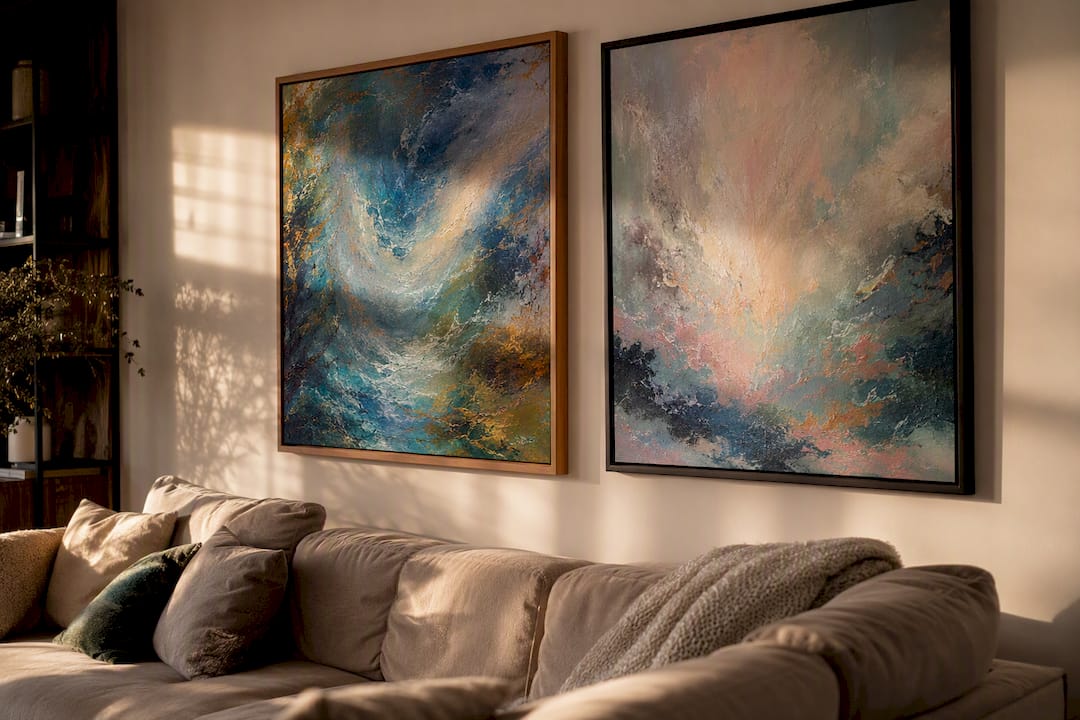
Where Exactly Should You Hang Art Above a Sofa or Mantel?
Placement mistakes are almost always about proportion or height, not taste. Fix the math and the rest falls into place.
- Measure your sofa or mantel width, then multiply by 0.66 to 0.75 to get your target art width, per the proportion rule designers use for grounded, balanced walls.
- Center the piece horizontally over the furniture, not the wall itself, since walls are rarely symmetrical to the room.
- Standard eye-level hanging puts the artwork’s center at 57 to 60 inches from the floor, but oversized pieces above a sofa can sit lower, using the sofa’s back cushions as the visual floor instead.
- Choose one statement piece for a clean modern look, a symmetrical pair for a media wall flanking a television, or a grid gallery when you want texture and story over a single focal point.
- Picture ledges let you lean and rotate art seasonally without drilling new holes every time your taste shifts.
- Before mounting anything heavy, find your studs, use a laser level, and choose anchors rated well past the frame’s actual weight, especially for plaster or mixed-media pieces with dense, uneven mass.
Our guide to the best paintings for living room spaces walks through real in-room examples if you want to see these proportions applied rather than just described.
Why Textured Wall Decor Is Taking Over Modern Rooms
The flat framed print is losing ground to art you can almost feel from across the room. Trend examples now include sculptural plaster, impasto oil painting, and layered canvas as direct alternatives to flat decorative prints, and the shift isn’t purely aesthetic.
Texture changes how a room sounds and feels, not just how it looks. Layered canvas and plaster relief diffuse sound in a way flat glass-framed prints simply can’t, which matters in open-plan living rooms with hard floors and minimal soft furnishing. The trend also connects to what some designers call quiet power: fewer, higher-quality gestures that feel earned rather than loud, maximalist statement walls.
Here’s how the main materials compare:
- Impasto oil painting. Thick, ridged brushwork that catches raking light beautifully; needs occasional dusting with a soft brush, never a wet cloth.
- Mixed-media panels. Combine paint, fabric, or found materials; check weight distribution carefully before mounting.
- Plaster or sculptural relief. Dramatic shadow play under angled light; heaviest option, so hardware selection is critical.
- Woven textiles. Warm and soft, but require occasional airing out and protection from direct sun to prevent fading.
- Metal wall art. Durable and low-maintenance, though it can feel cold without warmer materials nearby to balance it.
Whatever you choose, match it to your existing palette. Organic modern rooms tend to succeed with earth-toned, textured compositions, while strictly minimalist rooms benefit from art with generous negative space rather than dense texture competing for attention. Our piece on the role of texture in wall art breaks down the acoustic and visual mechanics in more depth.
Five Living Room Looks You Can Copy This Year
- Minimalist neutral. One oversized abstract canvas in muted tones, hung alone above a low sectional, with nothing else competing on that wall.
- Organic modern. A textured, earth-toned canvas paired with a woven textile hanging off to one side, balanced by linen upholstery and wood furniture.
- High-contrast modern. Black-and-white photography or abstract art against a stark wall, accented with matte black metal sculpture or sconces.
- Layered gallery. Mixed media, small originals, and a floating ledge combined for depth and story, ideal for rooms that evolve over time.
- Integrated media wall. A statement canvas positioned beside or above built-in shelving around the television, unifying storage and art into one composition.
Designers consistently find that combining multiple wall-decor techniques, like pairing an accent wall with floating shelves or layering drapery behind statement art, produces more compelling results than any single element alone. Lighting finishes each look: warm dimmable sconces for the organic modern palette, a single directional picture light for the minimalist canvas, and layered ambient lighting for the gallery wall so no single piece gets lost in shadow.
Eman’s Gallery: Original and Print Options for Modern Rooms
Eman’s Gallery offers three distinct paths into a modern living room, and each solves a different problem.
- Original paintings by Eman Khalifa, spanning abstract, geometric, floral, seascape, and landscape work, function as true one-of-a-kind focal points for collectors who want a piece nobody else owns.
- Museum-quality canvas prints give you the large-format visual impact of an original at a more accessible price point, ideal for readers who want the oversized-canvas look this article recommends without commissioning custom work.
- Bespoke commissions let you specify exact dimensions, palette, and mood, which solves the sizing headache entirely if your wall falls outside standard proportions.
Sizing and framing guidance is built into the buying process, and the gallery ships worldwide, including to the UK, US, Canada, Australia, Germany, France, Italy, Spain, Portugal, Greece, the UAE, and the Netherlands. If you’re staring at a blank wall and unsure whether an original or a print fits your space and budget, reach out for sizing help or a commission inquiry before you order.
What Color Palettes Are Trending in Modern Wall Decor Right Now
Warm neutrals have overtaken the cool grays that defined the last decade of modern interiors. Terracotta, sand, and muted olive now dominate textured canvases and plaster reliefs, paired with black or bronze metal accents rather than chrome. Moody tonalism, deep blues, charcoals, and near-black backgrounds lit dramatically, is having a real moment in living rooms that want drama without color noise.
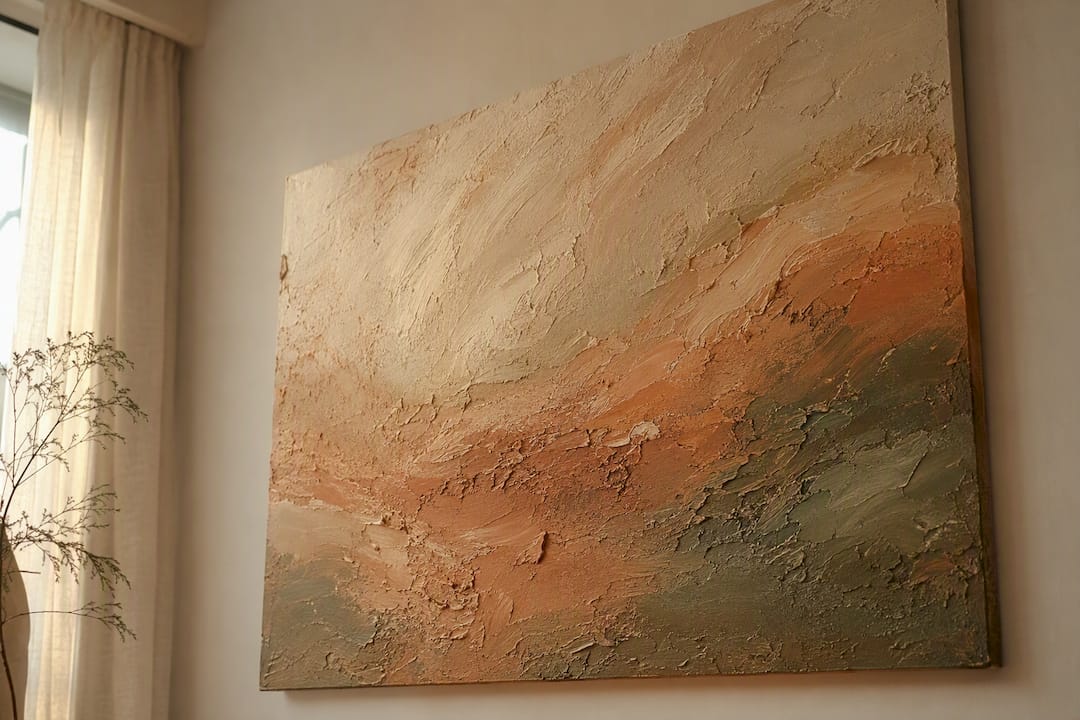
Monochrome abstraction (think layered grays, ivories, and soft taupe on a single canvas) still anchors the strict minimalist look, especially when paired with generous negative space rather than dense composition. Gold leaf accents and metallic finishes are appearing more often in mixed-media work, adding warmth under evening lighting without turning a room maximalist.
The through-line across all of these palettes is restraint. Even bold color choices, like a deep emerald or burnt sienna canvas, tend to work as a single statement piece rather than repeated across multiple items in the room. If your furniture and walls are already neutral, a saturated abstract painting in one of these tones does more work than five smaller pieces trying to achieve the same effect.
Where to Buy Modern Wall Decor: Sourcing Options
Big-box retailers and marketplace sites are useful for budget prints and frames, but they rarely offer the texture, originality, or sizing flexibility that a genuinely modern room benefits from. For readers who want something with real presence, three sourcing paths make sense.
Independent artists and galleries give you access to original work and commission flexibility that mass retailers simply can’t match. Eman’s Gallery falls into this category, offering originals, prints, and bespoke sizing directly from the artist. Print-on-demand museum-quality services bridge the gap between budget and original, letting you get gallery-grade canvas at large scale without the original’s price tag. Local artisans and framers are worth seeking out for finishing touches, custom framing that matches your specific wall material, or textured pieces too delicate to ship long distances.
Whichever route you choose, ask about canvas quality, print resolution at the intended size, and shipping protection for anything over 40 inches. A piece that looks stunning at thumbnail size can pixelate badly if it’s printed too large from a low-resolution file, which is one of the most common disappointments buyers report with budget print sites.
Making New Art Work With Furniture You Already Own
Wall decor succeeds or fails based on how well it talks to the furniture already in the room, not on how good it looks in isolation. Start with your sofa or media unit’s dominant tone and pick art that either matches it closely or contrasts it deliberately, never something that sits in an awkward middle ground.
If your furniture is neutral (gray, beige, or white upholstery), you have the most freedom: bold color or heavy texture both work. If your furniture already carries strong color or pattern, like a patterned rug or a saturated accent chair, let the art play a quieter, more textural role instead of competing for attention.
Architectural details matter just as much as furniture. A room with exposed brick or concrete reads well with woven textiles or warm-toned canvas to soften the hard surfaces, while a room with clean drywall and minimal trim can handle metal sculpture or high-contrast black-and-white work without feeling cold. Check our roundup of best art styles for modern interiors if you’re unsure which style family actually matches your existing furniture rather than just your aspirational mood board.
A Note From Eman on Choosing Art for Where You Live
I think people underestimate how much a painting changes the emotional temperature of a room. A living room isn’t a gallery wall you walk past. It’s where you sit at the end of a long day, and the art on that wall is quietly doing work the whole time, whether you notice it or not. When I paint, I’m thinking about atmosphere and memory as much as composition, because that’s what actually lives with someone once the canvas is hung. If you’re standing in front of a blank wall right now, I’d love for you to look through the collection and see what speaks to you, or reach out if you’re imagining something no one else has painted yet.
— Eman
Bring an Eman Khalifa Piece Into Your Own Living Room
Emansgallery gives you a direct route to the texture-forward, restrained modern art this article recommends, without the guesswork of a big-box retailer or the wait of a custom studio search. Every piece is either an original by Eman Khalifa or a museum-quality canvas print, so you’re choosing between one-of-a-kind ownership and accessible large-format impact, not settling for a mass-produced poster.
If you loved the oversized-canvas approach from earlier in this guide, the Good Tidings original delivers exactly that kind of fluid, large-scale focal point in blues and gold. Prefer something moodier for a tonalism-inspired living room? The Nocturned original captures that moonlit, quiet-power palette directly. And if a print at a lower price point fits your budget better, the Private Eye canvas print offers the same museum-quality large-format presence. Browse the full fine art print collection and request sizing guidance before you order, so the piece you choose fits your wall the first time.
Sources
- 17 Living Room Wall Decor Ideas—From Allover Tile to Aquatic Accents—That Add the Perfect Finishing Touch | Architectural Digest
- How Do You Pick The Right Wall Art For A Living Room? | Edward Martin
- Living room wall decor ideas | Havenly
FAQ
What Size Should Wall Art Be Above a Sofa?
Aim for art that spans roughly two-thirds to three-fourths of your sofa’s width, centered above the cushions rather than the wall itself.
Is Textured Wall Art a Passing Trend?
Textured pieces like plaster relief and impasto oil are gaining traction because they add tactile depth and soften room acoustics, a functional benefit beyond aesthetics that suggests staying power rather than a short-lived fad.
Should I Buy an Original Painting or a Print for My Living Room?
Choose an original if you want a one-of-a-kind piece and collector value; choose a museum-quality print, like those offered through Eman’s Gallery, if you want the same large-format impact at a more accessible price.
How Do I Hang a Heavy Textured Painting Safely?
Use mounting hardware rated well above the artwork’s actual weight, since textured or mixed-media pieces often have an uneven center of gravity that shifts load unpredictably.
What Lighting Works Best for Textured Wall Art?
A dedicated picture light or an adjustable sconce with a dimmer changes how textured brushwork reads entirely, flat overhead lighting flattens the very depth you paid for.
Stay Connected
- ✨ Explore Eman Khalifa's original art
- fine art prints and art-inspired merchandise.
- Follow Eman Khalifa's art journey on: Instagram @emans_gallery and Facebook
- Watch Eman Khalifa creating live art on: YouTube @emans_gallery
