


What Is a Lithograph? A Clear Guide to the Print Technique
A lithograph is a print made through lithography, a planographic printing process invented in 1796 that relies on one simple chemical fact: oil and water do not mix. The artist draws an image with a greasy medium directly onto a flat limestone or metal surface. When the plate is inked and pressed against paper, the oil-based ink adheres only to the drawn areas, transferring the image cleanly. The result is a print that preserves every nuance of the artist’s original hand.
Key components of lithographic printmaking:
- Printing surface: Polished limestone slab or a zinc or aluminum metal plate
- Drawing medium: Oil-based lithographic crayon or liquid tusche (a greasy ink)
- Chemical treatment: Gum arabic solution with mild acid to fix the image
- Ink: Oil-based printing ink, typically loaded with pigment
- Paper: High-quality printing paper, sometimes dampened before pressing
- Press: A flatbed lithographic press applying even pressure across the surface
How Alois Senefelder invented lithography
1. The accidental discovery, 1796
Alois Senefelder, a German author and actor, invented lithography in 1796 in the Electorate of Bavaria. The story goes that he was searching for a cheap way to print his own theatrical scripts when he discovered that a greasy mark on Bavarian limestone could hold ink while the wet stone around it repelled it. That observation became the foundation of an entirely new printing method.
2. Early applications: music and maps
Senefelder’s first commercial uses were practical rather than artistic. Lithography proved ideal for printing music scores, where the fluid lines of notation were difficult to reproduce with metal type, and for maps, which required fine detail over large areas. Both applications benefited from the process’s ability to reproduce drawn lines with high fidelity.
3. Spread across Europe, early 1800s
Within a decade of Senefelder’s invention, lithography had spread to France, England, and the United States. Printers recognized that the flat stone surface allowed longer, more detailed print runs than older relief or intaglio methods. Artists followed quickly, drawn to the freedom of drawing directly on stone rather than cutting or etching into a surface.
4. Fine art adoption, mid-19th century
By the mid-1800s, lithography had become a serious fine art medium. Francisco Goya, Honoré Daumier, and later Henri de Toulouse-Lautrec used it for original prints, posters, and illustrated journals. The Art Institute of Chicago holds notable lithographic works from this period, including covers from the journal L’Estampe Originale, which championed original artist-made prints.
5. Color lithography and the poster era, late 19th century
The development of chromolithography, using multiple stones for separate colors, transformed commercial and artistic printing alike. Toulouse-Lautrec’s bold theater posters are among the most recognized examples, combining flat color areas with gestural drawn marks in ways no other medium could replicate at scale.
6. 20th-century fine art revival
Lithography saw renewed interest in the mid-20th century through workshops like the Tamarind Institute, founded in 1960 in Los Angeles to preserve and teach the craft. Artists including Pablo Picasso, Joan Miró, and Robert Rauschenberg produced major bodies of lithographic work, treating the stone as a direct extension of their drawing practice.
How does lithography work, step by step?
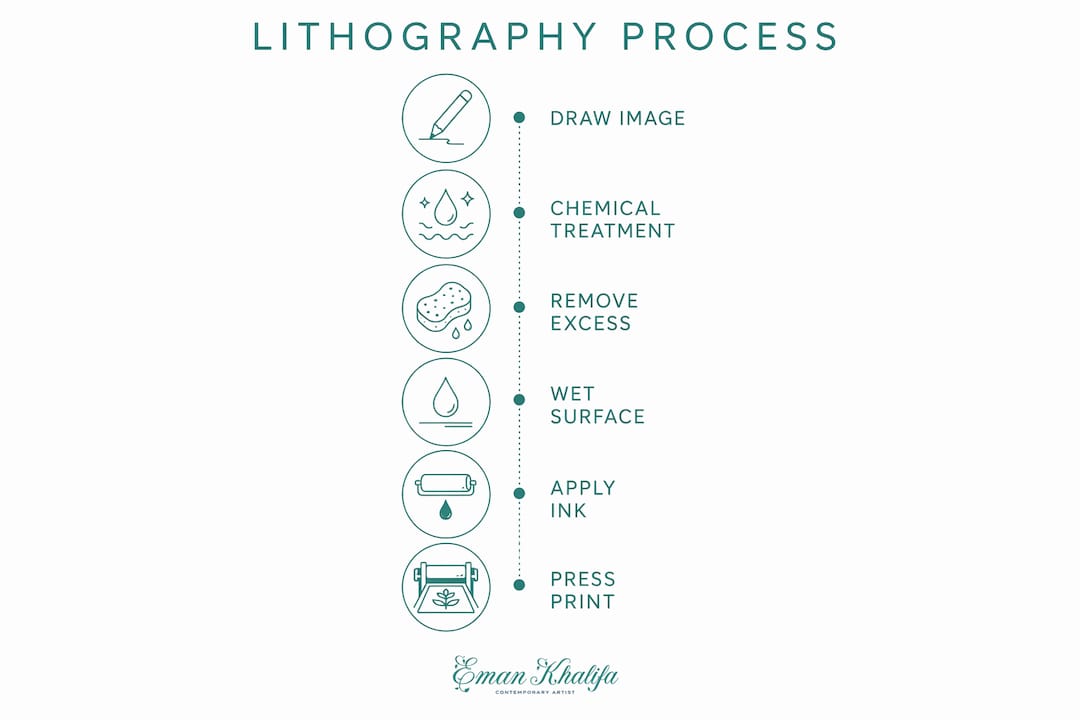
Step 1: Draw the image
The artist draws directly onto a polished limestone slab or a prepared zinc or aluminum plate using an oil-based lithographic crayon or liquid tusche. Every mark made here will eventually print, so the drawing stage is where the artistic decisions are made. The greasy medium bonds to the stone’s surface at a molecular level.
Step 2: Apply the chemical treatment
Once the drawing is complete, the surface receives a solution of gum arabic and mild acid. This treatment fixes the greasy image and creates a hydrophilic (water-attracting) layer over all non-image areas. The acid used is typically nitric acid, which reacts with the limestone to form calcium nitrate salts that permanently seal the blank areas against ink.
Step 3: Remove excess drawing material
The printer uses lithographic turpentine to wash away the visible drawing material. What remains is an invisible hydrophobic (water-repelling) molecular film on the image areas, bonded tightly to the stone. The non-image areas, sealed with gum arabic, remain hydrophilic.
Step 4: Wet the surface
Before inking, the stone is kept thoroughly wet with water. The water adheres to the gum-treated areas and is repelled by the oily image areas. This is the oil-water repulsion principle in action, and it is what makes the entire process work without any physical relief or recess in the surface.
Step 5: Roll on the ink
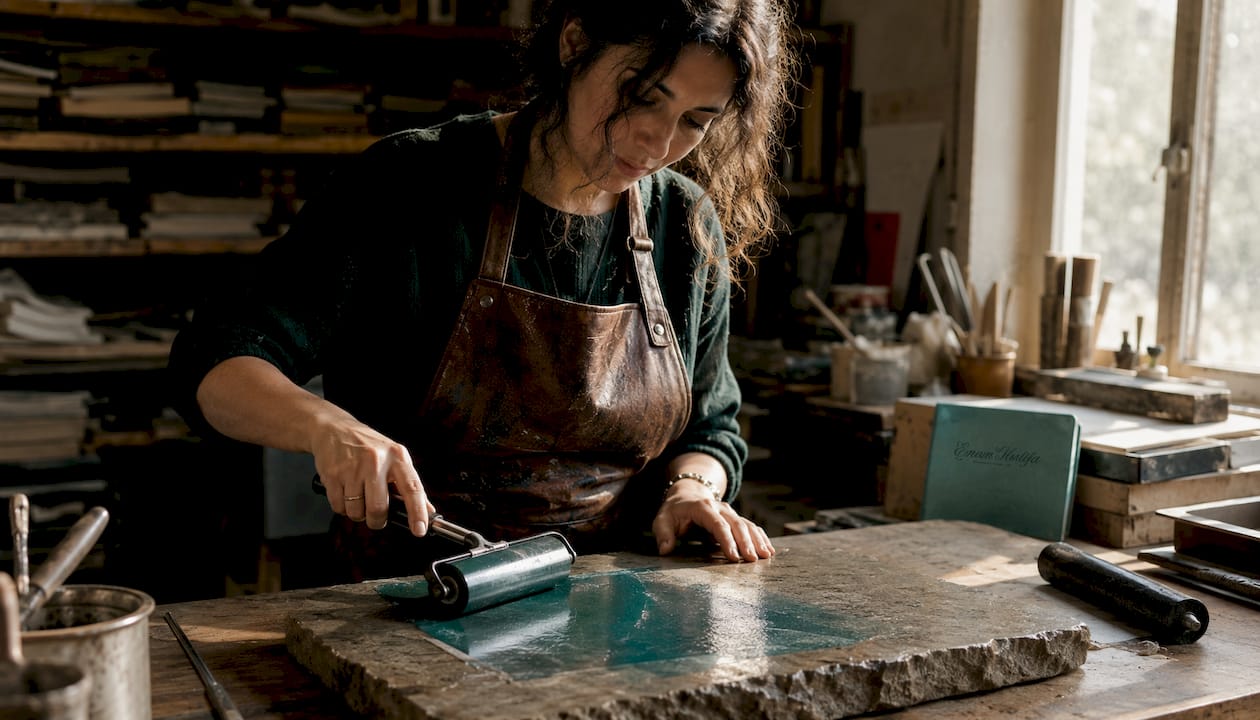
Oil-based printing ink, typically made with linseed oil and pigment, is rolled across the wet surface. The ink adheres to the hydrophobic image areas and is repelled by the water-covered non-image areas. The result is a perfectly inked image on an otherwise clean surface.
Step 6: Press and transfer
Paper is placed over the inked stone, and both are run through a lithographic press that applies even, consistent pressure. The ink transfers from the stone to the paper, producing the print. The stone can then be re-wetted and re-inked to produce additional prints in the edition.
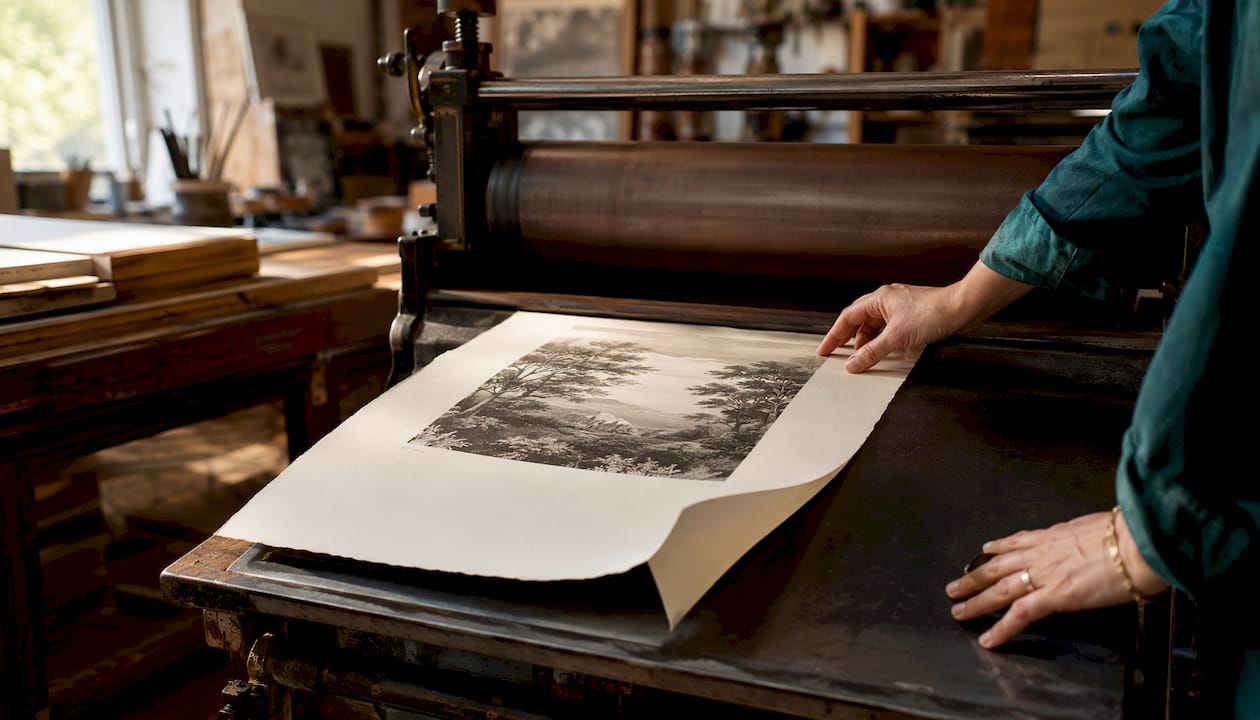
Pro Tip: Dampening the paper slightly before printing improves ink transfer and reduces the pressure needed, which protects fine details and extends the life of the stone. Professional printmakers at workshops like the Tamarind Institute use this technique routinely.
Color lithography: how multiple stones build a full image
Color lithographs require a separate stone or plate for each color in the composition. Artists use multiple stones, printing each color layer successively onto the same sheet of paper. A print with six colors requires six separate stones, six separate inkings, and six passes through the press.
Key technical and aesthetic aspects of color lithography:
- Registration: Each stone must align precisely with the others so colors fall in the correct position. Even a fraction of a millimeter of misalignment creates visible color fringing.
- Color sequence: Printers typically work from light to dark, building depth gradually across the layers.
- Ink transparency: Lithographic inks can be mixed to varying degrees of opacity, allowing colors to overlap and create new tones where they interact.
- Painterly quality: Because each color layer is drawn by hand, color lithographs retain the texture and gesture of the artist’s mark, producing a richness that photographic reproduction cannot match.
- Stone preparation: Each stone must be re-grained (resurfaced) between editions to remove the previous image, making the process labor-intensive.
The painterly qualities of lithography make it one of the most faithful means of translating a drawn image into print, a quality that has kept it relevant for fine art even as commercial printing moved to photographic methods.
How to identify an authentic lithograph print
Authentic lithographs carry specific physical characteristics that distinguish them from photographic reproductions or digitally printed copies. Collectors look for hand-drawn marks, artist signatures, limited edition numbers, and quality paper as primary indicators.
Signs of an original lithograph:
- Artist’s signature: Usually signed in pencil below the image, outside the printed area. A printed signature within the image is a reproduction warning sign.
- Edition number: Written as a fraction (e.g., 12/50), indicating this print is number 12 from an edition of 50. Lower edition numbers are not inherently more valuable, but the total edition size matters.
- Plate tone: Original lithographs often show a faint overall tone from the stone or plate surface, visible in areas meant to be white.
- Ink texture: Under magnification, lithographic ink sits on the paper surface with a slight texture rather than the perfectly flat dot pattern of offset printing.
- Paper quality: Fine art lithographs are typically printed on acid-free, rag-content papers such as Arches or Rives BFK, which have a distinct feel and surface.
- Proof markings: Terms like “A.P.” (artist’s proof) or “H.C.” (hors commerce) indicate prints outside the main numbered edition.- Registration marks: Small crosses or marks in the margins indicate multi-color printing alignment, a sign of hand-produced color work.
Pro Tip: Hold the print at a raking angle under a single light source. An original lithograph will show slight ink relief and surface variation. A photomechanical reproduction will look uniformly flat, and under a loupe you will see a regular halftone dot pattern rather than continuous drawn marks.
How lithographs differ from other types of prints
Lithography’s planographic method prints from a flat surface, which sets it apart from every other major printmaking category. The differences affect not just process but the visual character of the finished print.
| Print type | Surface | Ink placement | Key visual quality | Artist’s mark |
|---|---|---|---|---|
| Lithograph | Flat stone or metal | Adheres chemically | Painterly, gestural | Direct drawn marks |
| Etching (intaglio) | Recessed grooves in metal | Fills recesses | Fine lines, plate tone | Scratched or acid-bitten |
| Woodcut (relief) | Raised wood surface | Sits on raised areas | Bold, graphic | Carved marks |
| Screen print | Mesh stencil | Pushed through mesh | Flat color areas | Photographic or hand-cut |
| Digital print | No physical matrix | Inkjet or laser | Photographic precision | No physical matrix |
Lithography’s main advantage over intaglio methods like etching is freedom. The artist draws on the stone exactly as they would draw on paper, with no need to think in reverse or account for how acid will bite a line. Compared to woodcut, lithography handles tonal gradations and fine detail far more naturally. Against screen printing, it preserves the spontaneity of the artist’s hand rather than reducing the image to flat color separations.
The limitation is physical: limestone is heavy, fragile, and finite. Metal plates are more practical but require careful preparation to match stone’s natural porosity. Neither ages as gracefully as a copper etching plate, which can produce prints for centuries.
Artistic lithographs versus commercial lithography and photolithography
The word “lithography” covers three distinct processes that share a name but little else. Understanding the differences matters for anyone appraising, collecting, or discussing prints.
Original fine art lithographs are works where the artist draws directly on the printing surface. The artist’s direct creation of the image on the stone or plate is what qualifies these prints as original works of art, not reproductions. Each print in a limited edition is considered an original, not a copy of a painting or drawing made elsewhere.
Commercial offset lithography uses photographic methods to transfer an image onto a printing plate, then prints via an intermediate rubber blanket rather than directly from stone. Offset printing produces mass-market images without any artist’s hand involved in the plate-making stage. A poster printed in an edition of 50,000 by offset is not a lithograph in the fine art sense, even if the process shares the same chemical principle.
Photolithography in semiconductor manufacturing is a separate industrial technology entirely. It uses light to project circuit patterns onto silicon wafers coated with photosensitive material, enabling the manufacture of microchips. The name shares Greek roots with printmaking lithography (lithos, stone; grapho, to write), but the two processes have no practical overlap.
Distinctions at a glance:
- Fine art lithograph: Artist draws directly on stone or plate; limited edition; considered original artwork
- Commercial offset lithography: Photographic plate-making; mass production; no artist’s hand in matrix creation
- Photolithography: Light-based pattern transfer onto silicon; microchip manufacturing; industrial process
Collectors, curators, and appraisers consistently treat these as separate categories. A fine art lithograph by a recognized artist carries provenance, edition documentation, and market value tied to the artist’s direct involvement. A commercially printed poster does not, regardless of how it was produced.
Eman Khalifa’s work at Emansgallery reflects this distinction directly. Her original paintings and museum-quality canvas prints are produced with the same attention to the artist’s hand and material quality that defines fine art printmaking. For readers interested in collecting original works, the guide to choosing collectible prints at Emansgallery covers the key criteria in detail.
Key Takeaways
Lithography is a planographic printing process where oil and water repulsion on a flat stone or metal surface allows artists to create original, hand-drawn prints with painterly precision.
| Point | Details |
|---|---|
| Chemical principle | Oil-based drawing medium repels water, allowing ink to adhere only to image areas on a flat surface. |
| Inventor and date | Alois Senefelder invented lithography in 1796 in Bavaria, initially for printing music scores and maps. |
| Color lithography | Each color requires a separate stone or plate, printed successively with precise registration. |
| Identifying originals | Look for pencil signatures, edition numbers, plate tone, and rag-content paper as signs of an authentic print. |
| Three types of “lithography” | Fine art lithographs, commercial offset printing, and semiconductor photolithography share a name but are distinct processes. |
FAQ
What is a lithograph vs. a print?
A lithograph is a specific type of print made using the planographic lithography process, where the image is drawn with a greasy medium on a flat stone or metal plate. The broader term “print” covers all printmaking methods, including etching, woodcut, screen printing, and digital output.
Is a lithograph considered an original?
Yes, in fine art terms. Because the artist draws directly on the printing surface, each print in a limited edition is considered an original work of art, not a reproduction of something made elsewhere.
What is the purpose of a lithograph?
Lithography allows artists to create multiple original prints from a single hand-drawn image, combining the directness of drawing with the ability to produce a controlled edition. It has been used for fine art, posters, maps, and illustrated publications since 1796.
Is a lithograph worth money?
Value depends on the artist, edition size, condition, and provenance. A signed, numbered lithograph by a recognized artist in a small edition can carry significant market value. Mass-produced commercial prints labeled as lithographs without artist involvement are worth considerably less.
How does lithography differ from etching?
Lithography prints from a flat surface using chemical oil-water repulsion, while etching is an intaglio process where ink fills recessed grooves acid-bitten into a metal plate. Lithography preserves the artist’s drawn gesture more directly; etching produces finer lines and a characteristic plate tone.
Stay Connected
- ✨ Explore Eman Khalifa's original art, fine art prints and art-inspired merchandise.
- Follow Eman Khalifa's art journey on: Instagram @emans_gallery and Facebook
- Watch Eman Khalifa creating live art on: YouTube @emans_gallery
