


History Artwork: A Complete Guide to Art Through the Ages
TL;DR:
- History artwork documents human civilization from prehistoric cave paintings to modern abstraction. Art history organizes these works into periods and movements, revealing societal values and beliefs. Eastern traditions significantly influenced Western art, creating a global, interconnected narrative that reflects cultural and technological shifts.
History artwork is the visual record of human civilization, spanning from prehistoric cave paintings to contemporary abstraction, and every major cultural shift in between. Art history, the formal academic discipline, organizes these works into periods, movements, and genres to reveal how societies expressed their values, beliefs, and experiences. The Renaissance gave the world Michelangelo’s Sistine Chapel ceiling. Ancient Sulawesi gave us figurative cave paintings over 43,900 years old. Understanding this timeline is not just an academic exercise. It is the clearest window into who we were, and who we are becoming.
What is history painting and its role in art history?
History painting is a formal academic genre defined by multi-figure narrative scenes drawn from mythology, religion, and documented historical events. It is distinct from the broader concept of art history. History painting depicts stories intended to inspire moral qualities in the viewer, typically scenes from Greek and Roman mythology or the Bible. The genre ranked at the top of the academic hierarchy in European art academies from the 16th through the 19th centuries.
The subjects of history painting were chosen deliberately. Artists depicted the Judgment of Paris, the Crucifixion, or the Battle of Marathon not simply as illustrations but as vehicles for civic and spiritual instruction. Works like Jacques-Louis David’s Oath of the Horatii (1784) used Roman history to argue for patriotism and sacrifice during a politically charged era in France. The genre shaped how art academies taught composition, figure drawing, and color theory for centuries.
Key characteristics of history painting include:
- Multi-figure compositions with clearly defined narrative action
- Elevated subject matter drawn from mythology, scripture, or documented history
- Moral or didactic purpose, intended to instruct as well as impress
- Large scale, designed for public display in palaces, churches, and civic buildings
- Idealized human figures, following Classical Greek and Roman standards of beauty
Pro Tip: When studying a history painting, identify the literary or historical source first. Knowing the original story reveals layers of symbolism that are invisible without context.
How has artwork evolved through major historical periods and movements?
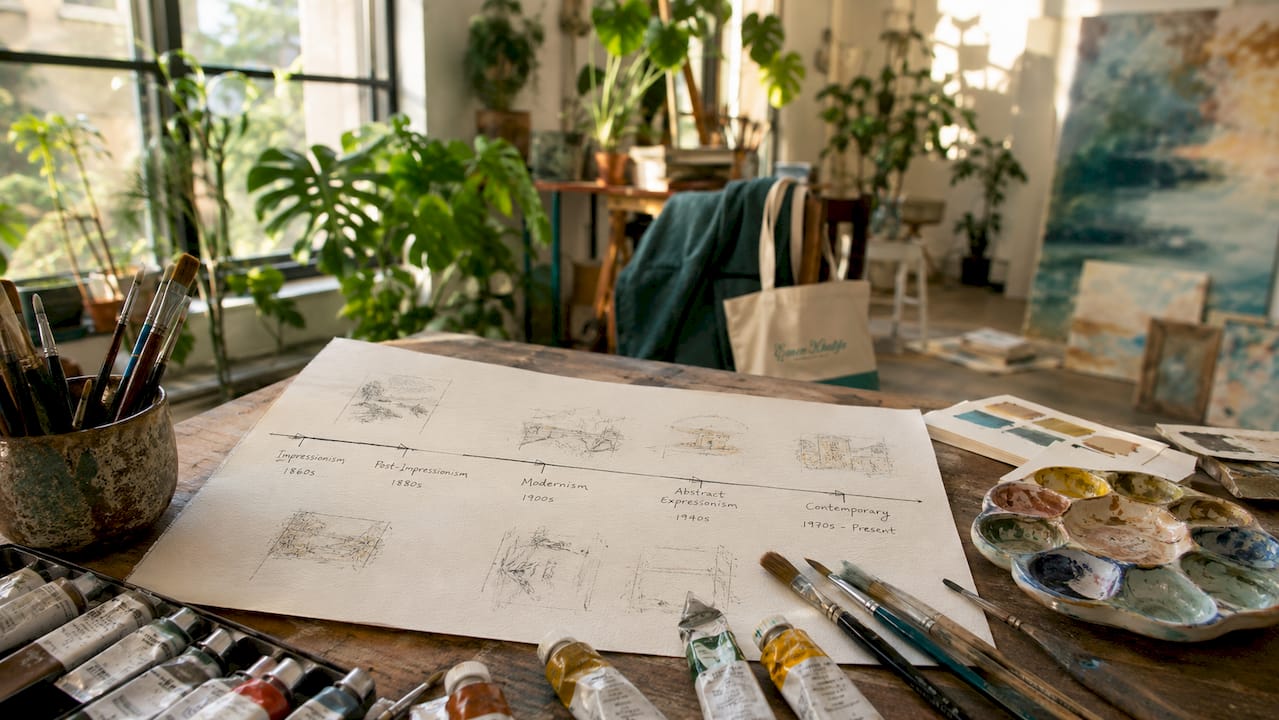
Art does not change randomly. Art movements are defined by specific goals pursued by groups of artists during defined periods, often as direct responses to the styles that came before. Movements can last months or decades. Modern art movements are characterized by rapid, consecutive shifts in style and ideology. That acceleration reflects the pace of social and technological change from the 19th century onward.
The art history timeline moves through distinct eras, each with its own visual logic and cultural purpose.
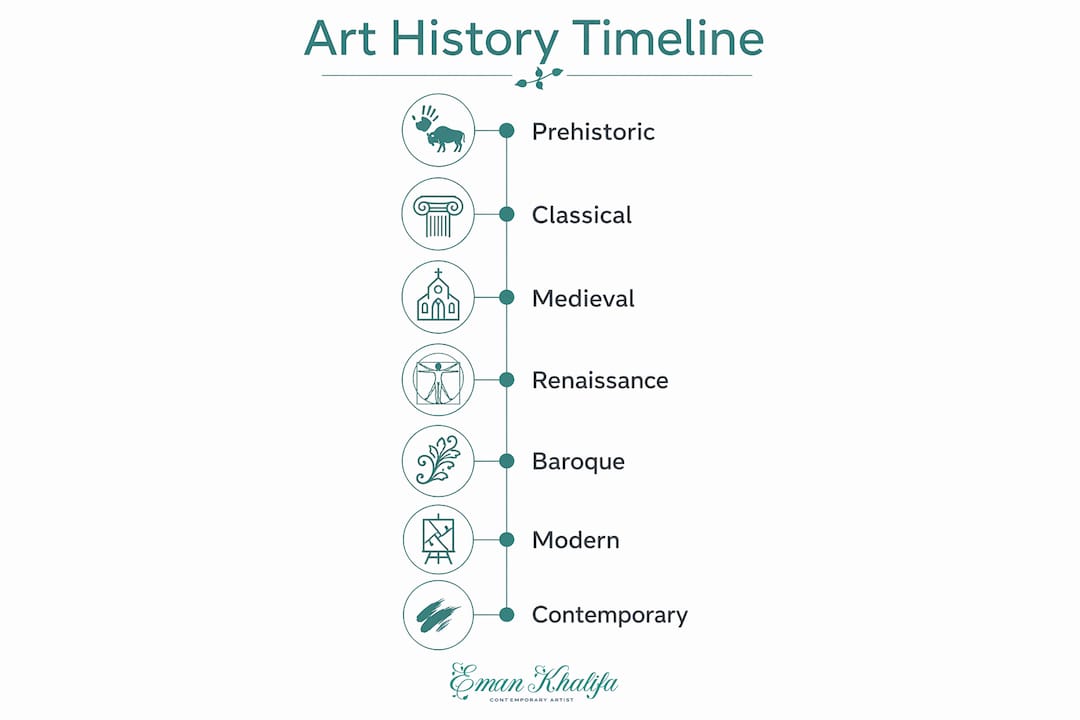
| Period | Approximate dates | Key characteristics |
|---|---|---|
| Prehistoric | Before 3000 BCE | Cave paintings, symbolic marks, animal figures |
| Classical Greek and Roman | 500 BCE–400 CE | Idealized human form, mythology, civic themes |
| Medieval | 400–1400 CE | Religious iconography, flat perspective, gold leaf |
| Renaissance | 1400–1600 CE | Perspective, humanism, naturalism, religious and mythological subjects |
| Baroque | 1600–1750 CE | Drama, chiaroscuro, emotional intensity |
| Romanticism | 1780–1850 CE | Emotion, nature, individualism, nationalism |
| Impressionism | 1860–1900 CE | Light, color, everyday life, loose brushwork |
| Modernism | 1900–1970 CE | Abstraction, experimentation, rejection of tradition |
| Contemporary | 1970–present | Conceptual, digital, global, interdisciplinary |
Each shift in this timeline reflects a change in what artists believed art was for. Medieval painters served the Church. Renaissance artists served humanist ideals. Impressionists served their own perception of light and sensation. That progression is not a straight line toward improvement. It is a series of arguments about what matters most.
Pro Tip: Study the famous art styles that define each period before memorizing individual artists. Understanding the movement gives individual works their full meaning.
What are the most famous historical artworks and what makes them iconic?
Famous historical artworks earn their status through a combination of artistic achievement, historical circumstance, and cultural repetition. The Mona Lisa is the clearest example. Leonardo da Vinci painted it between approximately 1503 and 1519. Its fame accelerated dramatically in the 20th century after its 1911 theft from the Louvre. The Mona Lisa was reproduced in 300 paintings and 2,000 advertisements following that event. Theft turned a masterpiece into a global phenomenon.
Michelangelo’s Sistine Chapel ceiling operates on a different scale entirely. The fresco, painted between 1508 and 1512, covers over 500 square meters and contains more than 300 figures. It presents nine episodes from Genesis alongside prophets and sibyls in a unified theological program. No single image captures it fully. The ceiling rewards repeated study across a lifetime.
Other works that define the art history timeline include:
- The cave paintings of Sulawesi, Indonesia, dated to over 43,900 years ago, showing pig hunting scenes with compositional sophistication
- The Venus de Milo (c. 100 BCE), representing Classical Greek ideals of beauty and proportion
- Raphael’s School of Athens (1509–1511), placing ancient philosophers in a Renaissance architectural setting
- Rembrandt’s The Night Watch (1642), redefining group portraiture through dramatic light and movement
- Vincent van Gogh’s The Starry Night (1889), translating emotional experience into swirling color and form
What these works share is not just technical skill. Each one captured a cultural moment so precisely that it became the symbol of that moment for future generations. Reproduction and education then locked that status in place.
How do Eastern and non-Western art traditions contribute to the history of artwork?
Eastern art traditions developed parallel to Western movements, often earlier, and with distinct visual languages that Western artists eventually borrowed from. Chinese painting moved from ornamental to representational art during the Warring States period (475–221 BCE), predating the European Renaissance by nearly two millennia. Japanese ukiyo-e woodblock prints directly influenced French Impressionist painters in the 19th century. That exchange was not incidental. It reshaped how Western artists thought about composition, flat color, and cropping.
The major Eastern traditions each carry their own formal logic:
- Chinese ink painting prioritizes brushwork, negative space, and the expression of inner spirit over literal representation. The concept of qi yun (spirit resonance) guided painters for over a thousand years.
- Japanese scroll painting and ukiyo-e use sequential narrative and decorative flatness, influencing artists from Edgar Degas to Henri de Toulouse-Lautrec.
- Korean celadon and court painting combine Confucian restraint with precise naturalistic detail, particularly in bird-and-flower compositions.
- Indian miniature painting, developed under Mughal and Rajput patronage, blends Persian technique with Hindu iconography to create densely layered narrative images.
- Islamic geometric art and calligraphy treat the written word and mathematical pattern as the highest visual expression, producing works of extraordinary precision across architecture, textiles, and manuscripts.
Eastern painting developments generally predate or parallel Western movements, with mutual influences flowing across continents through trade, conquest, and scholarship. Recognizing this corrects a persistent bias in standard art history curricula, which still tend to treat European movements as the primary narrative.
How do art movements reflect cultural, technological, and philosophical changes?
Art movements are not stylistic accidents. Impressionism and Cubism responded directly to 19th- and 20th-century societal shifts, redefining visual representation in the process. Impressionism emerged when photography freed painters from the obligation to document reality accurately. Cubism arrived when Einstein’s theory of relativity and Freudian psychology challenged the idea of a single, fixed perspective on anything.
The connections between art and its cultural moment are direct and traceable:
- Impressionism (1860s–1880s) responded to industrialization and urban life. Painters moved outdoors, capturing fleeting light and modern leisure rather than timeless allegory.
- Expressionism (1900s–1930s) reflected psychological anxiety and the trauma of World War I. Artists distorted form and color to externalize inner states.
- Cubism (1907–1920s) broke objects into simultaneous viewpoints, mirroring a world where fixed certainties were collapsing in science and politics alike.
- Abstract Expressionism (1940s–1950s) emerged from the aftermath of World War II and the existential questions it raised about meaning, identity, and human capacity for destruction.
- Conceptual art (1960s–present) shifted the focus from the art object to the idea behind it, reflecting postmodern skepticism about the authority of any single interpretation.
Art functions as cultural rebellion as much as cultural celebration. Every avant-garde movement defined itself against what came before. Understanding that dynamic makes the history of artistic styles readable as an argument, not just a sequence.
Pro Tip: When you encounter an unfamiliar art movement, ask what it was reacting against. The answer almost always explains the style. You can explore art prints through history to see how these movements translate into collectible works.
Key Takeaways
History artwork is best understood as a continuous global conversation between cultures, technologies, and ideas, not as a linear European progression.
| Point | Details |
|---|---|
| History painting is a formal genre | It depicts narrative scenes from mythology, religion, and history to convey moral ideals, distinct from art history as a discipline. |
| Art movements respond to society | Impressionism, Cubism, and Expressionism each emerged as direct responses to scientific, political, and philosophical shifts. |
| Famous works gain status through events | The Mona Lisa’s global fame accelerated after its 1911 theft, showing how cultural narrative shapes an artwork’s reputation. |
| Eastern traditions predate Western ones | Chinese representational painting predates the European Renaissance by nearly 2,000 years, and Japanese ukiyo-e reshaped Impressionism. |
| Cave art proves early human sophistication | Figurative paintings in Sulawesi dated to over 43,900 years ago show complex storytelling capacity far earlier than once assumed. |
Why I think most people miss the point of art history
Most people approach art history as a list of names and dates to memorize. That approach misses everything that makes it worth studying. What I find genuinely surprising, after years of working with historical styles and contemporary painting, is how personal the connection between an artist and their historical moment always is. Michelangelo did not paint the Sistine Chapel ceiling as a monument. He painted it under pressure, on commission, in a medium he initially resisted. The result is monumental precisely because the constraints were real.
The same applies to lesser-known works. A 17th-century Dutch still-life painting of a half-peeled lemon is not just a technical exercise. It is a meditation on transience, wealth, and the limits of material pleasure, painted for a merchant class that understood those tensions intimately. You do not need a museum label to feel that. You need context.
Cross-cultural dialogue in art is where things get genuinely interesting. Japanese woodblock prints changed how French painters thought about space. African masks changed how Picasso thought about form. These were not borrowings. They were collisions that produced something new. Art history is most alive when you trace those collisions rather than treating each tradition as a sealed category.
My advice: spend as much time with unfamiliar traditions as with canonical Western works. The art history timeline is not a single road. It is a network of paths that intersect in unexpected places.
— Eman
Original art that connects you to art history
Emansgallery brings the depth of historical art movements into contemporary, original work. Artist Eman Khalifa draws on traditions from Tonalism to fluid abstraction, producing paintings and prints that carry the weight of art history in a modern visual language.
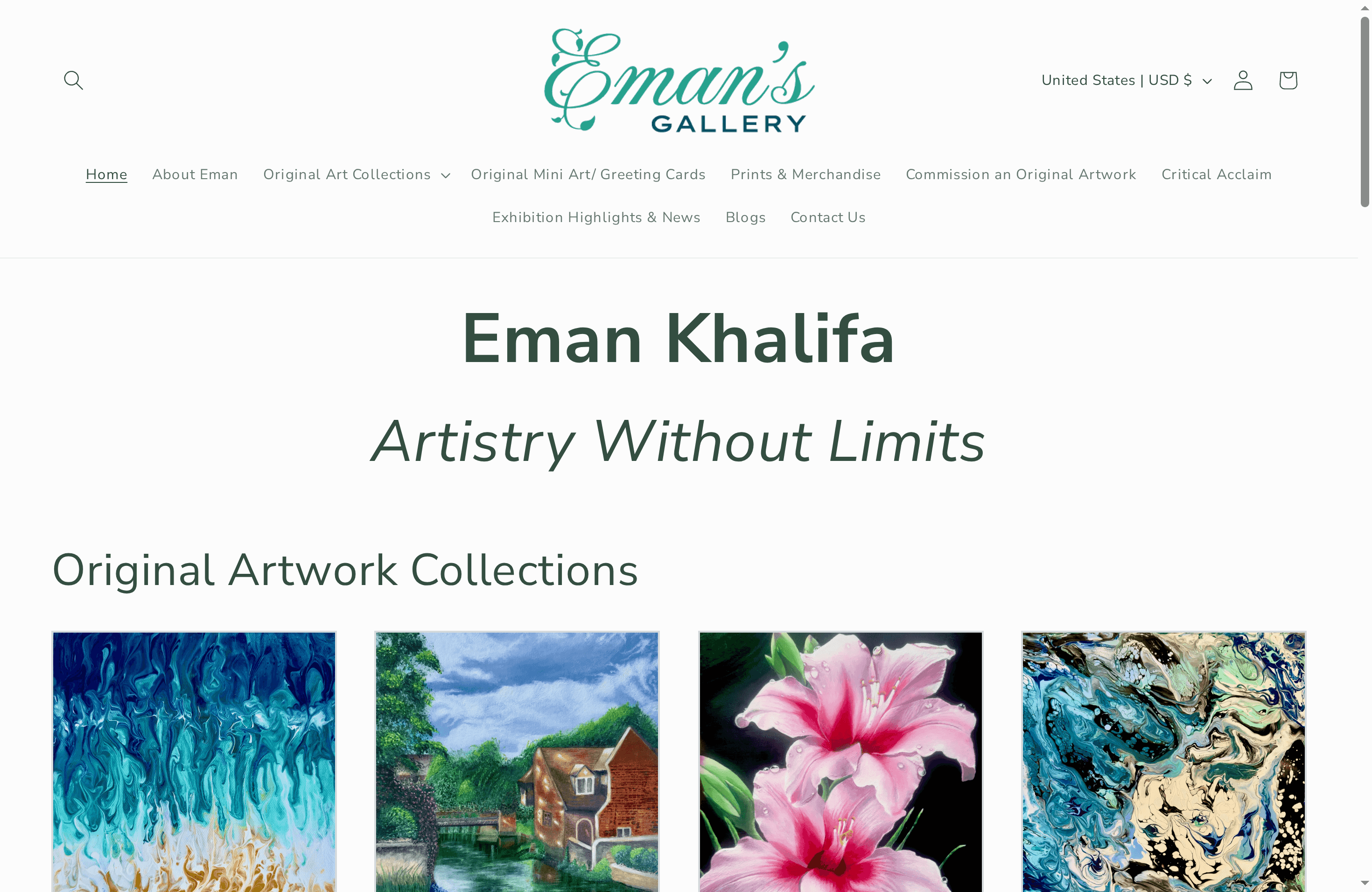
Collectors and art enthusiasts can explore pieces like the Nocturned original painting, a Tonalism-inspired moonlit scene that echoes the atmospheric depth of 19th-century landscape traditions, or the Good Tidings original, a fluid blue and gold ocean work that reflects the expressive freedom of modern abstraction. Each piece ships worldwide from the UK, USA, Canada, Australia, and beyond. For art enthusiasts who want to live with history on their walls, Emansgallery offers original paintings, museum-quality canvas prints, and art-inspired merchandise at artfuzz.com for additional print options.
FAQ
What is history artwork?
History artwork refers to visual works created throughout human civilization that reflect the cultural, social, and historical contexts of their time. The term covers everything from prehistoric cave paintings to Renaissance masterpieces and contemporary abstraction.
What is the difference between history painting and art history?
History painting is a specific academic genre depicting narrative scenes from mythology, religion, and historical events. Art history is the broader scholarly discipline that studies all visual art across time and cultures.
What are the oldest known examples of history artwork?
Figurative cave paintings discovered in Sulawesi, Indonesia, date to over 43,900 years ago, making them the oldest known examples of narrative storytelling in visual art.
How did Eastern art traditions influence Western art history?
Japanese ukiyo-e woodblock prints directly influenced French Impressionist painters in the 19th century, reshaping Western approaches to composition, flat color, and cropping. Chinese and Indian traditions also contributed distinct techniques and philosophies that enriched global art history.
Why is the Mona Lisa considered the most famous painting in history?
The Mona Lisa’s global fame grew significantly after its 1911 theft and recovery, which triggered mass reproduction across paintings and advertisements. That cultural exposure, combined with Leonardo da Vinci’s technical mastery, cemented its status as the world’s most recognized artwork.
Stay Connected
- ✨ Explore Eman Khalifa's original art, fine art prints and art-inspired merchandise.
- Follow Eman Khalifa's art journey on: Instagram @emans_gallery and Facebook
- Watch Eman Khalifa creating live art on: YouTube @emans_gallery
