


Examples of Modern Painting: A Collector's Guide
An example of modern painting is any work where color, form, and the canvas itself carry expressive weight rather than reproduce external reality. That shift, from depicting the world to describing internal states, defines Modernism as a movement and still shapes how collectors and designers evaluate paintings today. Quick reference examples:
- Abstract Expressionism: Jackson Pollock’s drip paintings, where gesture and material are the subject
- Color Field: Mark Rothko’s luminous rectangles, built to produce emotional states at scale
- Cubism: Pablo Picasso’s fractured planes, dismantling single-point perspective
- Non-objective abstraction: Wassily Kandinsky’s compositions, using color as pure feeling
- Geometric abstraction: Piet Mondrian’s grid-based De Stijl works
- Pop Art: Andy Warhol’s Campbell’s Soup Cans, blurring hand-made and mass-produced
- Contemporary extension: Olafur Eliasson’s light-responsive works, carrying modern concerns into experiential practice
Emansgallery offers original paintings and prints applying these same principles for collectors and interior designers sourcing work today.
Table of Contents
- What does “modern painting” actually mean?
- Named works and styles that define modern art painting
- How modern paintings work in interior spaces
- How to tell originals from reproductions
- Provenance and authentication: a buyer’s checklist
- Where to find and buy modern paintings
- Eman Khalifa and Emansgallery: modern principles in original work
- Key Takeaways
- Why modern painting still matters for contemporary interiors
- Original modern paintings and prints from Emansgallery
- FAQ
What does “modern painting” actually mean?
Modern art refers to work produced roughly from the 1860s through the 1970s. Contemporary art covers the 1970s to the present. Collectors often conflate the two terms, which matters for valuation, provenance expectations, and display planning.
“The Starry Night announces itself as color and paint — a canvas that is an object in its own right, not a window onto the world. Modern painting shifted from depicting external reality to describing internal states through color and material.” — MoMA collection notes
When someone searches for an example of modern painting, they usually want one of two things: canonical historical works (Pollock, Rothko, Picasso) or present-day paintings that carry the same visual language. Both are valid. The table below locates the key phases.
| Movement | Approximate Dates | Significance |
|---|---|---|
| Impressionism | 1860s–1870s | Broke from academic realism; prioritized light and perception |
| Post-Impressionism | 1880s–1900s | Introduced personal expression and symbolic color (Van Gogh, Cézanne) |
| Fauvism | 1905–1907 | Color used independently of natural appearance |
| Cubism | 1907–1920s | Fractured perspective; multiple viewpoints simultaneously |
| Abstract Expressionism | 1940s–1950s | Gesture, scale, and material as primary content |
| Color Field | 1950s–1960s | Large areas of flat color to produce psychological effect |
| Pop Art | 1960s–1970s | Mass imagery and consumer culture as subject matter |
Named works and styles that define modern art painting
The Art Institute of Chicago’s modern collection covers nearly 700 works across all major European movements, 1900–1950, and provides a reliable visual reference for each style below.
- Jackson Pollock, One: Number 31, 1950: Oil and enamel on canvas. Look for the absence of a focal point; the entire surface is the composition. Pollock stood over the canvas and dripped diluted paint, making movement and material the subject. MoMA holds the work and documents the technique in detail.
- Mark Rothko, Orange, Red, Yellow (1961): Soft-edged color rectangles at large scale. Rothko recommended viewers stand close enough for the color field to fill peripheral vision, producing the intimacy he described as the work’s purpose.
- Pablo Picasso, The Old Guitarist (late 1903–early 1904): Held at the Art Institute of Chicago. Fractured planes and compressed space; a direct example of how Cubism dismantled Renaissance perspective.
- Wassily Kandinsky, Improvisation No. 30 (Cannons) (1913): Also at the Art Institute. Color and line used as pure expression, with no requirement for representational content.
- Piet Mondrian, Lozenge Composition with Yellow, Black, Blue, Red, and Gray (1921): Primary colors and black grid lines. De Stijl reduced painting to its structural minimum.
- Andy Warhol, Campbell’s Soup Cans (1962): Hand-painted to mimic mass production. The MoMA notes confirm each canvas was individually painted, making the “hand of the artist” central even in a work designed to look mechanical.
Bridge to contemporary practice: Olafur Eliasson’s Your iridescence (2025) uses glass spheres that shift color with viewing angle and light, extending modernist concerns about perception into physical space. Cristina Iglesias’ Aurora Borealis Star Dome (2026) in Stockholm reshapes viewer experience through light and movement, a direct heir to Color Field’s preoccupation with atmosphere.
How modern paintings work in interior spaces
Scale and placement determine whether a modern painting reads as intended.
- Hanging height: Center the work at 57–60 inches from floor to center, the standard gallery sightline.
- Scale matching: Large Color Field works (Rothko-scale) need wall space with minimal competing objects. Smaller Cubist pieces tolerate denser arrangements.
- Lighting: Diffuse natural light reveals overall color relationships. Directional gallery lighting at 30 degrees from vertical picks out impasto texture and brushwork. Eliasson’s light-responsive works demonstrate how dramatically angle changes a surface’s perceived color.
- Color pairing: A Color Field painting with a neutral interior lets the work set the room’s emotional register. A Pop Art piece with flat, graphic color energizes a minimal palette.
- Furniture relationship: Allow breathing room; a painting’s edge should not align flush with furniture edges.
Pro Tip: Order a scaled print or use a digital mockup tool to confirm size and color on your actual wall before committing to a framed original. Color temperature in your space will read differently than it does on a screen or in a gallery.
How to tell originals from reproductions
Common supports and media in modern painting include oil on canvas, acrylic, mixed media, and encaustic. Surface cues matter: impasto (thick, raised paint) is visible under raking light; flat acrylic fields show no texture. Warhol’s process combined hand-stamping with screen printing, so even apparently mechanical works carry authenticated hand involvement that collectors prioritize.
Signature and edition conventions: Hand-signed originals carry the artist’s signature in paint or pencil, usually on the verso or lower edge. Numbered prints follow the format edition number/total edition size (e.g., 3/50), with a separate certificate of authenticity. Giclée prints on archival paper or canvas are high-resolution reproductions; museum-quality canvas prints use similar processes with UV-resistant inks.
Condition checklist: Craquelure (fine surface cracking) is normal in older oil paintings and does not always affect value. Varnish discoloration, loose stretching, and visible repairs do affect market comparables. A conservator’s report is worth requesting for any work above your personal price threshold.
Provenance and authentication: a buyer’s checklist
Authentication directly affects artwork price, and provenance documentation increases perceived value and collector confidence.
- Provenance chain: prior owners, purchase invoices, exhibition history
- Condition report from an independent conservator
- Signature verification against catalog raisonné entries for canonical artists
- Edition documentation for prints (certificate, edition number, publisher)
- Consistent medium and support with the artist’s known practice
Red flags: missing provenance for a high-value canonical work; signatures that vary from documented examples; edition numbers that exceed the stated print run; pricing that sits far below market comparables without explanation.
For works by major historical figures, consult the relevant catalog raisonné. For buying original paintings from living artists or galleries, request a direct provenance statement and, where possible, a video viewing.
Where to find and buy modern paintings
| Channel | Advantage | Consideration |
|---|---|---|
| Brick-and-mortar gallery | In-person viewing; established provenance | Geographic limit; higher overhead |
| Auction house | Market-tested pricing; documented history | Buyer’s premium; competitive bidding |
| Online gallery | Global reach; direct artist access | Requires verification steps |
| Artist studio | Lowest cost; direct provenance | Limited selection |
| Art fair | Concentrated selection; curator presence | Time-limited access |
Commissioning a site-specific or large-scale work typically follows this sequence: concept brief, reference images, artist sketch or digital mockup, client approval, production, and delivery.
Site-specific installations often require a site survey to confirm how light and viewer movement will interact with the finished piece. For standard commissions, allow 6–12 weeks from approval to delivery.
For online art buying, always request a high-resolution image of the actual work, a condition report, and provenance documentation before purchase. An online art showroom that provides full documentation and multiple viewing angles reduces the verification burden significantly.
Eman Khalifa and Emansgallery: modern principles in original work
Eman Khalifa is a London-based British-Egyptian-American contemporary artist whose practice applies the core concerns of modern painting, color as mood, atmospheric depth, and material handwork, to original canvases in oil, acrylic, and mixed media.
Representative works available through Emansgallery:
- Good Tidings: A fluid blue-gold abstract seascape. Color carries the emotional register; the surface shows visible layering and movement consistent with fluid art technique.
- Nocturned: A tonal moonlit landscape. Demonstrates how a restricted palette and atmospheric depth produce psychological presence, the same concerns that define Color Field and Tonalism.
- Mystic Sea: Large-scale abstract ocean work suited to statement walls in residential or commercial interiors.
Emansgallery documents provenance for all originals and offers framed and unframed options with worldwide shipping. Commissions are accepted. Press recognition includes FAD Magazine and Artlyst. The modern artwork buyer’s guide on the gallery’s site provides additional context for collectors evaluating style and scale.
Key Takeaways
Modern painting uses color, form, and material as expressive language rather than photographic depiction, a distinction that shapes every buying, display, and authentication decision a collector or designer makes.
| Point | Details |
|---|---|
| Modern vs. contemporary | Modern art spans roughly 1860s–1970s; contemporary art covers 1970s to present. The distinction affects valuation and provenance expectations. |
| Recognition cues | Look for abstraction, gestural brushwork, flat color fields, or fractured perspective rather than photographic likeness. |
| Authentication priority | Combine provenance documentation, a condition report, and signature verification before purchasing any significant original. |
| Display essentials | Hang at 57–60 inches center height; test scale with a print mockup before committing to a framed original. |
| Emansgallery | Offers original paintings, museum-quality prints, and commissions with full provenance documentation and worldwide shipping. |
Why modern painting still matters for contemporary interiors
Color and material are not decorative choices in a serious painting. They are the work’s content. A Rothko-scale field of warm ochre does something measurable to a room’s atmosphere; a Pollock-scale drip canvas changes how a space reads from across the room. That is not a stylistic preference. It is how these works were built to function.
What collectors and designers often underestimate is the difference between a work that references modern painting and one that actually applies its principles. Scale, surface, and the physical presence of paint matter. A canvas print of a Color Field painting is a useful reference tool. An original that carries the artist’s material decisions is a different object entirely.
Emansgallery accepts commissions and can provide scale mockups to support placement decisions. Contact the gallery directly for consultation.
Original modern paintings and prints from Emansgallery
Collectors and designers who want original works that apply modern painting principles, without the auction-house process or the institutional overhead, have a direct option through Emansgallery.
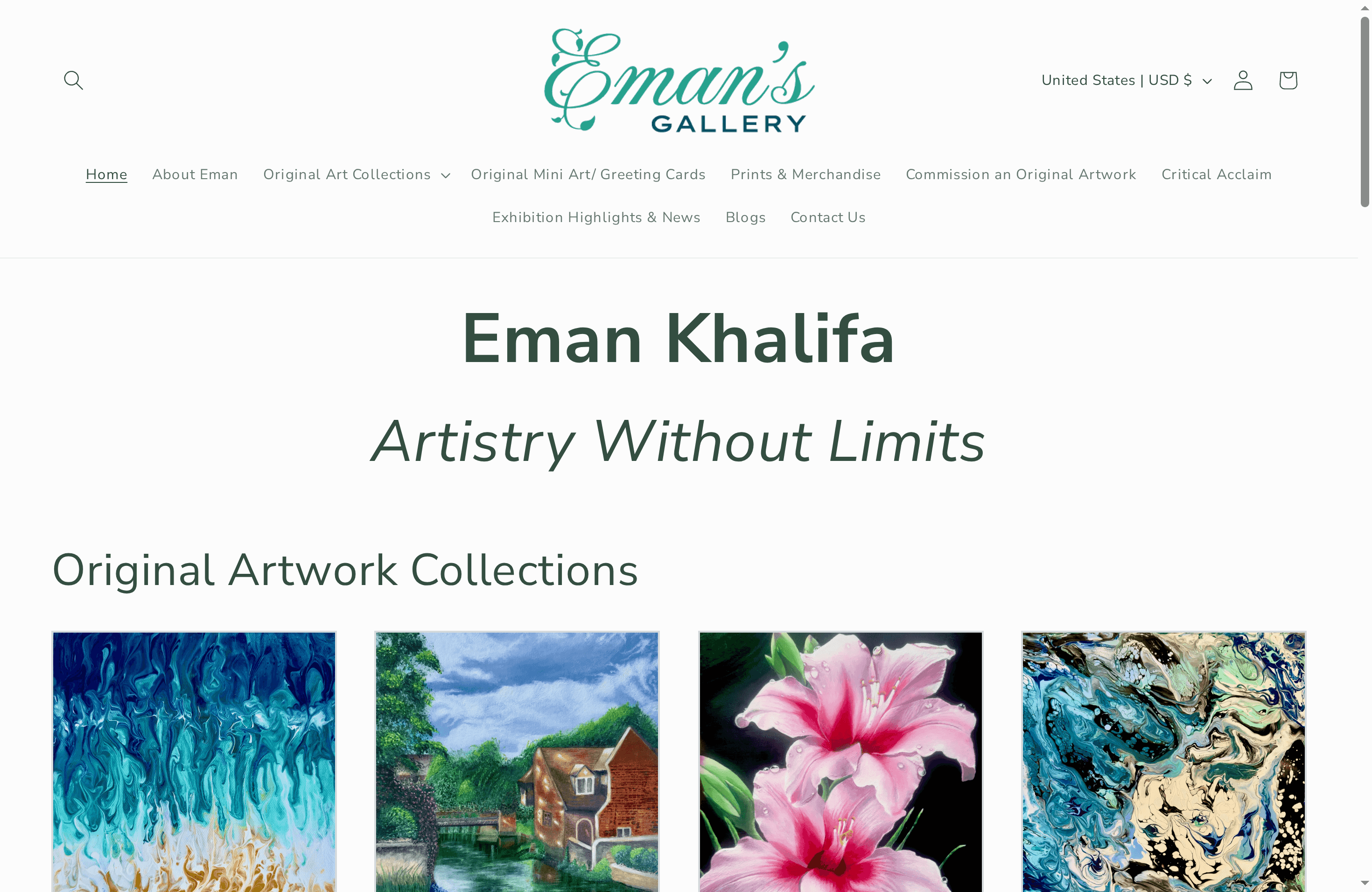
Eman Khalifa’s originals, including the fluid abstract seascape Good Tidings and the tonal nocturne Nocturned, are one-of-a-kind works with full provenance documentation. Museum-quality canvas prints, including geometric and expressionist options, are available at accessible price points. Art-inspired signature merchandise extends the same aesthetic into everyday objects. Worldwide shipping is available from fulfillment centers in the US, UK, and across Europe. To commission a site-specific or large-scale work, contact Emansgallery directly through the gallery website.
FAQ
What is a simple example of a modern painting?
Jackson Pollock’s One: Number 31, 1950 is a direct example: oil and enamel dripped onto canvas, where the gesture and material are the subject rather than any depicted scene. MoMA holds the work and documents the technique.
What is the difference between modern and contemporary painting?
Modern art refers to work produced roughly 1860s–1970s; contemporary art covers the 1970s to the present. The distinction affects valuation, provenance expectations, and how works are catalogued.
How do I verify a modern painting is authentic?
Combine provenance documentation (prior ownership, exhibition history, purchase invoices), an independent condition report, and signature verification against a catalog raisonné or gallery records. For significant purchases, a conservator’s assessment is standard practice.
Where can I buy original paintings in a modern style today?
Online galleries, artist studios, and art fairs all offer access. Emansgallery sells original handmade paintings with full provenance documentation and worldwide shipping, with commissioning available for custom or large-scale works.
How should I hang a modern painting in my home?
Center the work at 57–60 inches from floor to midpoint, the standard gallery sightline. Test scale with a print mockup before purchasing a framed original, and use directional lighting at roughly 30 degrees from vertical to reveal surface texture and brushwork.
Stay Connected
- ✨ Explore Eman Khalifa's original art, fine art prints and art-inspired merchandise.
- Follow Eman Khalifa's art journey on: Instagram @emans_gallery and Facebook
- Watch Eman Khalifa creating live art on: YouTube @emans_gallery
