


Abstract Painting Examples with Explanation: A Clear Guide
Abstract painting communicates through color, form, and composition rather than realistic depiction. The most instructive examples of abstract painting with explanation show how artists like Wassily Kandinsky, Mark Rothko, and Jackson Pollock translated raw emotion and philosophical ideas into visual language. This guide covers eleven landmark works and artists, explains what you are actually looking at, and gives you practical tools for interpreting any abstract canvas you encounter.
“Abstract art uses visual elements intentionally as vocabulary to express ideas and feelings that words cannot capture.” — Sozai Art Interpretation Guide
Table of Contents
- Famous abstract paintings explained: what you are really seeing
- How abstract art developed: key movements and milestones
- Artist profiles: the people behind the paintings
- How to interpret abstract paintings without getting stuck
- Eman Khalifa’s contemporary abstract art and what it demonstrates
- Original abstract art by Eman Khalifa, available now
- Key Takeaways
- FAQ
Famous abstract paintings explained: what you are really seeing
These examples span over a century of abstract art. Each one demonstrates a different approach to color, form, and meaning.
-
Wassily Kandinsky, “With the Black Arc” (1912). Red, blue, and violet color blocks clash against a black arc that symbolizes a Russian troika harness. Kandinsky believed color combinations could produce spiritual harmony the way musical chords do. The tension between the arc and the color fields is the point.
-
Piet Mondrian, “Grey Diamond” (c. 1919). Mondrian rotated his canvas 45 degrees and reduced his palette to grays and whites, leaving color almost entirely behind. The diamond-format grid at the Art Institute of Chicago shows his pursuit of universal order through pure geometric structure.
-
Joan Miró, “The Hunter (Catalan Landscape)” (1923–24). Miró flattened the Catalan countryside into biomorphic shapes, dots, and lines. The “hunter” is barely recognizable as a figure. Miró used this deliberate ambiguity to blur the line between dream and reality.
-
Jackson Pollock, “No. 5, 1948.” Pollock laid the canvas flat on the floor and dripped, poured, and flung paint across it. The all-over drip technique removed the artist’s wrist from the process, letting gravity and movement create a dense, non-hierarchical web of marks. The result captures raw physical energy.
-
Helen Frankenthaler, “Sky Above Clouds IV” (1965). Frankenthaler poured thinned paint directly onto unprimed canvas, letting it soak in and stain rather than sit on the surface. The large-scale work at the Art Institute of Chicago uses soft washes of color to suggest aerial space without depicting it literally.
-
Mark Rothko, “Orange and Yellow” (1956). Two luminous rectangles of color float on a dark ground. Rothko wanted viewers to stand close and feel absorbed. The National Gallery of Art describes his goal as provoking a direct emotional encounter, not aesthetic appreciation at arm’s length.
-
Gerhard Richter, “Abstract Painting (726)” (1990). Richter dragged a large squeegee across wet layers of paint, creating smeared, almost photographic passages of color. The process is partly controlled, partly accidental. Richter uses this tension to question whether painting can ever be purely abstract or purely objective.
-
Robert Motherwell, “Elegy to the Spanish Republic No. 70” (1961). Large black ovals press against vertical black bars on a white ground. The series, which Motherwell worked on for decades, memorializes the Spanish Civil War. The weight and repetition of the forms carry the grief.
-
Cy Twombly, “Untitled” (1970). Twombly covered canvas with looping, scrawled marks that resemble handwriting but say nothing legible. The Guggenheim’s collection includes several works in this vein. The gesture of writing, stripped of language, becomes the subject.
-
Christine Ay Tjoe, “White Discharge 3” (2012). Ay Tjoe layers dense, agitated marks that suggest biological forms, insects, or cellular structures. Her work sits at the edge of figuration and pure abstraction, using obsessive mark-making to externalize psychological states.
-
Eman Khalifa, “Good Tidings.” Khalifa pours fluid acrylic in blues and golds across canvas, letting the medium move and settle. The result reads as ocean surface, atmosphere, or pure sensation depending on the viewer. Her nature-inspired abstraction treats the painting process itself as a record of movement and light.
Pro Tip: Before reading a label or title, spend at least 30 seconds in quiet observation — noting shapes, colors, and your immediate physical reaction. That first unmediated response is often the most honest reading of an abstract work.
How abstract art developed: key movements and milestones
Abstract art did not appear suddenly. It emerged from a series of deliberate breaks with representation across roughly sixty years.
| Period | Movement | Key Characteristics |
|---|---|---|
| 1910–1919 | Spiritual Abstraction | Color and form as spiritual language (Kandinsky, Hilma af Klint) |
| 1917–1919 | De Stijl | Primary colors, right angles, universal order (Mondrian) |
| 1920s–1930s | Surrealist Abstraction | Biomorphic forms, automatism, dream imagery (Miró) |
| 1940s–1950s | Abstract Expressionism | Gestural mark-making, emotional directness (Pollock, Motherwell, Rothko) |
| 1950s–1960s | Color Field Painting | Large color areas, optical and emotional immersion (Frankenthaler, Rothko) |
| 1960s–present | Neo-Expressionism / Contemporary | Process-based, layered, questioning representation (Richter, Twombly, Ay Tjoe) |
The major milestones, in sequence:
- 1910: Kandinsky completes what many historians consider the first purely abstract watercolor, abandoning all reference to the visible world.
- 1915: Hilma af Klint paints “The Dove, No. 2,” combining Christian iconography, color theory, and spiritual symbolism guided by Theosophical ideas. Her work predates many canonical “firsts” of abstraction.
- 1917: Mondrian and Theo van Doesburg found De Stijl, publishing a manifesto for geometric reduction and universal harmony.
- 1943: The New York School emerges as European artists flee World War II and cross-pollinate with American painters, producing Abstract Expressionism.
- 1950s: Color Field painters shift focus from gesture to pure optical experience, with Frankenthaler’s staining technique opening a new direction.
- 1960s–1970s: Twombly and others dissolve the boundary between painting, drawing, and writing.
- 1980s–present: Artists like Richter, Ay Tjoe, and Khalifa continue expanding what abstraction can hold, including photography, digital process, and global cultural perspectives.
Artist profiles: the people behind the paintings
Understanding who made an abstract work, and why, changes what you see in it.
Wassily Kandinsky (1866–1944)
Kandinsky trained as a lawyer before turning to painting at 30. He developed a theory of color and form as spiritual forces, published in Concerning the Spiritual in Art (1911). His Guggenheim holdings include major works from his Bauhaus period. Kandinsky believed yellow was aggressive, blue was spiritual, and their combinations could affect the viewer the way a symphony does.

Piet Mondrian (1872–1944)
Mondrian moved from realistic Dutch landscapes to pure geometric abstraction over two decades. His De Stijl grid system reduced painting to horizontal and vertical lines, primary colors, and white. He saw this as a path to universal truth, not decoration.
Joan Miró (1893–1983)
Miró associated with the Surrealists but resisted their literary approach. He developed a personal visual language of signs, dots, and biomorphic forms that referenced the Catalan landscape and folk traditions. His Guggenheim works show the consistency of this private vocabulary across decades.
Jackson Pollock (1912–1956)
Pollock studied under Thomas Hart Benton and absorbed Jungian psychology before developing his drip technique around 1947. He worked on the floor, moving around the canvas, using the whole body. The method was as much performance as painting.
Helen Frankenthaler (1928–2011)
Frankenthaler’s staining technique, developed in 1952, influenced an entire generation of Color Field painters. She thinned her paint to watercolor consistency and worked on raw, unprimed canvas, creating works where color and support merge.
Mark Rothko (1903–1970)
Rothko rejected the label “abstract painter.” He wanted his color fields to carry specific emotions: tragedy, ecstasy, doom. He controlled gallery lighting carefully and preferred viewers to stand 18 inches from the canvas.
Gerhard Richter (born 1932)
Richter works across photorealism and abstraction, often within the same career phase. His squeegee abstractions use industrial tools to create surfaces that look almost digital. He treats the tension between control and accident as his primary subject.
Robert Motherwell (1915–1991)
Motherwell was the most intellectually articulate of the Abstract Expressionists. His “Elegy” series, running to over 100 paintings, demonstrates how a single formal motif can carry sustained emotional weight across decades of work.
Cy Twombly (1928–2011)
Twombly spent much of his career in Rome, absorbing classical history and Mediterranean light. His Guggenheim works show how he layered mythological references beneath surfaces of scrawled marks and smeared paint.
Christine Ay Tjoe (born 1973)
The Indonesian artist Ay Tjoe works with obsessive, small-scale marks that accumulate into large, charged fields. Her practice addresses psychological pressure, bodily experience, and the limits of control.
Eman Khalifa (contemporary)
London-based British-Egyptian-American artist Eman Khalifa works in oil, acrylic, and mixed media. Her fluid abstraction draws on seascapes, landscapes, and natural phenomena, using movement and light as primary subjects. Press coverage in FAD Magazine and Artlyst has noted her ability to hold atmosphere and psychological depth within a single canvas.
| Artist | Primary Movement | Signature Technique |
|---|---|---|
| Kandinsky | Spiritual Abstraction | Color-form theory, geometric composition |
| Mondrian | De Stijl | Grid reduction, primary colors |
| Miró | Surrealist Abstraction | Biomorphic signs, automatism |
| Pollock | Abstract Expressionism | Drip and pour, all-over composition |
| Frankenthaler | Color Field | Staining on raw canvas |
| Rothko | Color Field | Floating color rectangles, controlled light |
| Richter | Neo-Expressionism | Squeegee layering, controlled accident |
| Motherwell | Abstract Expressionism | Repeated formal motifs, series-based work |
| Twombly | Neo-Expressionism | Scrawled marks, mythological layering |
| Ay Tjoe | Contemporary | Obsessive mark accumulation |
| Eman Khalifa | Contemporary | Fluid pour, nature-inspired abstraction |
How to interpret abstract paintings without getting stuck
Abstract art does not require decoding. It requires a different kind of attention. Many engaging works exist along a spectrum between abstract and representational, and the most useful approach treats that ambiguity as a feature, not a problem.
A three-step observation method:
-
Note what you see. Describe the painting in purely physical terms: colors, shapes, marks, scale, texture. Avoid interpretation at this stage. “There are large black ovals pressing against vertical bars on white” is more useful than “it looks sad.”
-
Note what you feel. Color relationships create complex emotional experiences beyond individual hues. Red next to orange reads differently than red next to blue. Ask what the composition does to your body, not just your mind. Does it feel heavy, open, agitated, still?
-
Note what it reminds you of. Personal associations are valid data. A Rothko rectangle might remind you of a window, a horizon, or a door. That association is not wrong; it is your entry point into the work.
When the three-step method stalls, use a metaphorical framework. Ask: if this painting were weather, what would it be? A Pollock drip work reads as a thunderstorm; a Frankenthaler stain reads as fog lifting. If it were music, would it be jazz, a funeral march, or a single sustained note? These analogies bypass the pressure to find literal meaning and connect you directly to the painting’s emotional register.
Pro Tip: Composition and texture guide emotional experience by controlling balance and sensory depth. A symmetrical, centered composition induces calm; an asymmetrical one with heavy marks at the edges creates tension. Notice where your eye lands first and where it wants to go next.
Eman Khalifa’s contemporary abstract art and what it demonstrates
Eman Khalifa’s practice shows where abstract art stands in 2026: technically fluid, emotionally direct, and rooted in the natural world rather than pure formalism.
Her key characteristics as an abstract painter:
- Fluid technique. Khalifa pours and tilts acrylic, letting the medium move across canvas with minimal intervention. The process records the physics of liquid as much as the artist’s intention.
- Nature as subject. Seascapes, atmospheric light, and organic movement recur across her body of work. She treats these not as subjects to depict but as emotional states to inhabit.
- Psychological depth. Works like “Warm Embrace” use warm color and soft form to create a sense of enclosure and safety. The painting functions as an emotional environment, not an image.
- Scale and presence. Khalifa produces large-scale canvases designed to occupy a room rather than hang quietly on a wall. The scale is part of the meaning.
- Mixed media range. Oil, acrylic, and mixed media each appear in her practice, giving her work textural variety that rewards close looking.
Khalifa’s work has been covered by FAD Magazine and Artlyst, two of the UK’s most widely read contemporary art publications. She accepts commissions, allowing collectors to direct the emotional register of a work while leaving the formal decisions to her.
Pro Tip: When looking at Khalifa’s fluid abstractions, try the abstract art examples with meaning approach: identify the dominant color temperature first, then ask what that temperature does to the room you imagine the painting in. Warm golds and blues read differently in a north-facing room than in a sunlit one.
Original abstract art by Eman Khalifa, available now
Collectors who want an abstract painting with documented artistic context and a living artist behind it have a direct option at Emansgallery. Eman Khalifa’s originals ship worldwide from studios in the UK, USA, Canada, Australia, and across Europe and the UAE.
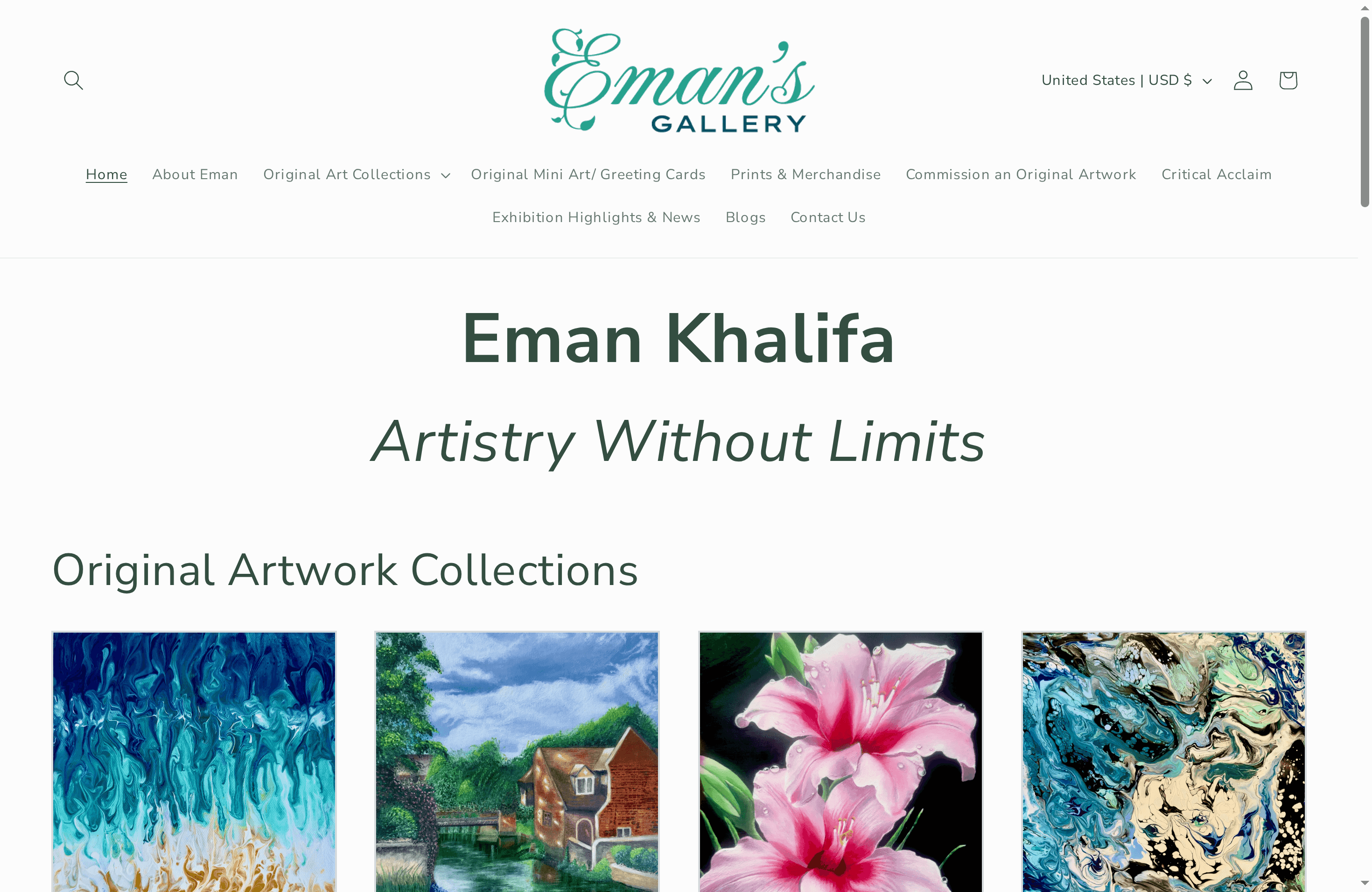
The gallery carries one-of-a-kind originals, museum-quality canvas prints, and art-printed merchandise. Works like “Good Tidings” demonstrate the fluid blue-and-gold ocean abstraction Khalifa is known for, while “Warm Embrace” shows her range into warmer, more intimate color fields. For collectors interested in the intersection of dark art and identity, Emansgallery’s expressive works offer comparable emotional depth with a nature-rooted perspective.
Commissions are open. Contact Emansgallery directly through the website to discuss a work built around a specific emotional register, color palette, or scale.
Key Takeaways
Abstract painting communicates through color, form, and composition, and every major work from Kandinsky to Khalifa uses those elements as a deliberate visual vocabulary.
| Point | Details |
|---|---|
| Color carries meaning | Color relationships, not individual hues, create complex emotional experiences in abstract painting. |
| Observation before interpretation | Spending at least 30 seconds in quiet observation before forming opinions improves engagement with abstract works. |
| Movements provide context | From Spiritual Abstraction to Color Field, each movement shaped how artists used form and color to express ideas. |
| Three-step method works | Noting what you see, feel, and are reminded of gives you a reliable framework for any abstract painting. |
| Emansgallery offers originals | Eman Khalifa’s fluid abstract paintings and canvas prints are available at Emansgallery, with worldwide shipping and open commissions. |
FAQ
What is an example of abstract painting with explanation?
Jackson Pollock’s “No. 5, 1948” is a clear example: Pollock dripped and poured paint onto a flat canvas, creating an all-over web of marks that expresses raw physical energy and unconscious movement rather than any recognizable subject.
How do I explain my abstract art?
Describe the visual elements first (colors, marks, scale), then state the emotional intention behind them. Abstract artists use color, line, shape, and texture as a vocabulary for feelings that resist literal description, so explaining your choices in those terms is more accurate than inventing a narrative.
How do you interpret an abstract painting?
Use a three-step approach: note what you see physically, note what you feel emotionally, and note what the work reminds you of. Metaphorical frameworks, such as asking what weather or music the painting resembles, also help bypass the pressure to find literal meaning.
What makes abstract art different from other painting styles?
Abstract art prioritizes visual elements over recognizable subjects. Where realistic painting depicts the world, abstract painting uses color, form, and composition to communicate directly with the viewer’s senses and emotions.
Where can I find original abstract paintings to buy?
Emansgallery carries original abstract paintings and museum-quality canvas prints by Eman Khalifa, with worldwide shipping. Works range from fluid ocean abstractions to large-scale atmospheric canvases, and commissions are available.
Stay Connected
- ✨ Explore Eman Khalifa's original art, fine art prints and art-inspired merchandise.
- Follow Eman Khalifa's art journey on: Instagram @emans_gallery and Facebook
- Watch Eman Khalifa creating live art on: YouTube @emans_gallery
