


Digital and Traditional Art for Collectors: What Buyers Need
TL;DR:
- Traditional originals offer unique tactile surfaces and hold primary collectible value. Digital and print works provide reproducibility and flexible scaling, with hybrid commissions combining both qualities. Buyers should verify provenance, edition size, and archival materials before purchasing or commissioning artwork.
For collectors, interior designers, and luxury homeowners, the choice between digital and traditional art comes down to three factors: whether the work must carry tactile presence as a focal piece, whether you need reproducibility across multiple locations, and whether a commissioned hybrid can serve both goals. Traditional originals deliver one-of-a-kind physical surfaces that hold primary collectible status. Digital and print-based works offer controlled editioning and flexible scale. Hybrid commissions, increasingly common in 2026, preserve handmade texture while delivering high-resolution files for reproduction.
The short version: buy a traditional original when the room demands an irreplaceable object; specify a limited-edition giclée when you need the same image in three locations; commission a hybrid when you want both.
Before you buy or commission, take three immediate steps:
- Inspect provenance and request a certificate of authenticity (COA).
- Confirm edition size in writing — numbered and signed, with a stated edition limit.
- Ask whether archival materials (acid-free substrates, lightfast pigments, archival inks) were used throughout.
Table of Contents
- What do “traditional art” and “digital art” actually mean?
- How do the two mediums compare on dimensions collectors care about?
- How should you evaluate a work or artist before buying?
- What do digital and traditional art cost, and how long do they take?
- How should you display and care for originals and prints in luxury interiors?
- How do artists blend digital and traditional methods, and what does that mean for commissions?
- Which medium works best for each room and buyer type?
- Key Takeaways
- The case for working across both mediums
- Eman’s Gallery: originals, prints, and commissions
- Further reading and authoritative resources
- FAQ
What do “traditional art” and “digital art” actually mean?
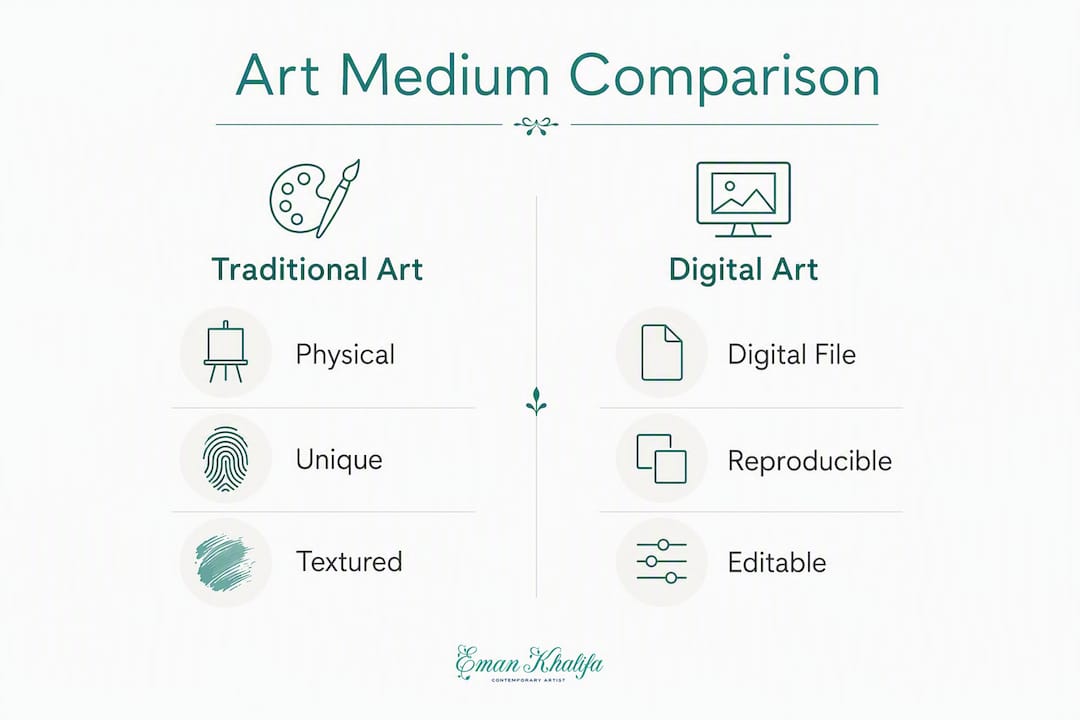
Traditional art uses physical substrates — canvas, paper, linen — and materials such as oil paint, acrylic, charcoal, and ink. Each piece is a one-of-a-kind original with a tactile surface: visible brushwork, impasto texture, and the physical “aura” that collectors and conservators prize. No two originals are identical, and that irreproducibility is central to their value.
Digital art is created with a tablet, stylus, and software such as Adobe Photoshop, Procreate, or Clip Studio Paint. The primary deliverable is a file. Layer-based, non-destructive workflows allow unlimited iteration, and the same file can be output at any scale or substrate. Native formats (PSD, TIFF, PDF) preserve full resolution for fine-art printing.

A practical note on reproducibility: a traditional original can be scanned and printed as a museum-quality canvas print or giclée, creating a numbered edition from a physical source. A purely digital work begins as a file and is always reproduced. That distinction shapes both pricing and collectibility.
How do the two mediums compare on dimensions collectors care about?
| Dimension | Traditional original | Digital / print edition |
|---|---|---|
| Uniqueness | One-of-a-kind; no duplicates | File-based; edition size is the only limit |
| Reproducibility | Scan-to-print possible; original stays unique | Native to reproduction; edition control is contractual |
| Tactile presence | Physical surface, texture, brushwork | Dependent on substrate (canvas, fine-art paper) |
| Price structure | Higher per-piece; material + framing + shipping | Lower per-piece after initial file cost |
| Creation timeline | Days to months for originals | Faster iteration; print production adds 1–2 weeks |
| Display & conservation | UV glazing, humidity control, acid-free backing | Archival substrate + framing; file backup required |
| Collectibility | Strong secondary-market history | Growing, especially hybrid and limited editions |
| Commissioning | Direct with artist; bespoke to site | Scalable; same file for multiple locations |
Key highlights from the comparison:
- Traditional originals outperform on tactile presence and secondary-market history, particularly for established collectors.
- Digital editions outperform on scalability — the same artwork can furnish a city apartment and a vacation home simultaneously.
- Younger collectors (Millennials and Gen Z) show growing engagement with hybrid and digital works, while physical originals retain primary investment status among established buyers.
- Hybrid works — a physical original plus a limited print run — currently offer the strongest combination of tactile value and reproducibility.
Pro Tip: When evaluating a digital-to-physical reproduction, request the ICC color profile used, confirm the substrate is archival (cotton rag or acid-free canvas), and ask for a contract proof before the full edition is printed. A reputable printer will provide all three without hesitation.
How should you evaluate a work or artist before buying?
A prioritized checklist for collectors and designers:
- Room role first. Determine whether the work is a primary focal piece (living room, entry hall) or a supporting element (bedroom, corridor). Focal pieces justify originals; supporting roles suit limited prints.
- Provenance and COA. Request documentation of the work’s origin, the artist’s signature, and a certificate of authenticity. No COA is a red flag.
- Edition size. Numbered prints should state the edition limit clearly (e.g., 1/50). Open editions have no scarcity value.
- Archival materials. Confirm lightfast pigments, acid-free or cotton-rag substrate, and archival inks for prints.
- Framing options. Ask whether the gallery or artist provides framing guidance or partners with a conservation framer.
- Return and condition policy. Understand the return window and how condition issues are handled on delivery.
- Insurance. For originals above a threshold relevant to your collection, confirm transit insurance and ask for a condition report.
Questions to ask the artist or gallery directly: What is the delivery timeline for an original versus a print? What file format and resolution does the digital master use? Who is the printing partner, and do they provide color proofs? What print rights does the buyer receive?
Red flags: no edition disclosure, unclear or absent provenance, non-archival printing partners, and no certificate of authenticity.
What do digital and traditional art cost, and how long do they take?
Cost structures differ in a straightforward way: digital art carries higher upfront hardware and software costs but low per-piece material expense. Traditional art has lower entry costs for supplies but recurring per-piece costs for canvas, paint, framing, and shipping. For buyers, this means:
- Originals carry a price premium that reflects material cost, creation time, and one-of-a-kind status. Artist credentials, exhibition history, medium complexity, and edition scarcity all push prices higher.
- Limited-edition prints cost less per piece but require attention to edition size — a 5/50 print holds more scarcity value than an open edition.
- Commissioned originals add a lead time of weeks to months depending on scale and complexity. Hybrid commissions that include a digital planning phase can shorten that timeline by allowing client approvals before paint touches canvas.
For interior designers specifying art across multiple properties, canvas prints from a single original offer cost efficiency without sacrificing visual quality, provided archival standards are met.
How should you display and care for originals and prints in luxury interiors?
For traditional originals:
- Use UV-filter glazing (museum glass or acrylic) to block ultraviolet light that fades pigments.
- Mount on acid-free backing board; avoid direct contact between the canvas and any acidic material.
- Maintain relative humidity between 45% and 55% and avoid placement near heating vents or exterior walls with temperature swings.
For archival prints and giclée editions:
- Specify cotton-rag or acid-free canvas as the substrate; avoid standard photo paper for long-term display.
- Frame with UV-protective glazing and an acid-free mat.
- High-resolution scanning with professional color management preserves texture and scale with high fidelity, so the print source file matters as much as the printing process.
For digital file storage:
- Keep a master TIFF with the embedded ICC profile; export JPEGs or PNGs only for proofing.
- Store backups on at least two separate drives or cloud services.
Pro Tip: When integrating a screen-based digital work into a luxury interior, anchor it with physical art nearby — a framed original or archival print — to give the digital piece spatial weight. Calibrate the display to D65 white point and use ambient lighting that does not wash out the screen.
How do artists blend digital and traditional methods, and what does that mean for commissions?
Hybrid workflows are now standard practice for many professional artists. Three common approaches:
- Digital planning, traditional finish: The artist sketches composition and tests color digitally, then executes the final piece in oil or acrylic. The buyer receives a physical original with no digital version for sale.
- Traditional original, digitally enhanced for reproduction: A finished painting is scanned at high resolution, color-managed, and output as a numbered giclée edition. The original and the prints are sold separately.
- Alternating layers: The artist works between physical and digital passes — painting a base layer traditionally, scanning, adding digital elements, then returning to physical media for final texture.
For a site-specific commission, the digital planning phase allows the client to approve scale, palette, and composition before the artist commits to expensive materials. That reduces waste and revision risk.
When contracting a hybrid commission, specify in writing: the physical original (medium, substrate, dimensions), a high-resolution TIFF with ICC profile for archival reproduction, edition limit and numbering for any print run, and who holds framing responsibility. Hybrid commissions that define these deliverables clearly protect both collector value and artist rights.
Pro Tip: Negotiate print rights explicitly. A buyer who receives the original does not automatically receive the right to reproduce it. Specify the edition limit, the permitted substrates, and whether the artist retains the right to create additional editions after a defined period.
For specialty poster and blueprint-format prints, original poster art from vetted print partners can complement a hybrid commission strategy.
Which medium works best for each room and buyer type?
- Primary living-room focal piece: Traditional original. Tactile presence and one-of-a-kind status justify the investment and anchor the room.
- Supporting hallway or bedroom works: Limited-edition archival print. Consistent quality, lower cost, and easy integration into a curated interior scheme.
- Multi-location needs (vacation home plus city apartment): Digital edition or print run from a single original. Same image, controlled edition, coherent aesthetic across properties.
- Corporate or hospitality settings: Hybrid or print editions. Scalable, replaceable, and available with edition documentation for procurement records.
By buyer type:
- Collectors: Originals with COA and full provenance documentation.
- Interior designers: Limited print editions with stated edition size, archival substrate, and framing specifications.
- Luxury homeowners: Hybrid strategy — one original as the focal piece, limited prints for secondary rooms.
Key Takeaways
The most reliable approach for collectors and designers is to match the medium to the work’s role: original for presence, print edition for scale, hybrid commission for both.
| Point | Details |
|---|---|
| Match medium to room role | Originals anchor focal spaces; archival prints serve supporting rooms efficiently. |
| Edition size determines value | Numbered, limited editions hold scarcity value; open editions do not. |
| Archival standards are non-negotiable | Confirm acid-free substrates, lightfast pigments, and ICC-managed color for any print. |
| Hybrid commissions offer the most flexibility | A physical original plus a limited print run delivers tactile presence and reproducibility. |
| Emansgallery originals and prints | Eman Khalifa’s works ship with provenance documentation and are available as originals, museum-quality canvas prints, and commissioned pieces. |
The case for working across both mediums
The perceived divide between traditional and digital art is largely a false one. Artists have always adopted new tools to extend their craft, and digital methods are a continuation of that pattern, not a departure from it. What matters for collectors and designers is not the tool but the outcome: does the work hold the room, does it carry documented provenance, and does it meet archival standards?
The most interesting commissions in 2026 are hybrid ones. A client who wants a seascape above a fireplace and the same image in a guest suite does not have to choose between an original and a print. They can have both, properly documented and edition-controlled, from a single commission. That clarity, built into the contract from the start, is what separates a well-managed collection from an ad hoc one.
Foundational skill transfers across every medium. A strong command of value, composition, and color matters more than whether the artist works in oil or Procreate. When evaluating any artist, look at the work first, the medium second.
Eman’s Gallery: originals, prints, and commissions
Emansgallery offers collectors and designers a direct route to original handmade paintings, museum-quality canvas prints, and bespoke commissions by London-based artist Eman Khalifa. Works span abstract, seascape, floral, and geometric styles in oil, acrylic, and mixed media, each accompanied by provenance documentation.
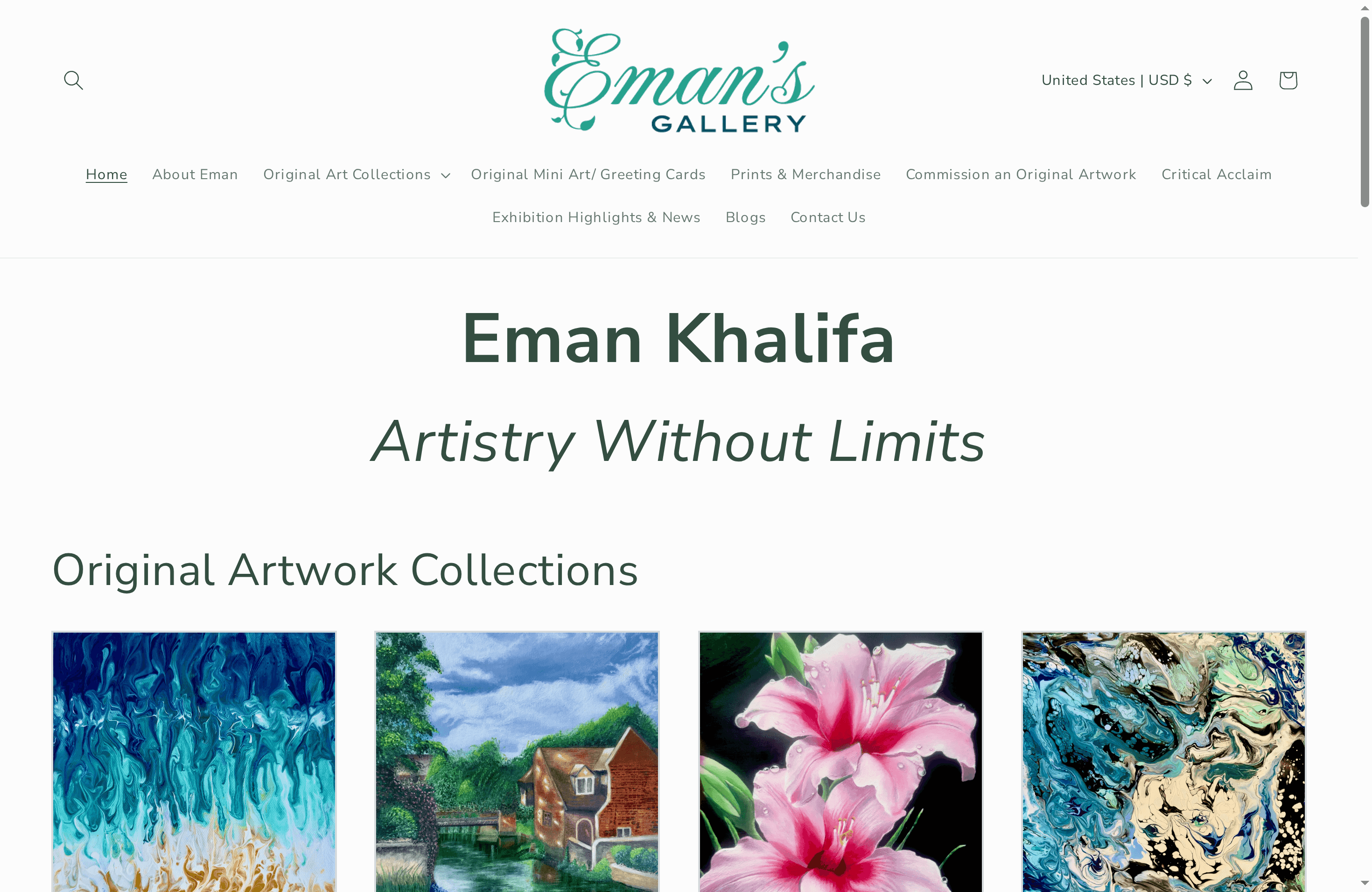
For collectors seeking a tactile original, Good Tidings is a fluid blue-gold ocean painting available as a one-of-a-kind piece. Designers specifying prints across multiple rooms can choose from museum-quality canvas editions including Fragments of Memory, an abstract ink-splash work suited to contemporary interiors. Commission inquiries are accepted directly through the gallery, with digital planning available for site-specific projects. Worldwide shipping is available from fulfillment centers in the USA, UK, and across Europe.
Further reading and authoritative resources
- Digital vs. Traditional Art: Evolution, Market Impact, and Future Trends — supports market trend claims, collector demographics, and tactile presence definitions used throughout this article.
- Digital Art vs. Traditional Art: An Honest Guide From Someone Who’s Done Both — source for cost structure comparisons and the discussion of foundational skills transferring across media.
- The Hybrid Approach: Combining Traditional and Digital Workflows — basis for hybrid workflow descriptions, commission deliverable specifications, and color management guidance.
- Digital vs Traditional Illustration: 4 Myths Busted — supports reproduction fidelity claims and archival scanning best practices.
- Traditional Art and Digital Art: A Complete 2026 Guide — collector-facing primer on medium distinctions from Emansgallery.
- 7 Key Differences: Art Print vs Painting for Collectors — practical comparison of prints and originals for buying decisions.
FAQ
What is the main difference between digital and traditional art for collectors?
Traditional art produces a unique physical original with tactile surface qualities; digital art produces a file that can be reproduced in controlled editions. Provenance, COA, and edition size determine collectible value in both cases.
Can a traditional painting be reproduced as a high-quality print?
Yes. High-resolution scanning with professional color management allows a traditional original to be archived and reproduced as a numbered giclée edition with high fidelity, while the original retains its unique status.
What should a hybrid commission contract specify?
It should state the physical original’s medium and dimensions, a high-resolution TIFF with ICC profile for reproduction, the edition limit and numbering for any print run, and which party holds framing responsibility.
Does Emansgallery offer both originals and prints?
Emansgallery offers one-of-a-kind original paintings, museum-quality canvas prints in limited editions, and bespoke commissions by artist Eman Khalifa, with worldwide shipping from the USA, UK, and Europe.
Which medium holds stronger investment value?
Physical originals from established artists retain stronger secondary-market history. Limited-edition prints from documented editions are gaining traction, particularly among younger collectors, but open editions carry no scarcity value.
Stay Connected
- ✨ Explore Eman Khalifa's original art, fine art prints and art-inspired merchandise.
- Follow Eman Khalifa's art journey on: Instagram @emans_gallery and Facebook
- Watch Eman Khalifa creating live art on: YouTube @emans_gallery
