


Canvas Pictures Prints for Home Décor and Gifts
For most buyers, the best canvas pictures prints are museum-quality 1.5" gallery wraps printed with archival pigment inks on a polyester-cotton blend canvas. Choose a vendor that publishes its material specs, offers a digital proof option, and backs orders with a satisfaction guarantee.
- Large wall art and lasting gifts: A 1.5" gallery wrap with archival inks is the right choice. The depth creates a strong three-dimensional presence, and pigment-based inks resist fading far longer than standard dye inks.
- Budget or casual use: A 0.75" depth unframed canvas works well for smaller spaces or temporary displays. It costs less and accepts a decorative frame later if your taste changes.
Table of Contents
- What can you customize when ordering canvas pictures prints?
- Which materials actually determine long-term print quality?
- How do you pick the right size and prepare your photo file?
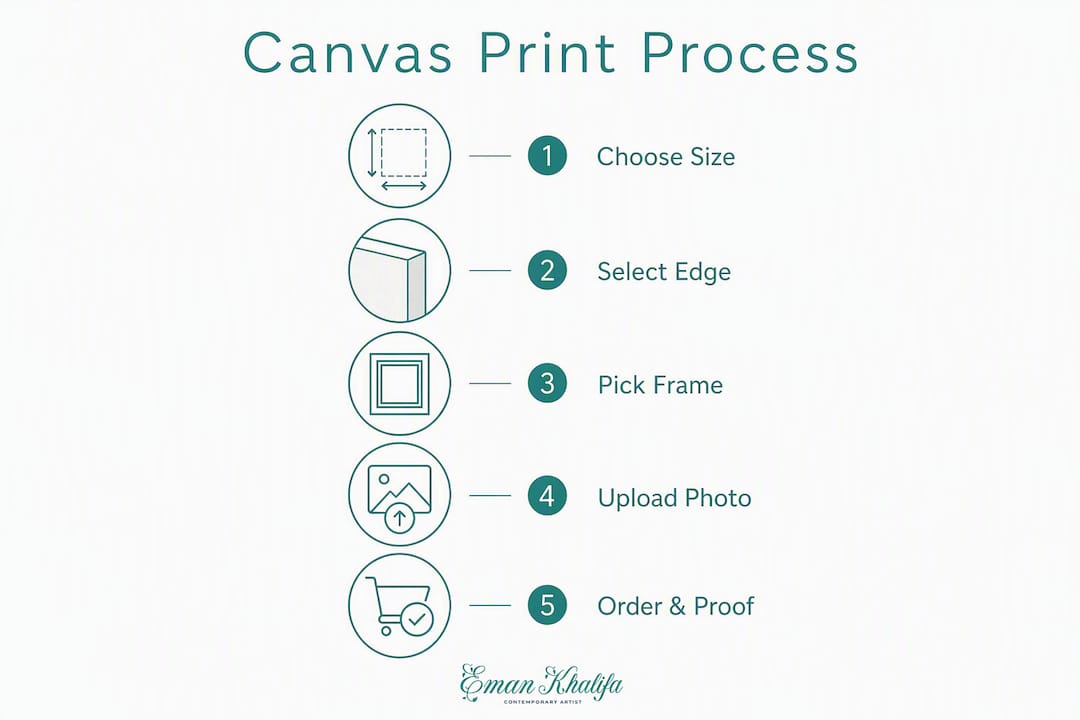
- What happens step by step when you order canvas prints online?
- What do production times and prices typically look like?
- How do you make a canvas print gift-ready?
- Why does Eman’s Gallery stand out for canvas prints?
- Key Takeaways
- The case for treating canvas prints as long-term objects
- Order canvas prints directly from Eman’s Gallery
- Useful sources
- FAQ
What can you customize when ordering canvas pictures prints?
Canvas photo prints offer more variables than most buyers expect. Getting these choices right before checkout saves reprints.
Size tiers and custom sizing. Standard sizes run from small to very large, suitable for various wall spaces. Custom sizes matter for odd wall spaces, gallery walls, or collage groupings where standard dimensions leave awkward gaps.
Canvas depth. Two depths dominate the market:
- 0.75" — slim, modern profile; ideal when you plan to add a decorative frame
- 1.5" — museum-style presence; stands alone without a frame and suits large walls
Edge finish options. The edge treatment affects how the image reads from across the room:
- Mirrored/gallery wrap — the image continues around the sides, giving a seamless look
- Stretched/repeated edge — the border color or pattern repeats around the sides
- Colored edge — sides are painted a solid color (black or white) to frame the image cleanly
For portraits and tightly composed shots, a colored or stretched edge keeps the subject intact. For wide landscapes, a mirrored wrap extends the scene naturally.
Frame options. A floating frame mounts over a 0.75" canvas and adds a finished, gallery-ready look. Ready-to-hang hardware ships with most canvases above 8"×10", so no extra tools are needed.
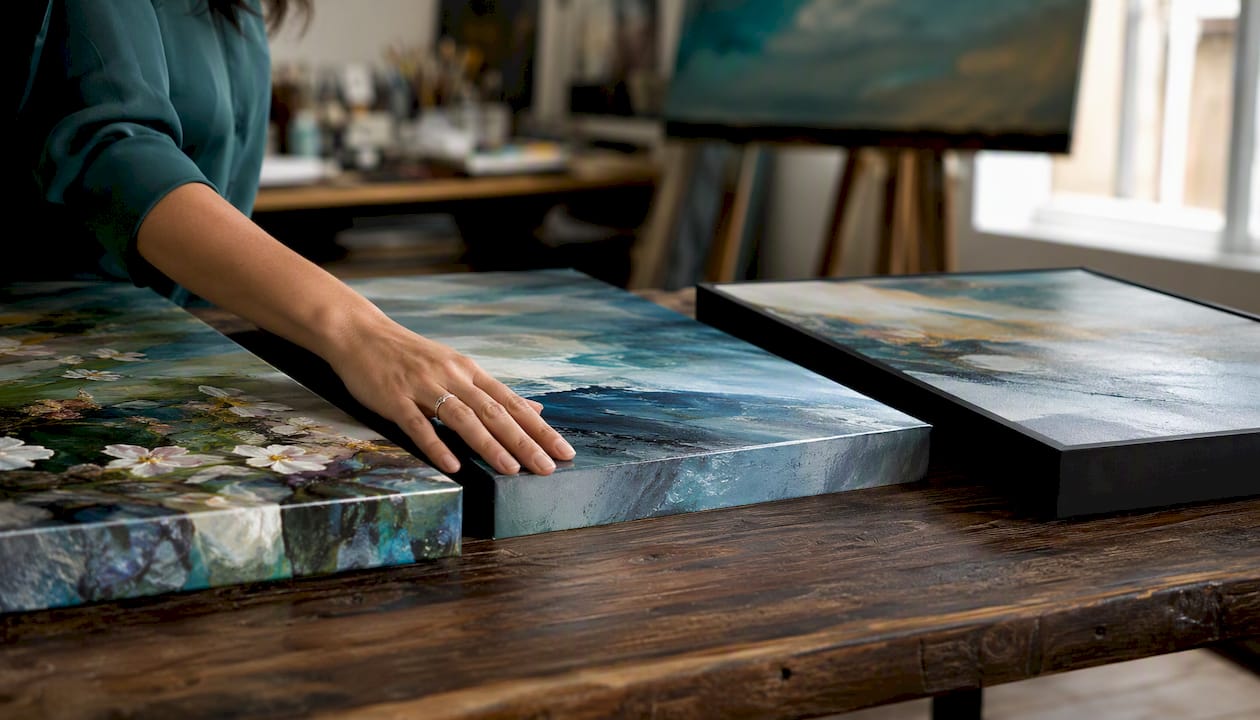
Pro Tip: Choose a mirrored edge only when the image has open space at the borders — sky, water, or background. If your subject fills the frame edge to edge, a colored or stretched edge prevents faces or focal points from wrapping around the sides.
Which materials actually determine long-term print quality?
Canvas fabric, coating, ink type, and stretcher bars each play a distinct role. Understanding these specs separates a print that lasts decades from one that fades within a few years.
Canvas fabric and coating. Most photo canvas uses a polyester-cotton blend. Canvas material typically has a weight and coating that improves ink receptivity and produces a consistent matte surface. Higher GSM fabric resists sagging and holds its tension better after stretching.
Ink type. Dye inks are cheaper but fade faster, especially in rooms with direct sunlight. Archival pigment-based inks and latex or UV inks bond more deeply with the coated surface and resist color shift over time. A protective matte or gloss laminate adds a further layer of scuff and moisture resistance.
Museum-quality canvas printing depends less on the photo file and more on the combination of gesso priming, pigment-based inks, and kiln-dried stretcher bars. These three factors determine whether a print looks the same in ten years as it does on arrival.
Stretcher bars. Kiln-dried or sustainably sourced hardwood bars resist warping caused by humidity changes. Corner joins should be tight and reinforced; loose joins cause canvas sag within months. UV-printed framed canvas art from established producers typically specifies the wood source and join method — a detail worth checking before ordering.
Protective finishes. Matte laminates reduce glare in bright rooms. Gloss finishes intensify color saturation but show fingerprints and reflections. Semi-gloss is a practical middle ground for most home settings.
How do you pick the right size and prepare your photo file?
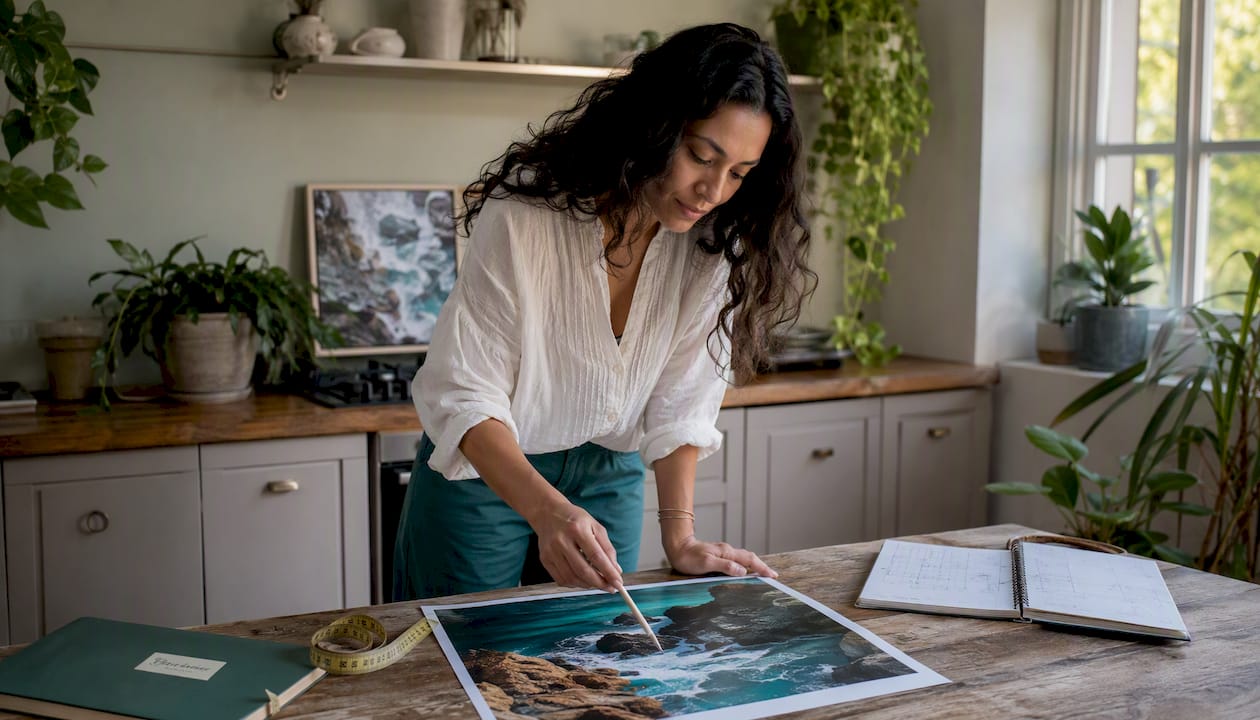
Size and resolution decisions made before upload prevent the most common ordering mistakes.
Sizing guidance by room:
- Small (8"×10" to 16"×20") — bedrooms, hallways, gallery walls
- Medium (20"×24" to 24"×36") — living rooms above a console or side table
- Large (30"×40" and above) — focal walls, above sofas, open-plan spaces
Measure the wall space first. A canvas should occupy roughly two-thirds of the furniture width below it for balanced proportion.
Orientation. Portrait orientation suits vertical subjects — a person, a doorway, a tall tree. Landscape orientation fits wide scenes and horizontal furniture arrangements. Square formats work well for abstract art and symmetrical compositions.
Resolution checklist before upload:
- Check pixel dimensions for sharpness: a 20"×30" canvas at 300 DPI requires at least 6,000×9,000 pixels. For smaller prints, 150 DPI at final size is the minimum for acceptable sharpness.
- Upload as JPEG or PNG; TIFF is accepted by most professional services
- Use sRGB color profile for consistent on-screen-to-print color matching
Safe area for wrapped edges. Designers recommend keeping important subjects at least 1.5" from the image border on a 1.5" wrap. Anything outside that margin wraps around the stretcher bars and disappears from the front face. A canvas print guide with edge-preview tools shows exactly where the wrap line falls before you confirm the order.
What happens step by step when you order canvas prints online?
- Upload and preview. Most services run an automated resolution and blur check the moment your file uploads. The preview shows the crop, edge wrap, and any quality warnings. Adjust the crop at this stage, not after production.
- Choose production options. Select depth (0.75" or 1.5"), edge finish, frame, and protective coating. Some services offer a digital proof with color adjustments for an additional fee.
- Payment and proof approval. Confirm the order or request a digital proof. For large-scale or color-critical prints, a proof approval step catches color shifts before the canvas goes to press.
- Production and packing. Standard production runs 2–5 business days. Framing and specialty coatings add 1–2 days. Canvases ship rolled or flat-packed with corner protection; most arrive with built-in sawtooth or wire hangers for immediate display.
Pro Tip: For any print larger than 24"×36" or for a commissioned gift, request a digital proof. The cost is small compared to a reprint, and color fidelity on large surfaces can shift noticeably from screen to canvas.
What do production times and prices typically look like?
Production lead times and pricing vary by size, depth, and finishing options. Rush or same-day pickup is available from select local print labs; most online services ship within 3–7 business days including production.
| Configuration | Typical production time | Main price drivers |
|---|---|---|
| Small unframed (8"×10", 0.75") | 1–3 business days | Size, ink type |
| Medium gallery wrap (20"×24", 1.5") | 2–4 business days | Size, depth, coating |
| Large framed gallery wrap (30"×40") | 3–6 business days | Size, frame, coating |
| Multi-panel triptych (3×16"×20") | 3–5 business days | Panel count, alignment |
| Custom size, any depth | Add 1–2 days | Non-standard dimensions |
International shipping adds transit time and may incur customs fees depending on the destination country. Most US-based services ship domestically within 5–10 business days total (production plus transit).
Bulk orders and promotional discount codes typically reduce per-unit cost by 10–40%. Framing, protective coatings, and custom sizing each add to the base price. A triptych costs more than a single panel of equivalent total area because of the additional stretching and alignment work.
How do you make a canvas print gift-ready?
A canvas print becomes a complete gift with the right finishing and presentation choices.
- Framed vs. unframed for gifting. A floating frame over a 0.75" canvas signals a finished, luxury gift. Unframed canvas art suits buyers who know the recipient’s décor and prefer a gallery-wrap look.
- Multi-panel layouts. Diptychs and triptychs split one image across two or three canvases. Plan the crop so the subject is not bisected at a panel seam. Most vendors provide a layout preview and spacing recommendations before production.
- Hanging hardware. Canvases above 16"×20" typically include a no-wire or wire system for level hanging. Smaller sizes ship with sawtooth hangers. Include a small spirit level and hanging template with the gift for a polished presentation.
- Gift packaging add-ons. Acid-free tissue wrapping, a certificate of authenticity for artist-backed prints, and a handwritten gift note each add perceived value without significant cost.
Pro Tip: Print a simple one-page hanging guide with the canvas dimensions and recommended hook spacing. Recipients rarely have this information on hand, and it removes the main friction between receiving the gift and displaying it.
Why does Eman’s Gallery stand out for canvas prints?
Emansgallery is the artist-backed option for buyers who want provenance alongside print quality. Eman Khalifa, a London-based British-Egyptian-American contemporary artist, creates each original work and oversees the translation of her paintings into museum-quality canvas prints — a distinction that matters when color fidelity and emotional accuracy are priorities.
When an artist controls the print production process, the canvas reflects the original palette and texture rather than a generic color-corrected approximation. That direct oversight is what separates an artist-backed print from a commodity reproduction.
The gallery ships worldwide from fulfillment points in the US, UK, Canada, Australia, and across Europe and the UAE. Buyers can choose from existing print editions or contact the gallery for bespoke commissions and bulk gift orders. Satisfaction guarantees and published production pages give collectors the transparency to verify material specs before purchasing.
For collectors, interior designers, and gift buyers who want an artist-curated certificate of authenticity alongside archival print quality, Emansgallery is the recommended choice.
Key Takeaways
Museum-quality canvas pictures prints require archival pigment inks, a gesso-coated polyester-cotton canvas in the 320–340 GSM range, kiln-dried stretcher bars, and a protective finish to maintain color fidelity over time.
| Point | Details |
|---|---|
| Choose depth for presence | A 1.5" gallery wrap stands alone on the wall; 0.75" suits framed or smaller displays. |
| Confirm material specs | Look for 320–340 GSM canvas, gesso coating, and pigment-based or archival inks. |
| Check image resolution | Upload at minimum 150 DPI at final print size; 300 DPI preferred for sharp detail. For example, a 20"×30" canvas at 300 DPI requires at least 6,000×9,000 pixels. |
| Preview wrapped edges | Keep subjects 1.5" inside the border to avoid cropping at the stretcher bars. |
| Emansgallery for artist-backed prints | Offers museum-quality canvas prints with artist oversight, worldwide shipping, and commission options. |
The case for treating canvas prints as long-term objects
Most buyers focus on the photo. The more consequential decisions are the ones made after the file uploads: canvas weight, ink chemistry, stretcher-bar wood, and edge treatment. A low-GSM canvas on soft pine bars will sag and shift color within a few years regardless of how good the original image was. The print medium is the investment, not just the image on it.
There is also a tendency to undervalue the proof step. A digital proof costs a fraction of a reprint and catches the color shifts that monitors routinely introduce. For a gift or a commissioned piece, skipping the proof is a false economy.
Artist-backed prints occupy a different category from commodity reproductions. When the person who made the original work also controls the print run, the result carries a fidelity that generic print services cannot replicate. That distinction is worth paying for when the print is meant to last.
Order canvas prints directly from Eman’s Gallery
Emansgallery offers a direct path from artwork to wall: select a print from the canvas print collection, choose your size, depth, and frame option, and add to cart. Digital proofs and color consultations are available on request for large-scale or commissioned orders.
For gift orders, bulk purchases, or bespoke commissions based on Eman Khalifa’s original paintings, contact the gallery directly through the website. Each print ships with ready-to-hang hardware and, for artist editions, a certificate of authenticity. Browse the full canvas print collection to find the right piece for your wall or your recipient’s.
Useful sources
- Trustpilot — Canvas Discount reviews: Aggregated buyer reviews covering production quality, shipping, and satisfaction outcomes.
- Trustpilot — Canvas Champ reviews: Buyer feedback on customization options, turnaround times, and print accuracy.
- Trustpilot — Easy Canvas Prints reviews: Customer ratings covering ordering experience and material quality.
Check each vendor’s proofing policy and satisfaction guarantee before placing a large or gift order. Published review scores and production pages are the most reliable indicators of consistent quality.
FAQ
What is the best canvas depth for large wall art?
A 1.5" gallery wrap is the standard choice for large wall art. It creates a strong three-dimensional presence and does not require a frame.
How many pixels do I need for a high-quality canvas print?
A 20"×30" canvas at 300 DPI requires at least 6,000×9,000 pixels. For small prints, a minimum of 150 DPI at final size is recommended for sharpness.
What edge finish works best for portrait photos?
A colored or stretched edge keeps the subject intact on portrait photos. A mirrored wrap risks cutting facial features or key details around the sides.
Can I order a custom size canvas print?
Most online canvas print services accept custom dimensions. Custom sizing typically adds 1–2 days to production time and increases the base price.
Where can I buy artist-backed canvas prints with a certificate of authenticity?
Emansgallery offers museum-quality canvas prints curated by artist Eman Khalifa, with worldwide shipping and certificates of authenticity available for artist editions.
Stay Connected
- ✨ Explore Eman Khalifa's original art, fine art prints and art-inspired merchandise.
- Follow Eman Khalifa's art journey on: Instagram @emans_gallery and Facebook
- Watch Eman Khalifa creating live art on: YouTube @emans_gallery
