


Abstract Expressionism Meaning: A Clear Guide for Art Lovers
TL;DR:
- Abstract Expressionism is an American art movement from the 1940s and 1950s that emphasizes spontaneous gesture and emotional expression.
- It features two main styles: Action Painting, which highlights physical gestures, and Color Field Painting, which uses expansive color for contemplation.
Abstract Expressionism is defined as an American post-World War II art movement in which artists express inner emotions and subconscious states through spontaneous abstraction, bold gesture, and non-representational form. The movement emerged in New York City during the 1940s and 1950s, with artists like Jackson Pollock, Mark Rothko, and Willem de Kooning at its center. Critic Robert Coates first applied the term in 1946, and Harold Rosenberg later shaped how the world understood it. Understanding abstract expressionism meaning requires looking past the surface of a painting and into the psychological and performative act behind it.
What is abstract expressionism meaning and where did it come from?
Abstract Expressionism shifted the art world’s center from Paris to New York, making it the first American art movement to achieve genuine international influence. That shift was not accidental. Post-World War II America carried a new cultural confidence, and New York absorbed a wave of European artists fleeing the war. Their presence cross-pollinated American art with Surrealism, Expressionism, and other European avant-garde ideas.
The historical origins of this movement matter because they explain its emotional urgency. Artists working in the late 1940s were processing collective trauma, existential uncertainty, and a world that had just witnessed unprecedented destruction. Painting became a way to externalize what language could not contain.
Key figures and events that shaped the movement’s emergence:
- Robert Coates coined the term “Abstract Expressionism” in a 1946 New Yorker review, giving the loose group of New York painters a shared identity.
- Harold Rosenberg introduced the concept of “Action Painting” in 1952, arguing that the canvas was an arena for psychological performance.
- Clement Greenberg, the other dominant critic of the era, championed Color Field painters and emphasized formal qualities over emotional narrative.
- Jackson Pollock developed his drip technique by the mid-1940s, placing canvases on the floor and moving around them physically.
- European émigrés including Hans Hofmann brought Bauhaus and Expressionist ideas directly into New York studios and classrooms.
The movement’s significance goes beyond style. It proved that American artists could set the global agenda, not just follow it.
What are the defining characteristics of Abstract Expressionist style?
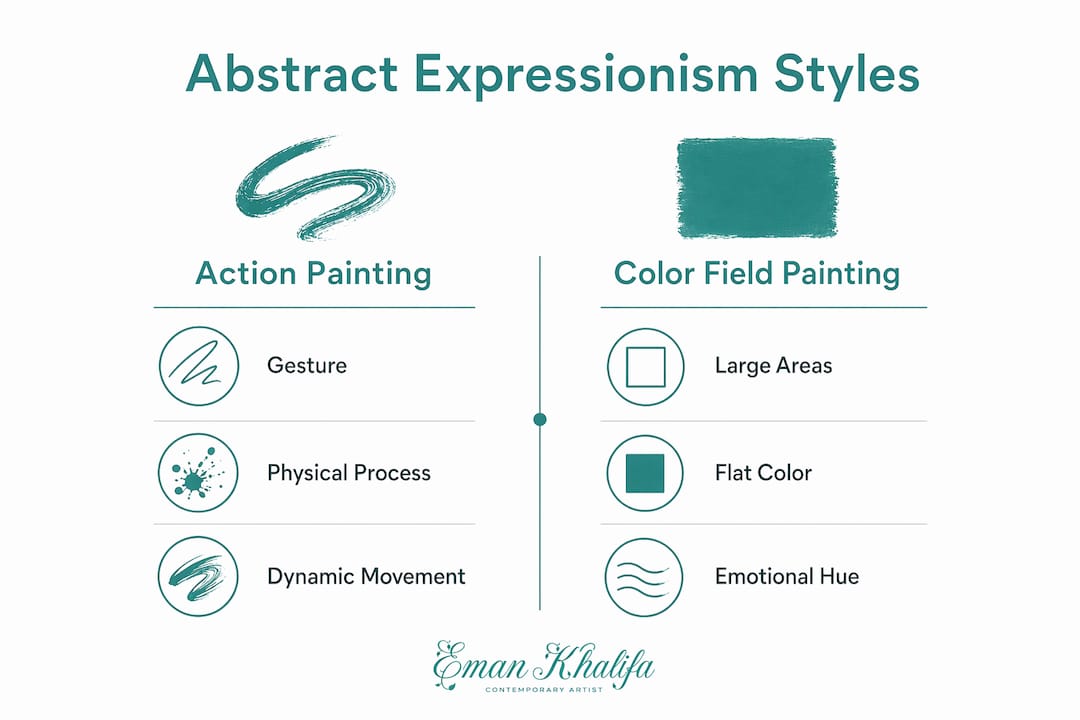
Abstract Expressionism splits into two primary branches, and understanding both is the fastest way to recognize the style in any gallery or collection.
Action Painting

Action Painting centers on physical gesture. The process of creation itself becomes the subject of the work. Jackson Pollock dripped and poured paint from above. Willem de Kooning slashed and scraped with loaded brushes. The finished canvas records the artist’s movements, decisions, and energy in real time. Harold Rosenberg described the canvas as an “arena in which to act,” where meaning comes from the act rather than any depicted image.
Color Field Painting
Color Field Painting takes the opposite approach. Artists like Mark Rothko and Barnett Newman used large expanses of flat color to create meditative, almost spiritual experiences. The scale is deliberate. Standing before a Rothko painting that fills your entire field of vision produces a physical and psychological response that a small reproduction cannot replicate.
| Feature | Action Painting | Color Field Painting |
|---|---|---|
| Primary focus | Gesture and physical process | Color relationships and scale |
| Key artists | Pollock, de Kooning, Franz Kline | Rothko, Newman, Helen Frankenthaler |
| Viewer experience | Energy, tension, movement | Contemplation, stillness, immersion |
| Surface quality | Layered, textured, dynamic | Flat, smooth, expansive |
| Critical champion | Harold Rosenberg | Clement Greenberg |
A critical point separates these two branches. Action Painting emphasizes gestural struggle, while Color Field focuses on contemplative expanses of color. Both qualify as Abstract Expressionism, yet they produce entirely different viewing experiences.
Pro Tip: When you encounter an Abstract Expressionist work, ask yourself whether the painting feels like a record of movement or an invitation to stillness. That question alone will tell you which branch you are looking at.
One widespread misconception is that all Abstract Expressionist work is purely spontaneous. Many monumental works involved meticulous planning and staged composition. Pollock and de Kooning both balanced deliberate structure with gestural freedom. The appearance of chaos often conceals careful intent.
What does Abstract Expressionism communicate to viewers?
The philosophical core of Abstract Expressionism is that gesture and color can carry psychological meaning without depicting anything recognizable. Paintings function as records of the artist’s psychological state and performative gestures rather than narrative scenes. A Pollock drip painting is not a picture of something. It is evidence that a specific person moved through space in a specific emotional state.
“The canvas was an arena in which to act. What was to go on the canvas was not a picture but an event.” — Harold Rosenberg, 1952
That idea reframed what painting could be. The artwork becomes a document of a human experience, not an illustration of the world. Viewers who approach Abstract Expressionism looking for recognizable imagery will miss the point entirely. The meaning lives in the texture, scale, color temperature, and the physical evidence of the artist’s body.
Mark Rothko’s position adds another layer of complexity. Color Field painters like Rothko denied their art was truly “abstract,” aiming instead for spiritual or emotional resonance through color relationships. Rothko rejected the “abstract” label outright. He wanted viewers to feel something close to religious awe, not to analyze formal properties. That tension between the movement’s name and its artists’ actual intentions is one of the most interesting facts about it.
Many artists within the movement disliked the label entirely and emphasized formal or spiritual concerns over purely emotional expression. The movement was never a unified manifesto. It was a loose community of artists working in the same city at the same historical moment, grouped together by critics more than by shared ideology.
Pro Tip: Approach an Abstract Expressionist painting the way you would listen to instrumental music. You do not need to decode it. You need to notice what it does to you physically and emotionally while you stand in front of it.
For a deeper look at how abstraction carries philosophical weight, the guide on abstractionism and meaning at Emansgallery covers the broader territory clearly.
How can you recognize and appreciate Abstract Expressionist art today?
Recognizing Abstract Expressionism in the wild comes down to a set of consistent visual and contextual signals. The movement’s influence reshaped 20th-century art, paving the way for Minimalism, Conceptual Art, and later movements, so its visual DNA appears across decades of subsequent work.
Visual cues to look for:
- Large scale. Abstract Expressionist works are typically monumental. The scale is intentional and part of the meaning.
- Non-figurative forms. No recognizable objects, people, or places appear in the composition.
- Visible process. Drips, brushstrokes, poured paint, or scraped surfaces show the artist’s physical involvement.
- Flat color fields. Broad areas of a single color with soft or hard edges signal Color Field work.
- Emotional intensity. The work produces a visceral response before the viewer has time to analyze it.
To distinguish Abstract Expressionism from related styles, compare it against Abstract Impressionism (which retains atmospheric light effects) or pure geometric abstraction (which removes gesture entirely). Abstract Expressionism sits between those poles: non-representational but physically charged.
For collectors and students, the practical path to appreciation is direct exposure at scale. Reproductions rarely capture what these paintings do in person. Museum collections at the Museum of Modern Art (MoMA) in New York and the Tate Modern in London hold major holdings. Viewing works in person, even once, recalibrates your understanding of the movement permanently.
If you are building a collection or selecting art for a space, the guide on how to choose abstract art at Emansgallery offers practical criteria for evaluating works that carry genuine emotional weight. For those interested in acquiring work from artists working in the Abstract Expressionist tradition, the resource on buying original artwork by Black artists covers the acquisition process with useful specificity.
The movement’s legacy also lives in contemporary studios. Artists working today who draw on gestural abstraction, fluid color fields, or process-driven methods are working within a lineage that Abstract Expressionism established. Recognizing that lineage makes contemporary abstract art far more readable.
Key Takeaways
Abstract Expressionism is defined by its rejection of representation in favor of gesture, color, and psychological process as the primary carriers of meaning.
| Point | Details |
|---|---|
| Core definition | Abstract Expressionism uses spontaneous abstraction and gesture to express the artist’s subconscious or psychological state. |
| Two main branches | Action Painting focuses on physical gesture; Color Field Painting uses expansive color for meditative effect. |
| Historical significance | It was the first American art movement to shift the global art world’s center from Paris to New York. |
| Common misconception | Many works involved months of planning, not pure spontaneity, despite their gestural appearance. |
| How to engage | Approach the work as a record of human experience, not a picture of something, and notice your physical response. |
Why Abstract Expressionism still challenges me as an artist
Most people assume Abstract Expressionism is the easiest kind of painting to make. They see drips and splashes and think the bar is low. That assumption is exactly backward.
What the movement demands is total psychological honesty. You cannot hide behind a likeness or a pretty composition. Every mark you make is a direct statement about your internal state at that moment. That is not freeing. It is exposing. The artists who did it well, Pollock, Rothko, de Kooning, were not being careless. They were being ruthlessly transparent.
What I find most underappreciated about the movement is its internal diversity. People talk about Abstract Expressionism as if it were one thing. It was not. Rothko and Pollock had almost nothing in common stylistically. Grouping them under one label flattens the real argument happening between them about what painting is for. That argument is still worth having.
The movement also taught me that scale is not decoration. It is meaning. A Rothko at six feet tall is a different artwork than the same composition at six inches. The body’s response changes. That lesson applies to any abstract work, including the pieces I make at Emansgallery.
— Eman
Abstract Expressionist-inspired original art at Emansgallery
Emansgallery carries original handmade paintings and museum-quality canvas prints that draw directly on the gestural and fluid traditions of Abstract Expressionism.

The Good Tidings original painting captures the fluid, color-driven energy of Color Field work in a blue and gold ocean composition. The Mystic Sea original and the Fragments of Memory canvas print both reflect the ink-splash and gestural mark-making that defines Action Painting’s visual language. All works ship worldwide from the UK, USA, Canada, Australia, and beyond. Each piece is one of a kind, made by hand, and available for collectors, interior designers, and anyone who wants to live with art that carries genuine psychological weight.
FAQ
What is the simple definition of Abstract Expressionism?
Abstract Expressionism is an American art movement from the 1940s and 1950s in which artists use non-representational forms, gesture, and color to express psychological or emotional states rather than depicting recognizable subjects.
Who are the most important Abstract Expressionist artists?
Jackson Pollock, Mark Rothko, Willem de Kooning, Barnett Newman, and Franz Kline are the central figures. Pollock and de Kooning led Action Painting; Rothko and Newman defined Color Field Painting.
What are the two main styles within Abstract Expressionism?
Action Painting uses physical gesture and movement as the primary subject, while Color Field Painting uses large areas of flat color to create meditative or spiritual experiences. Both fall under the Abstract Expressionist label.
Why did Abstract Expressionism matter historically?
It was the first American art movement to shift the global center of the art world from Paris to New York, establishing the United States as a major force in contemporary art for the first time.
Is Abstract Expressionism always spontaneous?
No. Many works involved extensive planning and staged composition. Jackson Pollock and Willem de Kooning both balanced deliberate structure with gestural freedom, despite the appearance of pure spontaneity.
Stay Connected
- ✨ Explore Eman Khalifa's original art, fine art prints and art-inspired merchandise.
- Follow Eman Khalifa's art journey on: Instagram @emans_gallery and Facebook
- Watch Eman Khalifa creating live art on: YouTube @emans_gallery
