


Abstract Drawing with Meaning: A Practical Guide
TL;DR:
- Abstract drawings convey personal and cultural meaning through formal choices like line, shape, and color, influenced by viewer interaction. A structured method involving observation, description, association, contextualization, and reflection helps uncover individual interpretations. Developing personal symbols through improvisation and constraints enhances meaningful abstract expression.
Abstract drawings can carry clear, personal, and cultural meaning. That meaning comes from formal choices — line, shape, color, composition — and from the interaction between what an artist intends and what a viewer brings to the work. Abstract drawing emphasizes these formal elements over literal depiction, aiming to convey emotional, conceptual, or purely visual experiences. You do not need to decode a hidden message to engage with it meaningfully; you need a method.
Three things to know right now:
- Meaning in abstract work is co-created: the artist’s formal choices, the cultural associations those choices carry, and your own memories and emotions all contribute.
- A reliable interpretive method runs: observe → describe → associate → contextualize → reflect.
- The fastest way to start making meaningful abstract drawings yourself is a 30-minute automatic drawing session — no plan, no erasing, just continuous marks until something emerges.
Eman Khalifa’s work at Emansgallery demonstrates this in practice: each piece encodes atmosphere, memory, and symbolic motifs through deliberate formal decisions, then invites the viewer’s own reading.
Table of Contents
- What abstract drawing actually is (and how it differs from representational work)
- Why meaning matters in abstract drawing, for viewers and makers
- The formal elements that create meaning in an abstract drawing
- Four abstract styles and how each shapes meaning
- A practical 5-step method to interpret any abstract drawing
- How to make abstract drawings that carry personal meaning
- Three worked examples: how formal choices produce meaning
- Eman Khalifa’s approach to meaning in the studio and on the wall
- Key Takeaways
- What meaning in abstract drawing has meant in practice
- Original abstract art and commissions from Emansgallery
- Useful sources and further reading
- FAQ
What abstract drawing actually is (and how it differs from representational work)
Abstract drawing prioritizes formal elements — line, shape, color, value, texture, and composition — over accurate depiction of recognizable subjects. Where representational drawing asks “does this look like the thing?”, abstract drawing asks “what does this mark do?”
The distinction is not always a clean break. Many abstract drawings retain traces of recognizable form: a horizon line, a figure reduced to gesture, a botanical shape simplified to its essential curve. The spectrum runs from abstracted (a subject distorted or simplified) to non-objective (no reference to the visible world at all). Both ends qualify as abstract drawing.
A single formal decision changes perceived meaning immediately. A thick, jagged line reads as tension or aggression; a thin, flowing line reads as calm or fragility. Neither carries a fixed dictionary definition, but both trigger consistent associations across viewers — which is exactly where meaning lives.
Why meaning matters in abstract drawing, for viewers and makers
Seeking meaning in abstract work is not an intellectual exercise imposed on a purely visual object. It deepens engagement, supports collection decisions, and helps artists direct intention rather than produce marks at random.
For viewers, meaningful abstract art can:
- Trigger emotional recognition — a color field or a dense cluster of marks can surface a feeling the viewer had not yet named.
- Prompt reflection on memory and personal history, since abstract forms carry no fixed narrative to override personal association.
- Build empathy by revealing that another person’s inner state can be communicated without words or literal images.
- Support interior decisions: artwork in a living space functions as an ongoing emotional presence, not a decoration.
For makers, working with intention produces:
- A personal visual vocabulary — recurring marks, shapes, and color relationships that become recognizable across a body of work.
- Greater creative freedom, since abstract drawing removes the pressure of realistic likeness and privileges composition and rhythm instead.
- A record of inner states that can be revisited, refined, and developed into larger works.
Cultural and historical context shapes shared associations too. Tate identifies moral and spiritual dimensions historically attached to abstract work — associations such as order, purity, simplicity, and spirituality that viewers bring without being told to. An artist who understands those associations can use or subvert them deliberately.
The formal elements that create meaning in an abstract drawing
Every mark in an abstract drawing is a choice, and every choice carries associative weight. These are the core building blocks:
- Line: Direction, weight, and continuity all signal emotional states. Horizontal lines suggest rest; vertical lines suggest stability or aspiration; diagonal lines introduce movement or instability. Broken lines read as uncertainty.
- Shape: Geometric shapes (circles, triangles, squares) carry cultural shorthand — triangles suggest tension, growth, or warning; circles suggest wholeness or continuity. Organic shapes feel natural, bodily, or unpredictable.
- Color: Warm hues (red, orange, yellow) advance and energize; cool hues (blue, violet, green) recede and calm. High contrast between values creates drama; low contrast creates atmosphere or ambiguity.
- Value: The range from light to dark controls mood independently of color. A drawing in deep shadow with a single light area directs the eye and creates psychological weight.
- Texture: Dense, layered marks convey anxiety or accumulation; smooth, open areas suggest clarity or absence. Repetition, gradation, and directional lines create visual flow that affects emotional reading.
- Space and composition: Where marks are placed — centered, pushed to an edge, clustered, or isolated — determines what feels stable, precarious, or unresolved. Negative space is not empty; it can suggest silence, loss, or potential.
- Scale: A mark that fills a page reads differently from the same mark in a corner. Scale signals importance, intimacy, or overwhelm.
A repeated triangle across a composition can suggest tension building toward a point, or growth pushing upward — context determines which. Dense, overlapping marks in one quadrant convey anxiety or pressure; open negative space in another suggests release or absence.
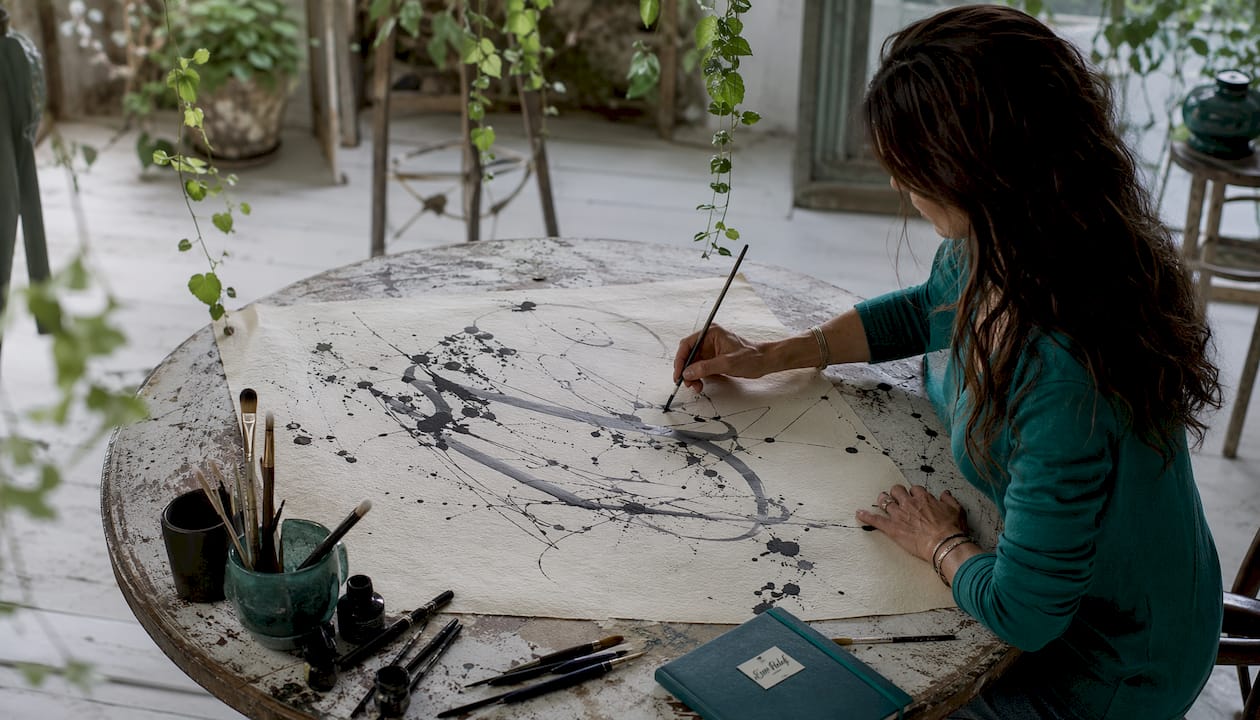
Pro Tip: The speed and tool you use bias interpretation before you make a single deliberate choice. Gestural marks made quickly with charcoal or ink tend to read as subconscious and emotionally raw. Controlled shapes drawn slowly with a fine liner read as considered and intentional. Mixing both within one drawing creates tension between the two registers — and that tension itself becomes part of the meaning.
Four abstract styles and how each shapes meaning
Recognizing broad stylistic categories helps you map formal choices to likely associations quickly.
| Style | Visual Cues | Typical Associations | Best Contexts |
|---|---|---|---|
| Gestural / expressive | Loose marks, visible brushwork, energetic line | Emotion, urgency, raw feeling | Gallery, statement walls, therapy spaces |
| Geometric / constructivist | Hard edges, grids, repeating shapes | Order, logic, modernity | Commercial spaces, minimalist interiors |
| Minimal / monochrome | Reduced palette, open space, single mark | Silence, contemplation, restraint | Meditation spaces, luxury interiors |
| Lyrical / organic | Flowing curves, soft color transitions, biomorphic forms | Nature, growth, calm, memory | Residential spaces, hospitality |
Gestural and expressive work prioritizes the mark as evidence of physical and emotional presence. The viewer reads the speed and pressure of the artist’s hand directly. Geometric and constructivist work uses structure to suggest rational order — or, when that order is distorted (as in the graphite drawing Bezweefd, where checkerboard patterns fold and twist into root-like structures), to explore the tension between control and transformation. Minimal and monochrome work uses restraint as its primary statement; what is absent carries as much weight as what is present. Lyrical and organic work moves between the two poles, using flowing forms to evoke natural processes and emotional states simultaneously.
A practical 5-step method to interpret any abstract drawing
This method applies to any abstract work, from a museum piece to a sketch on a napkin. Work through it in sequence.
- Observe. Spend two minutes looking without naming anything. Note your first physical reaction — where your eye goes, what you feel in your body. This is data.
- Describe. Name only what you see in formal terms: “There are three diagonal lines in the upper left. The marks are dense and dark at the center, lighter at the edges. The palette is limited to blue-gray and white.” No interpretation yet.
- Associate. Ask what the formal elements remind you of — personally, culturally, or metaphorically. Dense dark marks at center might remind you of pressure, a storm, a crowd. A single light line might read as escape or hope. There is no single correct interpretation; the work functions as a mirror for your own emotions and memories.
- Contextualize. Research or recall what you know about the artist’s intention, the historical period, or the cultural context. A work made during personal upheaval carries different weight when you know that. Hermeneutic-phenomenological frameworks treat drawings as multi-layered data — structured questions about spatial relationships, metaphor categories, and map type increase interpretive rigor and reduce the risk of projecting only your own experience.
- Reflect. Ask what the work triggers in you and why. What does your reaction reveal about your own associations, memories, or current state? This is where interpretation becomes personal meaning.
Exercise: Pick one abstract drawing — from a gallery, a book, or online. Apply all five steps in writing over 10 minutes. Record three distinct reactions: one physical, one associative, one contextual. The gap between them is where the most interesting meaning lives.
The limits of this method are real: multiple valid readings coexist, and artist intention does not override viewer experience. Both are legitimate sources of meaning.
How to make abstract drawings that carry personal meaning
The studio practices below work for beginners and experienced artists. The sequence matters: start loose, then constrain.
Materials to gather:
- Paper: cartridge paper for dry media, watercolor paper for wet; size A3 or larger gives room to move.
- Charcoal: vine or compressed, for gestural warm-ups.
- Ink: black and one accent color, applied with a brush, dropper, or stick.
- Graphite: a range from 2H to 6B for value control.
- Markers: fine-liner for controlled line, broad-tip for mass.
- Erasers: kneaded eraser for lifting, hard eraser for sharp removal.
- Blending tools: tortillon or fingertip for softening transitions.
Studio exercise sequence:
- Warm-up automatic drawing (15 minutes). Set a timer. Draw continuously without lifting the pen or planning the mark. Automatic drawing and meditative mark-making bypass conscious filters and tap subconscious expression. Do not evaluate during the session.
- One-line, one-thought (10 minutes). Choose a single word or feeling. Draw one continuous line that embodies it — no lifting, no correction. Repeat three times with the same word; notice how the line changes.
- Material constraint (20 minutes). Limit yourself to one tool and one color. Work on a single composition. Constraint forces formal decisions that would otherwise be avoided.
- Symbolic motif development (20 minutes). Review your automatic drawing. Identify one mark or shape that recurs or feels significant. Isolate it, redraw it at different scales, rotate it, combine it with another. This is how a personal symbol develops.
- Iteration and annotation (10 minutes). Select the strongest result from the session. Write three words beside it: what you intended, what you see now, and what it might mean to someone else. These annotations become a reference for future work.
Pro Tip: Alternate automatic mark-making with slow, deliberate mark-making within the same session. The contrast between the two registers — fast and subconscious versus slow and considered — creates internal tension in the drawing. That tension reads as narrative: something happened here, something shifted. It is one of the most reliable ways to give a single drawing a sense of time and psychological depth.
Simple exercises like continuous line, blind contour, and drawing an emotion help beginners build an abstract visual vocabulary and move past the habit of reaching for realistic depiction.
Three worked examples: how formal choices produce meaning
The table below maps formal decisions to plausible interpretations. Alternative readings are always valid; personal association is a legitimate source of meaning, not a misreading.
| Drawing Description | Formal Choices | One Interpretation |
|---|---|---|
| Dense overlapping graphite marks, dark center, lighter edges, no clear boundary | High-pressure mark-making, compressed value range, no negative space | Psychological pressure or anxiety; the center cannot hold, but the edges suggest possible release |
| Single continuous ink line on white paper, one small color accent at the terminus | Minimal mark, maximum negative space, isolated color | A journey completed; the color signals arrival or transformation after sustained effort |
| Distorted grid pattern with root-like forms pushing through, sparse color accents | Structural distortion, organic intrusion into geometric order, restrained color | Tension between control and growth; new ideas forcing their way through established structure |
The third example draws on the logic of Bezweefd, a graphite drawing in which checkerboard patterns fold and twist while root-like structures push through the composition. The artist uses color sparingly — when it appears, it carries specific weight, functioning as “moments” of life within a monochrome field. That restraint is a formal choice, and it is precisely what makes the color meaningful when it arrives.
Eman Khalifa’s approach to meaning in the studio and on the wall
Eman Khalifa is a London-based British-Egyptian-American contemporary artist whose practice spans abstract nature, seascapes, landscapes, and florals, working in oil, acrylic, and mixed media with fluid art and realism techniques. Her work focuses on atmosphere, movement, light, and psychological depth — formal concerns that translate directly into the kind of meaning this article describes.
Key aspects of her approach to meaningful abstract work:
- Recurring motifs as personal symbols. Across Eman’s portfolio, water, light, and organic movement appear as developed symbolic elements, not decorative choices. Each carries accumulated meaning across multiple works.
- Atmosphere as primary content. Rather than encoding a fixed narrative, her paintings prioritize the emotional register of a scene — the quality of light on water, the weight of a particular sky — so that viewer association can complete the meaning.
- Commission practice as applied interpretation. Eman accepts commissions, which means working directly with a collector’s stated intentions, memories, or spaces. The result is an abstract drawing or painting with meaning that is both the artist’s and the collector’s.
- Portfolio as evidence. Works like Good Tidings, Mystic Sea, and Nocturned demonstrate how fluid technique and restrained color choices produce paintings that function as emotional presences in a living space, not simply as decoration.
Her work has received press recognition from FAD Magazine and Artlyst. Viewing the abstract art collection at Emansgallery gives a direct sense of how formal choices accumulate into meaning across a body of work. Your interpretation of any piece remains valid alongside the artist’s intention.
Key Takeaways
Meaning in abstract drawing is co-created by formal choices, cultural context, and viewer association — and a structured method makes that meaning accessible to anyone.
| Point | Details |
|---|---|
| Meaning is co-created | Artist intention, formal elements, cultural context, and viewer association all contribute to meaning in abstract work. |
| Formal elements are the vocabulary | Line, shape, color, value, texture, composition, and scale each carry consistent emotional and symbolic associations. |
| Use the 5-step method | Observe, describe, associate, contextualize, and reflect — apply this sequence to any abstract drawing in 10 minutes. |
| Studio exercises build personal symbols | Automatic drawing, one-line prompts, and material constraints reliably generate marks that carry personal meaning. |
| Emansgallery as applied reference | Eman Khalifa’s portfolio demonstrates how recurring motifs, atmosphere, and restrained color choices encode meaning across a body of work. |
What meaning in abstract drawing has meant in practice
Abstract drawing taught me that intention and accident are not opposites. The marks I do not plan are often the ones that carry the most weight — not because they are random, but because they come from somewhere below the decision-making surface. When I work on a seascape or an abstracted natural form, I am not illustrating a feeling; I am finding out what the feeling looks like when it has a shape. The paintings that end up in collectors’ homes carry that process with them. Someone living with Nocturned or Mystic Sea is living with a record of attention — to light, to water, to the particular quality of a moment that resisted being named any other way. That is what abstract work with genuine intention does: it holds something that language cannot.
Original abstract art and commissions from Emansgallery
Emansgallery offers three clear routes to owning meaningful abstract work: an original painting, a bespoke commission, or a museum-quality canvas print.
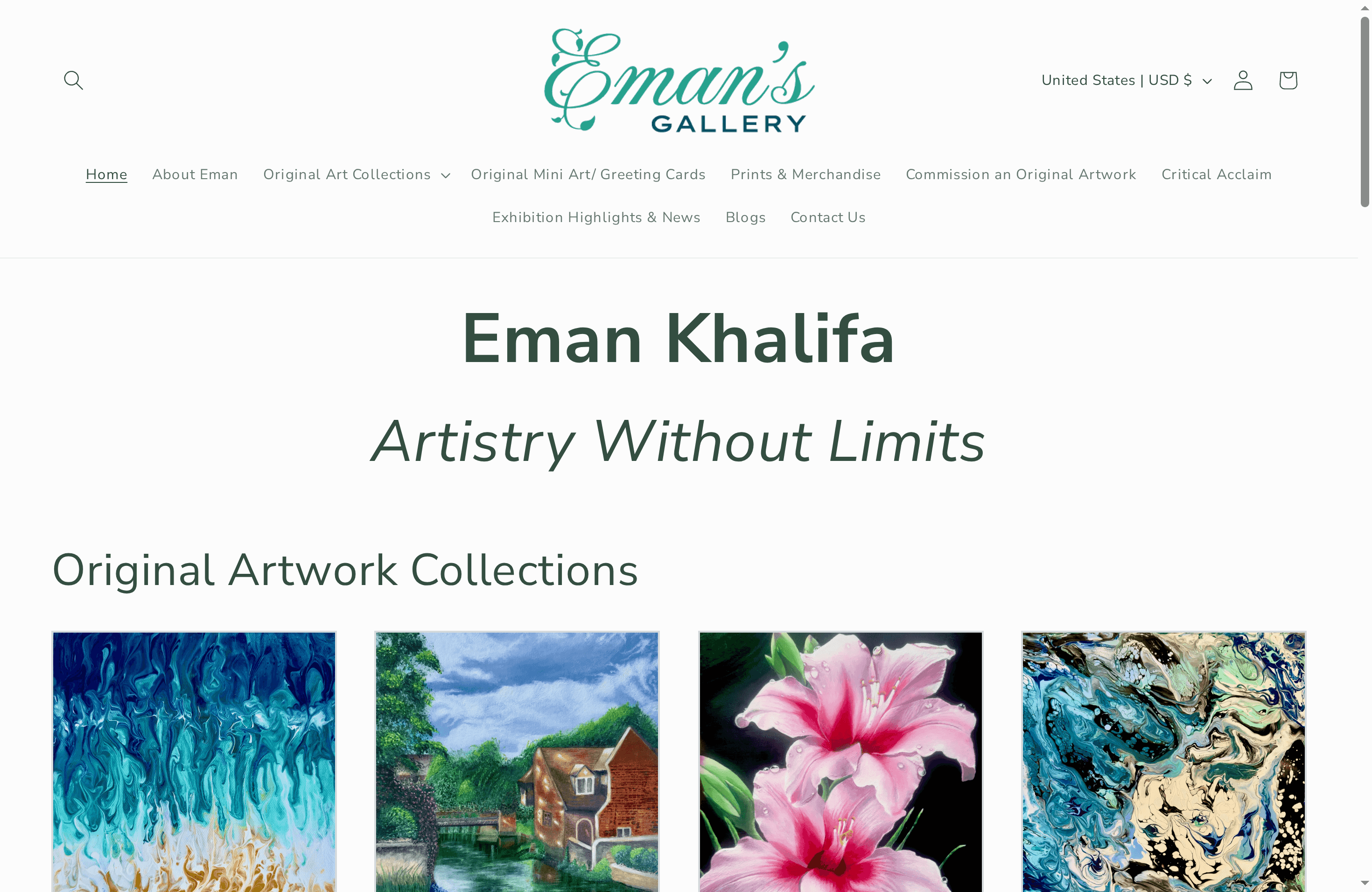
An original painting — such as Good Tidings or Mystic Sea — is a one-of-a-kind object with a specific material history. No two collectors own the same work. A commission means working directly with Eman Khalifa to develop a piece around your space, palette, or personal associations; commissions are available with customization options discussed directly with the artist. A canvas print — such as Fragments of Memory — delivers museum-quality reproduction at a lower price point, printed on archival canvas and suitable for most residential and commercial settings. For collectors pairing abstract work with interior textiles, choosing the right rug alongside a statement piece is worth considering early in the process. Browse the full collection and contact Emansgallery directly to discuss a commission or confirm availability.
Useful sources and further reading
| Source | Best For | Why Follow It |
|---|---|---|
| Tate: Abstract Art | Historical and cultural context | Museum-level framing of abstract art’s moral, spiritual, and formal dimensions |
| Fiveable: Abstract Drawing | Definition and formal elements | Clear, structured explanation of what abstract drawing prioritizes and why |
| Interpretative experiential analysis framework | Interpretive method and rigor | Hermeneutic-phenomenological approach with structured analytic prompts |
| Emansgallery abstract collection | Applied examples and portfolio | Practitioner perspective with works that demonstrate formal choices encoding meaning |
FAQ
What is the meaning of abstract drawing?
Abstract drawing uses formal elements — line, shape, color, texture, and composition — to convey emotional, conceptual, or visual experiences rather than depicting recognizable subjects. Meaning arises from the interaction between the artist’s formal choices, cultural associations, and the viewer’s own memories and emotions.
Should abstract art have meaning?
Abstract art does not require a fixed, singular meaning, but it benefits from intention. There is no single correct interpretation; the work functions as a mirror for viewer emotions and associations, which means multiple valid readings coexist alongside whatever the artist intended.
What are the four types of abstract art?
Four broadly recognized categories are gestural/expressive (loose, energetic marks conveying raw emotion), geometric/constructivist (hard-edged shapes suggesting order or logic), minimal/monochrome (restrained palette and mark emphasizing silence or contemplation), and lyrical/organic (flowing forms evoking nature and memory).
What are the key characteristics of abstract art?
Abstract art typically prioritizes formal elements over representation, uses line, shape, color, and texture to carry meaning, balances unity and variety through repetition and composition, and invites viewer association rather than directing a fixed reading. Tate also identifies historical associations with order, purity, and spirituality as recurring dimensions of abstract work.
How do you interpret an abstract drawing step by step?
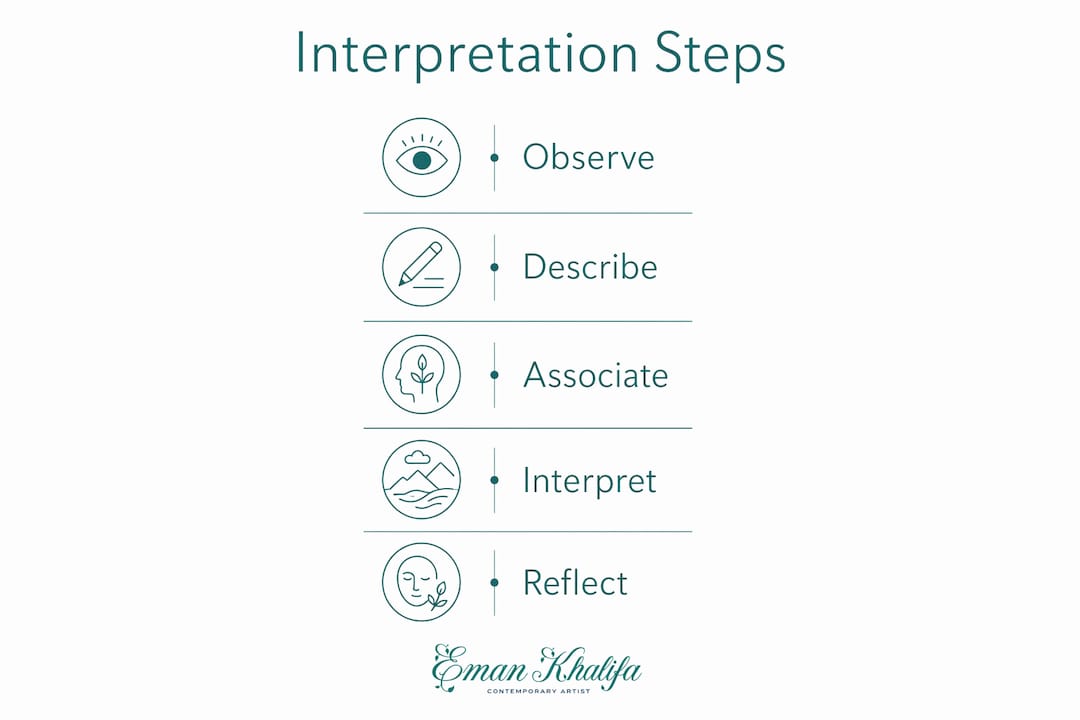
Apply five steps in sequence: observe (note your first physical reaction), describe (name only formal elements), associate (identify personal and cultural metaphors the marks trigger), contextualize (research artist intention and historical period), and reflect (consider what your reaction reveals about your own associations). This method works on any abstract drawing in about 10 minutes.
Stay Connected
- ✨ Explore Eman Khalifa's original art, fine art prints and art-inspired merchandise.
- Follow Eman Khalifa's art journey on: Instagram @emans_gallery and Facebook
- Watch Eman Khalifa creating live art on: YouTube @emans_gallery
