


Choosing Museum-Quality Wall Decals for Living Room Spaces
When we say “wall decals for living room” here, we mean something different from removable stickers. This guide covers original paintings and museum-quality canvas prints, the large-format pieces collectors and designers actually hang as permanent statements. If you’re standing in your living room right now trying to figure out what belongs on that empty wall, start with measurements, not inspiration boards.
Measure the wall and the furniture beneath it first. Your target piece should span roughly 60 to 75% of your sofa’s width, or about two thirds to three quarters of the available wall space if you’re not anchoring to furniture. Hang the center of the piece at the gallery standard: 145 to 152 cm (57 to 60 inches) from the floor.
- Define scope: original paintings and museum-quality canvas prints, not vinyl decals.
- Measure sofa or wall width before shopping for size.
- Target 60 to 75% of furniture width for a single statement piece.
- Confirm framing or stretching supports the gallery hanging height.
Pro Tip: Cut a piece of kraft paper to your target dimensions and tape it to the wall for 48 hours. If you stop noticing it, the scale is probably right.
Key Takeaways
| Point | Details |
|---|---|
| Define your scope | This guide covers original paintings and museum-quality prints, not removable vinyl stickers. |
| Measure before buying | Target 60 to 75% of sofa width or 2/3 to 3/4 of wall width for a statement piece. |
| Hang at gallery height | Center the piece at 145 to 152 cm (57 to 60 inches) with 15 to 30 cm clearance above furniture. |
| Match material to light | Choose canvas for flexibility, metal or acrylic for sun and humidity exposure, UV glazing for paper works. |
| Commission for a custom fit | Eman’s Gallery offers originals, museum-quality canvas prints, and commissions with installation guidance worldwide. |
Table of Contents
- Wall Decals for Living Room Walls: Getting Scale and Placement Right
- Material and Durability: Canvas, Prints, Acrylic, or Metal
- Style and Color: Letting the Art Set the Room’s Mood
- Buying Originals and Museum-Quality Prints: What to Ask Before You Pay
- Installation and Conservation: Fixings, Lighting, and Long-Term Care
- Pricing and Budgeting for Statement Living Room Art
- Types of Statement Wall Art Beyond Flat Canvas
- Popular Themes for Living Room Statement Art
- Preparing the Wall Before You Hang a Statement Piece
- Step-by-Step: Hanging and Repositioning Statement Art Safely
- Ongoing Maintenance for Living Room Statement Pieces
- Weighing Permanent Statement Art Against Other Wall Décor
- What I Look for When I Place a Painting in Someone’s Living Room
- See These Pieces in a Living Room Setting
- Sources
- FAQ
Wall Decals for Living Room Walls: Getting Scale and Placement Right
Most living rooms fail visually not because the art is wrong, but because it’s the wrong size. A 24 by 36 inch canvas floating above an 8 foot sofa reads as an afterthought no matter how good the painting is underneath it.
Start with two measurements: the width of the furniture the piece will hang above, and the total width of the usable wall. Designers generally recommend sizing artwork to 40 to 60 inches (100 to 150 cm) wide for a standard three-seat sofa, scaling up considerably for double-height rooms or great rooms with 10 to 12 foot ceilings.
- Measure the width of the sofa or console beneath the intended spot.
- Multiply that width by 0.6 and 0.75 to get your target artwork width range.
- Mark the gallery-standard center height of 145 to 152 cm (57 to 60 inches) from the floor.
- Leave about 15 to 30 cm of clearance between the top of the furniture and the bottom edge of the frame.
- For multi-panel or diptych works, treat the full grouping as one unit and apply the same width ratio to the combined footprint.
Most first-time buyers undersize out of caution, then live with a piece that looks apologetic rather than intentional. When you’re torn between two sizes, the larger one usually wins once it’s actually on the wall. Our guide on what size art works for living room walls walks through the math room by room if you want to run the numbers before you buy.
Material and Durability: Canvas, Prints, Acrylic, or Metal
Light does more damage to art than most buyers expect, and the material you choose should respond to how much of it your living room gets.
Canvas remains the most versatile option: flexible, relatively light to hang, and forgiving of minor humidity swings. Giclée prints on paper deliver exceptional color depth but need protection, since visible light contributes to fading over time and paper-based works are more vulnerable than stretched canvas. Acrylic-faced prints add gloss and depth while resisting surface damage. Metal or aluminum panels handle humidity and temperature swings better than canvas or paper, which makes them a strong pick for sunroom-adjacent living spaces or coastal homes.
- Canvas: lightweight, classic texture, moderate light sensitivity.
- Giclée on paper: rich color, requires glazing and UV protection.
- Acrylic-faced print: glossy depth, durable surface, moderate weight.
- Metal or aluminum: best for humidity and sun exposure, heavier mounting hardware needed.
If the wall in question catches direct afternoon sun, UV-filtering glazing isn’t optional; it’s the difference between a piece that holds its color for decades and one that visibly shifts within a few years. Works on paper should always be framed under UV glass or acrylic glazing, full stop, regardless of the room’s light levels.
Style and Color: Letting the Art Set the Room’s Mood
Buy the piece that stops you, not the one that matches your throw pillows. Designers consistently advise clients to buy what resonates and let that piece pull the room’s palette together, rather than shopping with swatches in hand.
Two color strategies work here. Analogous choices, where the art’s palette echoes tones already in the room, create calm and cohesion. Complementary choices, where the art introduces a contrasting hue, create energy and a visual anchor. Either way, the 60-30-10 rule applies well to art-led rooms: let the dominant wall color and large furniture cover 60 and 30%, then pull the remaining 10% accent color, in pillows, a vase, a throw, directly from the painting.
- Let the artwork guide furniture and accent colors, not the reverse.
- Choose analogous tones for calm, complementary tones for contrast.
- Match orientation (horizontal or vertical) to the wall’s actual proportions.
- Favor one large statement piece over several small ones on a feature wall.
Orientation matters more than most buyers realize. A wide horizontal piece over a low console reads differently than the same painting turned vertical beside a doorway. Check sightlines from the main seating position, not just from the entryway, since that’s where the piece will actually be seen day to day. For more on matching art to a room’s existing character, see our notes on choosing a wall art style for your home.
Buying Originals and Museum-Quality Prints: What to Ask Before You Pay
Provenance is not bureaucracy; it’s what protects the value and authenticity of what you’re hanging on your wall.
Before purchasing an original or a limited edition print, request the full title, year of creation, medium and support (oil on canvas, giclée on archival paper, and so on), unframed dimensions, and a signed invoice documenting the sale. If the piece is editioned, ask for the edition size and the print’s number within that run. A proper medium line on the certificate or invoice should specify materials precisely, not just say “print” or “canvas.”
- Request title, year, medium, dimensions, and edition details (if applicable) in writing.
- Confirm the signature location and compare it against the artist’s known practice.
- Ask for a signed invoice or certificate of authenticity as your provenance record.
- On arrival, unpack and inspect within 48 hours, photograph the piece and packaging, and keep the packaging until inspection is complete.
- For large or unusually shaped canvases, use a specialist for stretching or framing rather than a generalist framer.
Installation and Conservation: Fixings, Lighting, and Long-Term Care
A valuable painting hung on a single drywall anchor risks falling. Match your fixings to both the piece’s actual weight and the wall material behind it, as masonry, plaster, and stud walls all require different hardware. For wide or heavy works, use two fixings spaced across the width rather than one central hook, which keeps the piece level and distributes load.
- Use two spaced fixings for anything wider than about 90 cm (36 inches).
- Choose masonry anchors or toggle bolts for plaster and drywall; screw directly into studs where possible.
- Light with dimmable warm LED or narrow-beam picture lights rather than harsh overheads.
- Maintain gallery hanging height (145 to 152 cm center) with 15 to 30 cm clearance above furniture, per the designer-standard measurements.
Metal and acrylic-faced pieces typically mount with recessed hardware and tolerate a quick wipe with a microfiber cloth. Canvas needs a gentler touch: dust with a soft, dry brush and never use liquid cleaners near the surface.
Pro Tip: If you’re unsure whether your wall can bear a heavy framed canvas, find the stud line first. It changes which anchor you need and where the piece can actually go.
Pricing and Budgeting for Statement Living Room Art
Size, material, and finish drive most of the cost variation you’ll see between two paintings that look similar in photos. A 60 inch canvas costs meaningfully more to produce, stretch, and ship than a 30 inch one, and metal or acrylic finishes typically carry a premium over standard canvas.
- Size and material: larger works and specialty substrates (metal, acrylic) cost more.
- Framing and conservation mounting: quality framing can approach the cost of a modest artwork on its own.
- Shipping and installation: large-format pieces often need crating and specialist handling.
- Bespoke commissions: priced differently from stock pieces, based on scale, complexity, and timeline.
When requesting a quote, measure your wall first and decide on a material direction before contacting a seller or artist. A brief that includes exact dimensions, preferred medium, and intended lighting conditions gets you a far more accurate number than a generic price range ever will.
Types of Statement Wall Art Beyond Flat Canvas
Living room walls don’t have to carry a single flat rectangle. Textured works, heavy impasto oils, mixed media pieces with raised elements, or fluid art with layered resin finishes, add dimension that a flat print can’t replicate, and they catch ambient light differently throughout the day.
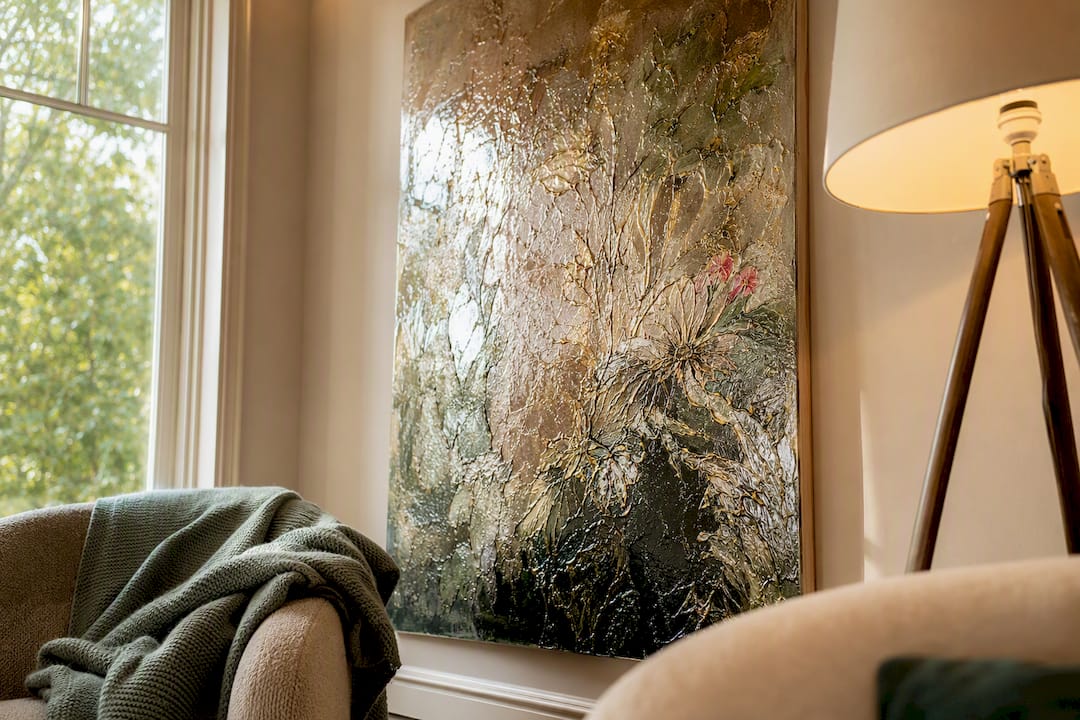
Diptychs and triptychs (two or three panel works meant to be read as one composition) suit wide walls where a single canvas would need to be unreasonably large to hit the right sizing ratio. Sculptural or dimensional pieces, including works with textured surfaces or mixed materials, add a tactile quality that flat prints can’t match, though they typically need sturdier mounting hardware given their added weight.
Metal and acrylic-faced prints introduce a different kind of dimension: light bounces off the surface rather than being absorbed the way it is with matte canvas, which changes how the piece reads at different times of day. In a room with shifting natural light, that surface quality can matter as much as the image itself.
Our piece on wall art display ideas that transform any room covers layout patterns that work particularly well for multi-panel and grouped installations. Whatever direction you choose, the underlying rule stays the same: scale and placement come before style.
Popular Themes for Living Room Statement Art
Abstract and fluid art dominate contemporary living room commissions right now, largely because the loose, non-representational forms integrate with almost any furniture style without competing for attention. Ocean and seascape themes follow closely behind, prized for the sense of movement and calm they bring into a room built for relaxing.
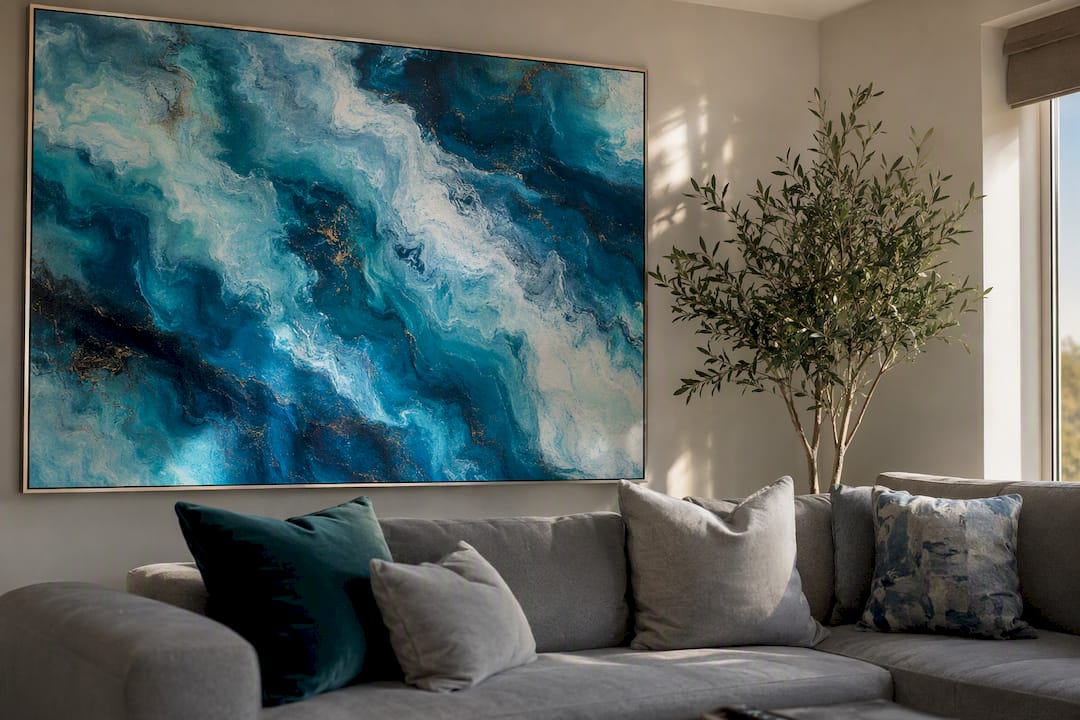
Nocturnal and tonalist works, moody, low-light scenes rendered in deep blues, golds, or muted grays, work particularly well in rooms with warm lamp lighting, where the painting’s own tonal range echoes the ambient glow rather than fighting it. Geometric and urban abstraction suits more minimal, architectural interiors, especially rooms with clean lines and limited color palettes that benefit from a single graphic anchor.
Botanical and nature-inspired pieces remain a steady favorite for buyers wanting warmth without literal representation; if you’re leaning toward natural textures more broadly, bamboo and organic wall treatments offer a complementary direction worth considering alongside a statement painting. Conceptual and expressionist works, meanwhile, suit collectors who want a piece that rewards a second and third look rather than reading instantly. None of these themes is inherently “right” for a living room; the better question is which one matches how the room is actually used, quiet reading corner versus active entertaining space, since that use shapes how much visual energy the art should bring.
Preparing the Wall Before You Hang a Statement Piece
A wall doesn’t need much preparation to receive a painting, but skipping the basics shows up later as uneven hanging or damaged plaster. Start by clearing the wall completely and wiping it down with a dry or slightly damp cloth to remove dust, since dust can interfere with anchor adhesion in plaster walls.
Check the wall surface for existing damage, hairline cracks, old nail holes, uneven texture, and patch anything visible before you commit to a hanging position. If you’re painting or repainting the wall as part of a broader refresh, let the paint cure fully, typically several weeks for oil-based paints, before drilling anchors into it.
Locate your studs using a stud finder if you’re hanging anything over roughly 7 kg (15 pounds), which covers most stretched canvases above 36 inches. For masonry or plaster walls without accessible studs, use appropriately rated wall anchors rated for the piece’s weight rather than assuming a standard picture hook will do. Mark your center point at the gallery-standard height before drilling anything, and double check it against the furniture clearance guidance covered earlier, since a small measurement error at this stage is much easier to fix on paper than after a hole is drilled.
Step-by-Step: Hanging and Repositioning Statement Art Safely
Getting a large canvas or framed print onto the wall correctly the first time saves you from patch-and-repaint work later.
- Mark your center point at 145 to 152 cm from the floor, then measure down from the piece’s hanging hardware to calculate exact nail or anchor placement.
- Use a level across the top edge before drilling, checking twice, since even a small tilt is obvious on a large piece.
- For pieces over roughly 7 kg, use wall anchors or locate studs rather than relying on a single nail.
- For wide or multi-panel works, place two fixings spaced evenly across the width to prevent sagging or tilting over time.
- Hang the piece, then step back to the main seating position to check the sightline before finalizing.
- If repositioning is needed, fill old holes with spackle, let it dry fully, then sand smooth and touch up paint before redrilling nearby.
Moving a heavy framed piece alone invites damage to both the art and the wall. A second set of hands, one supporting the frame while the other checks the level, makes the whole process faster and safer.
Ongoing Maintenance for Living Room Statement Pieces
Long-term care for original paintings and museum-quality prints is mostly about prevention rather than active cleaning. Dust canvas surfaces occasionally with a soft, dry, natural-bristle brush, moving gently in one direction rather than scrubbing. Never use household glass cleaner or water directly on an unvarnished canvas surface, since moisture can damage both the paint layer and the canvas itself.
Framed prints under glass or acrylic glazing can be cleaned with a microfiber cloth and a glass cleaner applied to the cloth, not sprayed directly onto the glazing, to avoid moisture seeping behind the frame. Metal and acrylic-faced prints tolerate a light wipe with a slightly damp microfiber cloth followed by a dry one, since their surfaces are more resistant to moisture than canvas or paper.
Check hanging hardware roughly once a year, particularly in homes with older plaster walls where anchors can loosen slightly over time or with seasonal humidity shifts. Reposition pieces away from direct sun exposure if you notice any seasonal changes in natural light patterns in the room, since a wall that’s shaded in winter can catch hours of direct afternoon sun in summer. If you ever notice fading, warping, or a musty smell near a canvas, address it immediately since humidity damage accelerates quickly once it starts.
Weighing Permanent Statement Art Against Other Wall Décor
Original paintings and museum-quality prints carry real advantages: they appreciate potential, they photograph beautifully for resale or insurance documentation, and they bring a depth of color and texture that mass-produced décor can’t replicate. They also demand more upfront thought, correct sizing, material selection suited to your room’s light, and proper installation, than décor meant to be temporary or frequently swapped.
The tradeoff is largely about intention and timeline. A permanent statement piece is chosen once and lives with you for years or decades, which rewards the extra care taken in material and placement decisions. It also represents a larger upfront investment than décor meant to be rotated seasonally or replaced on a whim.
For renters or buyers who expect to move frequently, the calculus shifts toward pieces that are easier to relocate: unframed canvases travel more easily than large framed and glazed works, and metal prints, while durable, add weight that matters during a move. For anyone planning to stay put and build a collection over time, though, an original or museum-quality print remains the stronger long-term choice, both for the visual impact and for the way it can grow in meaning as the room around it changes.
What I Look for When I Place a Painting in Someone’s Living Room
Scale is emotional before it’s mathematical. When I’m helping a collector choose a piece for their living room, I’m watching how they react to a painting’s size almost as much as its color or subject, because a piece that’s too small for a wall reads as hesitant, and a room should never feel hesitant.
My process for commissions starts with the wall itself: its dimensions, its light throughout the day, and how the room gets used. From there I work with the client on palette and scale before a single brushstroke happens, and I stay involved through installation, including advising on hanging height and color matching against existing furniture. That continuity, from concept to the moment the piece is actually mounted, is why so many of my clients commission a second piece once they’ve lived with the first.
I trained across oil, acrylic, and mixed media, and my work moves between abstract nature, seascapes, and tonalist scenes, always chasing atmosphere and emotional weight over literal representation. That range is deliberate: a living room’s needs shift from house to house, and the right painting should respond to the specific room, not a trend.
— Eman
See These Pieces in a Living Room Setting
Photos only tell you so much about scale and color depth, which is why Eman’s Gallery ships original paintings and museum-quality canvas prints worldwide, from the UK and USA to Australia, the UAE, and across Europe, so collectors can bring a piece home rather than guessing from a screen.

If a fluid, ocean-toned piece fits the mood you’re after, Good Tidings is an original painting built around exactly that kind of movement and gold-blue depth. Prefer something moodier for a room with warm evening lighting? Nocturned works as a tonalist night scene sized for a statement wall. For buyers who want museum-quality without an original’s price point, the Private Eye canvas print offers the same conceptual depth in a more accessible format. Eman also accepts commissions for collectors who want a piece built to a specific wall’s dimensions, palette, and light conditions, with installation and color guidance included. Browse the full collection or reach out to request a tailored quote for your space.
Sources
- How high to hang artwork? Designers’ guide with measurements — Chairish
- How to buy art that will look great in your home — Elle Décor
FAQ
How High Should I Hang Art Above a Sofa?
Center the piece at 145 to 152 cm (57 to 60 inches) from the floor, leaving 15 to 30 cm (6 to 12 inches) of clearance above the furniture below it.
Is Canvas or Metal Print Better for a Sunny Living Room?
Metal or acrylic-faced prints handle sun exposure and humidity better than canvas or paper, making them a stronger choice for rooms with significant direct light.
What Should I Ask Before Buying an Original Painting?
Request the title, year, medium and support, unframed dimensions, signature details, edition size if applicable, and a signed invoice for provenance.
Can Eman’s Gallery Create a Custom Piece for My Living Room?
Yes, Eman Khalifa accepts commissions and works with clients on scale, palette, and installation, in addition to offering original paintings and museum-quality canvas prints ready to order.
Stay Connected
- ✨ Explore Eman Khalifa's original art, fine art prints and art-inspired merchandise.
- Follow Eman Khalifa's art journey on: Instagram @emans_gallery and Facebook
- Watch Eman Khalifa creating live art on: YouTube @emans_gallery
