


Make a Statement: Secular Islamic Wall Art for Living Room & Designers
Islamic wall art for living room settings, in the sense collectors and designers actually shop for, means contemporary original paintings and museum-quality prints inspired by Islamic visual heritage. Not devotional calligraphy or Qur’anic verse panels, but atmospheric abstracts, geometric compositions, and expressive seascapes meant to anchor a room’s identity. For a single statement wall with long-term collection value, choose an original. For flexibility, gallery-wall layouts, or a tighter budget, a museum-quality print does the job. Eman’s Gallery, led by artist Eman Khalifa, offers both.
TL;DR:
- Originals are recommended for a statement wall that appreciates texture, uniqueness, and potential long-term value, especially in prominent living room locations.
- Museum-quality prints with archival inks and substrates can last over 100 years, making them ideal for gallery walls, seasonal displays, or budget-conscious decorating.
- Large-scale abstract or geometric artwork, centered at eye level and proportioned about two thirds of the sofa width, best achieves museum-like presence.
- Art with high contrast, bold composition, and atmospheric mood enhances depth and movement, fitting well with modern, traditional, or minimalist interiors.
- Buyers should verify archival materials, provenance, and framing details before purchase, and professionally mock up sizing to avoid incorrect scale or placement.
Table of Contents
- What “Islamic Wall Art for Living Room” Actually Means Here
- Original Paintings vs. Museum-Quality Prints: What Actually Differs
- Styles and Palettes That Give a Living Room a Museum Feel
- Getting Scale, Placement, and Lighting Right
- What “Museum-Quality” Actually Requires
- The Buying Checklist for Originals and Commissions
- Cultural and Religious Considerations Worth Understanding
- Motifs Beyond Calligraphy: Pattern, Repetition, and Form
- Fitting the Art Into Modern, Traditional, or Minimalist Rooms
- Caring for Your Painting or Print Over Time
- Where to Find Authentic Pieces Beyond a Single Gallery
- Curator’s Note: Why Originals Anchor a Collection
- Shop Eman’s Gallery: Originals, Prints, and Bespoke Commissions
- Sources
- FAQ
What “Islamic Wall Art for Living Room” Actually Means Here
Search results for this phrase often surface religious decor: framed Arabic calligraphy, verse plaques, prayer-themed prints. That is a different category, aimed at a different buyer. This guide covers something else entirely: contemporary paintings and prints that draw on pattern, color, and atmosphere rather than scripture, sized and styled for luxury living rooms.
That distinction matters because collectors and designers are not decorating a devotional space. They are furnishing a room that needs a visual anchor, something with presence, mood, and staying power. A living room can carry expressive, large-scale work that becomes a focal point in a way a hallway or bedroom cannot. This is exactly why the stakes on this particular wall are higher.
A few things shape whether a piece earns that spot:
- Provenance. Who made it, and can that be verified?
- Material. Oil, acrylic, or mixed media on canvas behaves differently under light than a print.
- Artist voice. A recognizable hand or signature technique gives a piece a reason to be a focal point rather than filler.
Original Paintings vs. Museum-Quality Prints: What Actually Differs
An original has texture you can see change as you walk past it. Brushwork catches light differently depending on the hour, and no two viewings look quite the same. Originals carry a palpable presence and a tactile record of the artist’s hand that a flat reproduction cannot replicate, and that uniqueness is exactly what collectors pay for.
Prints solve a different problem. A well-made giclée on archival canvas or paper can hold its color and structure for decades. Giclée prints made with archival inks can last 100+ years with proper care, which makes them a legitimate long-term choice, not a compromise.
Where each wins:
- Choose an original for a single dominant wall behind a sofa, in an entry that sets the tone for the whole home, or when you want a piece that appreciates in meaning and, potentially, value over time.
- Choose prints for gallery walls, rotating seasonal displays, or secondary rooms where budget needs to stretch further.
Handmade paintings generally outperform prints in luxury interiors for uniqueness and long-term value, while prints remain the stronger choice for flexible or budget-conscious décor. Before buying either, verify edition size if the print is limited, ask whether the archival claim is backed by a named ink and substrate, and request provenance documentation for any original.
Styles and Palettes That Give a Living Room a Museum Feel
Not every painting reads as museum-quality once it is on a wall instead of in a gallery. Scale, palette, and composition decide that, not the price tag.
Atmospheric abstracts work well in living rooms because they read differently depending on the light and the viewer’s mood, which keeps the room feeling alive rather than static. Geometric abstraction, drawing on the rhythm and repetition long associated with Islamic pattern traditions, brings structure without literal ornamentation. Textured florals and large seascapes or landscapes fill big walls with movement rather than flatness.
A few working rules:
- Let the art set the room’s mood; do not force it to match the sofa fabric exactly.
- Favor contrast over harmony. A piece that echoes the walls too closely disappears into them.
- Leave breathing room. Crowding a painting with furniture or shelving undercuts its presence.
Pro Tip: Stand at the room’s main entry point and look toward the wall you are considering. If the piece does not pull your eye the moment you walk in, it is either too small or too quiet for that spot.
Eman Khalifa’s practice moves between abstract nature, seascapes, and florals with a focus on atmosphere and light, which is precisely the register that reads as intentional rather than decorative in a formal living room. For more on matching mood to wall, the gallery’s styling guide covers composition cues in more depth.
Getting Scale, Placement, and Lighting Right
A painting that looks right in a gallery can look wrong at home if the proportions are off. A few fixed rules solve most of the guesswork:
- Size for the wall, not the room. Above a sofa, the piece should span roughly two thirds of the sofa’s width.
- Match orientation to the space. Wide, low sightlines call for landscape formats; tall, narrow walls call for portrait or vertical groupings.
- Center at eye level. Aim for the piece’s center around 57 to 60 inches from the floor, adjusted slightly lower in rooms with low seating.
- Mock it up before buying. Gallery-provided sizing templates and mockups prevent the two most common purchase regrets: too small and too high.
- Light it deliberately. Use an adjustable accent fixture angled to avoid glare on the surface, and keep dimming available so the piece can shift from daytime clarity to evening mood.
Grouping multiple prints works on the same logic as a single large original: treat the grouping as one visual mass, sized and centered as if it were a single canvas.
What “Museum-Quality” Actually Requires
The phrase gets used loosely. A genuine museum-quality claim rests on specific materials, not marketing language.
- Archival substrates. Cotton or poly-cotton canvas and acid-free archival paper resist yellowing and warping.
- Pigment-based inks. Archival giclée printing depends on stable, light-resistant inks rather than standard dye-based inkjet.
- Framing choices. Conservation glazing with UV-filtering glass protects paper works; float frames suit canvas pieces that need visible edges; gallery wraps skip framing entirely for a clean, contemporary edge.
- Shipping and handling. Rigid crating and climate-aware packing matter most for oil originals, which can be sensitive to humidity swings in transit.
Buyers should ask any gallery to state its archival materials and print partner outright. Verifying archival ink and substrate claims directly with the gallery is a reasonable ask, and a gallery confident in its materials will answer without hesitation.
The Buying Checklist for Originals and Commissions
A good purchase, original or print, comes down to a handful of confirmations before money changes hands.
- Confirm exact dimensions against your wall, not an approximate size range.
- Request a digital mockup or scale template for the actual space.
- Ask about provenance for originals and edition numbering for limited prints.
- Review the stated materials: canvas type, pigment or ink system, and any finish coating.
- Confirm shipping method, insurance coverage, and estimated delivery window.
- Understand the return policy, especially for made-to-order or commissioned work.
Commissioning follows a fairly standard sequence: you share a brief describing size, palette, and mood; the artist proposes a concept, often with a sketch or color study; you approve a mockup against your actual wall; a deposit secures the production slot; the finished piece ships once cured and packed. Timelines for an original commission typically run several weeks to a few months depending on scale and technique.
Eman’s Gallery offers concrete examples of how this plays out across both originals and prints. Good Tidings, a fluid blue and gold ocean piece, works as a statement original for a bright, open living room. Nocturned, a tonalist moonlit scene, suits a moodier, low-light space. Mystic Sea brings fluid abstract movement in ocean gold tones for collectors wanting texture and depth. On the print side, Private Eye offers conceptual expressionism for a smaller budget, Fragments of Memory delivers abstract ink-splash energy, and City in Grids brings geometric urban structure to a more minimal room.
| Buyer priority | Better fit | Why |
|---|---|---|
| Single statement wall, long-term value | Original (e.g., Good Tidings) | Unique, appreciates in personal and collection value |
| Moody, low-light room | Original (e.g., Nocturned) | Tonal depth reads differently under warm light |
| Budget-conscious gallery wall | Museum-quality print (e.g., Private Eye) | Archival quality at lower cost, repeatable |
| Geometric, minimal interior | Museum-quality print (e.g., City in Grids) | Clean structure suits pared-back rooms |
Cultural and Religious Considerations Worth Understanding
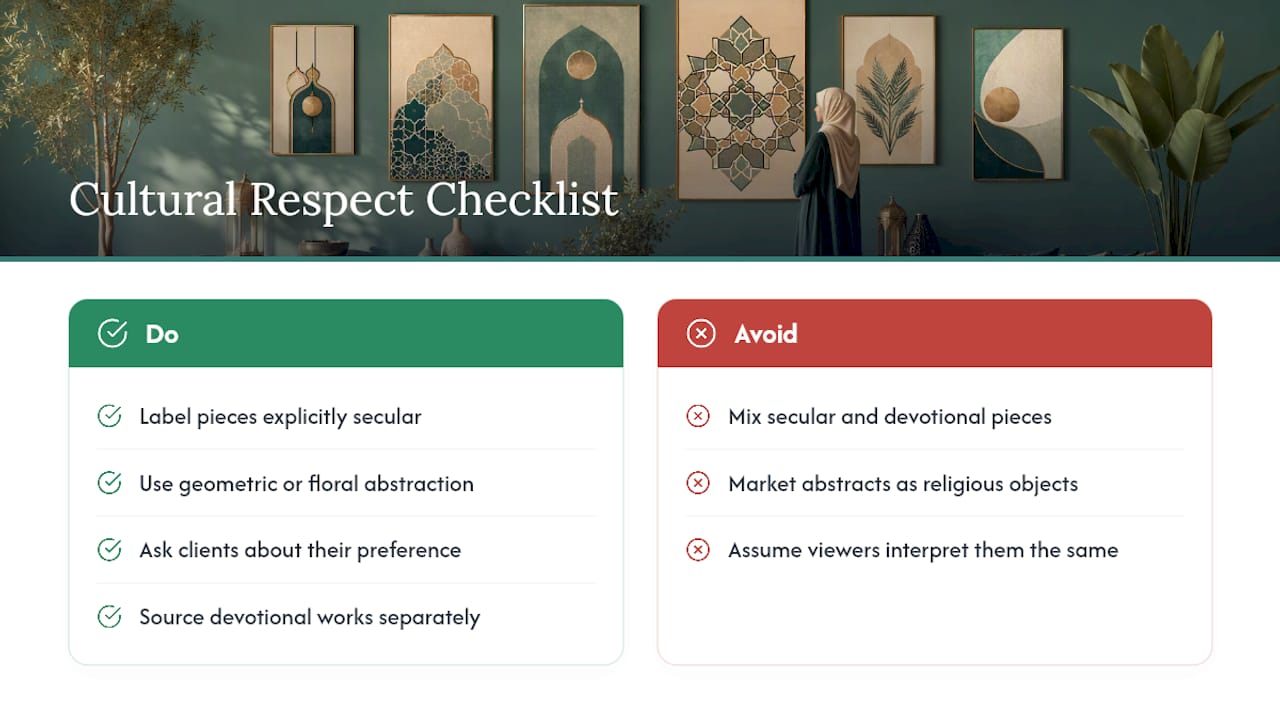
Because this category sits adjacent to religious Islamic art, it is worth being direct about the distinction. The pieces covered here are secular contemporary works inspired by pattern, movement, and atmosphere. They are not devotional objects and carry no religious text or liturgical function.
That said, sensitivity still matters, particularly for collectors and designers working across culturally diverse client bases. A geometric abstract that echoes traditional pattern-making reads very differently to different viewers depending on their own relationship to that visual language. Some guests will see elegant abstraction; others may read cultural or spiritual meaning into it whether or not the artist intended it.
The practical guidance is straightforward: be transparent about what a piece is and is not. If a design house or homeowner wants to signal cultural appreciation without venturing into religious symbolism, secular geometric or floral abstraction achieves that without the ambiguity that comes from anything resembling scripture or verse. Designers working with clients from Muslim backgrounds should ask directly whether the household wants explicitly secular work or is open to devotional pieces sourced separately and elsewhere. The two categories should not be blended on the same wall, and a contemporary abstract piece should never be mistaken for, or marketed as, a religious object.
Respecting that boundary is not a limitation on the art. It is what keeps a genuinely beautiful piece from being misread.
Motifs Beyond Calligraphy: Pattern, Repetition, and Form
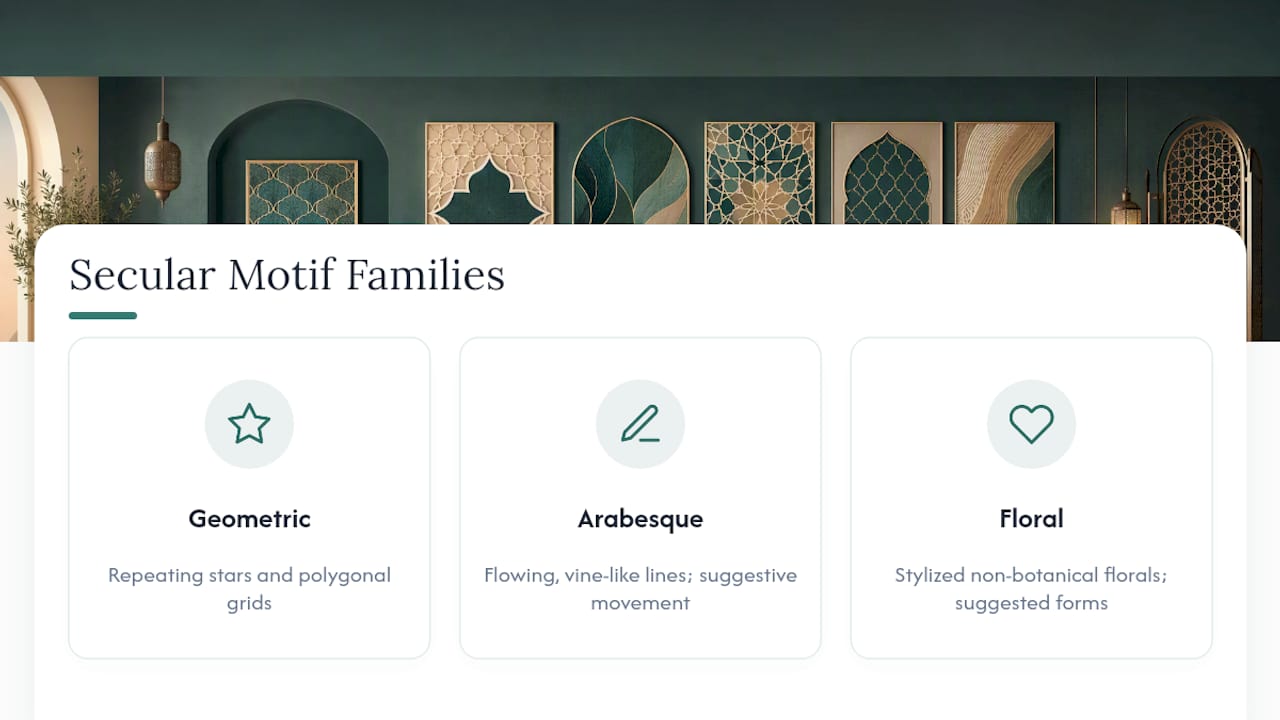
Islamic visual heritage runs far deeper than script. Geometric pattern, arabesque line work, and stylized florals have carried centuries of design language independent of any religious text, and contemporary artists draw on all three without touching devotional content.
Geometric patterns built on repeating stars, polygons, and interlocking grids translate naturally into modern abstract painting. A piece like City in Grids takes that structural logic and reframes it as pure urban geometry rather than ornamental tiling. The repetition creates rhythm on a wall the way a printed textile does, but at a scale that holds its own on a large surface.
Arabesque forms, the flowing, vine-like lines historically used in manuscript borders and architectural relief, show up today in fluid abstract painting. Sweeping, continuous lines that echo without literally copying that tradition give a piece movement without being derivative or decorative in a cliché way.
Floral motifs round out the set. Stylized, non-botanical florals, rooted in a long decorative tradition, work particularly well as textured mixed-media paintings where the flower is more suggestion than illustration. None of these three motif families require religious framing to carry cultural weight, which is exactly why they translate so well into secular contemporary collecting.
Fitting the Art Into Modern, Traditional, or Minimalist Rooms
The same painting can look entirely different depending on the room around it, so matching motif to interior style matters as much as choosing the piece itself.
In a modern interior, heavy on clean lines and neutral palettes, geometric abstraction earns its place by echoing the room’s structure while adding color and depth the architecture lacks on its own. A piece like City in Grids sits comfortably against exposed concrete or matte cabinetry without fighting the space.
Traditional interiors, with richer wood tones and layered textiles, tend to favor arabesque or floral abstraction. The flowing lines soften a room that already leans formal, and warmer palettes like the gold tones in Mystic Sea complement dark wood rather than competing with it.
Minimalist rooms benefit most from restraint on the wall itself. One large, quiet piece, an atmospheric seascape or a single-tone abstract, does more work than a busy composition. The goal in a minimalist space is a single visual event, not a collection of competing details.
Across all three, the through-line is contrast rather than matching. A room does not need art that repeats its existing palette; it needs art that gives the palette a reason to exist.
Caring for Your Painting or Print Over Time
Materials dictate maintenance, and oil originals, acrylic works, and archival prints each ask for slightly different handling.
- Oil paintings need stable humidity and indirect light. Direct sun fades pigment over years; a spot near a south-facing window without UV film is the most common cause of premature fading.
- Acrylic and mixed media are more forgiving of humidity but still benefit from dusting with a soft, dry brush rather than any liquid cleaner.
- Archival canvas prints hold up well long-term but should avoid direct spray cleaners; a barely damp microfiber cloth is sufficient for surface dust.
- Framed paper prints behind conservation glazing need only glass cleaning, never applied directly, always sprayed on the cloth first to avoid seepage under the frame.
Climate matters more than most buyers expect. Rooms with fireplaces, radiators, or frequent humidity swings from cooking or bathing nearby put more stress on canvas and paper than a stable, climate-controlled room ever will. A yearly visual check, looking for warping at the edges, color shift near light sources, or any looseness in the stretcher bars, catches most problems before they become permanent.
Where to Find Authentic Pieces Beyond a Single Gallery
A dedicated contemporary gallery is not the only legitimate source, though it is generally the most reliable for provenance and material transparency. Artisan cooperatives and independent print studios in regions with strong pattern-based craft traditions sometimes sell directly, though verifying archival claims and provenance takes more diligence without a gallery’s documentation standards behind the sale.
Online platforms built around independent artists have expanded access considerably, letting collectors browse a far wider range of geometric and abstract work than a local gallery circuit alone could offer. The trade-off is the same one that applies everywhere in this category: the burden of verifying materials, edition size, and authenticity shifts more heavily onto the buyer when there is no established gallery relationship backing the sale. Cross-cultural design resources, including guides on integrating Asian art traditions into modern interiors, offer useful parallel thinking on blending pattern-rich art into contemporary rooms, since the styling logic often transfers across traditions even when the visual vocabulary differs.
Whichever source a buyer chooses, the same checklist applies: confirmed materials, transparent provenance, and a clear return policy if the piece does not read correctly on the wall.
Curator’s Note: Why Originals Anchor a Collection
Staging a home with an original, rather than a print, changes how a room is perceived almost immediately. Fine art used in luxury staging does double duty, decorative and investment signal at once, and buyers notice the difference between a room dressed in reproductions and one built around a genuine piece, even when they cannot articulate why.
That does not mean every wall needs an original. The strongest living rooms tend to mix both: one anchor original on the primary wall, museum-quality prints doing quieter work elsewhere. It gives a collection room to grow without asking every surface to carry the same weight.
— Eman
Shop Eman’s Gallery: Originals, Prints, and Bespoke Commissions
Eman’s Gallery gives you a direct line to both sides of this decision instead of piecing together an original from one source and a print from another. Every original is painted by Eman Khalifa, and every museum-quality print ships from the same archival standards described earlier in this guide, with worldwide shipping already built into the process.
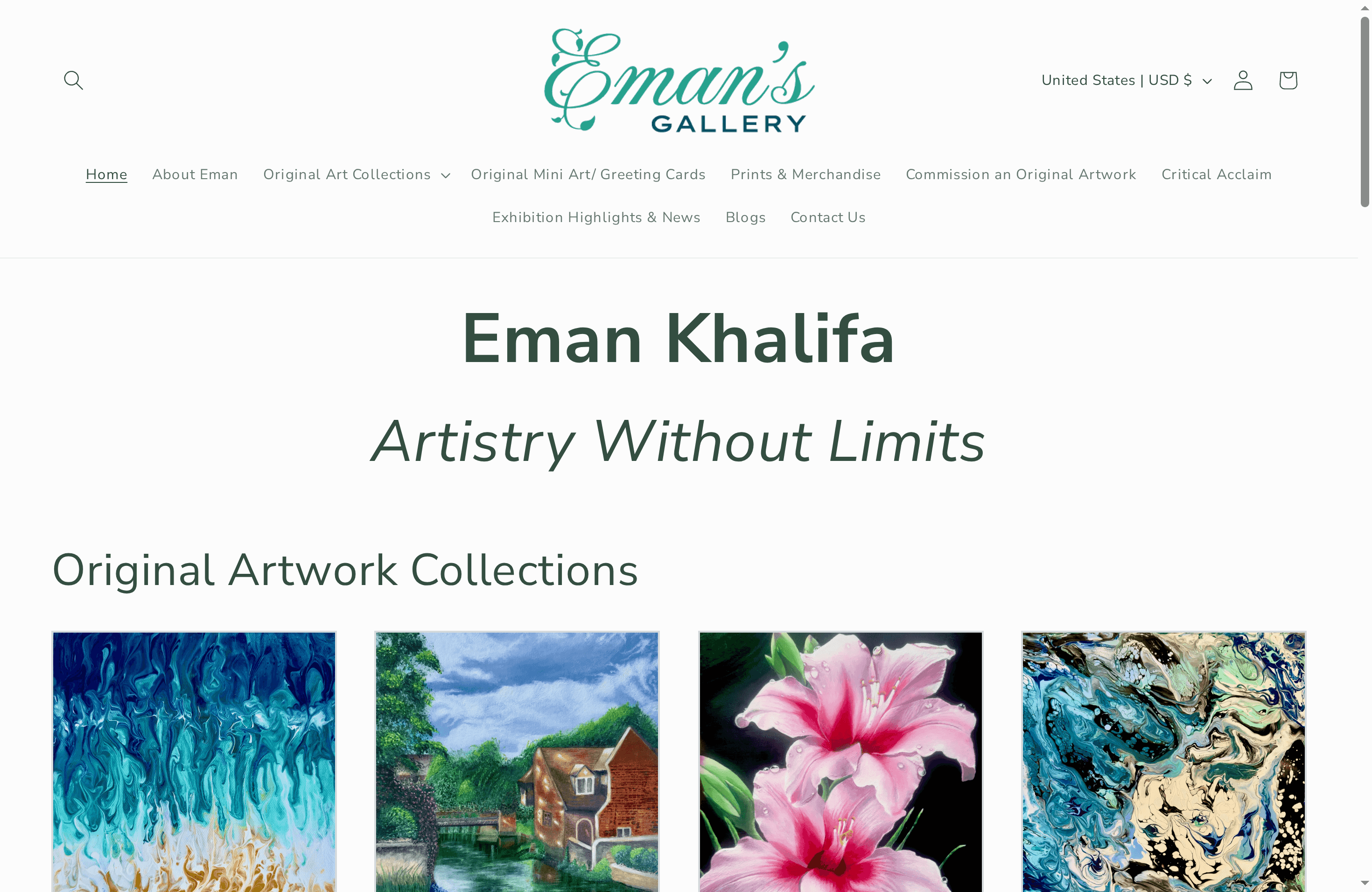
If a statement original is what your living room needs, Good Tidings and Mystic Sea are available now, alongside the moodier tones of Nocturned. Prefer a flexible print for a gallery wall or a first purchase? Private Eye and Fragments of Memory are both printed on archival canvas. If none of the current pieces match your wall exactly, commissioning gives you a piece built to your dimensions and palette from the brief onward. Browse the current collection, request a mockup for your space, or start a commission conversation directly through Eman’s Gallery today.
Sources
- Original Art vs. Prints: Complete 2026 Buyer’s Guide - Chiltern Fine Art
- How to Choose Art for Your Home - A Room by Room Guide - Marea Gallery
- How Fine Art Became Part Of Luxury Staging — And The Home Sale | Inman Real Estate News
- Why Handmade Paintings Are Better Than Prints for Luxury Interiors - Futomic Design Services-FDS
FAQ
What does “Islamic wall art for living room” mean on Eman’s Gallery?
It refers to contemporary original paintings and museum-quality prints inspired by pattern, geometry, and atmosphere, not devotional calligraphy or verse-based decor.
Should I buy an original or a museum-quality print?
Choose an original for a single statement wall with long-term collection value, and a museum-quality print for gallery walls, secondary rooms, or a tighter budget.
How long do museum-quality prints actually last?
Archival giclée prints made with pigment-based inks can last 100+ years when kept out of direct sunlight and stable humidity.
What size painting works above a standard sofa?
Aim for a piece spanning roughly two thirds of the sofa’s width, centered around 57 to 60 inches from the floor, and confirm with a sizing mockup before ordering.
How does commissioning an original from Eman’s Gallery work?
You submit a brief on size, palette, and mood, review a concept and mockup, pay a deposit, and the finished piece ships once completed and cured, with timelines depending on scale and technique.
Stay Connected
- ✨ Explore Eman Khalifa's original art, fine art prints and art-inspired merchandise.
- Follow Eman Khalifa's art journey on: Instagram @emans_gallery and Facebook
- Watch Eman Khalifa creating live art on: YouTube @emans_gallery
