


Cubism by Pablo Picasso: A Visual Analysis Guide
Cubism by Pablo Picasso and Georges Braque, developed in Paris between roughly 1907 and 1914, dismantled Renaissance perspective by representing subjects simultaneously from multiple viewpoints across fragmented geometric planes. The movement’s anchor works — Les Demoiselles d’Avignon (1907, MoMA), Ma Jolie (1911–12), and Still Life With Chair Caning (1912) — mark three distinct phases that dealer Daniel-Henry Kahnweiler documented and supported from the start. The Metropolitan Museum of Art frames the movement as the single most consequential break with pictorial convention in Western art since the Renaissance.
Core elements of Picasso’s Cubist practice:
- Multiple viewpoints: A face, guitar, or bottle appears from front, side, and above within a single plane.
- Planar faceting: Forms are broken into interlocking geometric fragments rather than modeled with light and shadow.
- Reduced palette: The Analytic phase uses muted ochres, grays, and browns; color returns in the Synthetic phase.
- Collage and papiers collés: From 1912, Picasso introduced newspaper clippings, oilcloth, and stenciled lettering directly into compositions.
Key Takeaways
Cubism by Pablo Picasso, developed with Georges Braque between 1907 and 1914, replaced Renaissance perspective with fragmented geometric planes viewed simultaneously from multiple angles across three distinct phases.
| Point | Details |
|---|---|
| Three core phases | Proto-Cubism (c. 1907), Analytic (c. 1908–1912), and Synthetic (from c. 1912) each use distinct techniques and palettes. |
| Five canonical works | Les Demoiselles d’Avignon, Girl with a Mandolin, Portrait of Kahnweiler, Ma Jolie, and Still Life With Chair Caning map the full arc. |
| Conceptual aim | Cubism depicts what is known about a subject, not what a single viewpoint shows — structure over optical impression. |
| Kahnweiler’s role | Dealer Daniel-Henry Kahnweiler’s patronage and records are primary sources for dating and attributing Analytic-phase works. |
| Use the checklist | Apply the seven-step analysis checklist (date, palette, viewpoints, faceting, collage, conceptual reading, Braque comparison) in any museum setting. |
Table of Contents
- How does Cubism fit into Picasso’s career chronology?
- What influences shaped Picasso’s Cubist vision?
- What does Analytic Cubism look like in Picasso’s work?
- How did Synthetic Cubism change Picasso’s approach?
- How did the social world around Picasso shape Cubism?
- What technical devices define Picasso’s Cubist visual language?
- What are the key Picasso Cubist works and where are they held?
- How was Cubism received by critics and the public?
- What is Cubism’s legacy across art, design, and performance?
- How do you analyze a Picasso Cubist painting step by step?
- How Cubism informs contemporary painting practice
- Explore Cubist-Inspired Contemporary Art at Emansgallery
- Sources
- FAQ
How does Cubism fit into Picasso’s career chronology?
The movement’s core formative period spans 1907 to 1914 — seven years that reshaped the entire trajectory of modern art.
| Phase | Years | Visual Characteristics | Techniques | Representative Works |
|---|---|---|---|---|
| Proto-Cubism | c. 1907 | Flattened planes, mask-like faces, multiple viewpoints emerging | Oil on canvas; Cézannian structure meets African and Iberian forms | Les Demoiselles d’Avignon (1907) |
| Analytic Cubism | c. 1908–1912 | Near-monochrome palette; dense faceting; forms dissolve into planes | Oil on canvas; tight geometric fragmentation | Girl with a Mandolin (—); Ma Jolie (1911–12); Portrait of Daniel-Henry Kahnweiler |
| Synthetic Cubism | c. 1912 onward | Simpler, flatter shapes; brighter color; text and found materials | Collage, papiers collés, stenciling, mixed media | Still Life With Chair Caning (1912); papiers collés series |
| Return to order | c. 1917 onward | Cubist devices coexist with classical figuration | Oil, drawing; Cubist geometry applied selectively | Portraits and figure studies alongside Cubist works |
1907–1914: The seven-year core period in which Picasso and Braque established every major device the movement would use.
Picasso’s stylistic fluidity means these phases overlap rather than replace one another. Christie’s notes that even at the height of Cubism he returned to figurative and classical modes, a pattern later called le rappel à l’ordre (“return to order”). Phase labels are useful reference points, not rigid containers.
What influences shaped Picasso’s Cubist vision?
No single source produced Cubism. Picasso drew on several converging forces simultaneously, and the synthesis was rapid.
- Paul Cézanne’s late work: Cézanne’s insistence on treating nature through geometric solids — the cylinder, sphere, and cone — gave Picasso a structural framework for dismantling conventional modeling. The 1907 Cézanne retrospective at the Salon d’Automne arrived just as Picasso was completing Les Demoiselles d’Avignon.
- African and Iberian art: Picasso’s visit to the ethnographic collection at the Palais du Trocadéro in 1907 exposed him to African masks whose flattened, simultaneous-view faces appear directly in the right-hand figures of Les Demoiselles. Iberian sculpture, which he had studied earlier, contributed the simplified, frontal facial structure of the left-hand figures.
- Les Demoiselles d’Avignon (1907): The painting synthesizes all of these threads. The Metropolitan Museum of Art treats it as proto-Cubist: its flattened planes, multiple viewpoints, and tribal-art references make it the hinge between Post-Impressionism and the fully Cubist works that followed.
- Georges Braque: After meeting Braque in 1907, Picasso found a collaborator whose parallel experiments with Cézannian structure accelerated the development of a shared visual language.
- Kahnweiler’s network: Dealer Daniel-Henry Kahnweiler recognized the importance of Les Demoiselles immediately and committed to supporting Picasso’s work, providing financial stability that allowed sustained experimentation.
What does Analytic Cubism look like in Picasso’s work?
MoMA describes Analytic Cubism as a joint invention: Picasso and Braque worked side by side, breaking lifelike depiction into interlocking geometric components and often producing works so visually similar that attribution requires dealer records and studio chronology.
The defining traits are a near-monochrome palette (ochres, grays, tans), dense planar faceting that fragments a figure or object into dozens of overlapping planes, and the near-disappearance of conventional space. The subject — a musician, a bottle, a sitter — remains legible but only barely, dissolved into a shimmering lattice of planes.
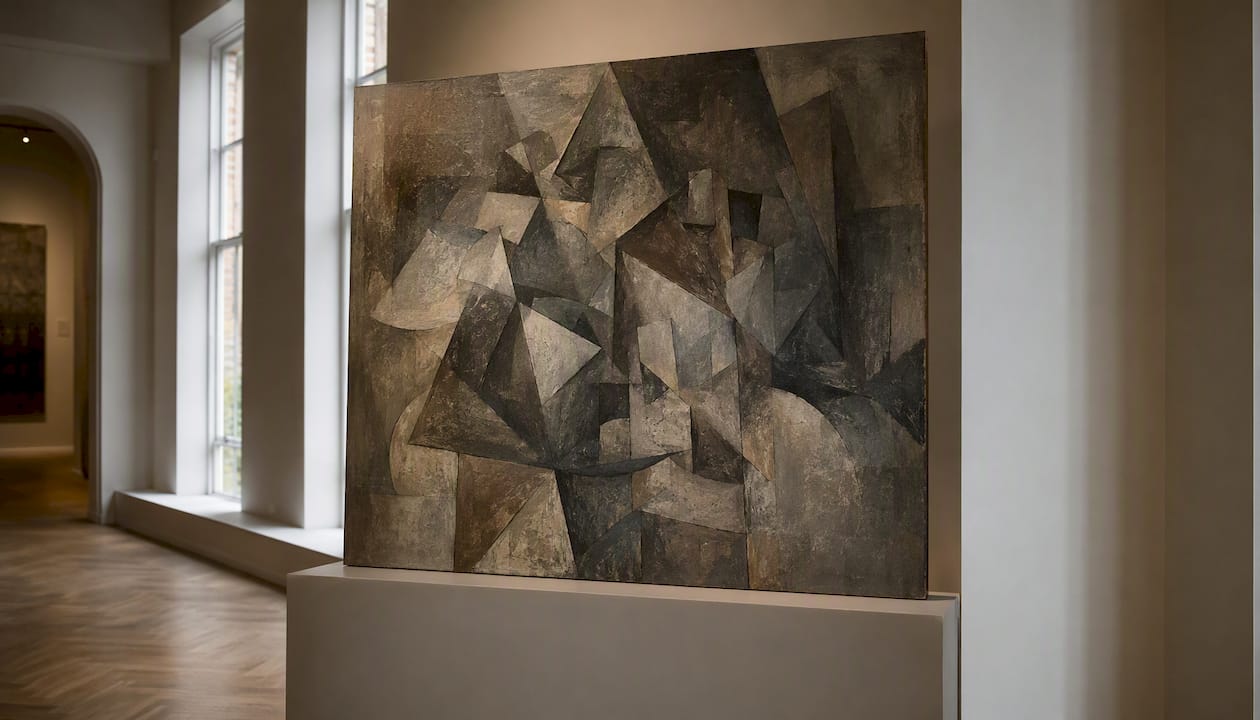
When captioning a work from this phase, note: the palette range (how close to monochrome), the degree of faceting (can you still read the subject?), and whether any plane reads as “in front of” another or whether depth has been fully collapsed.
How did Synthetic Cubism change Picasso’s approach?
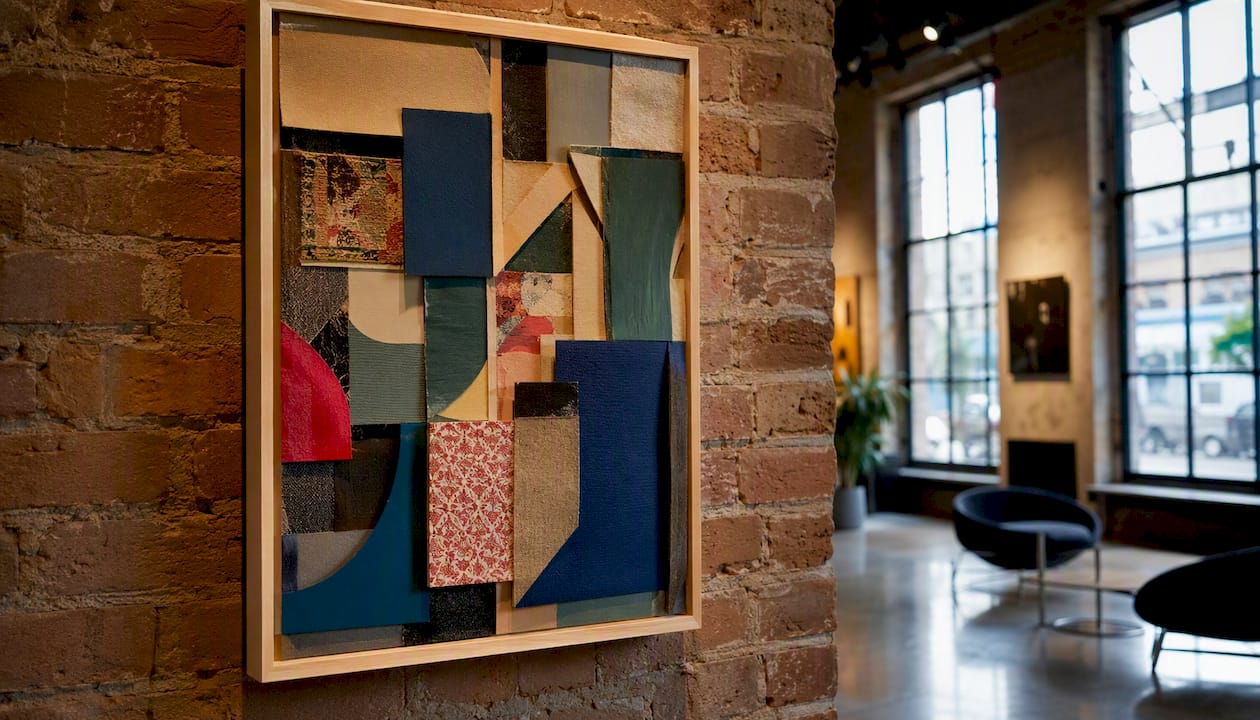
The shift from Analytic to Synthetic Cubism is a shift in method, not just appearance. Analytic Cubism takes a subject apart; Synthetic Cubism builds a sign for it from simpler, more legible components.
Musée Picasso Paris dates the Synthetic turn to around 1912, when Picasso began introducing collage elements and stenciled lettering. The palette brightens, shapes flatten and simplify, and found materials enter the picture surface directly.
| Work | Date | New Materials / Techniques | Significance |
|---|---|---|---|
| Still Life With Chair Caning | May 1912 | Oilcloth printed with chair-caning pattern; rope frame | First major collage; the oilcloth is both a representation of caning and a literal piece of material — the picture surface becomes an assemblage |
| Papiers collés series | 1912–1914 | Newspaper clippings, colored paper, charcoal | Text and printed matter become pictorial elements; the image alludes to objects rather than decomposing them |
The conceptual reorientation is significant. Where Analytic Cubism asked “how many planes does it take to describe a guitar?”, Synthetic Cubism asked “what is the minimum sign that stands for a guitar?” The picture stops being an illusion and becomes an object made of signs.
How did the social world around Picasso shape Cubism?
Cubism did not develop in isolation. Its formation depended on a specific network of relationships, institutions, and urban conditions.
- The Picasso–Braque collaboration: MoMA frames their partnership as a joint invention of a new visual language. Braque later described the two artists as “two mountaineers roped together” — a phrase that captures the daily, near-identical exchange of the 1908–1912 period. Works from those years are sometimes indistinguishable without provenance documentation.
- Daniel-Henry Kahnweiler: His gallery on Rue Vignon gave Picasso and Braque financial support and a private exhibition context outside the official Salons. Kahnweiler’s dealer records and correspondence are now primary sources for dating and attributing works from the Analytic period.
- Salon des Indépendants and Section d’Or: The “Salon Cubists” — Juan Gris, Fernand Léger, Albert Gleizes, Jean Metzinger — exhibited at these public venues and brought Cubist ideas to wider audiences. Picasso and Braque themselves rarely showed at the Salons during the core years; their work reached the public through Kahnweiler’s network.
- The 1913 Armory Show: This New York exhibition introduced Cubism to American audiences and critics, generating both scandal and serious attention. It remains a landmark in the transatlantic dissemination of modern art.
- Pre-WWI Paris: The rapid modernization of urban life — new technologies, mass print culture, fragmented experience — created a cultural context in which Cubism’s fractured, simultaneous vision felt like an accurate account of contemporary perception rather than mere formal experiment.
What technical devices define Picasso’s Cubist visual language?
- Simultaneity: Multiple viewpoints of the same object appear within a single pictorial plane. A nose is shown in profile and frontally at the same time.
- Planar faceting: Continuous surfaces are broken into discrete geometric planes. The planes interpenetrate rather than recede in conventional perspective.
- Restricted palette (Analytic phase): Ochres, grays, and tans reduce color to near-neutrality, forcing the eye to read structure rather than hue.
- Fragmentation and reassembly: Analytic works decompose; Synthetic works reassemble using simplified signs and found materials.
- Text and brand imagery (Synthetic phase): Stenciled words, newspaper mastheads, and commercial lettering enter the picture as both image and sign simultaneously.
The conceptual aim, as Tate explains, is to depict “what you know is there” rather than what a single optical impression delivers. A Cubist portrait shows the front and side of a face because both are known to exist, even if no single viewpoint reveals both.
Pro Tip: The clearest way to distinguish a Picasso Analytic Cubist work from a Braque of the same period is to look at the handling of the figure’s edges. Picasso tends to preserve a stronger residual silhouette — a shoulder line, a jaw — even at peak fragmentation, while Braque allows the figure to dissolve more completely into the surrounding field. This difference in “figure pressure” is subtle but consistent across the 1909–1912 works.
What are the key Picasso Cubist works and where are they held?
These five works are the canonical reference points for any study of Cubist artworks by Picasso.
Musée Picasso Paris holds Still Life With Chair Caning and provides the most detailed curatorial documentation of the Synthetic turn. MoMA’s holdings of Les Demoiselles, Girl with a Mandolin, and Ma Jolie make it the single most important institution for studying the Analytic phase in person.
How was Cubism received by critics and the public?
The public reception of Cubism was uneven, and the timeline of its institutionalization matters.
1911–1913: The three years in which Cubism moved from a private studio experiment to an internationally debated movement, via the Salon des Indépendants (1911), the Section d’Or exhibition (1912), and the Armory Show (New York, 1913).
The name “Cubism” itself was not chosen by Picasso or Braque. Critic Louis Vauxcelles coined it in 1908 after seeing Braque’s landscapes described as reduced to “geometric outlines, to cubes.” Neither artist embraced the label. The Salon Cubists — Gleizes, Metzinger, Léger, and Juan Gris — were the ones who exhibited publicly and published theoretical texts, including Du Cubisme (1912) by Gleizes and Metzinger, which gave the movement its first systematic written defense.
Guillaume Apollinaire’s criticism and poetry provided a parallel theoretical framework, framing Cubism as a new kind of truth-telling rather than mere formal experiment. His advocacy helped shift critical reception from hostility to serious engagement.
The authorship question — who invented Cubism, Picasso or Braque? — was debated from the start and remains a point of curatorial nuance. The Art Institute of Chicago notes the private, collaborative intensity of the early years, which explains why works from 1909–1912 are visually so similar and why provenance and dealer records are critical for attribution. Picasso’s greater public profile meant he received more credit in popular accounts; curatorial scholarship now treats the invention as genuinely shared.
What is Cubism’s legacy across art, design, and performance?
Cubism’s influence extended well beyond painting within a decade of its formation.
- Collage and mixed media: The papiers collés technique fed directly into Dada and Surrealist collage practice. Kurt Schwitters, Hannah Höch, and Max Ernst all worked with methods Picasso and Braque had established.
- Modern graphic design: The flattening of pictorial space, the use of text as image, and the grid-based fragmentation of Cubism became foundational to 20th-century graphic and typographic design.
- Stage and costume design: Picasso himself designed sets and costumes for the Ballets Russes, including Parade (1917), bringing Cubist geometry directly into performance. The collaboration with Sergei Diaghilev and Jean Cocteau made Cubist aesthetics visible to audiences far beyond the gallery circuit.
- Poetry and literature: Apollinaire’s Calligrammes (1918) applied Cubist simultaneity to the printed page. Gertrude Stein’s prose style has been described in similar terms.
- Architecture: Le Corbusier’s Purism drew on Cubist reduction; later, Cubist fragmentation influenced Deconstructivist architecture.
- Abstract art: The formal experiments of Analytic Cubism — the collapse of depth, the grid, the plane — are direct precursors to the pictorial flatness that Clement Greenberg would later theorize as the defining condition of modernist painting.
MoMA’s permanent collection and its recurring thematic exhibitions map this legacy in depth, positioning Cubism as the origin point of multiple 20th-century movements rather than a single bounded style. For collectors interested in how these influences shape contemporary art styles, the Cubist lineage remains directly relevant.
How do you analyze a Picasso Cubist painting step by step?
Use this checklist in a museum, classroom, or when studying a reproduction.
- Identify the date and phase. Establish whether the work is proto-Cubist (pre-1908), Analytic (c. 1908–1912), or Synthetic (c. 1912 onward). Date and phase determine which devices to look for.
- Note the palette. A near-monochrome range of ochres and grays signals the Analytic phase. Brighter, more varied color, or the presence of patterned paper, signals Synthetic.
- Map the viewpoints. Identify where the same object or body part appears from more than one angle simultaneously. Note how many distinct viewpoints you can count within a single figure.
- Trace the faceting. Follow the edges of individual planes. Do they interpenetrate? Do they create a sense of depth, or does the surface remain flat?
- Look for collage or text signifiers. Stenciled words, newspaper fragments, or patterned materials indicate the Synthetic phase. Ask what the text or material refers to and whether it functions as image, sign, or both.
- Ask what the painting “knows” versus what it “shows.” A Cubist work depicts knowledge of an object’s total form, not a single optical impression. This is the conceptual core that Tate identifies as Cubism’s central aim.
- Compare to a Braque work from the same year. Note differences in figure pressure, palette temperature, and degree of dissolution. The comparison clarifies each artist’s distinct contribution.
Pro Tip: When writing a visual-analysis paragraph, lead with structure, not subject matter. “The figure dissolves into seventeen interlocking planes across a compressed ochre field” is more analytically precise than “Picasso painted a woman playing guitar.” Subject identification is the starting point; structural description is the analysis.
Gallery labels and studio marks are worth examining closely. Kahnweiler’s records and the stamps of his gallery are primary provenance cues for works from the 1908–1914 period; their presence on a work significantly strengthens attribution confidence.
How Cubism informs contemporary painting practice
Cubist strategies — fragmentation, the simultaneous viewpoint, the collaged surface — did not end with Picasso. They remain active compositional tools in contemporary studio practice.
The decision to show multiple states of a subject within a single plane is, at its core, a decision about what a painting is for. If a painting’s purpose is to record a single optical impression, conventional perspective serves that aim. If its purpose is to convey accumulated knowledge of a subject — its weight, its texture, its relationship to surrounding space across time — then fragmentation and simultaneity become precise instruments rather than stylistic gestures. This is why Cubist devices recur in abstract painting, in collage-based work, and in any practice that treats the picture surface as a field of signs rather than a window.
Studying Picasso’s Analytic works closely — particularly the way Portrait of Daniel-Henry Kahnweiler holds a residual human presence within near-total geometric dissolution — clarifies something that no amount of theoretical reading can replace: the tension between legibility and abstraction is a compositional problem, not a philosophical one. You solve it with line, plane, and palette, one decision at a time.
For collectors and practitioners interested in how these principles translate into modern abstract art trends, the Cubist lineage offers a precise historical anchor for understanding why fragmentation and geometric structure remain central to contemporary practice.
Explore Cubist-Inspired Contemporary Art at Emansgallery
Picasso’s Cubist legacy lives in any work that treats the picture surface as a field of interlocking decisions rather than a transparent window. Emansgallery’s City in Grids canvas print — a geometric abstract urban composition — carries that structural thinking into a contemporary register, as does the conceptual expressionism of the Private Eye canvas print. Both are available as museum-quality prints, shipped worldwide.
Sources
- Cubism | The Metropolitan Museum of Art
- What Is Cubism? | MoMA
- Made for the Present: The Many Styles of Pablo Picasso | Art Institute of Chicago
- Cubism | Musée Picasso Paris
- All about cubism | Tate
- Pablo Picasso: a style guide | Christie’s
FAQ
What is Cubism by Picasso?
Cubism by Pablo Picasso is a movement he developed with Georges Braque in Paris from roughly 1907 to 1914, representing subjects from multiple simultaneous viewpoints across fragmented geometric planes rather than through conventional single-point perspective.
What are five key facts about Cubism?
The name was coined by critic Louis Vauxcelles in 1908; the movement has two main phases (Analytic and Synthetic); Les Demoiselles d’Avignon (1907) is the proto-Cubist starting point; dealer Kahnweiler’s records are primary attribution sources; and Cubism directly influenced Dada, Surrealism, and modern graphic design.
What is Picasso’s most famous Cubist work?
Les Demoiselles d’Avignon (1907, MoMA) is most frequently cited as the pivotal proto-Cubist work, while Still Life With Chair Caning (1912) is considered the first major Cubist collage.
Is Cubism an abstract style?
Cubism is not fully abstract — subjects remain identifiable, particularly in the Synthetic phase — but it departs from realistic representation by showing multiple viewpoints simultaneously, placing it between figuration and abstraction.
How is Analytic Cubism different from Synthetic Cubism?
Analytic Cubism (c. 1908–1912) uses a near-monochrome palette and dense faceting to decompose a subject into planes; Synthetic Cubism (from c. 1912) uses simpler shapes, brighter color, and collaged materials to build a sign for the subject rather than analyze it.
Stay Connected
- ✨ Explore Eman Khalifa's original art, fine art prints and art-inspired merchandise.
- Follow Eman Khalifa's art journey on: Instagram @emans_gallery and Facebook
- Watch Eman Khalifa creating live art on: YouTube @emans_gallery
