


Choosing Christian Wall Art for Living Room Spaces
Christian wall art for living room settings, in the way most designers and collectors now use the phrase, means original contemporary paintings or museum-quality prints chosen to anchor a room rather than devotional prints or scripture text. If that’s the goal, the rule is simple: choose one statement original, or a museum-quality print, sized to your furniture, made with archival materials, and selected for the texture and scale that holds a room together. The home decor market has shifted hard toward artist-made, one-of-a-kind pieces over mass-produced decor, and Eman’s Gallery sits squarely in that shift with in-stock originals and archival canvas prints built for exactly this kind of anchor placement.
Key Takeaways
The strongest living-room art choice prioritizes archival material quality and correct scale over subject matter, whether the piece is an original or a museum-quality print.
| Point | Details |
|---|---|
| Assess the room first | Measure wall width, sofa width, ceiling height, and track natural light before shopping for art. |
| Follow the two-thirds rule | Size artwork to roughly two-thirds the width of the furniture beneath it, centered 6 to 8 inches above. |
| Match material to light | Choose canvas for warm, low-glare rooms and UV-glazed paper prints for sunnier walls. |
| Plan commission logistics early | Budget 6 to 10 weeks total for a commissioned original, including varnish cure and shipping. |
| Consider Eman’s Gallery | Eman’s Gallery offers in-stock originals, museum-quality canvas prints, and full commission support with international shipping. |
Table of Contents
- Why Originals and Museum-Quality Prints Matter More Than Style Alone
- How Do You Assess a Living Room Before Choosing Art?
- What Size Should Living Room Art Be?
- Which Materials and Finishes Work Best in a Living Room?
- What to Expect When Commissioning or Buying Original Art
- How Do You Build a Living-Room Art Collection Over Time?
- How Do You Care for Art on Display in a Living Room?
- How Eman’s Gallery Supports Living-Room Art Decisions
- Choosing Motifs and Symbolism That Fit Your Room and Audience
- Matching Art to Your Existing Décor and Color Palette
- Where to Buy or Commission Contemporary Art With Spiritual Depth
- A Curator’s Note on Texture, Scale, and What a Room Remembers
- Bring an Original or Museum-Quality Print Into Your Living Room
- Sources
- FAQ
Why Originals and Museum-Quality Prints Matter More Than Style Alone
An original painting carries physical evidence of its making: raised brushstrokes, layered glazes, the drag of a palette knife across canvas. A print of the same composition can be beautiful and accurate, but it reads as flat by comparison, no matter how good the color reproduction.
Museum-quality prints still earn their place. Giclée printing on archival canvas delivers consistent, accurate color and durability at a fraction of an original’s price, and for many living rooms that trade-off makes sense.
- Originals: one-of-a-kind, textured, higher investment, strongest emotional anchor
- Museum-quality prints: consistent color, archival inks, accessible pricing, easier to replace or resize
- Hybrid approach: an original as the anchor piece, prints filling secondary walls
Texture is what separates a painting you glance at from one you keep noticing. An original holds the light differently every hour of the day, and that quiet variation is often what makes a living room feel finished rather than decorated.
The decision between the two usually comes down to scale and budget. A 60 inch original above a sectional sofa is a serious commitment in both cost and negotiation with a room’s proportions. A museum-quality print at the same scale lets you test a bold gesture before committing to an original later.
How Do You Assess a Living Room Before Choosing Art?
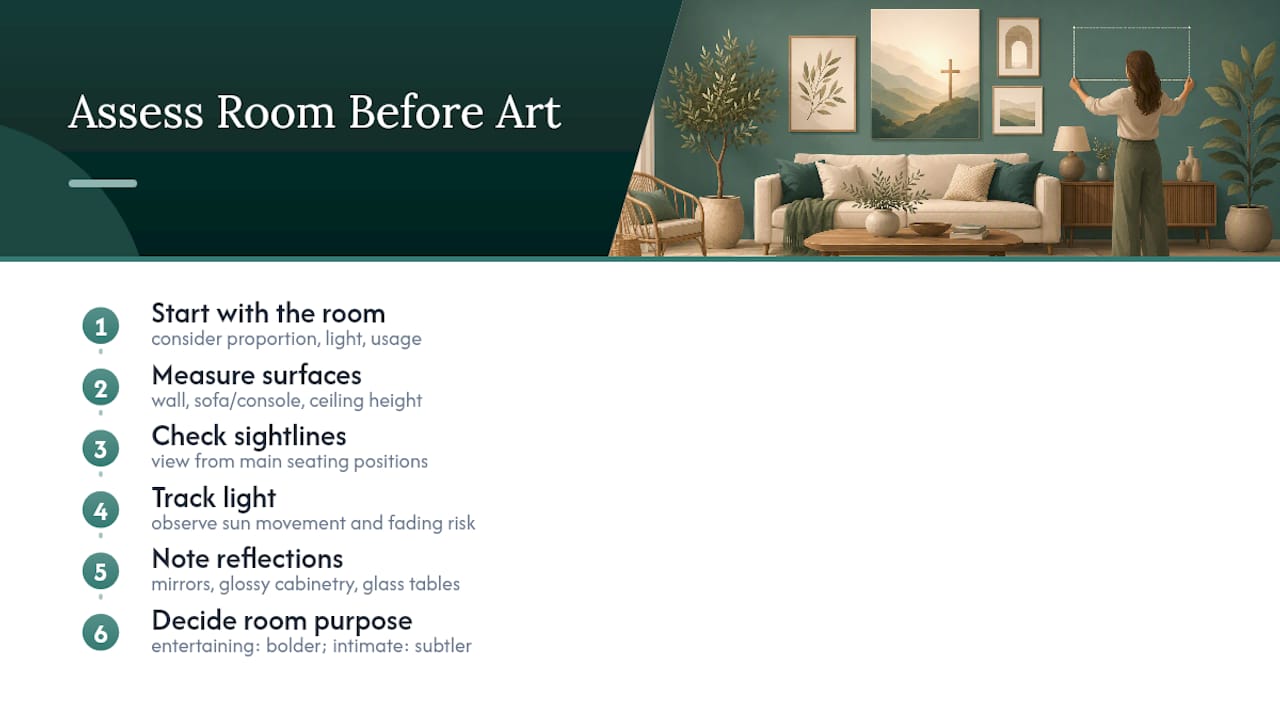
Start with the room itself, not the art. Proportion, natural light, and how the room actually gets used determine which pieces will succeed far more than any color-matching exercise.
Measure the wall you’re working with, along with the sofa or console beneath it, and note the ceiling height. Stand in the main seating positions and check what you actually see from there. A piece that looks perfect from the doorway can feel oddly placed from the armchair where people actually sit for hours.
Track how light moves through the room across a full day. South-facing rooms with long afternoon sun will fade unprotected paper prints and can throw glare across glazed frames. Note any reflective surfaces nearby, mirrors, glossy cabinetry, glass coffee tables, that might compete with or wash out the art.
Finally, decide what the room is for. A living room built for entertaining can carry bolder, more textural work that holds up under conversation and movement. A quieter, more intimate sitting room often calls for something subtler that rewards a longer look.
What Size Should Living Room Art Be?
The most reliable sizing rule in interior design: artwork width should run roughly two-thirds the width of the furniture beneath it. Over a sofa, that means measuring the sofa’s full width and aiming for a piece (or grouping) that fills about 60 to 70 percent of that span.
- Center the artwork 6 to 8 inches above the top of the sofa back, not the wall’s midpoint
- For a solo statement piece, err toward oversized. Design trend reporting for 2026 points to oversized, textured, hand-painted canvases as a defining living-room move
- For multi-piece arrangements, treat the grouping as one visual object: keep spacing between pieces between 2 and 4 inches, and measure the whole cluster against the two-thirds rule
- Before hanging anything permanently, tape the outline to the wall and step back to the main seating spot. What looks right up close often looks small from across the room
Tall-ceiling rooms distort perception in a specific way: a piece that seems generous at eye level can shrink visually once it sits under 10 or 12 feet of empty wall above it. In those rooms, go a size larger than instinct suggests, or build a vertical arrangement that draws the eye upward instead of leaving dead space overhead.
Which Materials and Finishes Work Best in a Living Room?
Canvas, paper, and acrylic each behave differently under living-room light, and the choice affects both mood and maintenance.
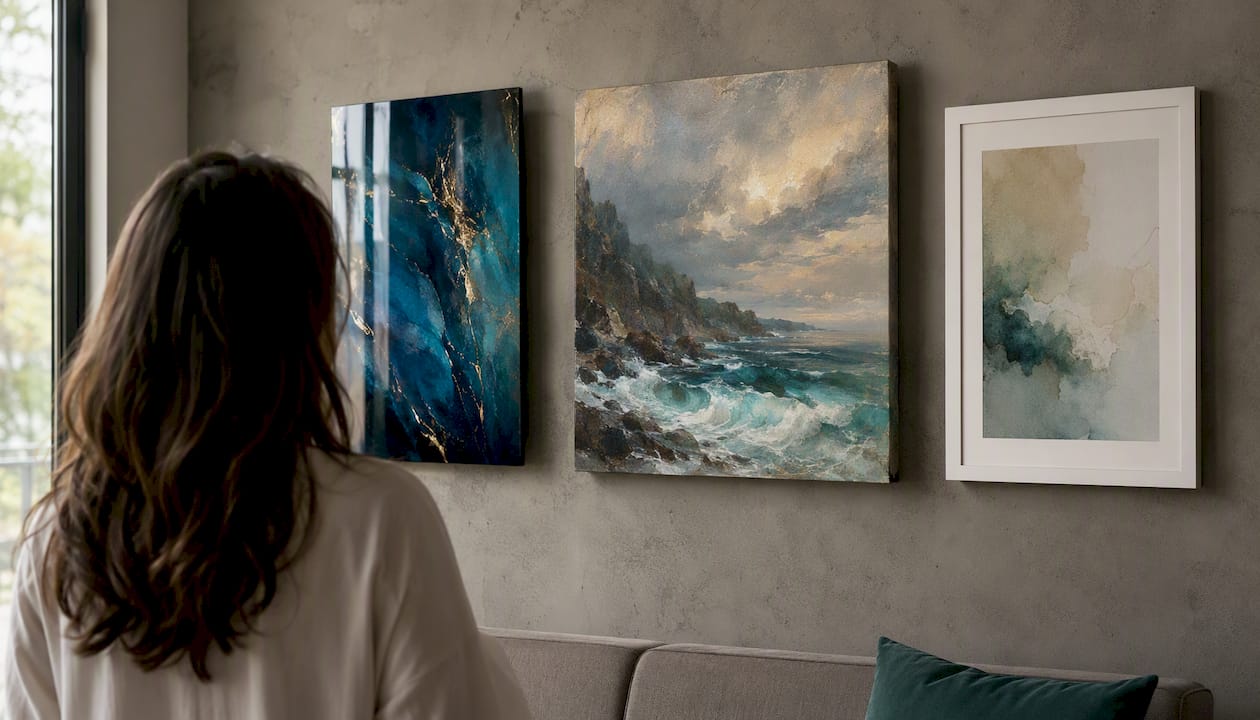
| Material | Look and Feel | Light Behavior | Best For |
|---|---|---|---|
| Canvas (original or print) | Matte, textured, tactile | Minimal glare, absorbs light | Warm, lived-in rooms |
| Fine art paper | Crisp, delicate detail | Can fade without UV glazing | Smaller works, low-light walls |
| Acrylic/metal print | Glossy, high contrast | Reflective, can create glare near windows | Contemporary, minimalist spaces |
Glazing decisions matter as much as the base material. Glass over a paper print keeps dust and moisture out but can throw glare across a piece hung opposite a window. UV-filtering glazing solves the fading problem for works on paper without the same reflectivity issue, though it adds cost. Original paintings on canvas are typically finished with a protective varnish instead of glass, which preserves the texture that makes an original worth owning in the first place.
For mood, a textured varnish on an original adds warmth and tactile depth that suits a room built around comfort. An acrylic-mounted print, by contrast, brings a color pop and contemporary sheen that reads well in a sleek, architectural space. Choose framing that echoes the room’s existing lines: floating frames for modern interiors, deeper traditional frames for rooms with more classical millwork.
What to Expect When Commissioning or Buying Original Art
Commissioning an original follows a fairly predictable arc, though timelines vary by artist and medium.
Price generally scales with size, medium, and the artist’s exhibition history, so a 24 inch study and a 60 inch statement piece from the same artist can sit at very different price points even before framing is added.
Before committing to a deposit:
- Confirm the deposit percentage and payment milestones in writing before work begins
- Ask what happens if you want changes mid-process, and whether that resets the timeline
- Request a condition report and confirm insurance coverage during transit
- Ask about crate type for international shipping. Wooden crates protect large canvases far better than cardboard for overseas transit
- Request a signed certificate of authenticity with provenance notes for any original purchase
Museum-quality prints move faster, usually shipping within one to two weeks since there’s no painting stage, but they still deserve the same attention to packing and condition documentation.
How Do You Build a Living-Room Art Collection Over Time?
Treat a living room’s art the way a good curator treats a gallery wall: as an ongoing conversation, not a single purchase. Buying every piece from one source or one series tends to flatten a room. Mixing an established original, a newer or emerging voice, and one or two meaningful found objects gives a space depth that grows more interesting over years, not less.
- Vary scale deliberately: one large anchor piece paired with two or three smaller works reads more intentional than five pieces of similar size
- Repeat a material, color, or gesture across a room to create rhythm without matching everything literally
- Use prints on secondary walls, hallways, reading nooks, powder rooms, and reserve originals for the primary sightline wall
- Let adjoining rooms echo each other loosely rather than matching exactly, so a home feels connected without feeling staged
If you want a broader sense of how different art types function across a home before settling on a direction, the types of home decor art guide walks through several categories worth considering, and pairing statement art with smaller modern accessory pieces is a straightforward way to round out a gallery wall without overcrowding it.
How Do You Care for Art on Display in a Living Room?
Living rooms get more daily light exposure and more foot traffic than almost any other room in a home, which makes preservation habits worth building early rather than after damage appears.
- Keep works on paper out of direct, prolonged sunlight; UV glazing helps, but placement still matters more
- Hold originals away from radiators, fireplaces, and exterior walls prone to temperature swings
- Dust gently with a soft, dry brush or microfiber cloth. Never use household cleaning sprays on a painted surface
- Handle unframed canvases with clean hands or cotton gloves to avoid oil transfer
- Revarnishing an oil original every 15 to 25 years keeps the surface protected without dulling the color underneath
Pro Tip: Schedule a quick visual check of your originals every six months, the same way you’d check smoke detectors. Look for hairline cracks near the frame edge or subtle color shifts near windows. Catching either early is far cheaper than a full conservation treatment later.
For anything above a few thousand dollars in value, a standalone fine art insurance rider and a written condition report at time of purchase are worth the modest annual cost. Most standard homeowner policies cap fine art coverage well below what a collection is actually worth.
How Eman’s Gallery Supports Living-Room Art Decisions
Eman Khalifa works across oil, acrylic, and mixed media, moving between fluid abstraction, seascapes, and tonalist scenes, all built around texture, movement, and atmosphere rather than literal representation. That range gives buyers real options depending on whether a room calls for a bold anchor or something quieter.
- In-stock originals, including large-scale seascapes and moody nocturnes ready for immediate placement
- Museum-quality canvas prints for secondary walls or budget-conscious primary walls
- A commission process for buyers who want a specific scale, palette, or mood matched to their space
- Framing guidance and installation support so a piece arrives ready to hang correctly the first time
Commissions typically follow the same concept-to-shipping arc outlined earlier, with a deposit securing the sketch phase and milestone payments tied to progress photos along the way. The gallery ships internationally, with regular delivery to the UK, USA, Canada, Australia, and across the EU and UAE, and every original leaves the studio with a signed certificate of authenticity and provenance notes. The gallery’s own guide to choosing original artwork covers sizing and placement in more detail for buyers still narrowing down a direction.
Choosing Motifs and Symbolism That Fit Your Room and Audience
If your living room does call for imagery with spiritual or symbolic weight, the strongest choices tend to work at the level of feeling rather than literal iconography: light breaking across water, a horizon at dawn, movement suggesting renewal or calm. This approach reads as sophisticated in a collector’s home and avoids the visual heaviness that overtly literal religious imagery can bring to a shared, secular space like a living room.
Consider who actually uses the room. A family living room that hosts guests of varied backgrounds generally does better with symbolic, atmospheric work than with explicit iconography, while a more private sitting room offers more latitude for personal meaning. Scale matters here too: a large, abstract piece built around light and transcendence tends to feel more like sophisticated decor than a smaller, more literal image would in the same spot.
Matching Art to Your Existing Décor and Color Palette
Color matching matters less than most people assume. Trade guidance consistently points to proportion, light, and mood as the stronger drivers of whether a piece works in a room, ahead of finding an exact hue match to your throw pillows.
That said, a few practical habits help a piece feel integrated rather than bolted on. Pull one or two tones from the painting and repeat them elsewhere in the room, a cushion, a vase, a rug border, so the eye has a reason to connect the piece to its surroundings. In a warm, neutral living room, a piece with cooler blues or golds can act as a deliberate contrast point rather than a clash, provided the framing and wall color give it room to breathe. For a full framework on aligning a piece’s palette and style with a room’s existing character, the gallery’s wall art style guide is a useful starting point before making a final decision.
Where to Buy or Commission Contemporary Art With Spiritual Depth
Reputable sourcing matters as much as the image itself. Look for galleries and artists with a documented exhibition history, clear provenance practices, and transparent commission processes rather than anonymous print marketplaces with no named artist behind the work.
Eman Khalifa’s practice has drawn coverage from FAD Magazine and Artlyst, two publications that track contemporary art with a critical eye, which gives collectors a way to verify the artist’s standing beyond the gallery’s own site. Works like the original painting Good Tidings, a fluid blue and gold ocean composition, and Nocturned, a tonalist moonlit night scene, both illustrate how atmosphere and light can carry symbolic weight without literal imagery. For buyers weighing a print instead, the canvas edition of Fragments of Memory shows how abstract, ink-splash compositions can hold emotional resonance at a more accessible price point.
A Curator’s Note on Texture, Scale, and What a Room Remembers
The living rooms that stay interesting after ten years almost always have one thing in common: at least one piece with real texture, something the eye keeps returning to because it isn’t fully resolved at a glance. Flat, decorative prints fill a wall. Textured originals, or prints made to the highest archival standard, hold a room’s attention over time in a way that has less to do with subject matter and more to do with the physical presence of the work.
Scale does something similar. A piece sized correctly for its wall reads as architecture, not decoration, and that distinction is what separates a room that feels curated from one that feels furnished. If you’re weighing a specific wall, a particular light condition, or a commission concept, Eman’s Gallery welcomes direct inquiries for a private consultation on scale, palette, and timeline before you commit to anything.
Bring an Original or Museum-Quality Print Into Your Living Room
Once you know the wall, the light, and the scale you’re working with, the next step is simple: look at actual pieces built for exactly this kind of placement. Eman’s Gallery carries in-stock originals like Mystic Sea, a large-scale fluid abstract in ocean gold tones built for a statement wall, alongside museum-quality canvas prints like City in Grids for rooms that call for geometric structure instead.
Every original ships with a signed certificate of authenticity, and every canvas print is produced to archival standards with framing guidance included, so a piece arrives ready for the wall you measured, not a generic size that forces a compromise. Commissions follow the concept-to-shipping timeline outlined earlier, with milestone payments and progress photos throughout. If a specific palette, scale, or mood is what you’re after, reach out through Eman’s Gallery to start a commission inquiry or browse current originals before your next installation date.
Sources
For readers who want to go deeper on any single decision covered here, these sources provide additional detail and specification.
- How to Choose the Best Art for Your Home
- How to Choose Statement Wall Art That Actually Transforms a Room in 2026 - Steeze Magazine
FAQ
What Does “Christian Wall Art for Living Room” Mean in This Context?
Here, it refers to original contemporary paintings or museum-quality prints selected to anchor a living room through scale, texture, and light, not scripture-based or devotional decor.
Should I Choose an Original or a Museum-Quality Print?
Choose an original when texture and one-of-a-kind presence matter most; choose a museum-quality print when consistent color and a lower price point better fit your budget and timeline.
How Big Should a Living Room Painting Be?
Aim for artwork width equal to roughly two-thirds the width of the sofa or console beneath it, centered 6 to 8 inches above the furniture.
How Long Does Commissioning an Original Painting Take?
A typical commission runs 6 to 10 weeks total, covering concept and sketch, painting, varnish curing, and packing for shipment.
Does Eman’s Gallery Offer Commissions and International Shipping?
Yes. Eman’s Gallery accepts commissions with milestone payments and ships originals and canvas prints internationally, including certificates of authenticity with each original.
Stay Connected
- ✨ Explore Eman Khalifa's original art, fine art prints and art-inspired merchandise.
- Follow Eman Khalifa's art journey on: Instagram @emans_gallery and Facebook
- Watch Eman Khalifa creating live art on: YouTube @emans_gallery
