


What Is a Giclée Painting? A Collector's Guide
A giclée painting — more precisely called a giclée print — is a high-resolution archival pigment inkjet reproduction produced on a fine-art substrate using a color-managed workflow. Three elements must all be present for a print to qualify as a true giclée: pigment-based archival inks, an archival-grade substrate (cotton rag paper or archival canvas), and a calibrated high-resolution inkjet output. Remove any one of them and the result is simply an inkjet print.
Collectors encounter several overlapping terms for the same thing:
- Giclée print — the standard industry label
- Archival pigment print — emphasizes the ink type and longevity standard
- Archival digital pigment print — the most technically precise description
A giclée is typically a reproduction of a pre-existing original painting or drawing. When the artwork was created digitally from the start, the giclée can be the primary expression of that work. The term itself dates to the early 1990s, coined to distinguish fine-art inkjet output from ordinary inkjet printing. It comes from the French verb giclée, meaning to spray.
Key Takeaways
A giclée print is only archival when all three elements are present: pigment-based inks, an archival substrate, and a color-managed high-resolution workflow.
| Point | Details |
|---|---|
| Three-part archival chain | Pigment inks, archival substrate, and color-managed output must all be present for a true giclée. |
| Longevity gap between ink types | Pigment prints rate 75–200 years under museum conditions; dye prints may fade in 5–25 years. |
| Edition documentation | A signed COA with ink type, substrate, and edition number is the minimum standard for any limited-edition giclée. |
| Buying checklist priority | Always request ink type, substrate specification, color proof, and COA before purchase. |
| Emansgallery prints | Eman Khalifa’s museum-quality canvas giclées are available with full archival documentation and international shipping. |
Table of Contents
- How are giclée prints made, from file to finished print?
- Do pigment inks really last longer than dye inks?
- How do editions and certificates of authenticity work?
- Are giclée prints considered original artwork?
- How do you verify giclée quality before buying?
- Where do collectors typically buy giclée prints?
- Why do artists choose giclée printing for their work?
- What artists get right about giclées that buyers often miss
- Eman Khalifa’s museum-quality giclée prints, available now
- Sources
- FAQ
How are giclée prints made, from file to finished print?
Giclée production is a controlled digital-to-print chain: file preparation, color management, high-resolution pigment inkjet printing, and finishing. Each stage affects the final quality and archival life of the print.
-
Source file preparation. The process starts with either a high-resolution scan of an original painting or a native digital file. Scans typically use drum scanners or high-end flatbed scanners to capture fine detail. Digital originals are prepared at the native resolution of the artwork.
-
Color management and ICC profiling. The file is color-profiled using ICC profiles matched to the specific ink and substrate combination. A color proof is produced and compared against the original before any final print run begins.
-
High-resolution pigment inkjet printing. Professional large-format pigment inkjet printers with multi-color ink systems (up to 12 colors) lay down ink at effective outputs of 300 DPI or higher. More colors produce smoother gradients and a wider color gamut than standard four-color commercial printing.
-
Substrate selection. Common substrates include 100% cotton rag paper, alpha-cellulose archival paper, and archival canvas. Each surface affects texture, color absorption, and longevity differently. Cotton rag is the benchmark for paper-based giclées.
-
Outgassing and settling. After printing, the print rests in a controlled environment for 24–72 hours. This outgassing period allows residual solvents to dissipate before any permanent mounting or glazing is applied.
-
Finishing. Depending on the substrate and artist preference, prints may receive a protective varnish coat. Canvas prints are typically stretched over wooden stretcher bars. Framing with UV-filtering glazing is standard for paper prints.
Pro Tip: Wait at least 48 hours after printing before framing a giclée on paper. Framing too soon traps residual solvents and can cause surface fogging or adhesion problems over time.
Do pigment inks really last longer than dye inks?
Pigment-based inks are the archival standard for giclées because they resist fading far better than dye-based inks. The difference is structural: pigment inks consist of solid particles that sit on the substrate surface and resist UV and chemical degradation. Dye inks are soluble colorants that can migrate into the substrate and fade more quickly under light exposure.
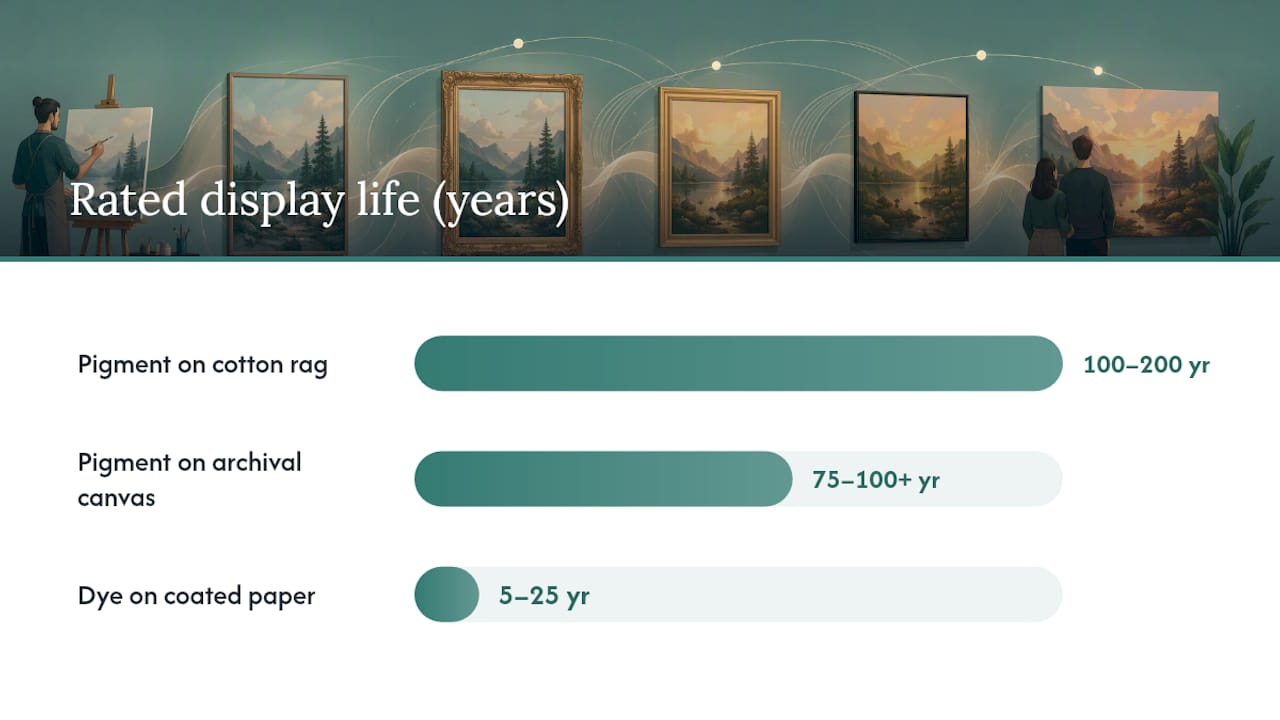
Longevity at a glance: Industry testing references, including Wilhelm Imaging Research, commonly rate well-produced pigment-based giclée prints at 75–200 years of indoor display life under museum conditions. Dye-based prints may fade in as little as 5–25 years under the same conditions.
Several variables shift these estimates significantly:
| Factor | Effect on longevity |
|---|---|
| Pigment ink on cotton rag | Highest rated: 100–200 years under museum conditions |
| Pigment ink on archival canvas | Typically 75–100+ years under controlled display |
| Dye ink on coated paper | Often 5–25 years before visible fading |
| UV-filtering glazing | Extends rated life substantially |
| Direct sunlight exposure | Reduces rated life for any ink type |
| High humidity or temperature swings | Accelerates substrate and ink degradation |
The substrate matters as much as the ink. A pigment print on acid-free cotton rag paper outperforms the same ink on a lower-grade coated stock. When a seller claims “archival” without specifying both ink type and substrate, the claim is incomplete.
How do editions and certificates of authenticity work?
Edition type and documentation are the two factors that most directly affect a giclée’s collectibility and resale value.
Edition types defined:
- Open edition — no fixed print limit; the artist or publisher may print as many copies as demand requires. Lower scarcity, lower secondary-market value.
- Limited edition — a fixed total number of prints, each numbered (e.g., 3/50 means the third print in an edition of 50). Once the edition sells out, no more are produced.
- Artist proof (AP) — traditionally a small number of prints (often 10% of the edition or fewer) set aside for the artist’s personal use. Numbered separately (e.g., AP 2/5). Learn more about artist proof editions and how they affect value.
What a strong certificate of authenticity (COA) includes:
- Artist’s name and signature
- Title and date of the original work
- Edition number and total edition size
- Substrate description (e.g., 100% cotton rag, 310 gsm)
- Ink type (pigment-based)
- Printer name or print studio
- Color proof reference or test strip notation
Authentication signals to verify:
- Edition number on the print matches the COA
- Signature placement is consistent with the artist’s documented practice
- Gallery or invoice records match the COA details
- No discrepancy between the stated edition size and the number in circulation
When an artwork is created digitally and the giclée is the primary expression of that work, the edition documentation becomes the only record of the work’s existence as a physical object. In that case, the COA carries even more weight than it does for a reproduction of a physical painting. For a full breakdown of print vs. original distinctions, the differences in valuation are worth understanding before buying.
Are giclée prints considered original artwork?
In traditional printmaking terms, a giclée is typically a reproduction. When the artwork’s primary expression is digital, the giclée can be considered the original form of that work.
Traditional printmaking distinguishes between hand-pulled prints (etchings, lithographs, screenprints) — where the matrix is made by the artist and each impression is part of the original creative act — and mechanically produced inkjet outputs, which reproduce a pre-existing image. Giclées fall into the second category when they reproduce a painting or drawing.
Two scenarios where the classification differs:
- Reproduction giclée: A painter creates an oil painting, then commissions high-resolution scans and giclée prints. The prints are reproductions. The original painting remains the primary work.
- Digital-original giclée: An artist creates a work entirely in digital media and releases it only as a limited-edition giclée. The print is the primary physical expression of that work, and some practitioners treat it as an original in that context.
Provenance details that help determine status include the artist’s statement about the work’s origin, the COA specifying whether the source is a digital original or a scan, and the edition documentation. For collectors who want to understand the full spectrum between original art and prints, the distinction has direct implications for insurance valuation and resale.
How do you verify giclée quality before buying?
Focus on three pillars: materials (inks and substrate), print documentation, and finishing and handling standards.
Checklist for buyers:
- Ask for the ink type in writing — pigment-based is the requirement for archival claims
- Request the substrate specification: 100% cotton rag or acid-free archival canvas, with gsm weight
- Ask for the printer model or print studio name and verify their giclée credentials
- Request a color proof or test strip showing the print matches the original
- Confirm the outgassing and varnish protocol used
- Obtain a signed COA with edition number, substrate, and ink type listed
- Verify the edition size and confirm no additional prints will be produced
- Check the return policy and packaging standards for shipping
- Ask for recommended framing specifications (UV glazing, acid-free mat)
Spotting weak claims:
Vague language is the clearest warning sign. “Archival quality” with no substrate or ink specification means nothing verifiable. No COA on a limited-edition print is a significant gap. No color proof or test strip means you cannot confirm the print matches the original.
For a broader guide to buying art prints without guesswork, verification steps and red flags are covered in detail. Quality giclée printing combines 300+ DPI effective output, multi-color pigment ink systems, high-quality substrate, and documented test proofs — no single specification alone is sufficient.
Pro Tip: Ask the seller for a high-resolution crop proof of a shadow or highlight area in the print. These transitions reveal ink system quality more clearly than a full-image thumbnail.
Where do collectors typically buy giclée prints?
Most collectors buy giclées directly from the artist, from galleries representing the artist, or from reputable fine-art print studios. Each channel has distinct trust markers.
- Direct from the artist. The strongest provenance chain. The artist signs the COA, controls the edition, and can answer questions about the source file and print specifications. Artist proofs are most often available through this channel.
- Galleries. A gallery representing the artist provides an additional layer of vetting. Gallery records create a provenance trail useful for resale and insurance. Ask whether the gallery holds the master file and print documentation.
- Fine-art print studios. Studios that specialize in giclée production often offer technical consistency and warranties on materials. They may print for multiple artists and can provide substrate and ink documentation independently of the artist.
- Museum stores. Museum-produced giclées are typically produced to high technical standards and come with clear documentation, though they are almost always open-edition reproductions.
For commissions, the typical process involves submitting a high-resolution source file (minimum 300 DPI at print size), agreeing on substrate and edition size, reviewing a color proof, and approving before the full edition is printed. Lead times range from days to several weeks depending on the studio and edition size. Pricing factors include substrate cost, print size, edition size, and finishing (varnish, stretching, framing).
Why do artists choose giclée printing for their work?
Artists favor giclées because they produce museum-quality reproductions, support just-in-time sales, and allow controlled editions without requiring large print runs or storage. No printing plates are needed, which means an artist can produce a single print to order or expand an edition incrementally as demand grows.
The workflow benefits are practical. Color management tools allow the artist to approve a proof before committing to an edition. Paper and canvas variants of the same image can be produced from the same digital file. Edition sizes can be set conservatively at launch and the master file archived for future reference.
Eman Khalifa, a London-based British-Egyptian-American contemporary artist whose work spans oil, acrylic, and mixed media across abstract nature, seascapes, landscapes, and florals, uses giclée printing to extend the reach of original paintings to collectors who want museum-quality reproductions at accessible price points. Original paintings remain one-of-a-kind; the giclée editions are produced to archival standards on gallery canvas, with full documentation.
What artists get right about giclées that buyers often miss
The most common mistake collectors make is treating “giclée” as a quality guarantee rather than a process description. The word describes a method, not an outcome. A giclée produced with pigment inks on cotton rag paper, with a documented color proof and a signed COA, is a serious archival object. A print labeled “giclée” with no substrate specification and no COA may be nothing more than a high-resolution inkjet print on coated stock.
Artists who work with giclées understand that editioning strategy is as important as print quality. An open-edition giclée of a popular image generates revenue but erodes scarcity. A tightly limited edition of 25 prints, each signed and numbered with a COA, holds value differently. The decision is deliberate, and collectors should ask about it directly.
Ethical labeling matters. A print that reproduces a physical painting should be described as a reproduction. A digitally originated work released as a limited-edition giclée should be described as a digital original in limited edition. The distinction is not semantic — it affects how the work is valued, insured, and resold. Transparency on this point is a reliable signal of a trustworthy seller.
Eman Khalifa’s museum-quality giclée prints, available now
Emansgallery produces museum-quality canvas prints and fine-art paper prints from Eman Khalifa’s original paintings, printed to archival standards with pigment-based inks on gallery canvas. Each print ships with full documentation and is available for purchase or commission directly through the gallery.
Collectors can choose from existing editions — including works like the Private Eye canvas print and Fragments of Memory canvas print — or commission a print of a specific original. International shipping covers the US, UK, Canada, Australia, Germany, France, Italy, Spain, Portugal, Greece, UAE, and the Netherlands. Packaging is designed to museum transit standards. For collectors considering an original before a print, the Good Tidings original painting is currently available. Contact Emansgallery directly through the site to discuss edition availability, commission specifications, or framing recommendations.
Sources
- Giclée Printing: Process, Materials & History Explained | World of Printmaking
- Giclée
- Giclée Printing: Process, Quality, Cost & How to Order | Callie
- Giclée Printing Process: How Quality is Achieved – Big Ox Printing
FAQ
Are giclée prints considered original artwork?
A giclée is typically a reproduction of a pre-existing original. When the artwork was created digitally and the giclée is its primary physical form, some practitioners treat it as an original — but this requires clear documentation in the COA and artist statement.
What makes a giclée different from a regular inkjet print?
A standard inkjet print may use dye inks on coated paper with no color proofing, which produces a shorter-lived result.
How long do giclée prints last?
Pigment-based giclée prints are commonly rated at 75–200 years of indoor display life under museum conditions, based on industry testing references including Wilhelm Imaging Research. Dye-based prints may fade in as little as 5–25 years under the same conditions.
What should a certificate of authenticity include for a giclée?
A reliable COA lists the artist’s name and signature, the title and date of the original work, the edition number and total edition size, the substrate specification, the ink type, and the print studio name. Missing any of these details weakens the document’s value as provenance.
How should you care for and preserve a giclée print?
Display giclée prints away from direct sunlight and high humidity. Frame paper prints with UV-filtering glazing and acid-free matting. Avoid hanging near heat sources or exterior walls subject to temperature swings. For long-term storage, keep prints flat in acid-free sleeves in a stable environment.
Stay Connected
- ✨ Explore Eman Khalifa's original art, fine art prints, and art-inspired merchandise.
- Follow Eman Khalifa's art journey on: Instagram @emans_gallery and Facebook
- Watch Eman Khalifa creating live art on: YouTube @emans_gallery
