


What Did Andy Warhol Do? Artist, Filmmaker, Pop Icon
Andy Warhol (1928–1987) was an American artist and filmmaker. He worked as a commercial illustrator in the 1950s, became a leading figure of Pop Art in the 1960s, made experimental films, and managed a rock band. His paintings and prints drew on advertising, consumer goods and celebrity images. This guide lists what he did, how he made his work, and why it still matters.
TL;DR
- Warhol began as a successful commercial illustrator, then moved into fine art in the early 1960s.
- He painted and silkscreened everyday products and celebrities, including Campbell’s Soup Cans and Marilyn Diptych.
- He used projectors, photo-silkscreens and a studio called the Factory to make work in series.
- He also made films, including Screen Tests and Empire, and managed the Velvet Underground.
- His methods changed what counted as fine art, and his influence continues.
Table of Contents
- Warhol’s career at a glance
- From commercial illustrator to fine artist
- Pop Art: the subjects he chose
- How Warhol made his paintings
- His best-known works
- Film, music and the Factory
- Why his art was controversial
- How Warhol influenced later artists
- Our perspective
- Choosing original art or prints for your home
- FAQ
- Sources
- Stay Connected
Warhol’s career at a glance
| Period | What he did |
|---|---|
| 1950s | Commercial illustration for major clients |
| Early 1960s | Moved into fine art as Pop Art emerged |
| 1962 | Exhibited Campbell’s Soup Cans in Los Angeles |
| 1963 onward | Silkscreened paintings, mechanical reproduction, the Factory |
| 1964–1966 | Filmed 472 Screen Tests |
| 1966–1967 | Exploding Plastic Inevitable multimedia events |
| 1987 | Death, after a career as a leading New York art figure |
The sections below explain each stage.
From commercial illustrator to fine artist
Warhol did not start as a gallery painter. The Andy Warhol Museum states that he became one of the most successful illustrators of his time in the 1950s. He won numerous awards for commercial illustration. His clients included Tiffany & Co., The New York Times and NBC.
This work shaped everything after it. The same museum notes that much of his commercial work was based on photographs and source images. He kept that approach for the rest of his life.
In the early 1960s he moved into fine art. According to the museum’s biography, he gained notoriety as Pop Art emerged. The change was one of subject and setting more than skill. He took the imagery of advertising and shop shelves and put it on canvas.
Pop Art: the subjects he chose
Warhol was a leading proponent of Pop Art. The Whitney Museum of American Art describes his work as an exploration of the relationships between advertising, consumerism, mass media and celebrity culture. His embrace of mechanical reproduction challenged the boundary between high and low culture.
The Smithsonian says he created many Pop icons by appropriating imagery from consumer and popular culture, from soup cans to film stills. He called his New York studio the Factory, a name that reflected mechanized production.
His typical subjects were:
- Packaged goods, such as soup cans
- Film stars and other celebrities
- Images lifted from mass media, such as newspaper advertisements
For a longer profile of the same topic, see our guide on what Andy Warhol is famous for.
How Warhol made his paintings
Warhol’s process changed over the years. It moved from hand painting toward mechanical reproduction.
Hand-painted soup cans
MoMA explains the method behind Campbell’s Soup Cans. Warhol drew each can in pencil on canvas. He then painted the can and label by hand. A light projector helped him superimpose the lettering and trace the form. Each canvas repeated the image at the same scale, while the label varied.
Projected and traced images
The Whitney describes another example of this method. For his Before and After paintings, Warhol took a National Enquirer plastic-surgery advertisement. He used an opaque projector to enlarge it and trace it onto canvas. The Whitney adds that he progressively removed visible brush evidence, aiming for art that could be “noncommittal, anonymous.”

Photo-silkscreen
The Andy Warhol Foundation says Warhol experimented with mechanical reproduction through photo-silkscreening. He developed a signature style: a grainy black image printed repeatedly on a painted canvas. The image appeared in series, grids, rows or pairs.
The Factory as a production system
The Foundation also states that Warhol set up an assembly-line type system. It was designed to echo the uniformity and seriality of mass production. Factory assistants silkscreened dozens of product cartons and celebrity portraits.
The Foundation quotes Warhol telling Artnews in 1963 that he wanted to be a machine. It also notes that each silkscreened canvas was unique. Choices about composition, format and color differed from one work to the next.

His best-known works
Two works come up most often in answers to this question.
Campbell’s Soup Cans (1962)
According to MoMA, Warhol first exhibited Campbell’s Soup Cans in 1962 at the Ferus Gallery in Los Angeles. The work is a set of 32 canvases. Each represents one of 32 soup varieties. They were arranged together like products on shelves.
Marilyn Diptych (1962)
Tate describes Marilyn Diptych as perhaps one of Warhol’s most iconic works. It has two canvases. Each carries 25 images of Marilyn in a grid. One canvas is vibrant and energetic. The other is monochrome and sombre.
| Work | Year | Format | Idea |
|---|---|---|---|
| Campbell’s Soup Cans | 1962 | 32 canvases | Products shown like items on a shelf |
| Marilyn Diptych | 1962 | 2 canvases, 25 images each | Celebrity repeated in a grid |
| Before and After | 1960s | Paintings from an advertisement | Mass media image, traced and enlarged |
Film, music and the Factory
Warhol’s practice was not limited to painting. The Whitney calls the Factory a hub for avant-garde experimentation. It brought together drag queens, poets, bohemians, musicians and wealthy patrons.
Films
MoMA describes Warhol as a pioneering filmmaker. Two projects show the range:
- Screen Tests (1964–1966): 472 individual filmed portraits of visitors to the Factory.
- Empire: an eight-hour stationary shot.
Both projects used repetition and duration as their method, the same logic found in his silkscreens.
Music and multimedia events
The Whitney says Warhol managed the rock band the Velvet Underground. The band performed at his Exploding Plastic Inevitable multimedia events in 1966 and 1967.
A short list of his roles therefore reads: illustrator, painter, printmaker, filmmaker, band manager and event producer.
Why his art was controversial
The controversy centered on method and subject, not on a single work.
- Mechanical look. MoMA describes the soup cans as serial and “mechanically produced” in appearance, even though Warhol painted each canvas by hand.
- Flat uniformity. MoMA also points to the flat uniformity of his silkscreen prints, and to multiplicity and replication as central strategies.
- Erased personal touch. The Whitney notes his removal of visible brushwork in favor of anonymity.
- Ordinary subjects. Soup cans and advertisements blurred the line between high and low culture, as the Whitney puts it.
These choices raised a question that remains open in art: how much of the artist’s hand a work needs to count as fine art.
How Warhol influenced later artists
MoMA says Warhol’s celebrity images became so familiar that people often refer to them by first name. The museum adds that his influence continues to reverberate.
The Warhol Foundation frames his impact as inventing new ways of making images. It says he expanded what could count as fine art, treating multiple media, including silkscreening and persona, as creative ground.
For readers interested in how this lineage shows up on walls today, our overview of contemporary wall art covers current styles. A second section explains the key features and materials used in it.
Our perspective
Warhol’s lasting lesson is that the choice of subject, scale and repetition is part of the artwork. A collector who understands those choices reads any painting more clearly.
We work from the same starting point. At Eman’s Gallery, every original painting is made by hand by one artist. Buyers can also commission a piece and specify its scale, palette and mood. We see that direct conversation between artist and buyer as the clearest way to get art that fits a room and a collection.
Warhol turned to series and reproduction. We offer originals alongside museum-quality canvas prints, so a collector can choose a one-of-a-kind painting or a print of a favorite image. Both start from the same artist’s work.
Eman
Choosing original art or prints for your home
Warhol’s career raises a practical point for buyers. Art can exist as a single object or as a reproduction, and each suits a different need.
Eman’s Gallery offers both:
- Original one-of-a-kind paintings by Eman Khalifa, including original mini paintings.
- Art prints on canvas and framed paper.
- Bespoke commissions, where you specify scale, palette and mood. Start from the gallery home page.
- Art-printed merchandise, including mugs, pillows, t-shirts and tote bags.
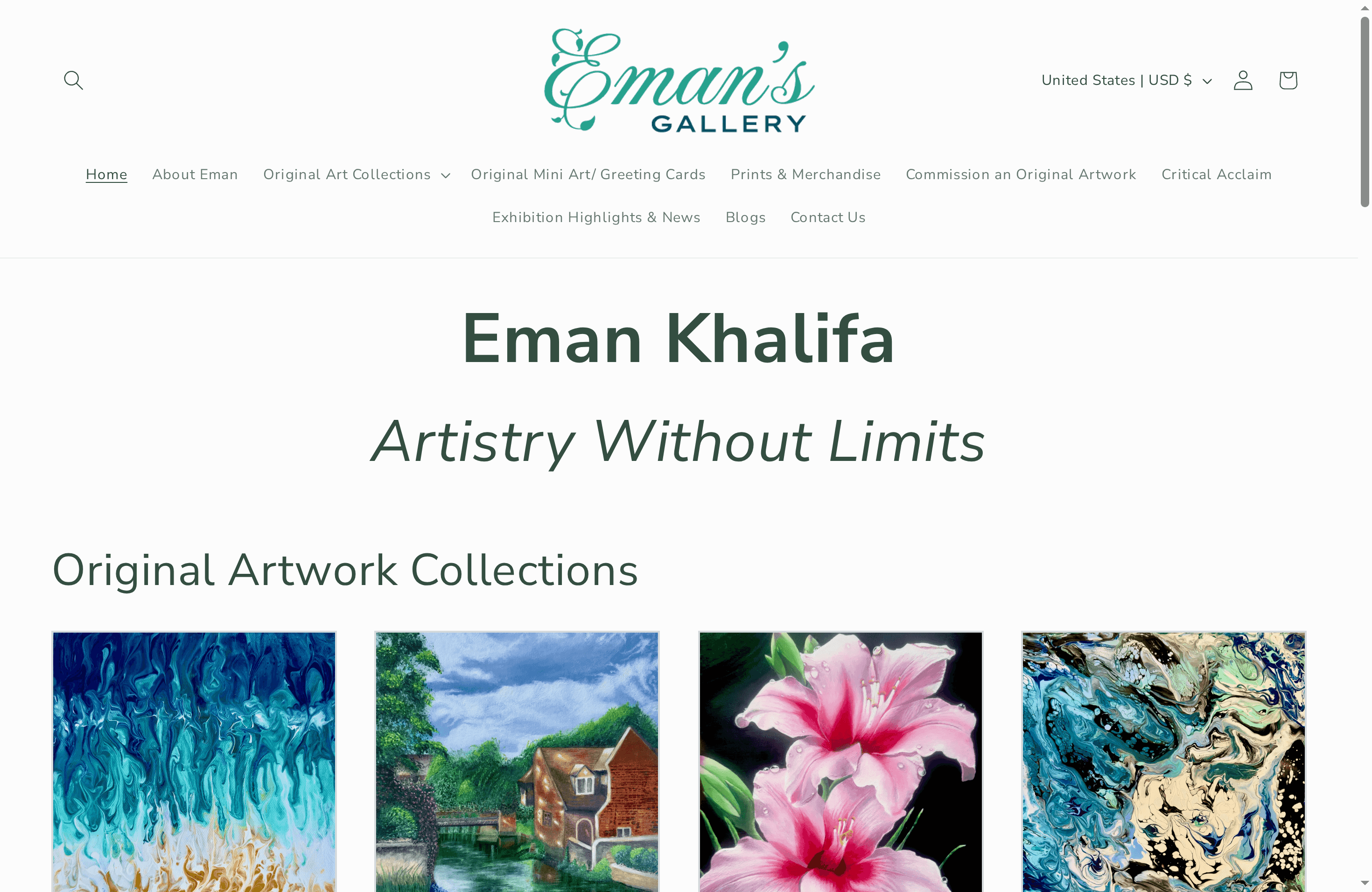
For a gift, the Art Gift Card lets the recipient choose. Eman’s Gallery ships worldwide from the UK, USA, Canada, Australia, Germany, France, Italy, Spain, Portugal, Greece, UAE and the Netherlands. Prices appear on each product page.
FAQ
What did Andy Warhol do for a living?
He began as a commercial illustrator in the 1950s. His clients included Tiffany & Co., The New York Times and NBC. In the early 1960s he moved into fine art, and later he also worked in film and music management.
What is Andy Warhol’s most famous work?
Two works are most often named. Campbell’s Soup Cans (1962) was first shown in Los Angeles as 32 canvases. Tate describes Marilyn Diptych (1962) as perhaps one of his most iconic works.
How did Andy Warhol make his paintings?
Methods varied. For the soup cans he drew in pencil, used a projector to trace the form, and painted by hand. Later he used photo-silkscreening to print grainy black images repeatedly on painted canvas, with help from Factory assistants.
Why was Warhol’s art controversial?
He used mechanical methods and ordinary commercial subjects. Museums note the flat, repeated look of his work and his removal of visible brushwork. This challenged the line between high and low culture.
Sources
- Andy Warhol, Whitney Museum of American Art
- Andy Warhol at the Smithsonian
- Biography, The Andy Warhol Museum
- Andy Warhol, Campbell’s Soup Cans, 1962, MoMA
- Andy Warhol, MoMA
- What Was Andy Warhol Thinking?, Tate
- Warhol, The Andy Warhol Foundation for the Visual Arts
Stay Connected
- ✨ Explore Eman Khalifa’s original art, fine art prints and art-inspired merchandise.
- Follow Eman Khalifa’s art journey on: Instagram @emans_gallery and Facebook
- Watch Eman Khalifa creating live art on: YouTube @emans_gallery
