


The Biggest Auction Houses in the World: Ranked and Compared
The biggest auction houses by auction sales are, in order: Christie’s, Sotheby’s, Beijing Poly (Poly Auction Group), China Guardian, Heritage Auctions, Phillips, Bonhams, and Artcurial. According to TheCollector, Christie’s and Sotheby’s lead on fine art and global reach, while Beijing Poly and China Guardian are among the largest houses influenced by Asian market demand.
- Christie’s — global fine art leader; holds the record for the highest single-lot sale at auction
- Sotheby’s — strongest private-sales infrastructure; diversified across jewelry, watches, and luxury
- Beijing Poly / Poly Auction Group — mainland China’s largest house; dominant in Chinese art and antiques
- China Guardian — second-largest Chinese house; deep expertise in ceramics, calligraphy, and classical works
- Heritage Auctions — the largest U.S. house for collectibles: coins, comics, and sports memorabilia
- Phillips — specialist in contemporary art, design, and watches; targets younger collectors
- Bonhams — strong in classic cars, antiques, and fine art across European buyer pools
- Artcurial — Paris-based; record car-auction results and curated European luxury categories
Artprice market indices track auction-house performance over time and confirm that no single metric captures “biggest” completely. Sales turnover, lot volume, global offices, and specialty strength all contribute to a house’s market position.
Key Takeaways
Christie’s and Sotheby’s lead the global auction market on fine art sales and single-lot records, while Beijing Poly and China Guardian rank among the largest houses when Asian market turnover is included.
| Point | Details |
|---|---|
| Sales leaders | Christie’s and Sotheby’s lead on fine art turnover and single-lot records globally. |
| Chinese houses | Beijing Poly and China Guardian rank among the largest by sales when Asian market demand is counted. |
| Specialist fit | Heritage Auctions leads U.S. collectibles; matching the lot to the house’s buyer pool drives results. |
| Provenance matters | Cross-referencing the INTERPOL stolen art database is a non-negotiable step in consignor due diligence. |
| Gallery alternative | Emansgallery offers a curated, private-sale route for contemporary works outside the public auction circuit. |
Table of Contents
- How the biggest auction houses compare at a glance
- What “biggest” actually means in the auction market
- Profiles of the leading auction houses
- How to choose the right auction house for your item
- Market trends shaping which houses rank as biggest
- Methodology: how this ranking was built
- How the biggest auction houses evolved over time
- Which categories does each house dominate?
- Regional influence beyond the US and China
- Controversies and legal issues affecting top auction houses
- When a gallery may outperform an auction house
- Eman’s Gallery as an alternative path for select consignments
- Sources
- FAQ
How the biggest auction houses compare at a glance
| House | Specialty / Strongest Categories | HQ & US Presence | Founded | Notable Record | Online Bidding | Best For |
|---|---|---|---|---|---|---|
| Christie’s | Fine art, jewelry, luxury estates | London / New York, Los Angeles | 1766 | Salvator Mundi (reported highest single-lot sale) | Yes — Christie’s Live | Trophy fine art, high-value estates |
| Sotheby’s | Fine art, jewelry, watches, private sales | London / New York, Los Angeles | 1744 | Multiple nine-figure fine art lots | Yes — Sotheby’s Buy Now | High-end art, jewelry, private transactions |
| Beijing Poly / Poly Auction | Chinese art, antiques, calligraphy | Beijing / no US saleroom | 2005 | Major Chinese imperial art results | Yes — online bidding platform | Chinese and Asian art, regional buyers |
| China Guardian | Chinese art, ceramics, calligraphy | Beijing / no US saleroom | 1993 | Record regional sales for Chinese works | Yes — online platform | Traditional Chinese art, antiques |
| Heritage Auctions | Coins, comics, sports memorabilia, fine art | Dallas, TX / Beverly Hills, New York | 1976 | Highest-priced comic book and coin sales | Yes — HA.com live bidding | Specialist collectibles, US buyers |
| Phillips | Contemporary art, design, watches | London / New York | 1796 | Strong results for contemporary artists | Yes — Phillips online | Contemporary art, design, modern collectors |
| Bonhams | Classic cars, antiques, fine art | London / Los Angeles, New York | 1793 | Record classic car auction results | Yes — Bonhams online | Classic cars, European antiques |
| Artcurial | Luxury cars, fashion, fine art | Paris / no US saleroom | 2002 | Record car-auction results in Europe | Yes — Artcurial online | Luxury cars, European collectors |
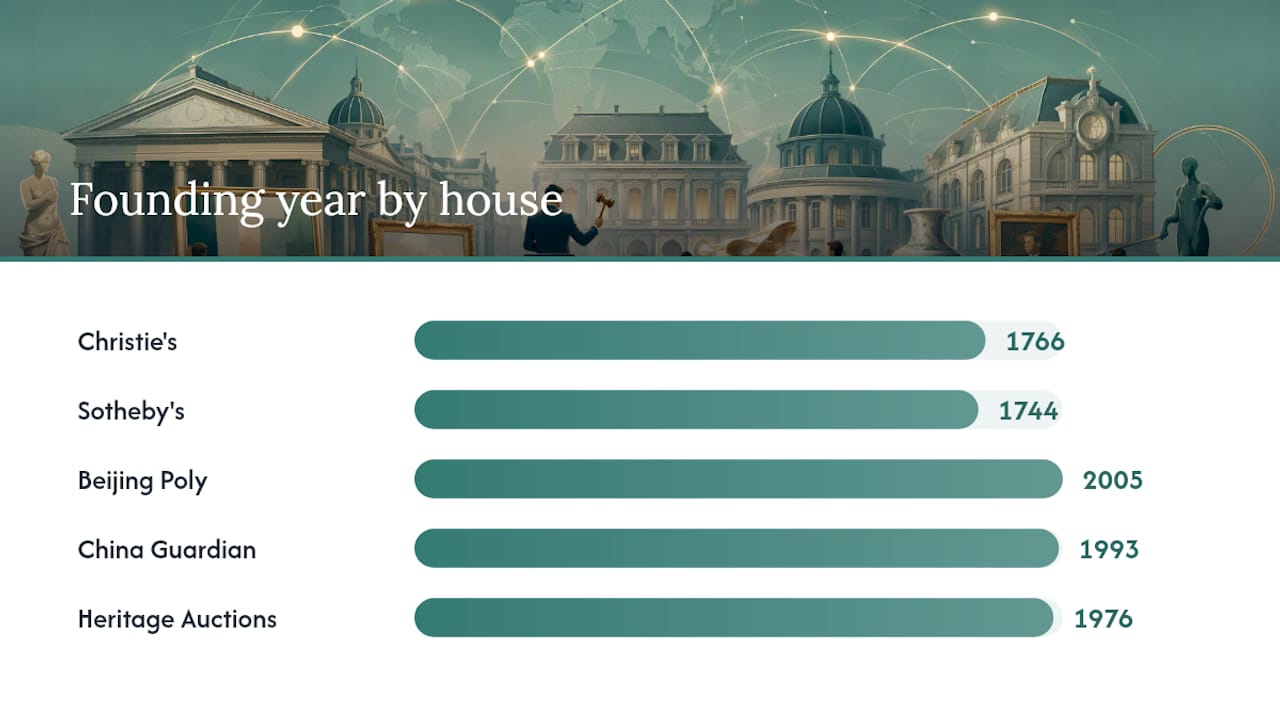
Worthbury’s roundup of high-end auction houses confirms that Christie’s and Sotheby’s lead on headline single-lot records, while Heritage Auctions dominates the U.S. collectibles market by volume.
What “biggest” actually means in the auction market
“Biggest” is not a single number. Analysts use four primary metrics to rank auction houses.
Primary metrics:
- Auction sales turnover (USD) — total hammer prices across all lots in a reporting period; the most widely cited figure
- Lots sold — total volume of transactions; favors high-volume houses like Heritage
- Global salerooms and offices — physical and digital reach; Christie’s and Sotheby’s lead here
- Specialty strength — dominance within a category (e.g., Heritage in coins, Poly Auction in Chinese art)
Secondary metrics include record single-lot sales, private-sale revenue, and online-only sale volume. The challenge is that private sales are not always disclosed, and reporting cycles differ between houses. Artprice indices provide year-over-year market health data that analysts use to compare houses without relying solely on headline sales.
For this ranking, auction sales turnover carries the most weight, followed by global reach and specialty reputation. Where turnover figures are not publicly confirmed, specialty dominance and press-reported market share inform placement.
Profiles of the leading auction houses
Christie’s
- Specialty: Fine art, jewelry, luxury estates, wine
- HQ & US presence: London headquarters; major salerooms in New York and Los Angeles
- Founded: 1766
- Notable record: The Salvator Mundi, attributed to Leonardo da Vinci, sold through Christie’s in a widely reported sale that set a benchmark for single-lot auction results
- Best for: Consignors with trophy fine art or high-value estate collections needing global buyer reach
Sotheby’s
- Specialty: Fine art, jewelry, watches, private sales
- HQ & US presence: London and New York dual headquarters; Los Angeles office
- Founded: 1744 — the oldest of the major houses
- Notable record: Multiple nine-figure fine art results across Impressionist, Modern, and Contemporary categories
- Best for: Sellers who want both public auction and private-sale options under one roof
Beijing Poly / Poly Auction Group
- Specialty: Chinese imperial art, antiques, calligraphy, contemporary Chinese works
- HQ & US presence: Beijing; no US saleroom
- Founded: 2005
- Notable record: Consistently produces major results for Chinese imperial bronzes and paintings
- Best for: Sellers of Chinese and Asian art targeting concentrated regional demand
TheCollector notes a measurable rise in Chinese auction houses’ share of high-value sales, driven by stronger regional demand for Chinese art and antiques.
China Guardian
- Specialty: Chinese ceramics, calligraphy, classical paintings, antiques
- HQ & US presence: Beijing; no US saleroom
- Founded: 1993
- Notable record: Record regional sales for classical Chinese works
- Best for: Traditional Chinese art where the buyer pool is concentrated in mainland China
Heritage Auctions
- Specialty: Coins, comics, sports memorabilia, fine art, jewelry
- HQ & US presence: Dallas, TX headquarters; offices in Beverly Hills and New York
- Founded: 1976
- Notable record: Holds records for the highest-priced comic book and rare coin sales
- Best for: U.S.-based collectibles sellers who benefit from Heritage’s concentrated specialist buyer base
Specialization drives market position. Heritage’s dominance in collectibles reflects a buyer pool that a generalist house cannot replicate for those categories.
Phillips
- Specialty: Contemporary art, design, watches, photographs
- HQ & US presence: London and New York dual presence
- Founded: 1796
- Notable record: Strong results for contemporary artists including Jean-Michel Basquiat
- Best for: Contemporary art and design pieces targeting collectors under 50
Bonhams
- Specialty: Classic cars, antiques, fine art, jewelry
- HQ & US presence: London headquarters; Los Angeles and New York offices
- Founded: 1793
- Best for: Classic car consignors and European antique collections
Artcurial
- Specialty: Luxury cars, fashion, fine art, comics
- HQ & US presence: Paris; no US saleroom
- Founded: 2002
- Notable record: Record car-auction results in Europe
- Best for: European-focused luxury car and fashion collectors
Pro Tip: For works with strong provenance and a clear collector narrative, a specialist house or gallery often produces a better net result than a generalist top house. Concentrated buyer pools and focused marketing can outperform broad reach for the right lot.
How to choose the right auction house for your item
The right house depends on the item, not the brand name.
- Match category to specialty. A rare coin performs best at Heritage. A Chinese imperial vase belongs at Poly Auction or China Guardian. A contemporary painting by a market-tracked artist fits Christie’s, Sotheby’s, or Phillips.
- Assess the buyer pool. The house with the largest relevant buyer pool for your category will produce the strongest competition and the highest hammer price.
- Review fees and reserve terms. Seller’s commission (the “seller’s premium”) and buyer’s premium vary. Confirm the reserve price policy and any guaranteed minimum before signing a consignment agreement.
- Evaluate marketing reach. Ask which catalogs, digital channels, and preview events will feature your lot. Online bidding infrastructure matters for reaching international buyers. Online art buying trends show that digital reach now directly affects final hammer prices.
- Check provenance and due diligence standards. Reputable houses verify provenance and cross-reference the INTERPOL database of stolen cultural property before accepting a consignment. This is a non-negotiable trust signal.
- Consider timing and seasonality. Major spring and fall sales at Christie’s and Sotheby’s attract the deepest buyer pools. Specialist sales at Heritage run year-round.
Red flags: opaque fee structures, no written reserve agreement, weak provenance verification, and no clear marketing plan for your lot.
Pro Tip: When a work has a strong personal story or documented provenance, a gallery sale can outperform auction. Galleries control the narrative, target specific collectors, and avoid the public price risk of an unsold lot. Understanding what makes art collectible helps consignors decide which channel fits their work.
Market trends shaping which houses rank as biggest
Several structural shifts are actively changing the rankings.
- Rise of Chinese auction houses. Beijing Poly and China Guardian have grown their share of global high-value sales by capturing concentrated demand for Chinese art. This shift means “biggest by sales” depends heavily on whether Asian market results are included in the count.
- Online bidding expansion. Every major house now runs live online bidding. Christie’s Live, Sotheby’s Buy Now, and Heritage’s HA.com platform have materially expanded buyer access. Houses that invested early in digital infrastructure now report higher lot-level competition and stronger hammer prices.
- Collectibles growth. Comics, watches, sneakers, and sports memorabilia have moved from niche to mainstream. Heritage’s growth reflects this directly. Phillips has expanded its watch category to capture younger collectors.
- Private sales. Christie’s and Sotheby’s both operate substantial private-sales divisions that do not appear in public auction totals. This means published sales figures understate the true revenue of the top houses.
- Macroeconomic pressure. High-interest-rate environments tend to slow discretionary luxury spending, which affects mid-market lots more than trophy works. The top houses have historically maintained strong results at the very high-end even in softer markets.
Artprice market indices track these shifts year over year, making them the most reliable tool for comparing house performance across cycles rather than relying on single headline sales.
Methodology: how this ranking was built
Primary data sources:
- Artprice market reports and the Artmarket Confidence Index — used for year-over-year sales trends and house-level performance comparisons
- Published press reports (Financial Times, ArtNews, The New York Times) — used for notable single-lot records and market-share commentary
- TheCollector and Worthbury market roundups — used for specialty rankings and house profiles
- INTERPOL’s stolen cultural property database — referenced for provenance and trust-signal criteria
Weighting:
Auction sales turnover carries the primary weight in placement decisions. Global saleroom count and specialty dominance serve as tiebreakers. Private-sale revenue is noted but not counted in the primary ranking because disclosure is inconsistent across houses.
Limitations:
Reported auction sales figures are not directly comparable across all houses. Private sales, non-US reporting standards, and different fiscal-year cycles mean that a house’s published total may reflect only a portion of its actual market activity. Rankings based solely on headline figures can misrepresent the relative scale of houses with large private-sale divisions or regional market concentration.
How the biggest auction houses evolved over time
Christie’s and Sotheby’s both trace their origins to 18th-century London, when the auction format was the primary mechanism for dispersing estates and collections. James Christie founded his house in 1766; Sotheby’s predates it by more than two decades, established in 1744 as a book auctioneer before expanding into art. Both houses moved their primary financial gravity to New York in the latter half of the 20th century, following the concentration of global art-market capital there.
The Chinese houses are a more recent development. China Guardian launched in 1993, and Beijing Poly followed in 2005. Their rapid ascent reflects the growth of a domestic collector class in mainland China and the repatriation of Chinese cultural objects that had been dispersed through earlier periods of conflict and export. Within two decades of founding, both houses were generating annual sales figures that placed them among the largest in the world by turnover.
Heritage Auctions represents a different evolution: a U.S.-focused house that built its scale through collectibles rather than fine art, expanding from coins and stamps into comics, sports memorabilia, and eventually fine art and jewelry. Its growth tracks the broader legitimization of collectibles as an asset class.
Which categories does each house dominate?
The market segments each house controls are not accidental. They reflect decades of specialist expertise, buyer relationships, and category-specific marketing.
Fine art (Impressionist, Modern, Contemporary): Christie’s and Sotheby’s share this segment at the top end. Phillips competes specifically in Contemporary, where it has built a younger collector base and strong results for artists like Basquiat and Kaws.
Chinese and Asian art: Beijing Poly and China Guardian dominate. Their buyer pools are concentrated in mainland China, Hong Kong, and the broader Asian diaspora. No Western house matches their depth in this category.
Collectibles: Heritage Auctions leads by volume and by category breadth. Its dominance in coins, comics, and sports memorabilia is structural. The house’s online bidding infrastructure and specialist expertise create a buyer pool that generalist houses cannot replicate for these lots. For collectors tracking contemporary art investment trends, the collectibles market offers a distinct risk-return profile from fine art.
Classic cars: Bonhams and Artcurial lead in this category. Artcurial’s Paris-based car auctions have produced record European results. Bonhams runs dedicated classic car sales in the US and UK.
Jewelry and watches: Sotheby’s and Christie’s both maintain strong jewelry departments. Phillips has built a credible watch category that attracts serious horological collectors.
Regional influence beyond the US and China
Christie’s and Sotheby’s maintain salerooms and offices across Europe, the Middle East, and Asia-Pacific. London remains the second-largest art market globally, and both houses run major sales there each season. Their Geneva offices handle high-value jewelry and watch sales, benefiting from Switzerland’s regulatory environment for luxury transactions.
The Middle East has emerged as a growing market. Both Christie’s and Sotheby’s have held sales in Dubai, targeting Gulf-region collectors with purchasing power concentrated in contemporary and modern art, Islamic art, and luxury categories. This is a relatively recent expansion but one that reflects a structural shift in where art-market capital is accumulating.
Artcurial’s European presence is concentrated in France, with its Paris headquarters serving as the primary venue for car, fashion, and fine art sales targeting continental European collectors. Bonhams covers the UK and European antiques market through its London salerooms and specialist sales.
Emerging markets in Southeast Asia, India, and Latin America remain underdeveloped relative to their collector populations. Some houses have held preview events in these regions, but dedicated salerooms are limited.
Controversies and legal issues affecting top auction houses
The major houses have each faced legal and reputational challenges that consignors and buyers should understand.
Sotheby’s and Christie’s price-fixing (2000–2002). Both houses were found to have colluded on seller’s commission rates during the 1990s. The case resulted in criminal convictions and civil settlements totaling hundreds of millions of dollars. Both houses have since restructured their compliance and governance frameworks.
Provenance disputes. Auction houses regularly face claims that lots were looted during World War II or removed illegally from their countries of origin. High-profile cases have involved works from Nazi-era confiscations and Chinese imperial objects removed during the 19th and early 20th centuries. Reputable houses now conduct pre-sale provenance research and cross-reference the INTERPOL stolen art database, but gaps remain, particularly for objects with incomplete ownership histories.
Sotheby’s regulatory scrutiny. In 2024, Sotheby’s faced a civil lawsuit from the New York Attorney General alleging that the house helped a collector avoid taxes on art purchases. The case drew attention to the financial structures used by high-net-worth collectors and the role auction houses play in facilitating them.
Chinese houses and export controls. Beijing Poly and China Guardian operate primarily within mainland China’s regulatory framework. Export of certain categories of Chinese cultural objects is restricted under Chinese law, which affects the cross-border movement of lots and the ability of international buyers to take physical possession.
These issues do not disqualify any house from consideration, but they underscore why provenance verification and transparent fee disclosure are non-negotiable criteria when choosing where to consign.
When a gallery may outperform an auction house
The auction format suits works with broad market recognition and a clear price history. For works that are less established, or where the seller’s narrative is the primary value driver, a gallery sale can produce a stronger net result.
Auction carries public price risk: an unsold lot acquires a “bought-in” record that follows the work and can suppress future sale prices. A gallery sale is private. The price is negotiated directly with a targeted buyer, and no public failure is recorded if the work does not sell immediately.
Provenance and story matter more than most consignors expect. Works with documented exhibition histories, press coverage, or a clear collector lineage tend to perform better in both channels. But galleries can build that narrative actively, while auction houses present it passively in a catalog entry.
For contemporary works by living artists, the gallery relationship also affects the artist’s long-term market. Selling through auction too early, before a secondary market is established, can set price benchmarks that are difficult to sustain.
Eman’s Gallery as an alternative path for select consignments
For collectors and consignors whose works do not fit the auction model, or who want to avoid the public price risk of an unsold lot, a curated gallery sale offers a direct alternative.

Emansgallery presents original handmade works by artist Eman Khalifa, including fluid abstract paintings like Good Tidings and Mystic Sea, sold directly to collectors, interior designers, and luxury buyers worldwide. The gallery model prioritizes curated presentation, targeted buyer relationships, and private transactions, without the seller’s commission structure or public reserve risk of a major auction house. For collectors seeking original contemporary works outside the auction circuit, browse the full collection at Emansgallery.
Sources
- Top 5 Auction Houses in the World | TheCollector
- The Top 9 High-End Auction Houses In The World By Record Sales
- Artprice — The best auction houses
- INTERPOL — Database on stolen works of art
FAQ
What are the top five auction houses in the world?
Christie’s, Sotheby’s, Beijing Poly (Poly Auction Group), China Guardian, and Heritage Auctions are consistently cited among the top five, ranked by auction sales turnover, global reach, and specialty strength.
What are the big three auction houses?
The traditional “big three” in fine art are Christie’s, Sotheby’s, and Phillips. When total global sales are measured, Beijing Poly and China Guardian now rank alongside or above Phillips by turnover, reflecting the scale of the Asian art market.
Who is bigger, Christie’s or Sotheby’s?
Christie’s and Sotheby’s trade the top position depending on the reporting period and whether private sales are included. Christie’s holds the record for the highest reported single-lot sale; Sotheby’s has a larger private-sales division. Neither house consistently leads the other across all metrics.
What are the largest auction companies in the world by sales?
Christie’s and Sotheby’s lead in fine art. Beijing Poly and China Guardian generate substantial turnover in the Asian market. Heritage Auctions leads the U.S. market for collectibles. Published figures vary because private-sale revenue is not uniformly disclosed across all houses.
Stay Connected
- ✨ Explore Eman Khalifa's original art, fine art prints and art-inspired merchandise.
- Follow Eman Khalifa's art journey on: Instagram @emans_gallery and Facebook
- Watch Eman Khalifa creating live art on: YouTube @emans_gallery
