


How to Hang Posters Without Damaging Wall or Poster
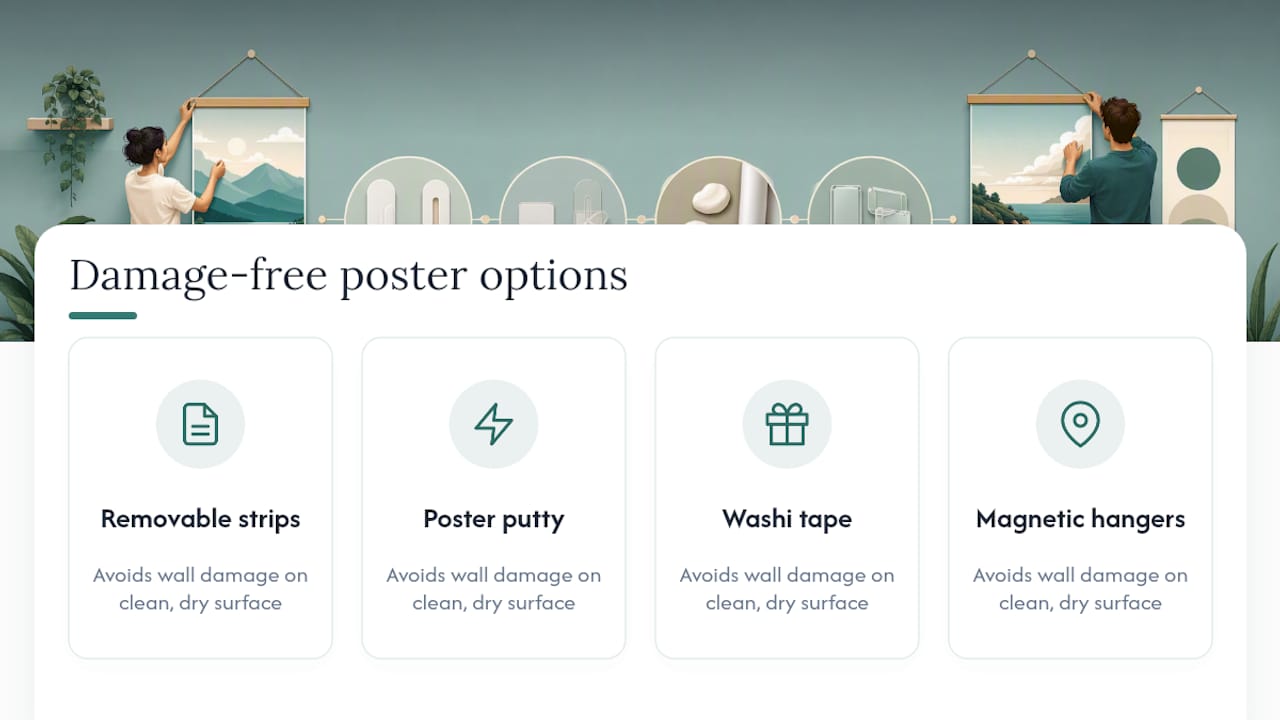
The safest damage-free options are removable poster strips, poster putty, removable double-sided tape or washi tape, and magnetic hangers or rails. For collectible prints, skip adhesives entirely and use a frame or archival mounting instead.
- Temporary display (a few weeks): washi tape or poster putty
- Mid-term display (months to a year): FrogTape reMOVEables or 3M Command strips
- Collectible or valuable prints: magnetic rails, archival corners, or a frame
Key Takeaways
Damage-free poster hanging depends on matching the method to the wall surface and the poster’s value, never treating every poster and every wall the same way.
| Point | Details |
|---|---|
| Match method to value | Use removable strips or putty for casual posters, frames or magnetic rails for anything collectible. |
| Prep the wall first | Clean and dry the surface before applying any adhesive to prevent the most common failure. |
| Remove strips correctly | Stretch the tab parallel to the wall rather than pulling outward to protect the paint. |
| Test before committing | Try a hidden patch of wall first on fresh paint, wallpaper, or textured surfaces. |
| Consider ready-to-hang art | Emansgallery’s framed originals and canvas prints skip the adhesive decision entirely. |
Where Can You Find More Reliable Hanging Guidance?
- FrogTape reMOVEables product page for manufacturer application and removal steps
- 3M Command technical guidance for removal technique and surface prep
- Family Handyman’s poster hanging guide for general prep and troubleshooting
- Vistaprint’s how-to hub for adhesive-to-surface matching
- Eman’s Gallery art print care instructions for preservation-focused advice
Table of Contents
- What Are the Best Damage-Free Poster Hanging Methods?
- How Do You Prepare a Poster and Wall Before Hanging?
- How Do You Apply and Remove Poster Strips Without Peeling Paint?
- When Should You Use Poster Putty, Tape, or Washi Tape Instead?
- What Non-Adhesive Options Protect Valuable Posters?
- How Do You Hang Posters on Different Wall Surfaces?
- What Are the Most Common Poster Hanging Mistakes?
- What Do Preservation Experts Recommend for Collectible Prints?
- Ready-to-Hang Options When You’d Rather Skip the Adhesive Question
- Sources
- FAQ
What Are the Best Damage-Free Poster Hanging Methods?
Not every method fits every wall or every poster. Here’s the quick match.
- 3M Command / FrogTape strips: best for painted drywall, holds roughly 0.5 lb per strip on smooth surfaces, low residue when removed correctly, renter-friendly.
- Poster putty: best for lightweight posters on smooth or lightly textured walls, easy to reposition, but can leave an oily mark on porous paint.
- Removable double-sided tape: good for medium-weight posters, works on more surfaces than putty, but wide strips increase removal risk.
- Washi tape: decorative and low-hold, best for temporary displays on drywall, fails on brick or heavy texture.
- Magnetic hangers or clip rails: best for collectible or oversized prints, zero adhesive contact with the paper, ideal for renters who want a polished look without commitment.
Pro Tip: Always test any adhesive on a hidden patch of wall (behind a door or under a shelf) for a few minutes before committing to the full poster. Paint reacts differently depending on age and finish.
Fresh paint, wallpaper, and textured plaster are the three surfaces most likely to surprise you; for tips on non-invasive updates, see Refresh Your Space Without the Renovation Headache. If your wall falls into one of those categories, test first or skip adhesive altogether.
How Do You Prepare a Poster and Wall Before Hanging?
Surface prep is the single biggest reason posters fall down or paint peels off later. Family Handyman points to skipped cleaning as the most common cause of adhesive failure.
- Decide whether the poster is a temporary print or a piece worth preserving.
- Wipe the wall with water or a mild cleaner, then let it dry completely.
- Wash your hands before handling the poster to avoid oils on the paper.
- Flatten a rolled poster under books or a mattress for a day or two, printed side out, rather than trying to force it flat by reverse rolling.
- Check the paint condition. Chalky, cracked, or very fresh paint (under 30 days) needs a gentler method or a small test patch first.
Pro Tip: If a poster keeps curling at the corners, tape the back corners flat first with a small archival tape loop, then mount as usual.
How Do You Apply and Remove Poster Strips Without Peeling Paint?
Poster strips like FrogTape reMOVEables give a flush, frameless look and hold well within their rated limits. Each FrogTape strip supports about 0.5 lb (227 grams) on a smooth surface, so a standard poster typically needs four to six strips placed at the corners and midpoints.
- Clean the wall and let it dry fully.
- Press one half of the strip onto the back of the poster.
- Press the poster (and attached strip) to the wall and hold for 15 seconds per FrogTape’s application guidance.
- Repeat at each corner and along the top and bottom edges for larger posters.
- To remove, stretch the tab straight down or up, parallel to the wall surface, rather than pulling it outward.
Pulling a strip away from the wall at an angle is what tears paint off. Stretching it flat and slow releases the adhesive bond without disturbing the surface underneath, a technique 3M’s own Command removal guidance also recommends.
Skip strips on delicate wallpaper or paint that hasn’t fully cured. Both surfaces can lift with the adhesive no matter how carefully you remove it.
When Should You Use Poster Putty, Tape, or Washi Tape Instead?
These three options cost less than strips and work well for casual, short-term displays.
- Poster putty works best on smooth or lightly textured drywall. Roll a pea-sized ball, flatten it slightly, and press at each corner. Too much putty in one spot can leave a translucent grease mark over time.
- Removable double-sided tape distributes weight well when you use several short strips instead of one large patch. Test a corner first since tack strength varies by brand.
- Washi tape is the most decorative option but the weakest holder. It looks great on smooth drywall and peels away cleanly, but it slips off brick, popcorn ceilings, or rough plaster almost immediately.
Never substitute duct tape, masking tape, or packing tape for any of these. All three bond far too aggressively for paper and painted walls, and they tend to leave a sticky residue or pull paint away when removed.
Pro Tip: Keep adhesive off collectible or limited-edition prints entirely. Even “removable” tape can discolor archival paper over months of contact.
What Non-Adhesive Options Protect Valuable Posters?
Skipping adhesive altogether is the safest route for anything you’d hate to lose. Magnetic poster hangers use a top and bottom rail that clamps the paper with magnets, so nothing ever touches glue. Hang the rail itself with a small removable hook or a standard picture hanger, and the poster stays adhesive-free from top to bottom.
- Clips and spring clamps let you swap posters in seconds with zero contact beyond the top edge.
- Magnetic rail systems distribute weight evenly and suit oversized or heavier prints.
- Frames or archival corners on a rigid backing offer the strongest long-term protection, especially for prints you plan to display for years.
For deeper how-tos on frameless display, our guide on hanging prints without a frame covers rail spacing and clip placement in more detail.
Pro Tip: A basic wood or metal poster rail costs less than a frame and still gives collectible prints a gallery finish without a single drop of glue.
How Do You Hang Posters on Different Wall Surfaces?
Not all walls behave the same, and treating brick like drywall is how most poster damage happens.
- Painted drywall: the most forgiving surface. Clean it, test a small area if the paint is under a month old, and most adhesive methods work fine.
- Textured walls and brick: skip putty and thin strips, since they can’t grip an uneven surface reliably. Heavy-duty removable strips rated for texture, or a rail system, hold up better.
- Wallpaper: the riskiest surface. Poster Studio Express notes that porous or flaky surfaces are more prone to residue and peeling, and wallpaper often lifts with any adhesive. Test an inconspicuous corner first, or choose a non-adhesive hanger.
- Glass or tile: slick, non-porous surfaces often need suction mounts or adhesives specifically labeled for glass. Check the product’s surface compatibility before buying.
What Are the Most Common Poster Hanging Mistakes?
- Skipping wall prep. Dust and oils block adhesion, which is often why a poster suddenly drops. Reclean the wall and reapply fresh adhesive.
- Using the wrong tape. Duct, masking, or packing tape bonds too hard and pulls paint. Stick to products made for wall mounting.
- Overloading one point. A single strip in the center can’t hold a large poster. Spread attachment points across corners and edges, or add a backing board.
- Yanking during removal. Pulling outward tears paint; stretching the tab parallel to the wall releases it cleanly.
Pro Tip: If residue is left behind, a little rubbing alcohol on a soft cloth usually lifts it without harming most painted surfaces.
How Much Time and Money Should You Budget?
Most damage-free methods take 5 to 30 minutes per poster, with leveling and multiple attachment points adding a few extra minutes for larger prints.
- Poster putty: $3 to $8 a pack
- Poster strips: $5 to $15 a pack
- Magnetic hangers: $10 to $40
- Framing or rail systems: $30 and up, reaching several hundred dollars for larger or custom pieces
Professional framing is worth the higher cost once a print has real resale or sentimental value.
What Do Preservation Experts Recommend for Collectible Prints?
Eman’s Gallery advises against letting any adhesive touch a valuable print directly. Use magnetic rails, a frame, or archival corners on a rigid backing board instead, following the same care principles outlined for fine art prints.
- Keep prints out of direct sunlight and away from vents or radiators. Humidity swings and heat cycles accelerate fading and can cause adhesive residue to migrate into paper fibers over time.
- Store rolled posters printed side out, with weights across the ends, rather than reverse rolling them, which stresses the print in the wrong direction.
- If a print must travel before hanging, our storage and preservation guide walks through flattening techniques that protect ink and paper.
Pro Tip: A print stored flat for 48 hours under light weight will hang noticeably straighter than one hung straight out of a mailing tube.
Why Preservation Should Guide Every Hanging Choice
A poster you love is worth treating as more than décor. I’d rather see someone choose a slightly less convenient method than watch a print they care about fade or tear. For readers who want to go deeper, our wall art display ideas cover layout alongside preservation.
Ready-to-Hang Options When You’d Rather Skip the Adhesive Question
If you’d rather avoid the tape-versus-putty decision altogether, a framed original or a canvas print sidesteps it completely. Emansgallery’s originals arrive ready to hang, already mounted and finished, so there’s no wall test, no strip count, and no adhesive dilemma to weigh.

Pieces like Good Tidings, an original fluid ocean painting, or the Private Eye canvas print come framed or gallery-wrapped, so they hang the same way a professional installer would mount them, without a single strip or dab of putty required. Both ship with the same preservation-first handling described above. Browse the current original paintings and canvas prints to find a piece that fits your wall, then check the product page for shipping and returns details before you order.
Sources
- How to Hang a Poster Without Damaging the Wall | Family Handyman
- 3M Command technical and removal guidance (regional Command site)
- How to Hang a Poster — VistaPrint hub
FAQ
What can I use to put posters on my wall without damage?
Removable poster strips, poster putty, washi tape, or magnetic hangers all avoid wall damage when applied to a clean, dry surface and removed by stretching the tab parallel to the wall.
Will Command strips damage posters?
No, as long as you remove them by stretching the tab straight down rather than pulling outward, following 3M’s own removal guidance.
What is a renter-friendly way to hang up posters?
Removable strips like FrogTape reMOVEables, poster putty, or magnetic rail hangers are the most renter-friendly options since they leave no holes and minimal to no residue.
How do I stick posters on the wall without ripping off paint?
Clean and dry the wall first, use a product rated for painted walls, and remove it slowly and parallel to the surface instead of pulling it away at an angle.
Should valuable or collectible posters ever use adhesive?
Avoid direct adhesive on collectible prints. Magnetic rails, archival corners on a rigid backing, or a frame protect the paper better over time.
Stay Connected
- ✨ Explore Eman Khalifa's original art, fine art prints and art-inspired merchandise.
- Follow Eman Khalifa's art journey on: Instagram @emans_gallery and Facebook
- Watch Eman Khalifa creating live art on: YouTube @emans_gallery
