


How a $25.4M Shredding Rewrote What Banksy's Art Means
Banksy is a pseudonymous, England-based street artist, political activist, and filmmaker whose stencil murals and staged interventions have redefined how the public reads graffiti. His identity has never been officially confirmed, and that anonymity is not incidental. It is the mechanism that lets his work critique power, surveillance, and consumer culture without the artist himself becoming the story. What follows traces his career, decodes his signature works, and explains how the art world verifies and prices something designed to look illegal.
TL;DR:
- Authentic Banksy pieces must be verified by Pest Control, and without their certification, resale value remains highly uncertain despite appearances.
- The market often handles murals differently depending on whether they are removed and sold privately or remain on public walls, affecting their cultural significance.
- Most well-known works rely on site-specific placement and symbolic recombination, making location essential to understanding the message.
- Proven identity claims, like Robin Gunningham, remain unconfirmed because evidence does not definitively verify authorship, and Banksy’s anonymity is strategic.
- Street art’s inherent impermanence means many murals will inevitably fade, be vandalized, or removed, influencing preservation and valuation practices.
Table of Contents
- Banksy What? Tracing His Career From Bristol to Global Stagings
- Signature Works and What They Actually Mean
- How Banksy’s Style Turns a Wall Into an Argument in Seconds
- Who Is Banksy, and Can Anyone Actually Prove It?
- How Pest Control Authenticates a Banksy, and What It Means for the Market
- The Vandal-or-Artist Debate Banksy Never Settles
- Why So Many Banksy Murals Disappear
- What Museum-Quality Prints Owe to Street Art’s Rise
- What Actually Matters When You’re Trying to Understand Banksy
- Sources
- FAQ
Banksy What? Tracing His Career From Bristol to Global Stagings
The question “Banksy what?” usually means one of two things: what is he, exactly, and what has he actually done? The second question has a clearer answer than the first. Banksy’s career runs in three overlapping phases, from underground tagger to internationally staged provocateur, and each phase left a distinct body of work behind.
He came up through Bristol’s underground scene in the early 1990s as part of the DryBreadZ Crew, working in freehand graffiti before switching to stencils. The shift to stenciling was practical: freehand pieces take time, and time is the one resource a street artist working outside the law does not have. A stencil can be cut in advance and sprayed in seconds, which is part of why his work spread so fast across Bristol and then London. Wikipedia’s account of his career traces this technical pivot as the foundation of everything that followed.
By the 2000s, Banksy had moved from local walls to global gestures. He self-published Existencilism and Wall and Piece, staged unauthorized exhibitions inside major museums including the Louvre and the British Museum, and painted sections of the separation barrier in the West Bank. The decade closed with Banksy vs. Bristol Museum in 2009, drawing a large number of visitors and signaling that institutions were now willing to host what they once would have painted over.
The next stretch of his career turned him into a household name well beyond the art world.
- 2010: Exit Through the Gift Shop premieres, a documentary ostensibly about French filmmaker Thierry Guetta that doubles as commentary on art-world commodification, and earns an Academy Award nomination.
- 2013: Better Out Than In runs as a month-long residency across New York City, producing a new piece nearly every day and turning the city into an open-air scavenger hunt.
- 2015: Dismaland, a “bemusement park” built in a defunct seaside resort in Weston-super-Mare, England, satirizes Disney-style entertainment and consumer spectacle.
- 2018: Girl with Balloon partially shreds itself moments after selling at Sotheby’s, instantly rebranded Love Is in the Bin.
- 2024 to 2026: New murals and public interventions continue to surface with little warning, and BBC reporting from May 2026 documents fresh works alongside renewed public speculation about his identity.
What ties these phases together is a deliberate back-and-forth between guerrilla street work, which depends on speed and secrecy, and curated staging, which depends on audience and spectacle. Banksy has never fully abandoned either mode. He still paints walls at night uninvited, and he still builds elaborate, ticketed experiences designed to be photographed and shared. TheArtStory frames this duality as central to his lasting influence, noting how he helped push narrative-driven street art from the margins into mainstream and even museum contexts.
Signature Works and What They Actually Mean
Most people who search “Banksy what” already have a specific image in mind: a girl reaching for a red balloon, two policemen kissing, a CCTV camera looming over a wall. These pieces work because they compress an argument into a single frame, and the argument shifts depending on where the piece was placed and when.
Girl with Balloon first appeared on a wall in London in 2002 and has since been repainted, reproduced, and auctioned more times than almost any other Banksy image. The most famous version of the piece is not the mural at all. It is the 2018 Sotheby’s sale, when the framed print began shredding itself through a hidden mechanism the moment the hammer fell. Banksy retitled the partially destroyed work Love Is in the Bin, and it later resold in 2021 for roughly $25.4 million, becoming one of his highest recorded auction prices. The stunt turned a sentimental image into a commentary on the absurdity of the very market that had just paid for it.
Kissing Coppers, stenciled in Brighton in 2004, showed two uniformed police officers locked in an embrace. It reads as a direct jab at institutional authority and, depending on the viewer, as commentary on suppressed identity within rigid systems. The piece was removed from its original wall and sold privately, a pattern that recurs across Banksy’s career and raises questions the market authentication section below addresses directly.
One Nation Under CCTV, painted near a real surveillance camera in London in 2008, pairs a child painting graffiti with a police dog watching nearby, all under looming block lettering. The camera’s real-world presence inches from the mural was not incidental. Banksy frequently plants work within sight of the exact system it criticizes, which is one reason his surveillance-themed pieces land harder in person than in photographs.
Shop Till You Drop and Laugh Now work the same anti-consumerist and humanist irony from different angles: a shopper collapsed face-down in a supermarket aisle, and monkeys wearing sandwich boards reading “Laugh now, but one day we’ll be in charge.” Both use dark humor to needle complacency rather than deliver a lecture.
His rats deserve their own mention because they appear more often than any other single motif across his entire output. Banksy has used rats as stand-ins for the powerless, the overlooked, and the ungovernable, sometimes brandishing tools, sometimes holding protest signs, sometimes just scurrying past a wealthy backdrop. Britannica’s biography notes rats and policemen as two of his most recurring figures, both chosen for how quickly they signal an idea without a caption.
Site and timing change how a single motif reads. A rat painted outside a bank means something different than the same stencil outside a public housing block, even though the image itself is identical.
A recurring pattern in his work: across his best-known pieces, four themes dominate almost every reading critics give them: anti-capitalism, surveillance critique, anti-war sentiment, and humanist irony aimed at everyday complacency. Nearly every major work fits at least one of these categories, and several fit two or three at once.
How Banksy’s Style Turns a Wall Into an Argument in Seconds
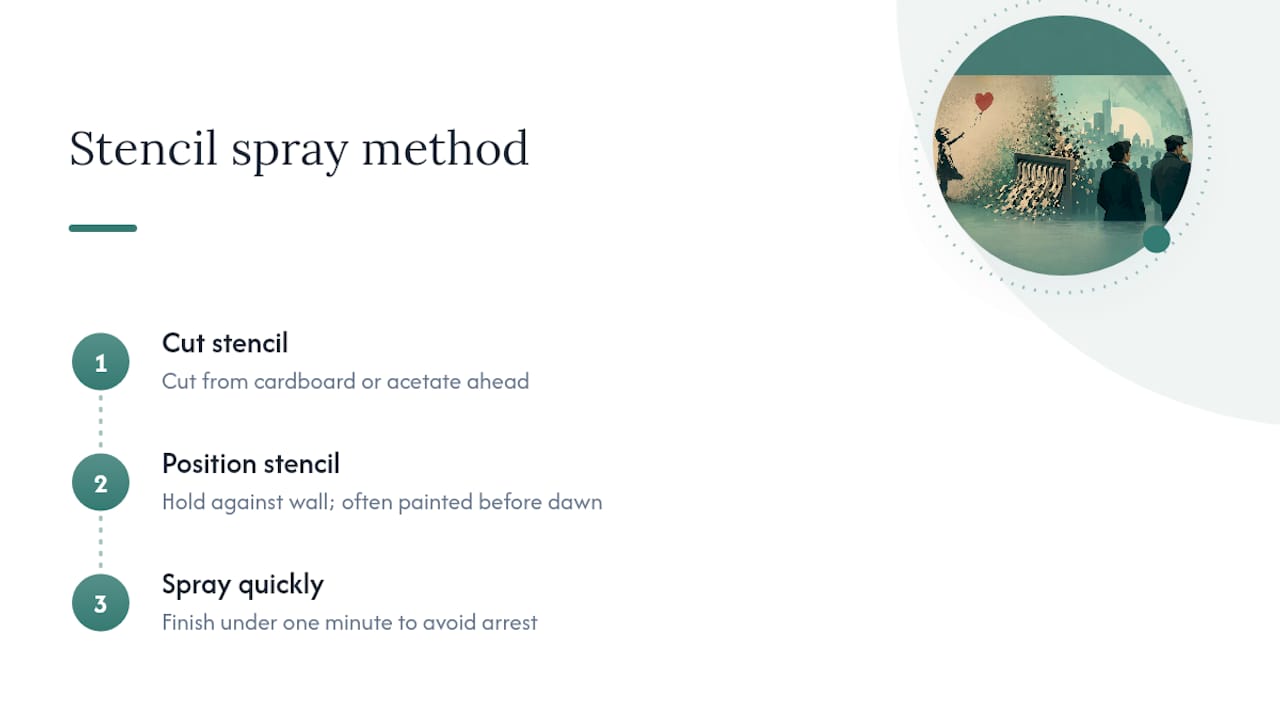
Stencil work exists because street art has one constraint that gallery painting does not: time. A stencil is cut ahead of time, often from cardboard or acetate, then held against a wall for a spray session that can be finished in under a minute. That speed is not a stylistic preference. It is the difference between finishing a piece and getting arrested mid-stroke.
Color reinforces the same urgency. Banksy’s default palette is black-and-white stenciling with a single, deliberate accent color, usually red. The restraint is not about aesthetics so much as legibility. A driver, a commuter, or a pedestrian glancing at a wall for two seconds needs to read the image instantly, and a cluttered composition fails that test. High-contrast silhouettes read at a distance and in low light, which matters when most of this work goes up before dawn.
The deeper mechanism is semiotic. A peer-reviewed analysis of his work describes Banksy’s method as recombining socially agreed symbols to force viewers into a moment of reinterpretation rather than simple appreciation. A police officer is a familiar symbol of order; put two of them kissing and the symbol still communicates instantly, but the meaning attached to it flips. A separate semiotic study of his graffiti applies Peirce’s framework to make the same point: the images work because the underlying symbols are already universally understood, so Banksy only has to disrupt one element to change the entire statement.
Placement functions as a component of the artwork itself, not just its backdrop. Many of his pieces are intentionally site-specific, chosen to sit near a corporate logo, a government building, or a civic landmark that the image directly comments on. A stencil of a child on a swing gains a different weight painted beside a derelict playground than it would on a gallery wall.
Pro Tip: If you’re trying to decode a Banksy piece you’ve only seen in a photo, search for where it was originally painted before deciding what it means. The location often carries half the argument.
Who Is Banksy, and Can Anyone Actually Prove It?
The identity question has outlived every other debate about this artist, and for good reason: it is unresolved. The most persistent theory names Robin Gunningham, a man from Bristol whose educational and family background loosely matches details that have surfaced in press coverage over the years. The theory dates back to at least 2008, when British tabloids first floated the name based on photographs and secondhand accounts.
The claim resurfaced with more weight in 2026, when a Reuters investigative report examined legal records and other documentary evidence it said connects Banksy to Gunningham. The report has been widely discussed since publication, and just as widely picked apart, because none of the evidence it presents amounts to a confirmed admission. BBC’s May 2026 coverage of the ongoing mystery reaches a similar conclusion: the identity remains unconfirmed despite fresh reporting, and Banksy himself has never verified or denied any specific name.
Here is why certainty stays out of reach:
- Legal records can place a name near a location or an event, but they cannot prove authorship of a specific artwork.
- Manager and associate testimony has occasionally hinted at details, but statements from people close to the operation are filtered through nondisclosure arrangements and carry obvious incentive to protect the brand.
- Stylistic matching, comparing known works to attributed pieces, is useful for spotting forgeries but cannot independently confirm a real-world name.
- Banksy’s own silence functions as a strategy, not an oversight. Every unconfirmed theory that circulates without an official response keeps the mystery, and the market value tied to it, intact.
Anonymity is not a side effect of Banksy’s career. It is the operating premise. A known face invites profile pieces, gallery representation deals, and personal scrutiny that would undercut the outsider posture his work depends on. As one recent piece of reporting put it, renewed investigative attention tends to reignite old questions rather than settle them, which is exactly what happened again with the 2026 Reuters report.
How Pest Control Authenticates a Banksy, and What It Means for the Market
Anyone can spray a stencil that looks like a Banksy. What they cannot do is get it authenticated, because Banksy operates his own verification body, Pest Control, and it is the only entity with the authority to confirm a piece is genuine. Britannica notes that Pest Control issues certificates of authenticity, and without one, a work carries serious doubt at auction regardless of how convincing it looks.
The process matters because it solves a problem unique to illegal street art: there is no gallery invoice, no signed contract, no traditional paper trail. Pest Control fills that gap, and its refusal to authenticate a piece can tank its resale value overnight, even when the piece is genuinely his work painted on a public wall.
Murals raise a second complication once collectors get involved: they are usually attached to someone else’s property. Several notable Banksy pieces have been physically removed, wall section and all, and sold privately or at auction, sometimes with the property owner’s blessing and sometimes triggering local outcry over erasing public art for private profit. Kissing Coppers went through exactly this process after its removal from a Brighton pub wall.
A handful of practical rules govern how the market actually treats his work today:
- Authentication comes first. No serious buyer, gallery, or auction house will move on a piece without Pest Control’s sign-off.
- Removal changes the object’s context. A mural stripped from its original wall loses the site-specific meaning that gave it half its argument, even if it retains full market value.
- Stunts can raise value rather than destroy it. The partially shredded Love Is in the Bin sold for roughly $25.4 million in 2021, well above what the intact Girl with Balloon image alone would likely have commanded.
- Institutions inherit long-term costs. Museums or collectors that legally acquire a piece take on conservation, insurance, and provenance documentation that street art was never designed to need.
For collectors weighing a purchase, the practical takeaway is simple: Pest Control’s certificate is worth more than the wall it came from.
The Vandal-or-Artist Debate Banksy Never Settles
Every city that finds a new Banksy mural overnight faces the same argument: is this vandalism or public art? Some municipalities have moved quickly to protect newly discovered pieces with plexiglass, while others have painted over work worth six figures before anyone realized what it was. Both responses have happened to Banksy pieces within the same decade.
The deeper tension sits in his relationship with money. A body of work built on anti-capitalist messaging now regularly sells for millions of dollars at the same auction houses it appears to mock. Critics have called this contradiction hypocrisy; others read it, following the postesthetic framework applied to his work, as the point itself: the market’s willingness to monetize anti-market art is part of what the art is commenting on.
A few concrete tensions define the debate:
- Property owners have sometimes fought to keep a mural in place after learning it appreciated their property value, reversing decades of instinct to remove graffiti on sight.
- Local governments have occasionally prosecuted unauthorized murals as criminal damage, even after international media coverage confirmed the artist’s identity as Banksy.
- Academic readings tend to treat the commercialization not as a flaw in the work but as evidence that Banksy anticipated it, building the eventual sale into the piece’s meaning from the start.
- Public reaction splits sharply by geography. A mural welcomed as a civic landmark in one city gets buffed within days in another.
TheArtStory’s overview of his career situates this friction as central to his cultural footprint, arguing that the contradiction between message and market is part of what kept him relevant across three decades rather than a passing controversy.
Why So Many Banksy Murals Disappear
Street murals are not built to last, and that impermanence is baked into the medium. A piece painted on an unprotected exterior wall faces weather, vandalism, theft, and property redevelopment, often within months of going up. Ephemeral art as a category exists precisely because impermanence is part of the intent, and Banksy’s street work fits squarely inside it.
Preservation choices carry real trade-offs:
- Leaving a mural in place keeps its original context intact but exposes it to weather, graffiti-over-graffiti, and accidental destruction during construction.
- Removing the wall section protects the physical object but strips away the site-specific meaning that made the piece land in the first place.
- Plexiglass covers, now common on high-value pieces, protect the surface while leaving the work publicly visible, though they cannot stop deliberate theft.
- Media attention itself acts as informal preservation, since a widely photographed piece survives in public memory even after the physical wall is gone.
Institutions that legally acquire a Banksy need a Pest Control certificate, a clear removal and conservation plan, and a realistic budget for long-term upkeep, since street materials were never engineered for gallery permanence.
What Museum-Quality Prints Owe to Street Art’s Rise
Banksy’s career proved that work meant to provoke rather than decorate could still command serious collector attention, and that shift reshaped how people think about buying art at every price point. Interest in bold, message-driven visuals has pushed collectors toward pieces that carry a point of view, not just a pleasant palette.
Eman Khalifa’s original paintings and museum-quality canvas prints offer bold, expressive works across abstract, geometric, floral, landscape, seascape, and still-life styles, shipping worldwide. For readers who admire the scale and impact of urban street art but want something legally acquired and built to last on a living room wall, that overlap is worth exploring through wall art prints or the gallery’s art-inspired merchandise.
| What draws collectors to Banksy | What Eman Khalifa’s gallery offers instead |
|---|---|
| Bold, high-contrast visual statements | Original paintings with the same visual confidence, fully attributed |
| Scarcity driven by illegal, temporary placement | Scarcity through one-of-a-kind original works |
| Uncertain authentication process | Direct purchase with clear provenance from a named artist |
| Street-scale murals | Large-scale wall art and museum-quality canvas prints sized for real interiors |
Readers curious about bringing that urban-scale energy indoors might start with a piece like City in Grids, a geometric abstract urban print built for exactly that kind of statement wall.
What Actually Matters When You’re Trying to Understand Banksy
Most explanations of Banksy spend too much energy chasing the name behind the mask and not enough on why the mask works as art. The 2026 Reuters reporting on Robin Gunningham is worth reading, but treating it as a solved case misses the point entirely. Banksy built a practice where the uncertainty itself does communicative work, and that is the part conventional coverage tends to skip past in favor of a cleaner, more satisfying reveal.
If you actually want to understand a piece, start with where it was painted and when, not with who might have painted it. The semiotic research on his symbol recombination explains far more about why Kissing Coppers or One Nation Under CCTV still land decades later than any identity theory does. Prioritize the argument the image makes over the mystery of its author. The mystery sells headlines. The argument is the actual art.
— Eman
Sources
The biographical and technical claims here draw from a small set of consistently reliable sources: Britannica for foundational biographical details and the role of Pest Control, Reuters and BBC for the most current identity reporting, and a peer-reviewed semiotic analysis for the visual-strategy explanations. Career milestones and cultural context lean on TheArtStory and Wikipedia’s documented timeline.
- Banksy | Biography | Britannica
- Banksy - Wikipedia
- Visual strategies of contemporary art: a case study of Banksy’s artworks
- Banksy | TheArtStory
FAQ
Who is Banksy and why is he controversial?
Banksy is an anonymous, England-based street artist and activist whose stencil murals critique capitalism, surveillance, and war. He is controversial because his work is technically illegal graffiti that now sells for millions at auction, a contradiction critics and admirers both point to constantly.
Is Robin Gunningham Banksy?
A 2026 Reuters investigation cited legal records connecting Banksy to the name Robin Gunningham, and BBC coverage has discussed the same claim, but Banksy has never confirmed it and no single piece of evidence is considered conclusive.
What does the term Banksy mean?
Banksy is not a real name but a pseudonym used by an anonymous street artist active since the 1990s. The name functions as a brand and a shield, letting the work stay the focus rather than the person behind it.
How does Banksy avoid getting caught?
Banksy relies on stencils that can be sprayed in under a minute, often works at night or in low-visibility conditions, and maintains a guarded anonymity reinforced by Pest Control’s role as the only verified point of contact, keeping his real identity officially unconfirmed.
Stay Connected
- ✨ Explore Eman Khalifa's original art, fine art prints and art-inspired merchandise.
- Follow Eman Khalifa's art journey on: Instagram @emans_gallery and Facebook
- Watch Eman Khalifa creating live art on: YouTube @emans_gallery
